Engineered hardwood, solid white oak, tile, polished concrete, and where LVP earns its place. How we pick flooring that survives Burnaby's radiant slabs, humidity swings, and a decade of real life.
What's the best flooring for a Burnaby custom home?
For most rooms in a Burnaby custom home, engineered white oak over a properly acclimatized subfloor is the safest high-end choice, especially over a radiant slab. Solid hardwood still has a place, but our climate punishes it: Metro Vancouver swings from a soaking-wet winter to a dry, heated interior, and that wet-to-dry cycle is exactly what makes solid boards cup and gap. Tile and polished concrete win in the wet zones and over radiant heat. Luxury vinyl plank has a real, honest role too, just not where people usually try to use it.
That's the short version. The longer version is that there's no single "best" floor. There's the right floor for each room, the right moisture conditions for the product, and an install sequence that doesn't get rushed. We'll walk through all three.
Engineered vs solid hardwood, and why engineered usually wins here
The difference is in how the board is built. A solid board is one piece of wood all the way through. An engineered board is a real hardwood wear layer bonded to a cross-laminated plywood core. That core is the whole point. Cross-banding the layers fights the wood's natural urge to expand and contract across its width, so the board moves far less when humidity changes.
On the Wet Coast, that stability is the difference between a floor that looks the same in year ten and one that opens up gaps every winter. We're a high-rainfall coastal climate, rainfall here comfortably exceeds the 1,000 mm/year threshold that drives a lot of our envelope decisions. Indoors, your heating system then pulls that humid air down to bone-dry. Solid wood feels every bit of that swing. Engineered shrugs most of it off.
Solid hardwood isn't off the table. On an upper floor over a wood-framed assembly, with a well-controlled interior and a homeowner who keeps a humidifier honest, solid white oak is gorgeous and can be sanded more times over its life. But the moment a radiant slab enters the picture, engineered is almost always the answer.
Solid wood over a heated slab is a bet against physics. Engineered is how you stop gambling and still get a real-wood floor.
Icon Projects Team
A good engineered product also gives you wider boards without the drama. Which matters, because wide is what people want right now.
White oak, wide plank, and what actually ages well
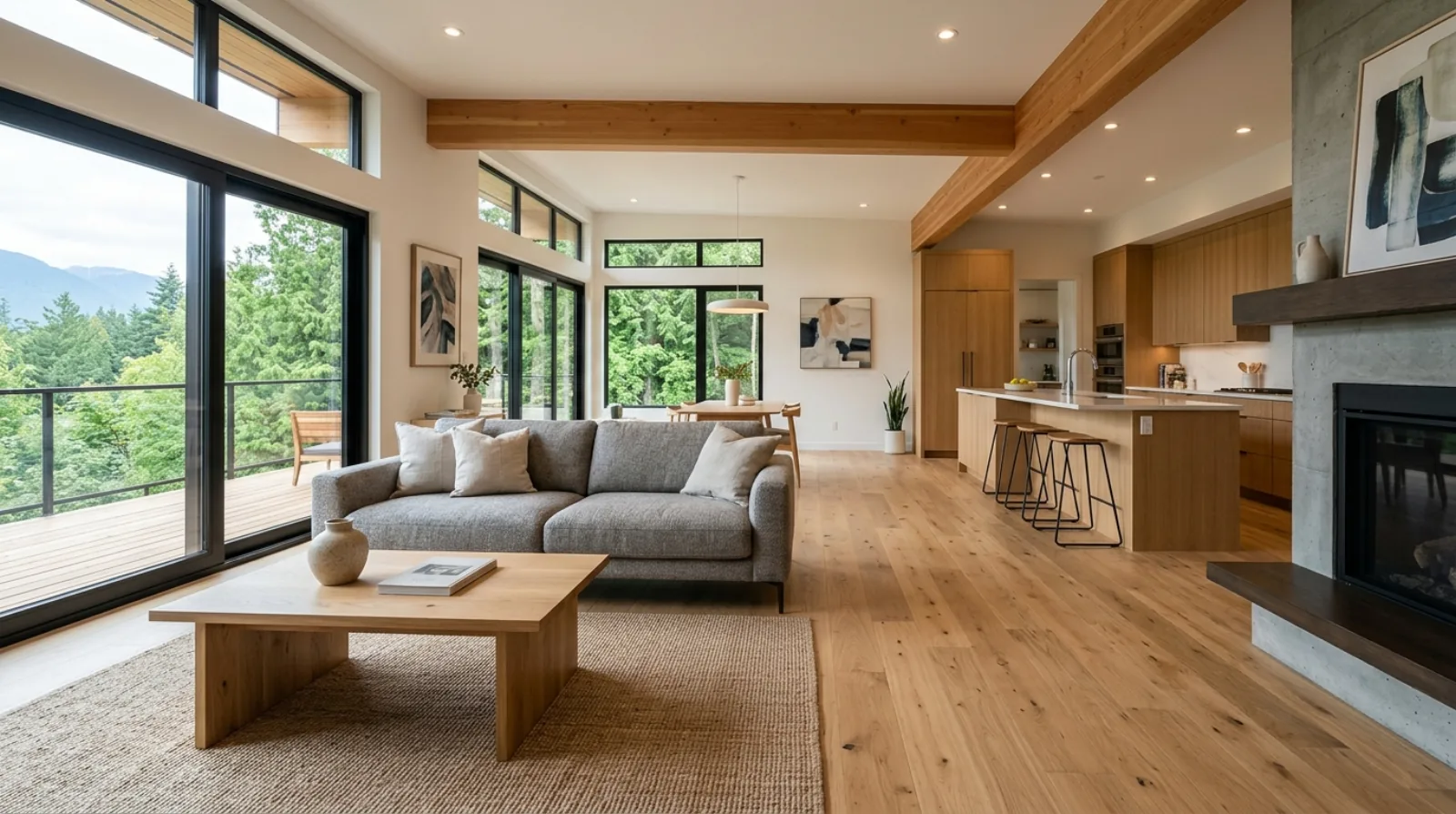
White oak has been the default request on nearly every Burnaby build we've done for years now, and for good reason. It takes stain and natural finishes beautifully, the grain hides everyday wear, and it doesn't carry the yellow-orange cast that dates a floor the way old red oak or honey-toned maple can. A wire-brushed or light matte white oak is about as timeless as flooring gets.
Wide plank, 7 to 9 inches is the common ask, reads calm and modern because there are fewer seams across the room. The trade-off is that wider boards move more in absolute terms, so the wider you go, the more you want an engineered core and a careful install. This is one more reason engineered keeps winning.
A few things we've watched go in and out of style, for whatever it's worth:
- Ages well: white oak in natural or soft matte finishes, herringbone in a restrained tone, large-format stone-look tile, honed (not glossy) surfaces.
- Dates fast: high-gloss finishes, dark espresso stains that show every speck of dust, grey-washed "driftwood" tones that already feel like a specific year, busy multi-width "rustic" mixes.
The pattern is consistent: matte, natural, and quiet ages slowly. Glossy, trendy, and high-contrast ages fast. We'd rather you fall in love with the wood than the finish. This is the same thinking we bring to every surface in the house, there's a fuller take in our piece on materials that age beautifully.
Living with radiant heat under your floors
If your home runs hydronic radiant heat, warm water in tubing inside or under the slab, your flooring choice narrows in a useful way. Radiant wants a floor that conducts heat well and tolerates being warmed and cooled over and over.
Tile and polished concrete are the natural partners. They conduct heat readily, they don't mind the cycling, and the slab basically becomes one big warm surface. Over radiant, stone and porcelain are hard to beat for both comfort and longevity.
Wood over radiant can absolutely work, but it has rules. Engineered, not solid. A board width and species that won't fight the heat. And a controlled ramp-up of the system before and during install so the slab and the wood reach an equilibrium slowly instead of getting shocked. We coordinate that ramp-up with the radiant designer so it's scheduled, not improvised on the last day.
What doesn't belong over radiant: thick solid planks, anything with a foam underlayment that insulates the heat you paid to generate, and most cheap floating products that trap heat against their own backing. The floor's job over radiant is to pass heat up, not hold it down.
Tile, polished concrete, and where LVP earns its place
Tile is the workhorse of any Burnaby build, and not only in bathrooms. Mudrooms, entries, laundry, scullery floors, basement zones, anywhere water, grit, or muddy boots show up, large-format porcelain is the floor we reach for. It's effectively waterproof, it pairs with radiant, and large formats mean fewer grout lines to keep clean. Getting the waterproofing and slope right underneath matters as much as the tile itself; we go deeper on that in our tile selection and waterproofing piece.
Polished concrete is having a real moment in modern Burnaby homes, and we like it for the right client. On a main-floor slab with radiant beneath, a ground-and-sealed concrete floor is durable, low-maintenance, and architecturally clean. It's not for everyone, it's hard underfoot, it reads cool and industrial, and any cracking or pour quality shows. But in the right contemporary house it's honest and it lasts.
Then there's luxury vinyl plank. We'll say the quiet part out loud: LVP has a real place, and pretending otherwise is just snobbery. Where it earns its keep:
- Suites and rentals. A legal secondary suite or a basement that'll see hard use is a sensible place for a good rigid-core LVP, it's waterproof, tough, and forgiving.
- Below-grade rooms where slab moisture makes wood a fight you don't need to pick.
- Gyms, workshops, and utility spaces where performance beats prestige.
Where LVP does not belong is the main living floor of a high-end custom home, sold to you as "looks just like wood." It doesn't, not next to the real thing, and it won't add the value real wood does. Use it where its strengths matter and skip it where they don't.
Acclimatization on the Wet Coast, the step that gets skipped
Here's where most floor failures are actually born. Wood flooring needs to sit inside the house, in its real conditions, long enough to reach the moisture content it'll live at. On the Lower Mainland that's not optional, our outdoor air is wet, our heated interiors are dry, and a board delivered straight off a damp truck and nailed down the same afternoon is set up to move.
Acclimatization means the home is closed in, the HVAC is running and holding a normal interior climate, and the flooring is stickered and resting in the rooms where it'll be installed for the period the manufacturer specifies. Rush it and you get gapping in the first dry winter or cupping in the first wet stretch. Both are avoidable.
This ties straight into build sequence. Flooring goes in after the home is weather-tight and conditioned, not before, which is one reason we walk clients through what's behind the walls and floors at the pre-drywall walkthrough and keep finish materials off site until the building can actually protect them.
When a flooring claim does get made, warranty providers don't guess, they judge gapping, cupping, and finish issues against the BC Housing Residential Construction Performance Guide, the same reference book that backs the 2-5-10 home warranty. The Guide sets out what's considered acceptable versus a defect. Proper acclimatization is how you stay on the right side of that line, because a floor that moved because nobody let it settle is a workmanship issue, not a product defect.
Stair-to-floor transitions and the details that read as quality
Floors don't live in isolation, and the spots where they meet something else are where craftsmanship shows. The most-watched one is the staircase. When your main floor is white oak, the smartest move is usually matching engineered treads or solid stair parts in the same species and finish so the floor appears to flow up the stairs without a jarring line. A mismatched tread or a clunky transition strip at the bottom step is the detail a guest can't name but feels.
Other transitions worth getting right:
- Wood to tile at a mudroom or bathroom threshold, a flush, tight transition reads custom; a fat metal strip reads builder-grade.
- Level changes between a tiled wet zone and a wood living area, kept deliberate and clean.
- Floor to baseboard and door casing, where reveal and scribe work separate trim that looks built-in from trim that looks tacked on.
These are small in dollars and large in perception. They're also where the difference between a crew that rushes and a crew that doesn't becomes visible for the life of the home.
Frequently asked questions
Can I put hardwood over radiant heat in a Burnaby home? Yes, but use engineered, not solid. Engineered's cross-laminated core handles the heat-up and cool-down cycles without the cupping and gapping solid wood is prone to. The radiant system also needs a controlled ramp-up before and during install so the slab and the wood reach equilibrium slowly. Done that way, an engineered white oak floor over radiant performs well for the long haul.
Why does my hardwood floor gap in winter? Almost always moisture, not a defect. Lower Mainland winters pull humid outdoor air into dry, heated interiors, and wood shrinks as it loses moisture. Gapping that opens in winter and closes in summer usually means the floor wasn't acclimatized to its real interior conditions before install, or solid wood was used where engineered would have been more stable.
Is luxury vinyl plank worth it in a custom home? In the right rooms, absolutely. Rigid-core LVP is waterproof, durable, and a smart pick for secondary suites, below-grade rooms, gyms, and workshops. It's the wrong choice for the main living floor of a high-end home, where real engineered or solid hardwood looks better up close and holds its value. Use LVP for its strengths, not as a stand-in for wood.
What flooring ages the best? Quiet, natural, matte finishes age slowest. Natural or soft-matte white oak, honed large-format stone and porcelain, and restrained patterns like a calm herringbone all stay looking current. High-gloss finishes, dark stains that show every speck of dust, and trendy grey washes tend to look dated fastest.
The floor is the one surface in the house that touches every single day of your life there. Spend your attention on getting the moisture physics and the install sequence right, pick a wood you'd be happy to look at in ten years, and the floor will quietly do its job long after you've stopped noticing it. That's the goal, a floor you forget about because it never gives you a reason to think about it.
Related on the Journal
- Materials that age beautifully
- Radiant vs forced air in a Burnaby custom home
- Tile selection and waterproofing
- Staircase design in a Burnaby custom home
Frequently asked questions
- Can I put hardwood over radiant heat in a Burnaby home?
- Yes, but use engineered, not solid. Engineered hardwood's cross-laminated core handles the heat-up and cool-down cycles without the cupping and gapping solid wood is prone to. The radiant system also needs a controlled ramp-up before and during installation so the slab and the wood reach equilibrium slowly. Done that way, an engineered hardwood floor over radiant performs well for the long term.
- Why does hardwood floor gap in winter?
- Almost always moisture, not a defect. Lower Mainland winters pull humid outdoor air into dry, heated interiors, and wood shrinks as it loses moisture. Gapping that opens in winter and closes in summer usually means the floor was not acclimatized to its actual interior conditions before installation, or solid wood was used where engineered would have been more stable.
- Is luxury vinyl plank a good choice for a custom home in Burnaby?
- In the right rooms, absolutely. Rigid-core LVP is waterproof, durable, and a smart pick for secondary suites, below-grade rooms, gyms, and workshops. It is the wrong choice for the main living floor of a high-end home, where real engineered or solid hardwood looks better up close and holds its value better. Icon Projects uses LVP for its strengths, not as a substitute for wood.
- What flooring works best over radiant heat in a Burnaby home?
- Tile and polished concrete are the natural partners for radiant heat because they conduct heat readily and tolerate being warmed and cooled over and over, turning the slab into one large warm surface. Engineered hardwood also works over radiant, but it needs a controlled ramp-up of the heating system before and during install so the slab and wood reach equilibrium slowly. Solid hardwood and anything with a foam underlayment that traps heat should be avoided over radiant.
- Where should tile be used in a Burnaby custom home?
- Large-format porcelain tile is the workhorse choice anywhere water, grit, or muddy boots show up, not only in bathrooms. Icon Projects specifies it for mudrooms, entries, laundry rooms, scullery floors, and basement zones because it is effectively waterproof, pairs well with radiant heat, and fewer grout lines in a large format make it easier to keep clean. Getting the waterproofing and slope right underneath matters as much as the tile itself.
- Is polished concrete flooring practical for a Burnaby custom home?
- Yes, for the right client and the right room. On a main-floor slab with radiant heat beneath it, a ground-and-sealed polished concrete floor is durable, low-maintenance, and reads as architecturally clean in a modern home. It is hard underfoot and reads cool and industrial, and any cracking or pour-quality issue shows on the finished surface, so it suits an owner who wants that honest, contemporary look.
- How does the stair-to-floor transition affect a Burnaby custom home's finish quality?
- When the main floor is hardwood, matching engineered treads or solid stair parts in the same species and finish lets the floor appear to flow up the staircase without a jarring line. Icon Projects treats these transitions, wood to tile at a mudroom threshold, level changes between a wet zone and a wood living area, and floor-to-baseboard reveals, as details that separate a crew that rushes from one that does not, even though they cost little.
- Why does acclimatization matter so much for flooring on the Wet Coast?
- Wood flooring needs to sit inside the finished house, in its real conditions, long enough to settle to the moisture level it will live at, and this step is not optional in a climate where outdoor air is wet and heated interiors run dry. Icon Projects sequences flooring installation after the home is weather-tight and conditioned, never before, because a board delivered off a damp truck and installed the same afternoon is set up to gap or cup in its first season.