Craft
Materials That Age Beautifully (and the Ones That Don't): A Builder's Read for Burnaby Custom Homes
After two decades of builds across Burnaby, Vancouver, and the Fraser Valley, we've watched which materials look better in year ten than year one, and which ones quietly betray you. The Pacific Northwest climate sorts them ruthlessly.
There is a category of material that looks best on day one and only ever gets worse. Cheap engineered stone with too-perfect veining. Glossy white-painted MDF baseboards. Gloss-finish hollow-core doors. Mid-tier laminate floors. They're affordable. They photograph well. They look ten years old after eighteen months.
Then there are materials that improve with age. That develop patina. That absorb the life lived around them. We try to push every Burnaby custom home we build toward more of those, even when it means making harder choices on day one.
The Pacific Northwest climate complicates this conversation in ways that matter. Burnaby, Vancouver, North Vancouver, and the Fraser Valley all live with high humidity, heavy seasonal rainfall, dramatic temperature swings on hillside lots, and a coastal salt influence that drifts further east than people assume. Material choices that work fine in drier climates fail here in specific, predictable ways. We've watched it for twenty years.
What ages well in a Burnaby home
Five categories of material we specify almost without exception when the brief allows.
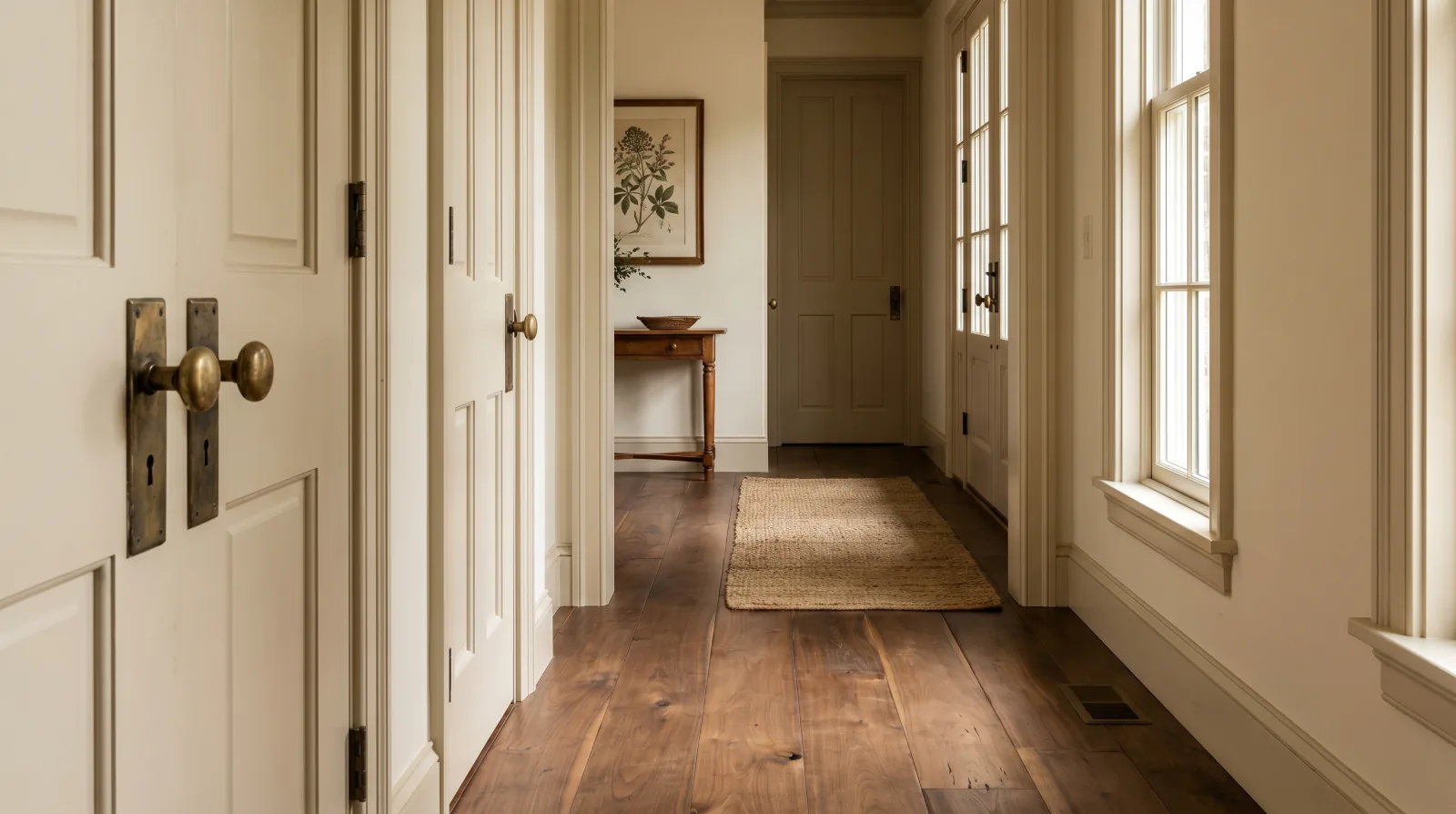
Solid hardwood floors with an oil finish. Wide-plank oak, white oak, walnut, or local Pacific maple. Oil finish penetrates the wood instead of sitting on top of it as a film. It scratches, dings, and patinas with use, but the damage is part of the wood rather than separate from it. A solid hardwood floor with an oil finish at year ten reads as lived-in. The same floor with a polyurethane top coat at year ten reads as worn out. The difference is what's actually happening to the surface.
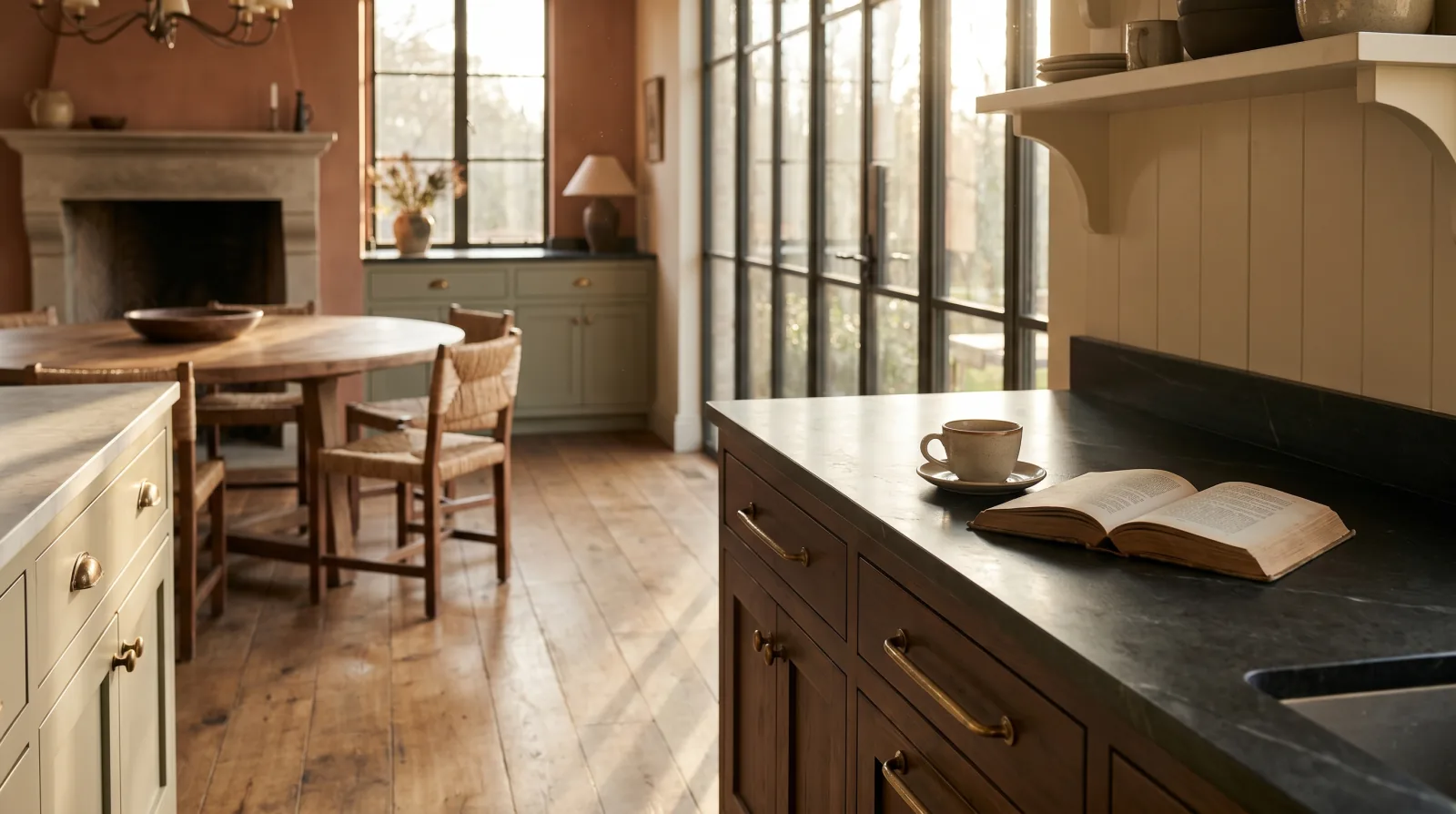
Honed natural stone. Limestone, soapstone, certain marbles, slate. The honed finish is matte rather than polished, which means small scratches blend in instead of standing out. Honed soapstone in a kitchen develops a deeper, softer colour over five years that's almost impossible to fake. Polished marble looks great until the first acid spill, after which it never looks great again.
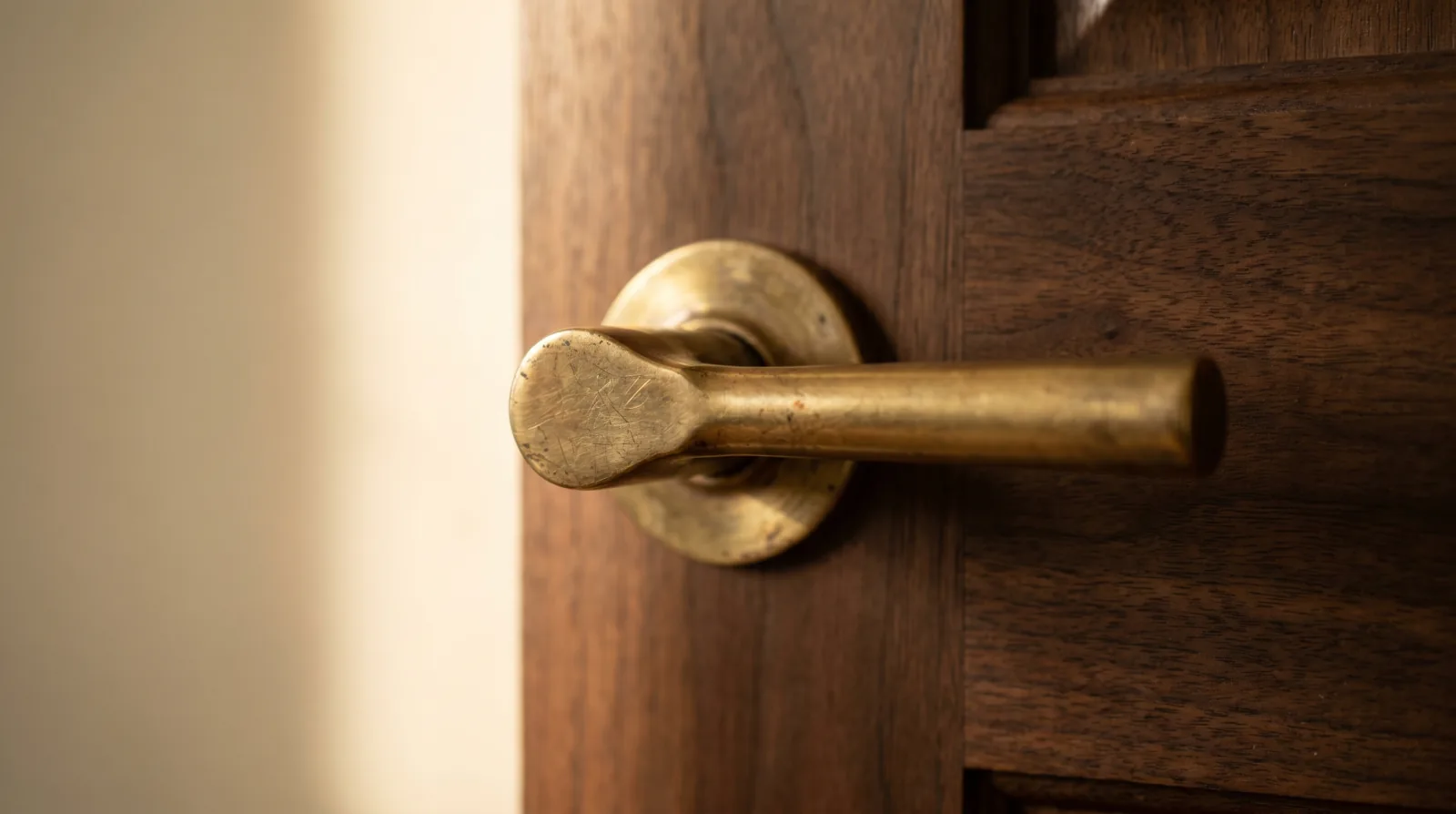
Quality solid brass, unlacquered. Door hardware, faucet bodies, light fixtures, cabinet pulls. Unlacquered brass tarnishes initially, then evens out into something only time can produce. The hand-grease patterns where you actually grip a door handle become part of the finish. Lacquered brass eventually fails at the lacquer layer and looks splotchy. Plated brass over zinc fails sooner and worse.
Real wood cabinetry with proper finishing. Solid maple, alder, walnut, or quartersawn oak. Built locally to the cabinetmaker's spec rather than ordered as a flat-pack with custom fronts. The build quality of the carcass matters more than the door style; a properly built carcass is what survives twenty years of family use.
Lime-wash and high-grade flat paints. Real mineral and lime-based finishes have depth that flat builder white can't replicate, and they age into softer versions of themselves rather than discoloring against the original. The colour shifts subtly with light through the day, which makes a room read as more dimensional than the same colour in standard flat acrylic.
What doesn't
Five categories we steer clients away from when we can.
- Glossy thermofoil cabinet doors. The vinyl film delaminates over five to seven years, particularly near the dishwasher and the oven where heat accelerates failure. There is no field repair.
- Cheap chrome plumbing fixtures. Pitting starts within two years in a humid bathroom. The plating fails first at the visible high points, which is exactly where the eye lands.
- Bargain quartz with aggressive veining. Quartz itself is a fine material at the high end. Bargain-tier quartz with overdone veining patterns dates fast because the patterns are tied to a specific year's design trend. Honed slabs without aggressive vein matching age more gracefully.
- High-sheen laminate flooring. The shine is the first thing to dull, and it dulls inconsistently across high-traffic spans. Year three looks worse than year one in ways no maintenance routine fixes.
- Builder-grade vinyl windows on a forever-home build. This is the one that hurts most because windows are the hardest thing to upgrade later. The seals on bargain vinyl frames fail in the 8-to-15-year range, the gaskets harden, the operating hardware loosens. Spending up on the windows is almost always the right move.
Spend the money where you'll touch the building every day. Floors. Fixtures. Hardware. Doors. Those are the things you'll feel in year five, not just see in year one.
Icon Projects Team
The window conversation deserves its own section
Windows are the single material category where the BC code is actively pushing the industry up-market, and we welcome that.
Every new Part 9 home in Burnaby and across BC has to meet at least Step 3 of the BC Energy Step Code, and Step 5 is on the trajectory to become the default for new homes by 2032. Step 3 already pushes the window specification well above bargain vinyl. Step 5 effectively requires triple-glazed units with thermally broken frames, U-values in the 0.20 W/m²·K range, and serious airtightness at the rough opening.
For an owner staying in the home twenty or thirty years, the math on windows works backward from the cost of replacement. Replacing windows in year fifteen is more expensive than upgrading them in year zero, by a wider margin than most owners assume. The cost of better seals, better frames, and better glass on day one is meaningful but recoverable. The cost of mid-life replacement is rarely recoverable.
For an owner not building to Step 5 today, designing the rough openings and the wall thickness as if you were is still worth it. It costs almost nothing extra at framing and leaves the option open later.
Material durability under Pacific Northwest conditions
Three regional considerations that change the material conversation in Burnaby and across the Lower Mainland.
Humidity and rot. Average annual rainfall in Burnaby and Vancouver is in the 1,100 to 1,200 mm range, concentrated in the cool half of the year. Persistent humidity tests every wood-substrate joint in the home, window jambs, exterior trim, and wherever cladding meets a horizontal surface are the first places to fail. Painted MDF in any moisture-adjacent location is a slow disaster. Solid wood with appropriate species selection (cedar, certain hardwoods) and proper end-grain sealing holds up.
Coastal salt and metal corrosion. Burnaby sits inland from Burrard Inlet but the coastal salt influence reaches surprisingly far. Hardware specified for inland use can show pitting on a Burnaby Heights or North Vancouver lot within five years. Solid brass, marine-grade stainless, and properly finished bronze handle this fine. Plated finishes don't.
Hillside thermal cycling. Capitol Hill, Burnaby Heights, parts of Forest Glen and Buckingham Heights sit on real grade with significant seasonal sun and shadow patterns. South-facing facades on hillside lots see more thermal cycling than flat lots in Brentwood or Metrotown. Material expansion and contraction matters here. Composite siding products with low movement tolerance fail at the joints over a decade. Solid wood and properly detailed metal cladding tolerate the cycle better.
The trade-off worth making
We tell clients this often. It's better to finish 80% of a home with materials that age well than 100% of it with materials that don't. The unfinished basement. The uncompleted landscape. The deferred guest bath. Those can wait. The wood floors. The windows. The hardware on the front door. Those need to be right the first time.
Three concrete trade-offs we recommend on a Burnaby custom-home brief when the budget tightens:
- Skip area, not quality. Solid wood doors in the bedrooms and the office, hollow-core in the closets where they aren't seen. Solid hardwood floors on the principal levels, durable engineered hardwood in the secondary basement. Real plaster in the dining room, well-finished drywall everywhere else.
- Defer the landscape, not the envelope. A finished home with a basic graded yard reads as a complete project waiting to be landscaped. A finished home with cheap windows and patio tile that's already failing reads as an unfinished project that's already going wrong.
- Spend on what's hard to change. Windows, doors, hardware, the kitchen carcasses, the floors. Defer what's swappable: the dining-room chandelier, the powder-room vanity, the upper cabinets in the laundry.
This is also where the BC 2-5-10 home warranty intersects with material choices. Two years on materials and labour, five on the building envelope, ten on structural elements. The envelope warranty is meaningful, but it doesn't cover wear-and-tear failure of bargain finishes. Spending properly on materials that age well isn't just an aesthetic decision; it's a long-term cost decision the warranty was never designed to backstop.
What this looks like in a Burnaby brief
A Burnaby custom-home brief that respects the Pacific Northwest climate, the energy code, and the long-term economics of material choices ends up looking specific. Solid wood floors with oil finish. Step-Code-grade windows. Solid brass or marine stainless hardware. Real wood cabinetry. Honed stone where stone shows. Carefully detailed exterior cladding in materials that handle the climate. Real plaster or high-grade flat paint where it matters.
None of that is exotic. It's the result of refusing to specify materials based on what a catalogue called affordable, and choosing them instead based on what they'll feel like in year ten. That principle works as well in Vancouver, Coquitlam, North Vancouver, and the Fraser Valley as it does in Burnaby. The climate is the same. The math is the same. The materials are the same. Only the bylaws change.
Related on the Journal
- Why 'builder-grade' has no place in our specs
- Year-five regrets we hear from clients
- Windows that survive Burnaby winters
Frequently asked questions
- Why do oil-finished hardwood floors age better than polyurethane-finished floors?
- Because oil finish penetrates the wood instead of sitting on top of it as a film, so scratches and dings become part of the wood rather than damage sitting on a separate surface layer. A solid hardwood floor with an oil finish reads as lived-in at year ten, while the same floor under polyurethane reads as worn out, because the visible wear is happening in the film coating rather than the wood itself.
- What is honed stone, and why does it hide wear better than polished stone?
- Honed stone has a matte rather than glossy finish, so small scratches blend into the surface instead of standing out against a reflective sheen. Honed soapstone in a kitchen develops a deeper, softer colour over about five years, while polished marble looks best on day one and shows every scratch and acid etch afterward, particularly from something as simple as a citrus spill.
- Why choose unlacquered brass hardware over lacquered or plated brass?
- Unlacquered brass tarnishes initially, then evens out into a patina that only time can produce, and the wear patterns where a hand actually grips a door handle become part of the finish rather than a flaw. Lacquered brass eventually fails at the lacquer layer and looks splotchy, and plated brass over zinc fails sooner and worse, which is why solid unlacquered brass is specified on hardware, faucet bodies, and light fixtures.
- What cabinet finish fails fastest in a Burnaby custom home?
- Glossy thermofoil cabinet doors. The vinyl film delaminates over five to seven years, particularly near the dishwasher and oven where heat accelerates the failure, and there is no field repair once it starts. Real wood cabinetry, solid maple, alder, walnut, or quartersawn oak, built to a cabinetmaker's spec rather than ordered as a flat-pack, holds up because the carcass quality matters more than the door style for surviving decades of family use.
- How is the BC Energy Step Code pushing window quality up in new Burnaby homes?
- Every new Part 9 home in Burnaby has to meet at least Step 3 of the BC Energy Step Code, which already pushes window specifications well above bargain vinyl, and Step 5, the 2032 provincial target, effectively requires triple-glazed units with thermally broken frames. Builder-grade vinyl windows see their seals fail in the 8 to 15 year range, and since windows are one of the hardest building components to upgrade later, spending more on them at construction is usually the better long-term math.
- How does Burnaby's rainfall affect material choices in a custom home?
- Average annual rainfall in Burnaby and Vancouver runs 1,100 to 1,200 millimetres, concentrated in the cool half of the year, and that persistent humidity tests every wood-substrate joint in the home. Window jambs, exterior trim, and any spot where cladding meets a horizontal surface are the first places to fail, which is why painted MDF in a moisture-adjacent location is a slow disaster while solid wood with proper species selection and end-grain sealing holds up.
- Does coastal salt affect hardware on Burnaby homes even though the city isn't right on the water?
- Yes. Burnaby sits inland from Burrard Inlet, but the coastal salt influence reaches further than most people assume, and hardware specified for inland use can show pitting on a Burnaby Heights or Capitol Hill lot within five years. Solid brass, marine-grade stainless steel, and properly finished bronze tolerate the salt exposure, while plated finishes corrode and pit noticeably faster.
- What's a practical rule for choosing materials when a custom home budget gets tight?
- Finish 80 percent of the home with materials that age well rather than 100 percent with materials that don't. Deferring an unfinished basement, an uncompleted landscape, or a guest bathroom can wait without regret, but wood floors, windows, and front-door hardware need to be right the first time because they are the hardest and most expensive things to change later. Spending on what's hard to swap and deferring what's easy to swap later is the practical version of this rule.