Industry & Code
Heat Pumps and HRV in a Burnaby Custom Home: What the 2026 BC Code Requires
Cold-climate heat pumps and balanced ventilation aren't the upgrade anymore, they're the baseline. Here's how they integrate in a current Burnaby custom home, and what to ask your mechanical designer.
In a 2026 Burnaby custom home, a cold-climate air-source heat pump is the practical default for heating and cooling and an HRV (heat-recovery ventilator) is mandatory mechanical ventilation. Both are driven by Burnaby's current code requirement, Step 3 of the BC Energy Step Code plus EL-4 of the Zero Carbon Step Code, in effect since January 1, 2025.
A decade ago I'd quote a heat pump as an upgrade option on a Burnaby custom-home proposal. An HRV was something I'd recommend on the high-performance builds and watch the owner skip on everything else. That's done. The BC Energy Step Code at Step 3, the Zero Carbon Step Code at EL-4 (which effectively bans fossil-fuel space- and water-heating in new construction in Burnaby), and the airtightness numbers a current envelope hits, together they made both pieces of equipment baseline. There's no new Burnaby home being permitted right now without them.
This is the post I wish I could hand to every owner before they sit down with the mechanical designer.
Why both pieces are now baseline
Two things drove the shift. The Step Code's airtightness target at Step 3 to 2.5 air changes per hour at 50 pascals, means the house is sealed tight enough that it can't ventilate itself. Open a bath fan and there's nowhere for replacement air to come from except a window. So you need balanced mechanical ventilation. That's an HRV (or in some cases an ERV). And Step 5, the provincial 2032 target, tightens that number to 1.0 ACH50, even less margin for accidental ventilation.
Then the Zero Carbon Step Code's EL-4 requirement effectively rules out fossil-fuel space- and water-heating equipment. A gas furnace can satisfy lower emissions tiers but not EL-4. A cold-climate heat pump clears the bar without exotic equipment, and the same is true for the water heater.
Both standards are documented in the provincial guidance on the BC Energy Step Code. Burnaby's local adoption of Step 3 + EL-4 is the strictest in the region; Vancouver, Surrey, and Coquitlam have set similar, though not identical, local requirements.
What "cold-climate" means and why Burnaby is easy
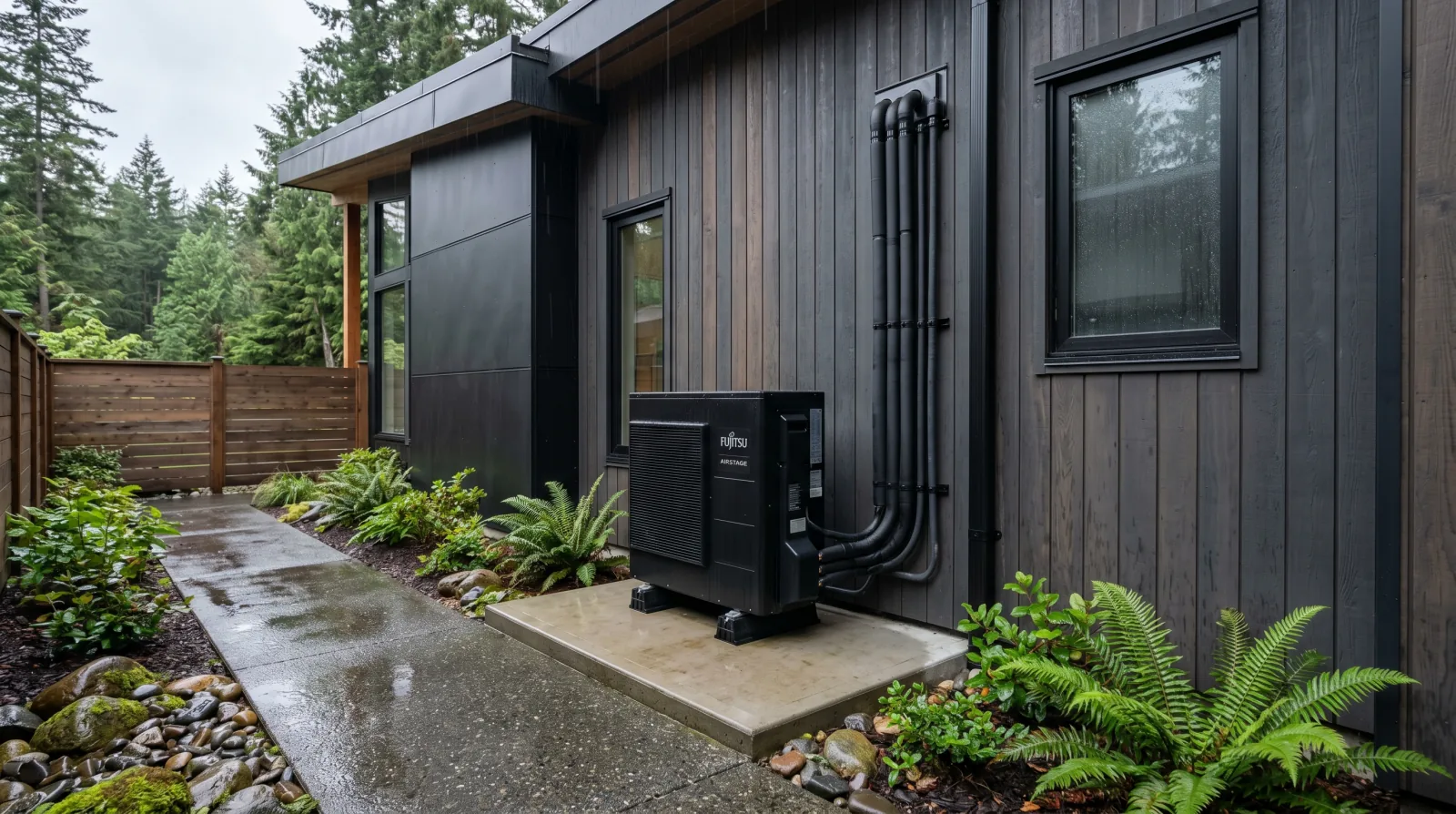
A cold-climate air-source heat pump is what the rest of the industry now calls "a heat pump." The qualifier matters because the older split units lost capacity below freezing, homeowners who remember that vintage of equipment still ask me about backup heat. Modern variable-capacity units, inverter-driven, hold rated capacity down to about -15°C and produce useful heat well below that.
Burnaby's design heating temperature is around -7°C. The cold snaps each winter rarely drop below -10°C. A properly sized cold-climate heat pump on a Burnaby lot handles the entire heating load without backup, and I don't spec electric resistance backup for new builds in Burnaby, Vancouver or Coquitlam, the climate doesn't justify the cost or the panel load. In Abbotsford and further into the Fraser Valley, where colder snaps come in more often, the mechanical designer sometimes calls for a small backup. That's their call to make per project.
The product list I work from starts with the Natural Resources Canada cold-climate specification. From there I look at HSPF and SEER2, higher is better on both, and at sound levels at the outdoor unit. That last one matters more than people think on tight Burnaby Heights or Brentwood lots, where the condenser is going to sit four metres from someone's bedroom window.
Sizing right: CSA F280-12, not square-footage tonnage
This is where most mechanical scopes go wrong, and it's the single most important question to ask.
The standard for residential sizing in Canada is CSA F280-12. It's a calculation that takes the actual wall and roof insulation, window areas and U-factors, the infiltration assumption from your blower-door target, internal gains, and the design temperatures for your lot, and produces a heating and cooling load for your specific house. Not a tonnage rule of thumb off square footage.
The reason this matters: on a Step 3 + EL-4 build, and even more so on the Step 5 builds we and some other builders do voluntarily, the envelope is doing so much of the work that the calculated load comes in lower than the rules of thumb an HVAC contractor learned twenty years ago would predict. An old-school 3-ton spec that would have been right on a 1980s home of the same size is now usually oversized. Oversized heat pumps short-cycle, run inefficiently, and fail to dehumidify on summer afternoons, exactly the comfort problem the owner thought they were paying to avoid.
On our Eagle Mountain Contemporary build in Coquitlam, the F280-12 number came in well under what the first contractor's rule-of-thumb quote had assumed. The right-sized unit costs less, runs quieter, and the house holds temperature more evenly. That same pattern has held on every Step Code build since.
I won't sign off on mechanical drawings without a stamped F280-12 calculation. Neither will the City. It's the basis for the equipment selection, the ductwork, and the energy model the energy advisor needs for Step Code compliance.
Ducted vs ductless, and why the duct layout is what people regret
A heat pump can deliver to the home through ductwork or through individual wall-mounted heads. Both work. The choice is design-driven.
For most ground-up custom homes in Burnaby I spec ducted with a small number of dedicated zones. Whole-house filtration through one good filter, cleaner aesthetic without wall-mounted heads, easier integration with the HRV distribution, better summer humidity control, one piece of equipment to maintain. Multi-zone ducted with VAV dampers is the right call when the architecture demands fine-grained control room by room.
Ductless is the right answer when a whole-home renovation makes running ducts impractical, or when a specific zone needs independent control, a home office, a guest suite over the garage, an addition on a build I didn't do the original of.
But the brand and type of equipment is not the decision people regret. It's the duct layout.
The mechanical decision people regret most isn't the equipment brand. It's the duct layout. Ducts forced to bend around structure they were never designed for don't deliver the air the model promised, and the owner lives with it for the next thirty years.
Icon Projects Team
I've inherited duct runs from other builders' projects that were the textbook explanation of every comfort complaint the owner had. The fix is to design the duct layout into the structural drawings, not around them.
Why HRV becomes mandatory and why I prefer it over ERV in Burnaby
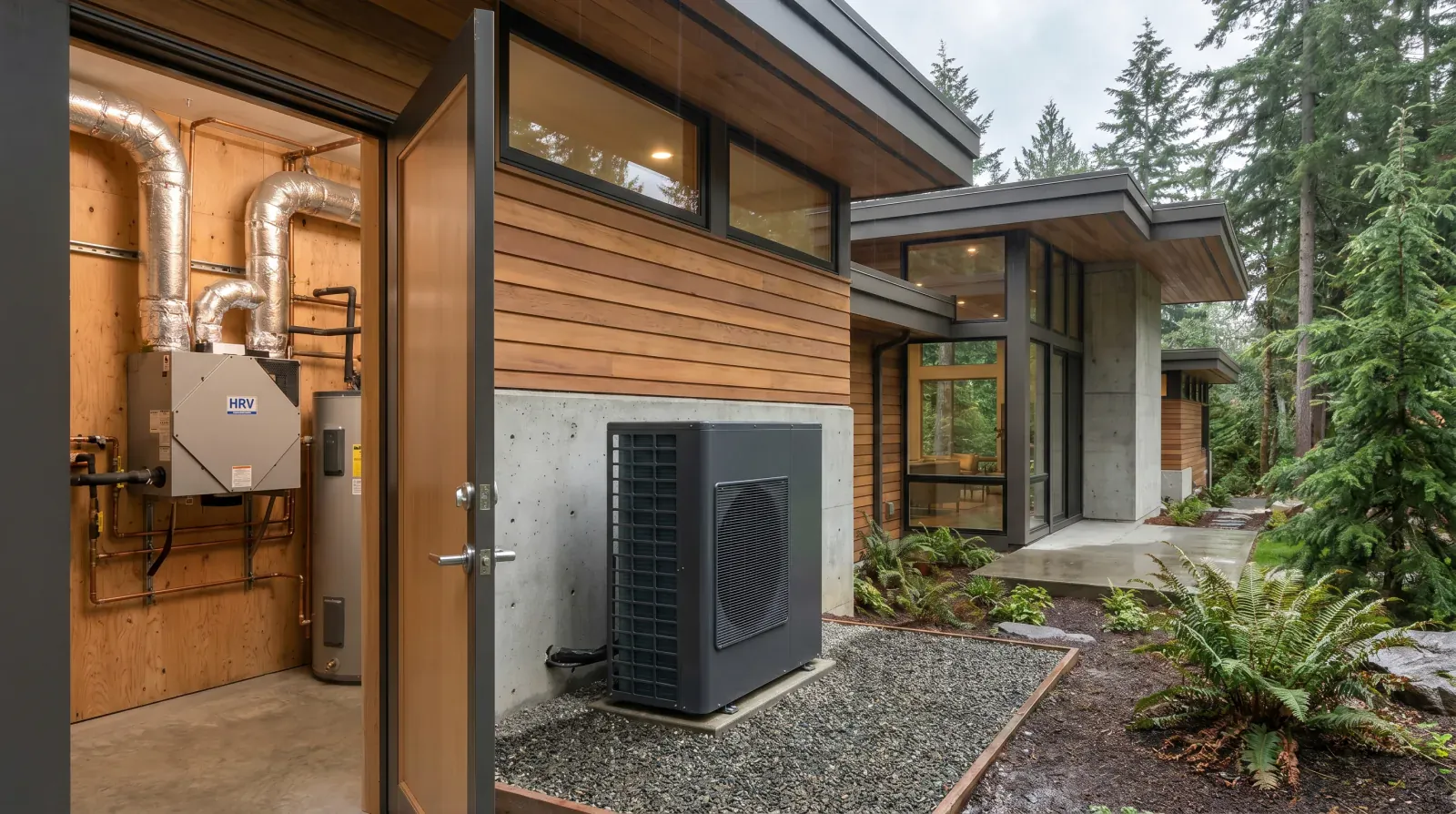
When the envelope is sealed to 1.0 ACH50, the home cannot ventilate itself. Pull a bath fan and the only place replacement air can come from is the few unintentional leaks the airtightness target was meant to eliminate. The answer is balanced mechanical ventilation, a heat-recovery ventilator (HRV) or energy-recovery ventilator (ERV) that supplies fresh air to bedrooms and living spaces, exhausts from kitchens and bathrooms, and recovers heat (HRV) or heat plus humidity (ERV) from the outgoing stream.
In Burnaby's climate I generally go with an HRV. The wet coast's year-round humidity doesn't need the moisture transfer an ERV provides, and in mid-winter an ERV can hold a little too much humidity inside, raising condensation risk on cold surfaces I've then watched develop into envelope problems. The drier Fraser Valley in summer or a high-occupancy household sometimes argue for ERV. The mechanical designer makes the call per project, but I'll push back if HRV is being skipped without a reason I find convincing.
Sizing follows HRAI ventilation guidelines and the requirements in CSA F326:23 (the current edition of the residential mechanical ventilation systems standard, updated in 2023). The HRV's distribution network needs to be sized and balanced like any other ductwork. A poorly balanced HRV on a tight envelope is a comfort complaint waiting to happen, and unlike the heat pump, where the symptom is obvious, an unbalanced HRV is the problem the owner can't explain but lives with for years.
Commissioning is the step nobody talks about
Mechanical equipment doesn't deliver design performance until it's commissioned. Commissioning is the formal process of measuring airflow at every supply and exhaust grille, adjusting dampers to match the design intent, and documenting the result. It's required as part of the Step Code compliance scope.
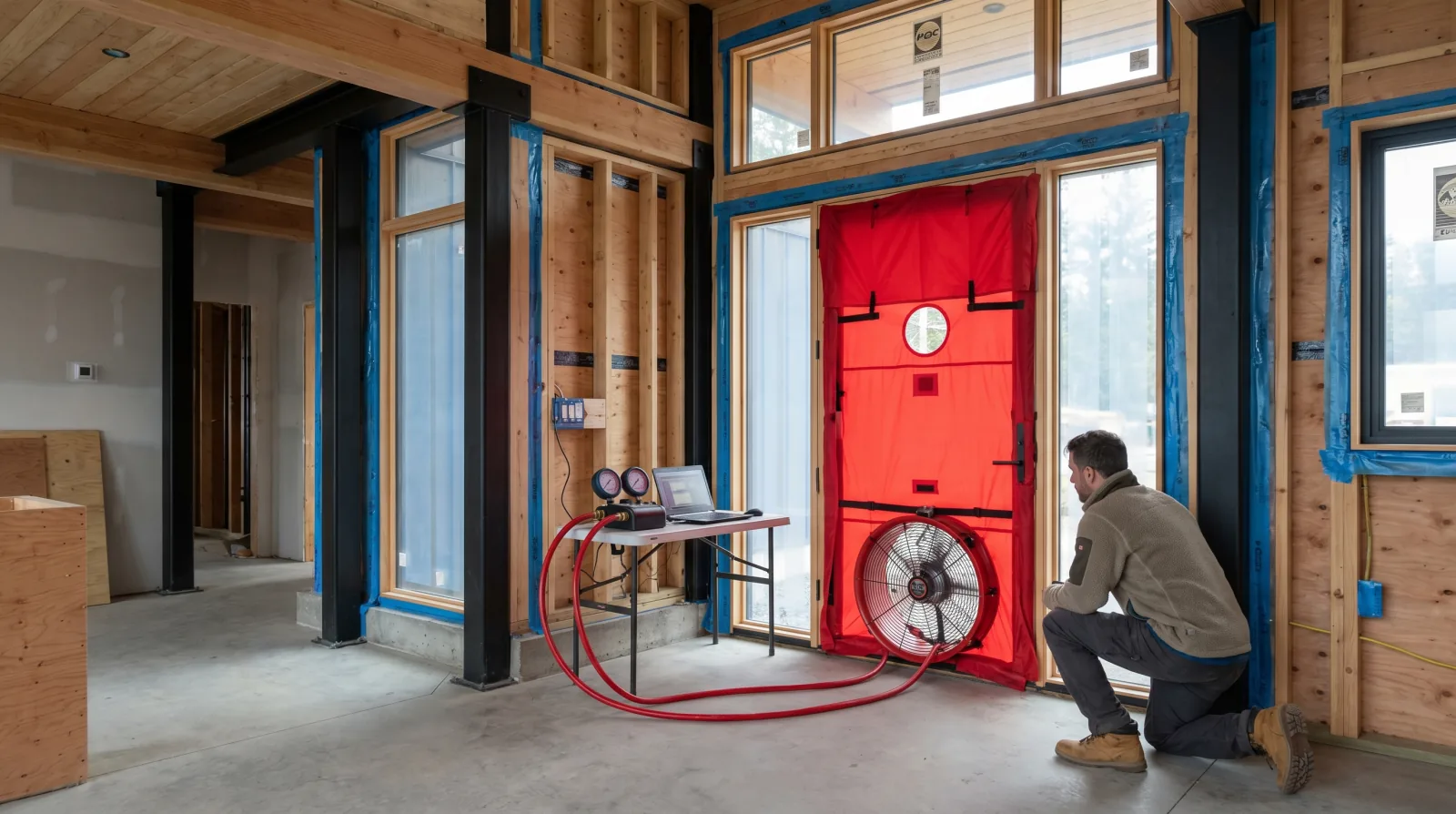
The blower-door verifies the envelope. Commissioning verifies the ventilation. Both happen near the end of construction. Both produce paperwork the energy advisor needs for the Step Code file.
I've walked into homes, not Icon's, where the equipment was correctly sized but nobody balanced the system at completion. The owners moved in with the wrong air patterns and lived with cold rooms and noisy supply registers for years before anyone connected the comfort complaints to the missing commissioning step. It's the small step that prevents the big regret, and it costs almost nothing relative to the equipment it commissions.
Choosing a mechanical designer
The mechanical designer for a Step 3 + EL-4 Burnaby custom home is doing more than picking equipment. They produce the F280-12 calculation, design the duct and HRV distribution, select the heat pump and HRV based on the calculation, coordinate with the energy advisor on the Step Code energy model, write the commissioning protocol, and review the installer's work in the field.
The right designer has done this on Burnaby and Vancouver custom homes in the current code era. The flags I watch for: oversized equipment proposals, exhaust-only ventilation specs, no mention of commissioning. Each one tells me the designer hasn't updated their methods since Step Code arrived.
Five questions to ask when the mechanical schematic comes back
When the mechanical schematic lands on your desk:
- Where's the CSA F280-12 calculation, and what design temperatures did you use?
- What's the heat pump's rated capacity at -10°C, not just at 8°C?
- Is the HRV ducted independently or sharing the heat pump's ductwork?
- What's the commissioning plan and who does it?
- How will the system be controlled, single thermostat, zoned controls, smart-home integration?
For the envelope side of the same conversation, our companion piece on Step Code Step 5 covers the airtightness and thermal envelope decisions that drive heat pump sizing. For the long-term durability conversation, why we don't believe in builder-grade is where I lay out our take on equipment and material selection.
If you're holding a mechanical proposal for a Burnaby, Vancouver or Coquitlam custom home and want a second read before you sign off, send it through. The drawings are technical, but the questions a homeowner needs to ask are accessible, I'll walk through them with you on a call.
Frequently asked questions
- Are heat pumps required in new BC homes in 2026?
- Heat pumps are not required by name, but Burnaby's Step 3 plus EL-4 code requirement makes them the practical default for new residential construction. EL-4 effectively rules out fossil-fuel space and water heating, and a sealed envelope without mechanical ventilation is not code-compliant. In practice, virtually every new custom home permitted in Burnaby in 2026 uses a cold-climate heat pump as the primary heating and cooling system.
- What is an HRV and why is it required in a BC custom home?
- An HRV, or heat-recovery ventilator, supplies fresh air to bedrooms and living spaces and exhausts stale air from kitchens and bathrooms, recovering the heat from the outgoing stream. It is required in new BC homes because airtight envelopes, mandated by the Step Code, cannot ventilate naturally. Without an HRV, a sealed home accumulates carbon dioxide, volatile organic compounds, and moisture from occupants and cooking.
- Should I choose an HRV or ERV for a Burnaby home?
- For most Burnaby custom homes, an HRV is the right choice. The west coast's mild humidity year-round does not require the moisture transfer that an ERV provides. In mid-winter, an ERV can retain enough indoor humidity to increase condensation risk on cold surfaces. ERVs are more appropriate for drier interior climates or airtight homes with high occupant density. The mechanical designer makes this call per project.
- What is commissioning and why does it matter for heat pump and HRV systems?
- Commissioning is the formal process of measuring airflow at every supply and exhaust grille, adjusting dampers to match the design intent, and documenting the result. It is required on Step Code compliant homes in BC. Without commissioning, even correctly sized equipment may deliver air unevenly, producing cold rooms, noisy registers, or humidity imbalances. Icon Projects schedules commissioning near the end of construction alongside the blower-door airtightness test.
- What size heat pump does a Burnaby custom home need?
- Sizing follows a CSA F280-12 heat load calculation specific to the home, wall insulation, window U-factors, infiltration rate, and local design temperatures. On a Step 3 plus EL-4 envelope, the calculated heating load typically comes in well below a rule-of-thumb square-footage estimate, because the high-performance envelope does more work. Any mechanical designer who quotes a size without a CSA F280-12 calculation is guessing.
- Does a cold-climate heat pump need backup electric resistance heat in Burnaby?
- Usually not. Burnaby's design heating temperature sits around minus 7 degrees Celsius, and winter cold snaps rarely drop below minus 10. A modern variable-capacity cold-climate heat pump holds rated capacity down to about minus 15 degrees Celsius, so a properly sized unit handles the entire Burnaby heating load without backup. Icon Projects does not spec electric resistance backup on new Burnaby, Vancouver or Coquitlam builds, since the local climate does not justify the added cost or panel load.
- Should a heat pump system be ducted or use wall-mounted heads?
- For most ground-up custom homes in Burnaby, Icon Projects specs ducted delivery with a small number of dedicated zones, which gives whole-house filtration through one filter, a cleaner look without wall-mounted heads, and easier integration with the HRV's air distribution. Ductless wall-mounted heads make more sense for a renovation where running ducts is impractical, or where one specific zone, like a home office or a suite over the garage, needs independent control.
- What does HRV or ERV sizing follow in a BC custom home?
- Sizing follows HRAI ventilation guidelines and the requirements in CSA F326:23, the current edition of Canada's residential mechanical ventilation systems standard. The HRV's distribution network has to be sized and balanced like any other ductwork. A poorly balanced HRV on a tight, airtight envelope becomes a comfort problem that is hard for the owner to pin down but is lived with for years if it is not addressed.