Three things change for Burnaby custom-home owners in 2026: permits go digital-only, the Energy Step Code tightens, and the tree bylaw quietly drives a lot more decisions than people realise.
What changed for Burnaby custom homes in 2026?
Three changes affect every Burnaby custom-home build starting in 2026: building permit applications are digital-only (submitted via My Permits Portal since January 1, 2026, with digital-only permits issued from March 31, 2026), the Energy Step Code minimum is Step 3 plus EL-4 of the Zero Carbon Step Code for all new Part 9 homes, and the Burnaby Tree Bylaw now catches more lots than owners realise, any tree 20 cm or larger in trunk diameter on a development application property is a Protected Tree requiring declaration at permit.
The owners we sit down with at the start of a Burnaby custom build almost always ask the same first three questions. How long is permit going to take? What does the energy code actually mean for the design? And do I really have to deal with the tree on the back of the lot? In 2026 the answers to all three look meaningfully different than they did even eighteen months ago.
This piece is a working builder's read on what changes for a custom home in Burnaby this year, what the changes mean in practice, and where the timeline-killers actually hide. We build across Greater Vancouver, Burnaby first, then Vancouver, Coquitlam, Surrey, Abbotsford and the Fraser Valley, and Burnaby's permit and code environment is doing more in 2026 than any other municipality we work in.
Burnaby's permit process is now digital-only
The biggest operational change is straightforward. Per the City of Burnaby, all building permit applications submitted on or after January 1, 2026 are processed digitally, and any permit issued on or after March 31, 2026 is provided exclusively in digital format. Paper-based intake at the counter is winding down, and the My Permits Portal becomes the front door for every new home application.
That sounds like a small administrative shift. It is not. A digital intake means the City can hold an application at the door if the document set is incomplete, where in the past a coordinator might have caught a missing item over the phone and asked you to drop off a corrected page later. Pre-flight matters more than it used to. The five things we now check before we click submit:
- Architectural set is fully coordinated with the structural set, no orphaned dimensions
- Energy compliance package is attached (more on that in a minute)
- Tree bylaw declaration is included for every tree on the lot above the protected threshold
- Geotechnical report is attached if the lot has any slope, fill, or known soft soils
- Site plan, survey and grading plan all reference the same datum and the same lot lines
If any of those is missing, a digital intake will let you submit, but the reviewer can flag it on day one. That's not a delay. It's just an honest start.
The Building Permit Hub is the bigger story
A second piece of the digital shift is provincial, not municipal. The BC Building Permit Hub launched on May 27, 2024 as a one-stop digital intake that automatically checks an application for completeness and screens parts of the BC Building Code before the file even reaches a human reviewer. The Hub started with twelve local governments and two First Nations as pilot partners, expanding through 2025 and into 2026.
For a Burnaby custom-home owner that translates to a meaningful narrowing of the variance band on permit timelines. Single-family permits in Burnaby have historically run twelve to twenty weeks for a clean application. Complex infill, fill or steep-slope sites can take six to twelve months when resubmissions are needed. The Hub is intended to compress the early review cycle by catching code-compliance issues automatically and pushing the back-and-forth to the front of the process. We're seeing it in practice on simpler files; complex files still depend heavily on human review.
The energy code is the quietest big change
The second 2026 shift sits behind the wall, and most owners we talk to have heard of the Energy Step Code without ever reading what it actually requires.
Here's the floor. As of January 1, 2025, every new Part 9 residential building in Burnaby must meet at least Step 3 of the BC Energy Step Code and EL-4 of the Zero Carbon Step Code. That isn't a soft target. It's the minimum the City accepts at permit, and it requires a certified Energy Advisor to submit modeling with the application.
Step 3 typically lands a home in the range of 20% better than the 2018 baseline on energy performance. It's achievable with thoughtful envelope design and decent windows. It is not achievable by accident.
The bigger horizon is 2032. Provincial policy targets Step 5 of the Energy Step Code as the default standard for new homes by 2032. Step 5 is "net-zero ready," which is equivalent to Passive House for the airtightness and envelope numbers, and demands serious envelope design from the schematic stage. Wall assemblies in the R-28+ range. Triple-glazed windows in deep reveals. Airtightness tested at 1.0 air changes per hour at 50 Pascals or better.
If you're building today and intending to live in the home for twenty or thirty years, the relevant question isn't whether you have to meet Step 5. It's whether you should design for it now anyway.
Why we tell custom-home clients to design above the floor
Three reasons we recommend designing for Step 5 even when only Step 3 is required at permit:
- The window and wall-assembly decisions become expensive to retrofit. The cost gap to specify good windows on day one is meaningfully smaller than the cost of replacing them in year ten.
- Resale and refinancing both increasingly look at energy ratings. A Step-3-built home sold in 2032 sits in a different market than a Step-5 home.
- The mechanical sizing logic flips. A high-performance envelope lets you size the heat pump to a smaller load, which matters every winter for the rest of the home's life.
The trade-off is real on day one, but it's almost always worth running the numbers.
The tree bylaw drives more design than owners expect
The third change isn't new in 2026, but it gets understood properly only when an owner gets a letter from the City asking them to replant. The Burnaby Tree Bylaw is the regulation we see catch the most owners off-guard during a custom build.
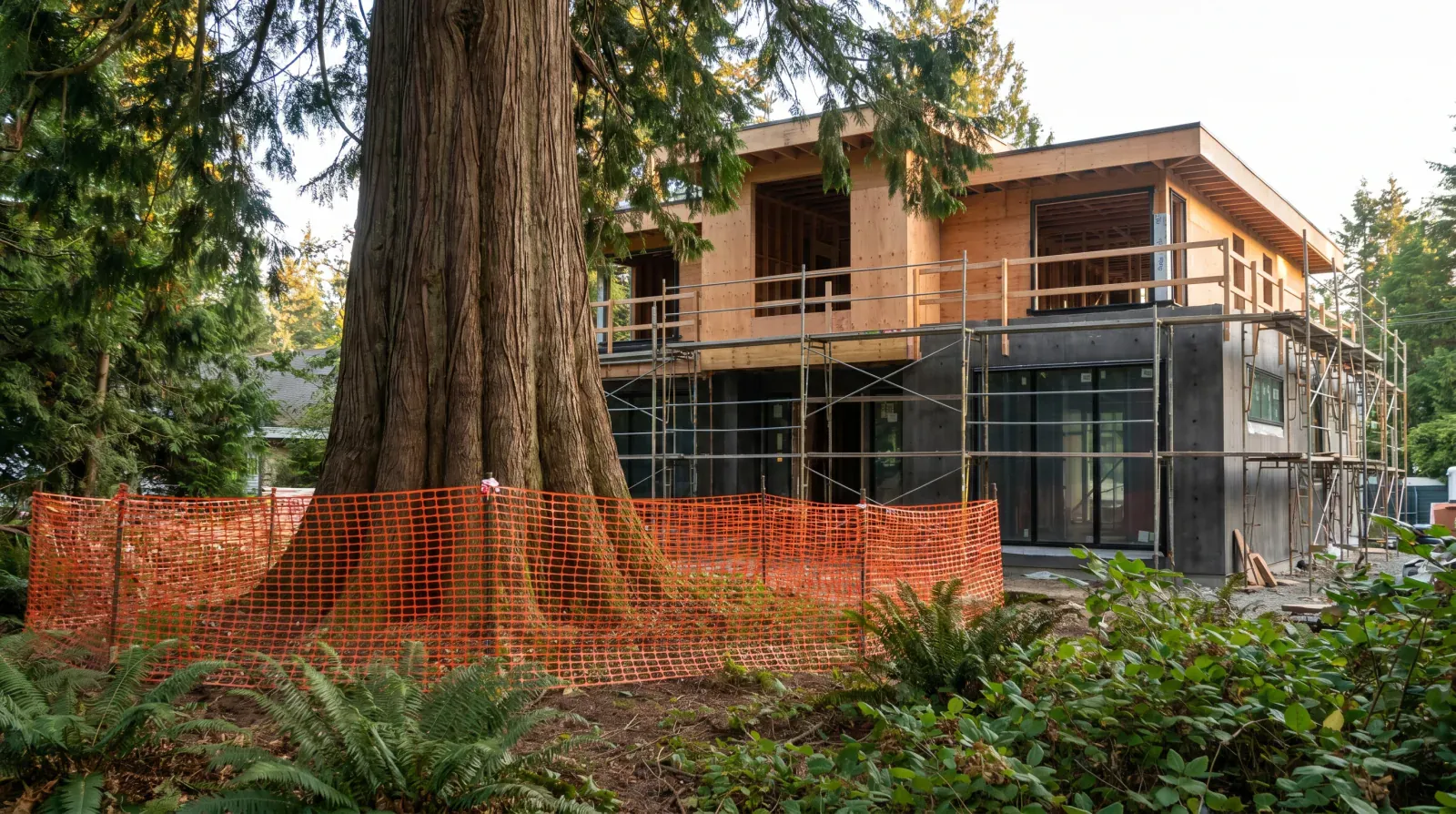
Under the Burnaby Tree Bylaw, any tree 20 cm or larger in trunk diameter on a property subject to a development application is a Protected Tree. That threshold is much lower than people expect. A 20 cm diameter trunk is roughly the size of a healthy decade-old conifer, and most central Burnaby lots, Burnaby Heights, Capitol Hill, Brentwood, Deer Lake, have several of them.
Three points worth knowing before design starts:
- The tree bylaw permit is auto-generated when you apply for a building permit. You don't apply for it separately, but you do have to declare every protected tree on the lot.
- Every tree you remove has to be replaced. Replacement coniferous trees must be at least 2 metres tall, and replacement deciduous trees must have a minimum trunk diameter of 5 cm at planting. That's not a small sapling.
- If the lot can't physically hold the required replacement count, the City accepts cash-in-lieu, but the calculation usually pushes the design back toward keeping more of the existing trees on site.
What that means in practice is that if you're walking a lot in Capitol Hill or Burnaby Heights with a builder, the tree inventory matters as much as the orientation. A lot with three mature Douglas firs on the south edge isn't a lot you can clear-cut. It's a lot you design around.
The Burnaby tree bylaw isn't a bureaucratic line item. It's a design constraint we put on the brief in the first meeting. We'd rather work with the trees than work around them in a fight with the City.
Icon Projects Team
Putting it together: a 2026 Burnaby custom-home checklist
When we start a Burnaby custom build now, the first six weeks of planning revolve around five questions:
- What's the actual lot inventory? Survey, grading plan, every tree above 20 cm DBH, soils where there's any doubt, and the existing services to the lot.
- What energy step are we designing to? Step 3 is the floor; Step 5 is where we usually land for owners staying long-term.
- What's the building permit submission package going to look like? Architectural, structural, energy, tree, geotechnical (if applicable). The digital intake means the package has to be clean before we click submit.
- Where are the long-lead items? Windows specified for Step 5 performance can run 14 to 20 weeks; certain stone slabs and millwork run further. We sequence these against the schedule, not against the move-in date.
- What's the contingency, in writing? The Homeowner Protection Act mandates that every licensed builder in BC carry 2-5-10 home warranty insurance, two years on materials and labour, five on the building envelope, ten on structural. The warranty is the floor. The contingency is yours to set, and on a Burnaby site we recommend it be honest.
What hasn't changed
A lot. The fundamentals of a great Burnaby custom home are the same as they were a decade ago. Orient for light, not just view. Design around how the family actually lives. Specify the touch surfaces well, floors, hardware, faucets, cabinetry, because those are the things you'll feel for twenty years. Budget the envelope properly. Build above the code, not to it.
The 2026 changes don't override any of that. They just narrow the band of acceptable execution. The City is asking for cleaner submissions, the energy code is asking for better envelopes, and the tree bylaw is asking for more thoughtful site work. None of those are bad directions for a custom home.
If you're starting a custom build in Burnaby, Vancouver, Coquitlam or anywhere else in Greater Vancouver in the next twelve months, the conversation that saves the most time is the one that happens before a single line is drawn. The lot, the trees, the energy target, the long-lead items, the timeline against your real-life calendar. A focused hour at the beginning is worth weeks at the end.
Frequently asked questions
- What changed for Burnaby custom homes in 2026?
- Three changes affect every Burnaby custom home starting in 2026. First, building permit applications moved to digital-only intake through My Permits Portal as of January 1, 2026, with digital-only permit issuance from March 31, 2026. Second, the BC Energy Step Code minimum for new homes is Step 3 plus EL-4 of the Zero Carbon Step Code, the strictest carbon tier in Metro Vancouver, requiring all-electric heating. Third, the Burnaby Tree Bylaw protects any tree 20 cm or larger in trunk diameter on a development-application property, which shapes lot design more than most owners anticipate. Icon Projects builds exclusively in this environment.
- What is the BC Energy Step Code minimum for a new home in Burnaby in 2026?
- Since January 1, 2025, every new home in Burnaby must meet Step 3 of the BC Energy Step Code and EL-4 of the Zero Carbon Step Code. Step 3 requires a whole-building airtightness of 2.5 ACH50 or better, proven by a blower-door test on the finished home. EL-4, Burnaby's specific carbon requirement, the strictest in the region, requires all-electric space heating and hot water, which in practice means a heat pump. A certified energy advisor must submit energy modelling with the permit application.
- How does the Burnaby Tree Bylaw affect custom home design in 2026?
- The Burnaby Tree Bylaw declares any tree 20 cm or larger in trunk diameter on a development-application property a Protected Tree. That threshold is lower than most owners expect, a healthy decade-old conifer can hit 20 cm. Every protected tree removed must be replaced: coniferous replacements at minimum 2 metres tall, deciduous at minimum 5 cm trunk diameter at planting. The tree inventory must be declared at permit and the tree plan must be included in the permit submission package. On most central Burnaby lots, Burnaby Heights, Capitol Hill, Brentwood, this constraint shapes the building footprint directly.
- What is the BC Building Permit Hub and how does it affect a Burnaby build?
- The BC Building Permit Hub launched on May 27, 2024 as a one-stop provincial digital intake that automatically checks an application for completeness and screens parts of the BC Building Code before a human reviewer sees the file. It started with twelve local governments and two First Nations as pilot partners and has been expanding through 2025 and into 2026. For a Burnaby custom-home owner, it means the early review cycle narrows because code-compliance issues get caught automatically rather than discovered several weeks into human review.
- Why replant trees if the Burnaby lot cannot hold the required replacement count?
- When a lot physically cannot hold the required number of coniferous or deciduous replacement trees, the City of Burnaby accepts cash-in-lieu payment instead. In practice, that calculation usually pushes the design back toward keeping more of the existing trees on site rather than paying the fee, because most owners would rather preserve mature trees than pay for replacements the lot cannot fit. This is one reason the tree inventory shapes the footprint before a single wall is drawn.
- What is Step 5 of the BC Energy Step Code, and does a Burnaby home have to meet it in 2026?
- Step 5 is the net-zero-ready tier of the BC Energy Step Code, roughly equivalent to Passive House performance for airtightness and envelope numbers, requiring wall assemblies in the R-28+ range, triple-glazed windows in deep reveals, and airtightness tested at 1.0 air changes per hour at 50 Pascals or better. Burnaby's current minimum for a new home is Step 3 plus EL-4, not Step 5. Provincial policy targets Step 5 as the default standard for new homes by 2032, so a home built in 2026 is not required to hit it yet.
- What building components are checked in a Burnaby permit's completeness review?
- Since digital-only intake began, a Burnaby building permit submission needs a fully coordinated architectural and structural set with no orphaned dimensions, an attached energy compliance package, a tree bylaw declaration for every tree above the protected threshold, a geotechnical report if the lot has slope, fill, or known soft soils, and a site plan, survey, and grading plan that all reference the same datum and lot lines. A digital intake can flag a missing item on day one rather than catching it weeks later at the counter.
- Why does Icon Projects recommend designing above the Step 3 energy floor?
- Three reasons. Window and wall-assembly decisions are far cheaper to specify correctly at design than to retrofit in year ten. Resale and refinancing increasingly weigh energy ratings, so a Step 3 home sold in 2032 sits in a different market than a Step 5 home. And a high-performance envelope lets the heat pump be sized to a smaller load, which lowers the mechanical cost and improves comfort every winter for the life of the home. Icon Projects walks Burnaby clients through this trade-off at the design stage.