Planning
Geotechnical Reports on Burnaby Slope Lots: When You Need One and What It Tells You
On a sloped Burnaby lot, the geotechnical report drives every foundation, drainage, and retaining-wall decision. Here's when the City requires one, what it actually contains, and how to read it as a homeowner.
A geotechnical report on a Burnaby slope lot is a formal engineering investigation, test pits or boreholes, soil profiling, slope-stability analysis, that the City of Burnaby requires before issuing a building permit on steep or hazard-adjacent lots. It tells you what foundation type the lot will accept, how the drainage has to be designed, and whether the slope is stable enough for the structure you've sketched.
"Is the geotech really necessary?" is the question I get on almost every sloped lot proposal. The honest answer: on a Burnaby hillside, Capitol Hill, Cariboo Heights, Buckingham Heights, Government Road, yes, even when the City doesn't strictly force it. The report is the document most owners hope they don't need and many wish they'd commissioned earlier. I'd rather see an owner spend a few thousand dollars to find out what the ground will do than discover it once concrete is poured.
This is what's actually in the report, when Burnaby will demand one, and how to read it as a homeowner before subjects come off on the lot.
When Burnaby triggers a geotech requirement
The City of Burnaby's building department requires a geotechnical report when a property is on a steep slope, near a recognized slope-hazard area, or when the structural design depends on soil-bearing assumptions that need to be verified. The thresholds are described in the City's building permit submission requirements and the foundation requirements in Section 9.15 of the BC Building Code (Part 9, Footings and Foundations), including the minimum 75 kPa allowable bearing pressure assumption that, on slope or uncertain-soil lots, has to be confirmed by an engineer rather than assumed.
In practice, a Burnaby lot triggers a geotech requirement when any of the following apply:
- The natural slope across the lot exceeds roughly 20% (a vertical change of one metre across five metres horizontal)
- The lot abuts a designated slope-hazard area
- The proposed foundation requires deep footings, helical piles, or engineered footings
- A retaining wall over a metre in exposed height is part of the design
- The soil profile is uncertain, recent fill, proximity to a watercourse, an old clay pit or quarry pocket (Burnaby has these in several neighbourhoods)
- An adjacent property has had geotechnical issues that could affect the new build
If you're not sure whether your lot triggers a requirement, the City's planning counter will confirm it. Your designer or builder should be checking this in pre-design, if they're not, that's the first flag.
What's actually in the report
A geotechnical report from an engineer registered with Engineers and Geoscientists BC under the EGBC professional practice guidelines for residential geotechnical assessments is a structured document. The major sections:
- Site description and history. Topographic context, existing structures, history of the lot, was it filled, was it logged, has there been past slope movement.
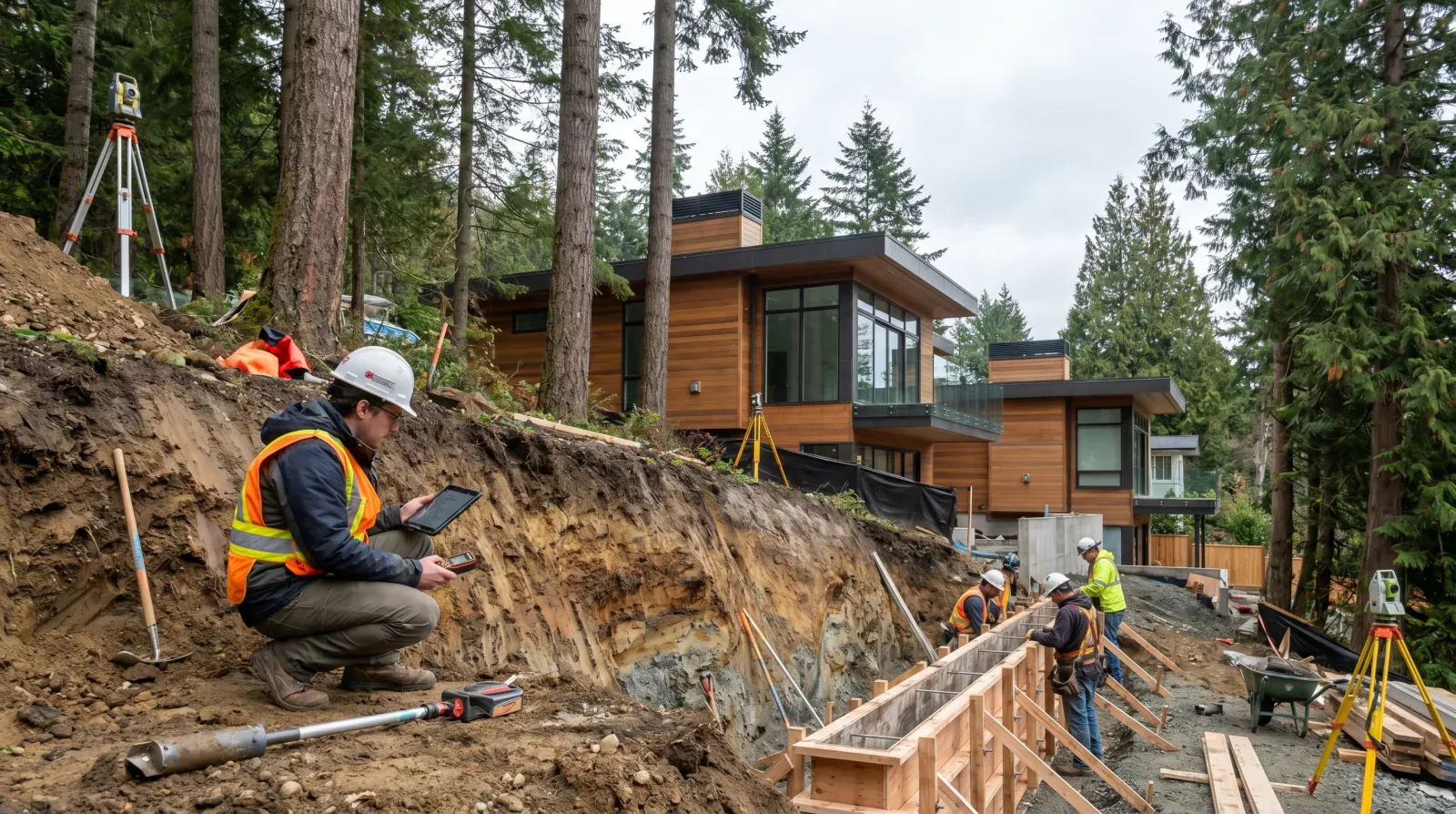
- Field investigation. Test pits, boreholes, or both. Test pits are excavated with a small machine and let the engineer see the soil profile in cross-section. Boreholes are drilled and sampled. Most Burnaby residential lots get two to four investigation locations.
- Subsurface conditions. A logged description of the soil at each investigation point, depth, type (sand, silt, clay, glacial till, fill), groundwater table, organic content.
- Foundation recommendations. Allowable bearing pressure, foundation type (spread footings, deep footings, piles), depth of bearing, frost-protection requirements, drainage requirements.
- Slope-stability analysis. For sloped lots, an analysis of the lot's stability under static and seismic loading. Recommendations for slope stabilization if needed.
- Construction monitoring requirements. What the engineer requires during construction to verify their assumptions, usually footing inspections, sometimes monitoring during excavation.
- Letter of assurance. A signed and sealed letter committing the engineer to the recommendations and to the field reviews. The City of Burnaby requires this letter for permit issuance.
The report is typically 25 to 60 pages. It's technical, but the executive summary and the recommendations sections are written for designers, builders and the City's reviewers, meaning a homeowner can read them and follow what's being said. I'd suggest reading them; you don't need to follow every soil log to spot the recommendations that are about to change your project.
From soil bearing to foundation type
The recommendations section is where the report ties to the rest of the project. A typical Burnaby hillside report reads something like:
- Competent bearing soil is encountered at 1.2 to 1.8 metres below existing grade.
- Allowable bearing pressure of 150 kPa may be assumed for spread footings on competent soil.
- Foundation walls retaining more than 1.2 metres of fill require structural design and drainage per recommendations herein.
- A perimeter drainage system is required; details are provided in Section X.
- Helical piles may be considered as an alternative to spread footings; if used, capacity to be verified by torque testing.
Each line drives a downstream decision. The bearing pressure goes to the structural engineer. The drainage requirements go to the architect and the civil engineer. The foundation type informs the cost, the schedule, and the construction sequence. The foundation-decision side of this is covered in our piece on foundations on Burnaby's hillside lots.
Slope stability versus bearing capacity
On a flat lot, the geotech is mostly about bearing capacity, how much load the soil can support. On a sloped lot, it's also about slope stability, whether the slope will move under the loads the building is adding.
Slope stability analysis looks at the lot's geometry, the soil's shear strength, the groundwater conditions and any seismic loading. The output is a Factor of Safety. A FoS above about 1.5 under static conditions and 1.1 under seismic is typically acceptable for residential development. Below those thresholds, the engineer will recommend slope stabilization, soil nails, retaining walls, additional drainage, or in some cases a redesign of where the building sits on the lot.
This is the part of the report that changes projects most. A finding that the slope is only just stable under seismic loading might mean the building has to be set back from the slope crest, or that a soldier-pile shoring wall is required at the rear of the excavation. Neither of those is a small adjustment.
The geotech is the most important consultant on a sloped Burnaby lot. They tell us what the ground will and won't accept, and every other consultant works downstream of their answer. When the report and the design agree from the start, the project stays coordinated. When they don't, everything downstream has to be reworked.
Icon Projects Team
Working with the engineer
The strongest geotechnical reports come from engagements where the engineer is given enough information up front. Before the field investigation, I send the engineer the architect's schematic site plan with the proposed building footprint, the structural design intent and the survey of the existing lot. That lets them locate the test pits and boreholes to maximise information about the actual building, not just somewhere convenient on the lot.
Two practical recommendations for homeowners:
- Commission the geotech early. Schematic design, not building permit. Findings can change the footprint, and changing a footprint on paper is cheap. Moving concrete is not.
- Don't shop the report. A second geotech opinion in mid-design is rarely useful and creates a coordination problem the City won't appreciate. Pick an engineer with experience in your neighbourhood and stay with them.
How findings cascade into design
A geotechnical report doesn't sit in a file. Its findings move through every consultant on the project:
- The architect adjusts the building footprint, the basement depth, and the rear-yard grading
- The structural engineer designs footings to the specified bearing pressure and detail
- The civil engineer (or the architect's drainage consultant) designs the perimeter and stormwater systems to the geotech's drainage recommendations
- The builder plans the excavation sequence, the shoring (if required), and the foundation construction
- The City reviews the building permit submission against the report's recommendations
When all five flow from the same document, the project stays coordinated. When one of them gets ahead of the report, or worse, when the design proceeds without a report and one is added at permit, the project develops contradictions that are expensive to resolve. I've inherited mid-design projects where that happened; the structural engineer had assumed bearing values that the geotech later disagreed with, and re-pricing the foundation cost more than the report itself would have, twice over.
The de-risking value
Owners sometimes ask me whether a geotech is "really necessary" on a lot that doesn't strictly trigger a City requirement. The answer in my experience: on any sloped lot, yes, even when the City doesn't require it. The report buys certainty in three places that otherwise become risk, foundation type, drainage, slope stability, and it sometimes surfaces a much bigger surprise (a buried tank, an unexpected fill layer, a perched water table) that would have shown up during excavation at twenty times the cost.
The report is the cheapest insurance the project will ever buy. I tell clients in Capitol Hill, in North Vancouver above the District's slopes, and in West Vancouver perched above Burrard Inlet the same thing: commission the report.
When shallow bedrock changes everything
Burnaby's hillside neighbourhoods, Capitol Hill, Government Road, parts of Buckingham Heights, sit on the flanks of Burnaby Mountain. In certain pockets the bedrock is close to surface. Shallow bedrock changes a project in ways only a geotech investigation reveals.
Foundation type. Deep footings that rely on soil bearing aren't available when competent bearing is rock. The engineer's recommendation shifts to drilled piers anchored into the rock (rock sockets), which require different equipment, different sequencing, and a structurally engineered connection at the pier head. The cost per linear metre of drilled pier is higher than a conventional footing, but bearing capacity into Burnaby Mountain basalt is effectively unlimited, there is no settlement problem at the pier seat.
Excavation. Cutting rock for a basement, a sunken garage or a deep footing requires either controlled blasting (subject to City of Burnaby permits and neighbourhood notification) or mechanical rock breaking with a hydraulic hammer, which is slow and expensive. Both options are workable. Neither is a surprise you want to discover after a fixed-price foundation contract is signed. On our Eagle Mountain Contemporary build in Coquitlam, different municipality but the same flank of mountain geology, the rock-versus-soil profile shaped the foundation strategy from week one. The geotech finding the bedrock depth early meant the excavator showed up with the right equipment, not the wrong one.
Drainage. Bedrock is impermeable. On a hillside lot, water that would normally percolate through soil travels along the rock surface instead, concentrating groundwater at the bedrock interface, often a metre or two below surface, and making perimeter foundation drainage more important, not less. The geotech report will specify a drainage blanket or gravel layer against the foundation wall, a perforated collector drain and a discharge path, all of which have to be coordinated into the foundation design.
For owners considering a Burnaby hillside lot, "what's the depth to bedrock?" is the most useful single question to add to the pre-purchase conversation. An engineer can usually answer it with a desktop review and a site walk before subjects come off, at a small fraction of the cost of a full investigation, let alone a foundation surprise. The answer either confirms the project or quietly changes it.
When to bring it up
The right time to commission a geotechnical report is during pre-design, after the architect has produced a schematic site plan but before structural and civil design begins. I include this in the pre-construction services agreement so the report's findings inform the design rather than constrain it after the fact.
If you're early in design on a Burnaby slope lot, or even before purchase, weighing whether to make an offer on a property where the geotech is uncertain, send me the address. For the broader pre-purchase conversation, our lot evaluation checklist and the planning checklist cover the steps before the engineer arrives on site.
Frequently asked questions
- Does every Burnaby slope lot require a geotechnical report?
- Not every slope lot, but most. Burnaby's building department requires a geotech report when the natural slope exceeds approximately 20%, the lot abuts a designated slope-hazard area, the proposed foundation requires deep or engineered footings, a retaining wall over one metre is part of the design, or the soil profile is uncertain. If you are unsure whether your lot triggers the requirement, the City's planning counter will confirm it, Icon Projects checks this at pre-design.
- When should I commission a geotechnical report, before or after buying the lot?
- Before subjects come off, if the lot has any slope, fill, or proximity to a watercourse. A geotechnical engineer can often provide a preliminary desktop review and site reconnaissance, at a fraction of a full investigation, that tells you whether the lot is likely to trigger expensive foundation requirements. Commissioning after purchase but before design is the next best time; commissioning after design is expensive because findings often change the footprint.
- What happens if the geotechnical report finds a problem on a Burnaby lot?
- The finding shapes the design, not necessarily the decision to build. A slope-stability result might mean setting the building back from the slope crest or adding a soldier-pile wall at the rear of the excavation. Shallow bedrock means drilled piers instead of spread footings. A high water table means an engineered perimeter drainage system. Most findings are buildable at known additional cost discovered in the design phase, not during excavation.
- Which Burnaby neighbourhoods most commonly require geotechnical reports?
- Capitol Hill, Buckingham Heights, Cariboo Heights, Government Road, and the slopes around Deer Lake are the most common. These sit on the flanks of Burnaby Mountain and the Burnaby Heights ridge where slope angles regularly trigger the requirement. Capitol Hill and Government Road also have pockets where bedrock is close to surface, which changes both foundation type and excavation cost.
- What sections make up a Burnaby geotechnical report?
- A Burnaby geotechnical report typically runs 25 to 60 pages and includes a site description and history, the field investigation with test pits or boreholes, subsurface conditions logged at each investigation point, foundation recommendations covering bearing pressure and depth, a slope-stability analysis for sloped lots, construction monitoring requirements, and a signed letter of assurance from the engineer that the City of Burnaby requires for permit issuance.
- What is a Factor of Safety in a slope-stability analysis, and what number is acceptable?
- The Factor of Safety is the output of a slope-stability analysis, measuring how much margin a slope has against movement under the loads a building adds. A Factor of Safety above about 1.5 under static conditions and 1.1 under seismic conditions is typically acceptable for residential development in Burnaby. Below those thresholds, the engineer recommends stabilization such as soil nails, retaining walls, additional drainage, or in some cases relocating the building on the lot.
- How does shallow bedrock change a Burnaby hillside foundation?
- Shallow bedrock rules out deep footings that rely on soil bearing, shifting the recommendation to drilled piers anchored into rock, which need different equipment and a structurally engineered connection at the pier head. Excavation into rock requires either controlled blasting, subject to City of Burnaby permits and neighbourhood notification, or slower mechanical rock breaking with a hydraulic hammer. Bedrock is also impermeable, so groundwater concentrates along the rock surface, making perimeter drainage more important, not less.
- Who prepares a geotechnical report for a Burnaby custom home, and what credential do they need?
- A geotechnical report for a Burnaby custom home is prepared by an engineer registered with Engineers and Geoscientists BC, following EGBC's professional practice guidelines for residential geotechnical assessments. The City of Burnaby requires a signed and sealed letter of assurance from that engineer, committing them to the report's recommendations and to field reviews during construction, before it will issue the building permit.