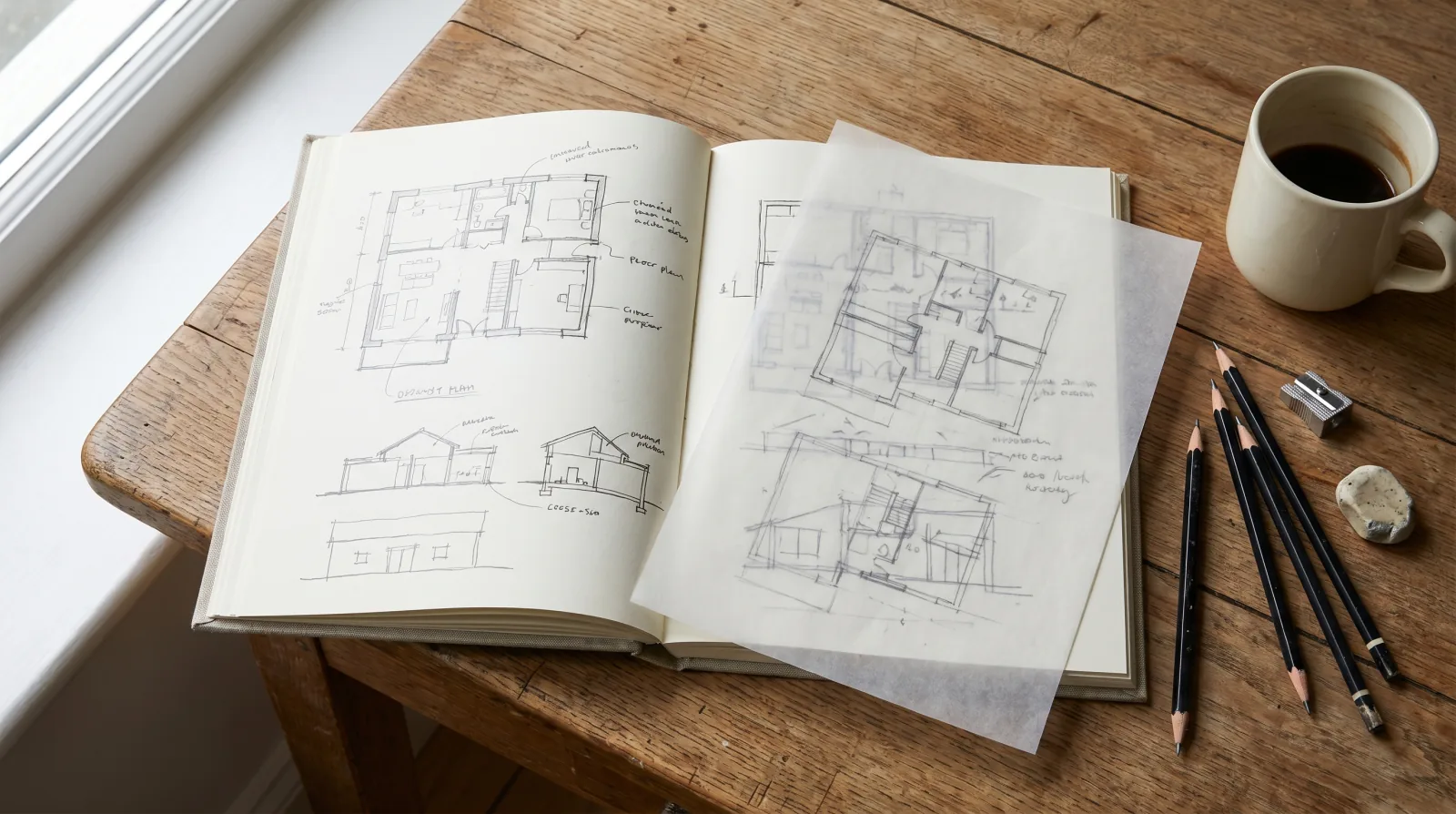

Almost every problem on a custom build traces back to a decision that was rushed or skipped during planning. Here's the checklist we walk every new Burnaby client through before a single line is drawn.
Almost every problem we encounter on a custom build can be traced back to a decision that was rushed or skipped during planning. The work we do in the first eight to twelve weeks is what determines whether the rest of the build feels predictable or like a series of fires.
This is the checklist we walk every new client through before we draw a single line, the same process behind every custom home we build in Burnaby. We work primarily in Burnaby, with regular custom builds in Vancouver, Coquitlam, North Vancouver, Surrey, and across the Fraser Valley, and the front-end planning conversation is the same regardless of municipality. The details that change are the bylaws, the soils, and the permit pipeline.
The eight planning steps, in order:
- Define the brief, then the constraints
- Understand what your specific lot allows
- Articulate how the family actually lives
- Pick the team before locking the design
- Plan the timeline against real life
- Test the long-lead items before locking the schedule
- Engage the City early
- Plan the close-of-build period as carefully as the build itself
Each step is covered in full below.
1. Define the brief, then the constraints
A complete brief covers more than a wish list. It covers the lot, the soft costs, the design fees, the construction itself, the finishes, the landscape, and a real contingency. We have hard conversations about scope in week one because they are far less expensive than the same conversations in month nine.
The same applies to constraints that aren't optional. The 2024 BC Building Code took effect on March 8, 2024 and applies to every new permit application from that date forward. Every new Part 9 home in Burnaby and across the province has to meet at least Step 3 of the BC Energy Step Code and EL-4 of the Zero Carbon Step Code as of January 1, 2025. Those requirements feed back into the brief through wall assemblies, window specifications, ventilation strategy, and mechanical sizing. Designing as if the code doesn't exist is the most expensive shortcut a custom-home owner can take.
2. Understand what your specific lot allows
Zoning, setbacks, height restrictions, easements, tree bylaws, soils, drainage. All of it shapes what you can build before architecture begins. A short feasibility study at the lot stage is one of the highest-leverage decisions a Burnaby custom-home owner can make.
Three lot-specific questions worth answering before design starts:
- Is there a fish-bearing stream within 30 metres? BC's Riparian Areas Protection Regulation requires a Streamside Protection and Enhancement Area between 10 and 30 metres wide on residential development near fish-bearing streams. A Qualified Environmental Professional has to produce an assessment. This applies in pockets of Burnaby (Stoney Creek, Brunette River) and is common in parts of Coquitlam, North Vancouver, and the Fraser Valley.
- What does the tree inventory look like? The Burnaby Tree Bylaw makes any tree with a trunk 20 cm or larger in diameter a Protected Tree on a property under a development application. Other municipalities have similar bylaws with their own thresholds.
- What do the soils tell you? Lower Mainland soil conditions vary widely. Burnaby Mountain slopes carry shallow topsoils over silty sands and gravel. Surrey and parts of South Burnaby have glacial till and clay layers that hold water. Delta is built on deep river sediments and peat. A geotechnical report is the cheapest insurance you'll buy on the entire project.
3. Articulate how the family actually lives
Floor plans tend to come out of magazines. Great homes come out of how a specific family moves through their day. Where do shoes land? Where does the laundry pile up? Which rooms get used at 7am vs 9pm? Bring those answers before bringing Pinterest.
The questions we work through with new clients before any drawings begin:
- Morning rhythm. Coffee where, breakfast where, kids where.
- Evening rhythm. Where does the family decompress? Where do you watch the news, the game, the screen?
- Where the friction lives. The chronic argument with your current home is almost always solvable in a new plan, but only if it's named on day one.
- Storage rhythm. Coats, sports gear, off-season clothing, pantry overflow, mechanical room access. The number of homes we walk into where storage was the last decision instead of the first is staggering.
- Aging plan. Are you building this home for ten years or thirty? Aging-in-place adjustments cost almost nothing during the build.
4. Pick the team before locking the design
Architect, builder, interior designer, structural engineer, energy advisor. All of them have opinions that affect the drawings. Aligning the team early avoids redrawing later, which is the most expensive way to design a home.
The energy advisor in particular is now non-negotiable. Every new Part 9 home in BC has to submit energy modeling produced by a certified Energy Advisor as part of the building permit application. Bringing that modeling in at the schematic-design stage rather than at submission lets the wall assemblies and window specs evolve in dialogue with the architect, instead of getting bolted on at the end as a compliance afterthought.
Two project-level questions worth confirming with your builder before signing anything:
- Are they a CHBA BC Master Residential Builder? The Master Residential Builder designation requires at least 10 years in residential construction (5 of those at management level), an 80% pass on CHBA BC's required courses, and three reference letters from clients, suppliers, or subtrades. It's a meaningful baseline.
- Are they licensed and warrantied? Under BC's Homeowner Protection Act, every residential builder has to be licensed by BC Housing, and every new home has to carry mandatory 2-5-10 home warranty insurance. Two years on materials and labour, five years on the building envelope, ten years on structural defects. That's the floor.
We take pride in everything we create. When you work with Icon, you can be assured you are getting a home that surpasses code requirements, uses the latest building advancements, and is built to last.
Icon Projects Team
5. Plan the timeline against real life
Custom homes typically take 18 to 24 months from sketch to keys. Some come in faster. A handful take longer. Map that against leases, schools, weddings, work travel, anything that touches the people moving in. The schedule should serve the family, not the other way around.
The phase breakdown most owners are unfamiliar with:
- Design (4 to 7 months). Schematic, design development, construction documents. Variance is almost entirely about decision speed.
- Permits (4 to 9 months). The longest single source of timeline variance. Burnaby is now digital-only for permit submissions on or after January 1, 2026. Surrey, Vancouver, and Coquitlam each run their own review timelines, all of which change.
- Pre-construction (4 to 6 weeks). Subtrade tendering, lead-time confirmation, schedule lock, lot staging. Skipping this phase is the most common reason a project starts late.
- Construction (12 to 16 months). Excavation through final walkthrough. The upper end captures finish complexity: millwork, stone, integrated mechanical.
A realistic move-in date includes about three months of buffer. Not because we expect to need it. Because the families who build that buffer in actually enjoy the last eight weeks instead of camping out among unfinished trim.
6. Test the long-lead items before locking the schedule
A 2026 supply chain isn't 2018's supply chain. Triple-glazed windows specified for Step 5-grade performance can run 14 to 20 weeks from order to delivery. Certain natural-stone slabs, specific imported tile, custom millwork in real species, all of these have lead times that compound if the specification gets locked late.
We tender the long-lead items at the start of construction documents, not after permit. The pattern that consistently delivers on schedule is to backsolve the schedule from the longest lead time, not from the move-in date.
7. Engage the City early
Pre-application conversations with municipal planners are underrated. Burnaby's New Home Construction process recommends a Preliminary Plan Approval review before the full building permit application, which surfaces zoning issues, setback questions, and tree-bylaw implications before they become resubmissions. The same pattern applies in Vancouver, Coquitlam, and the Fraser Valley Regional District: every municipality has a pre-application path, and using it costs nothing but time.
8. Plan the close-of-build period as carefully as the build itself
The last six weeks of a custom home are the most exhausting. Trade decongestion, deficiency walks, final inspections, the move itself, the warranty handover, the warranty inspection at year one. Owners who plan this period as deliberately as they plan the build itself land much more comfortably in the finished home.
What we recommend including in the close-of-build plan:
- A realistic move-in date with a three-month buffer baked into the contract dates
- A scheduled deficiency walk at substantial completion, with a written list and target dates for each item
- A clear handover of the BC 2-5-10 home warranty insurance documentation: two years on materials and labour, five on the building envelope, ten on structural elements
- A first-anniversary inspection booked at month eleven (before the materials-and-labour warranty period closes), so any year-one issues are documented and addressed under coverage
- A maintenance manual: who serviced what, what filters need replacing, when the year-five envelope check should happen
The single most useful sentence we say in the first meeting is also the simplest. Don't start the architectural set until the lot, the trees, the soils, the energy targets, and the scope are all on the same page. The hour spent at the planning desk saves weeks at the framing stage. That's true on a Burnaby Heights infill, on a Capitol Hill hillside, on a flat Brentwood lot, and on a Fraser Valley acreage. The municipalities differ. The principle doesn't.
Related on the Journal
- How long a BC custom home actually takes
- 12 questions before signing a builder contract
- Burnaby's 2026 permit timeline
- Custom home FAQ
Frequently asked questions
- What is the first step in planning a custom home in Burnaby?
- The first step is defining the brief and the constraints together: the lot, the soft costs, the design fees, construction, finishes, landscape, and a real contingency, alongside non-negotiables like the 2024 BC Building Code and the BC Energy Step Code. Icon Projects has these scope conversations in week one because they are far less expensive than the same conversations in month nine of a Burnaby custom home build.
- How long does the planning phase of a custom home take?
- Realistic duration for the pre-build planning phase on a competent Burnaby project is three to six months, covering schematic and developed design, structural engineering, mechanical and electrical layout, and package assembly. It can compress to two months with clear owner direction and an experienced design team, or stretch past nine months if the design changes mid-stream.
- Why does a geotechnical report matter before designing a Burnaby custom home?
- Lower Mainland soil conditions vary block to block: Burnaby Mountain slopes carry shallow topsoils over silty sands and gravel, South Burnaby has glacial till and clay layers that hold water, and Delta sits on deep river sediments and peat. A geotechnical report tells the design team what the lot can actually support before drawings are finalized, which is why it is described as the cheapest insurance an owner buys on the whole project.
- What does the Burnaby Tree Bylaw require before building a custom home?
- The Burnaby Tree Bylaw makes any tree with a trunk 20 cm or larger in diameter a Protected Tree on a property under a development application. A tree inventory by a certified arborist has to be part of the pre-application package, and the City's own guidance recommends contacting Burnaby to discuss any trees that may be affected before submitting the Engineering pre-application.
- How long does a custom home take from design to move-in in BC?
- Custom homes typically take 18 to 24 months from sketch to keys, broken into design (4 to 7 months), permits (4 to 9 months), pre-construction (4 to 6 weeks), and construction (12 to 16 months). Icon Projects recommends building about three months of buffer into a realistic move-in date, since families who plan that cushion in enjoy the final weeks instead of living among unfinished trim.
- What should a homeowner confirm about a builder before signing a contract?
- Two project-level questions matter most: whether the builder is a CHBA BC Master Residential Builder, a designation requiring at least 10 years in residential construction with 5 at management level, an 80% pass on required courses, and three reference letters, and whether the builder is licensed under BC's Homeowner Protection Act and carries mandatory 2-5-10 home warranty insurance on every new home.
- Why do long-lead items need to be ordered early in a custom home build?
- Triple-glazed windows specified for Step 5-grade performance can run 14 to 20 weeks from order to delivery, and certain natural-stone slabs, imported tile, and custom millwork carry similarly long lead times. Icon Projects tenders these items at the start of construction documents, not after permit, and backsolves the schedule from the longest lead time rather than from the desired move-in date.
- What happens in the final weeks before moving into a custom home?
- The close-of-build period includes trade decongestion, a scheduled deficiency walk with a written list at substantial completion, handover of the BC 2-5-10 home warranty documentation, a first-anniversary inspection booked at month eleven before the materials-and-labour warranty period closes, and a maintenance manual covering filters and future service needs. Planning this period as deliberately as the build itself makes for a far more comfortable move-in.