On a sloped Burnaby lot, the foundation strategy is locked early in design and ripples through every other decision. Here's how we choose between walkout, full daylight basement, and hillside crawlspace.
The foundation question on a sloped lot in Burnaby is rarely what, it's which. A lot in Capitol Hill, Buckingham Heights, Cariboo Heights, or along Government Road has options that a flat lot in Brentwood doesn't have. The wrong call locks you into expensive concrete you'll never see again. The right call delivers an extra floor of usable living space, a daylight kitchen-out-the-back walkout, or a clean drainage strategy that protects the home for decades.
This is how we choose.
The foundation question on a slope
We start with three numbers: front-to-back grade change, side-to-side grade change, and depth to competent bearing soil. Front-to-back is read off the topographic survey. Side-to-side is read from the same. Bearing depth comes from a geotechnical investigation by an engineer registered with EGBC. On most Burnaby hillside lots, those three numbers point unambiguously to one of three foundation strategies. When they don't, we model two and pick the one with the cleaner waterproofing detail.
The point of doing this in schematic design, not in working drawings, is that everything else hinges on it. Stair locations, basement-floor elevation, lot drainage, retaining-wall integration, parking access, and the relationship between the front entry and the street are all downstream of the foundation choice.
Walkout basement when grade allows
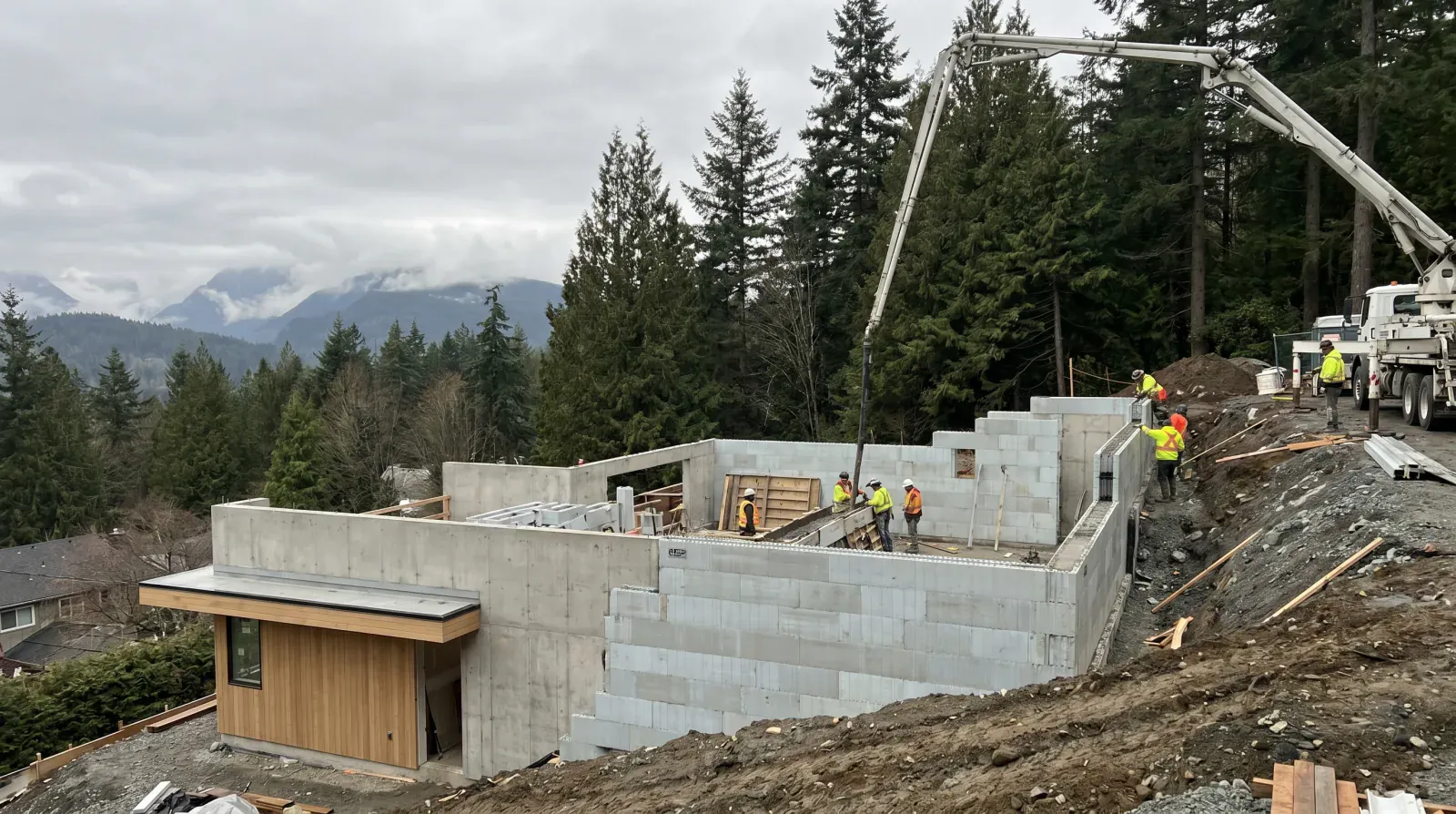
A walkout basement is the prize on a hillside lot. The rear of the basement opens to grade. You get a full storey of natural-light living space below the main floor, often with a covered deck above it, and the home reads as two storeys from the street and three from the back yard.
To make a walkout work, you need at least 2.4 to 2.7 metres of front-to-back grade change across the buildable envelope, and the rear yard has to drain away from the building, not toward it. Soils need to support a foundation wall acting as both structure and retaining element, a mid-rise foundation wall earning its keep on both sides. On softer soils, the wall thickens or gets internal buttressing.
Drainage at the daylight transition is where these projects fail. The zone where the foundation goes from buried to exposed is where surface water concentrates. We detail it with a perimeter drain, a dimpled membrane, a properly graded swale, and, on aggressive sites, an interceptor drain set back from the wall.
The walkout is the most beautiful foundation we build. It's also the one we get out the calculator for first. Done wrong, you get the worst of both worlds: a wall that's neither dry nor square.
Icon Projects Team
Full daylight basement
When the grade change is there but the rear yard can't accept a walkout, for example, a lot with a slope that runs sideways across the lot, not front to back, we'll often build a full daylight basement instead. The basement floor is set deep enough that windows can be sized for habitable rooms (per the egress requirements in Section 9.9 of the BC Building Code, specifically 9.9.10 for bedroom egress windows) but the rear yard remains at the natural grade.
A daylight basement with full-height window wells, well-detailed, properly drained, and architecturally treated, gives almost the same quality of space as a walkout, but with simpler waterproofing. The trade-off is that you don't get the direct grade-level access. For some homeowners that's a feature, not a bug.
Hillside crawlspace
A hillside crawlspace is what you build when the grade change isn't enough for a basement, or when the soils are bad enough that a deep foundation excavation is unjustified. It's also what you build on small lots where every cubic metre of excavation is fighting a setback or a tree-protection zone.
Modern crawlspaces are not the damp afterthoughts of the 1970s. A current-code Burnaby crawlspace is conditioned space, fully sealed, insulated below the slab and at the perimeter, with a vapour barrier and mechanical ventilation. It's clean, dry, and walkable. Our preference, when a crawlspace is the right answer, is to make it tall enough, 1.4 to 1.8 metres clear, that future trades have a real shot at servicing the home.
Helical piles and engineered footings
When the geotechnical report comes back saying competent bearing is six metres down, traditional spread footings are not viable. The choices become helical piles, driven steel piles, or a deep concrete pile with an engineered grade beam on top.
Helical piles are screwed into the ground until torque-tested capacity is achieved (most installations are designed per the manufacturer's CCMC evaluation, with field torque-correlation to the geotech's specified ultimate capacity). They install in a day or two, displace little soil, and produce minimal vibration, useful when neighbours are close. Driven piles are more aggressive but appropriate where the soil profile demands them.
The presence of helical piles changes the underside of the home. You typically lose the basement entirely (the home sits on a grade beam over piles) and gain a vented or unvented crawlspace. The geotech, structural engineer, and architect need to be in one room when the pile recommendation lands; left to communicate by email, the design ends up with a foundation no one's happy with.
Drainage and weeping tile
On a slope, water is the enemy. Every Burnaby hillside foundation we build gets:
- A perimeter drain at the footing, dimpled membrane and filter fabric on the wet side
- A clear-stone backfill against the foundation wall
- A separate roof-drain leader system that does not share the perimeter drain
- A swale or surface contour that moves water around the building, not under it
- Where slopes are steep, an interceptor drain uphill of the home
This is not exotic. It's Section 9.14 of the BC Building Code, executed without shortcuts. The shortcuts are how leaks happen.
The retaining-wall integration
Hillside foundations almost always integrate with retaining walls, sometimes a freestanding wall above the home, sometimes a wall that is the rear of the foundation. Engineered retaining walls above a metre in exposed height are designed by the structural engineer, not improvised by the framer. The wall's drainage, surcharge load, and freeze-thaw protection all matter.
We've taken over more than one project where a previous builder built a retaining wall as a finish detail. They never end well. A retaining wall is structure.
Seismic loading and hillside foundations
BC sits in one of Canada's most seismically active regions. On a hillside, the combination of gravity load and potential seismic lateral force shapes the foundation design in ways that flat-lot construction doesn't have to address.
The structural engineer calculates the seismic demand from the 2024 BC Building Code's seismic hazard values for the specific site (the values are produced by Natural Resources Canada's National Seismic Hazard Model and incorporated into the BCBC's Climatic and Seismic Data appendix), and then designs the foundation to transfer that lateral demand into the soil. On a hillside, where the foundation itself may be acting as a retaining structure, this gets complex: the wall has to resist lateral earth pressure from the soil AND lateral seismic demand from the building above, simultaneously.
In practice, this is a solved engineering problem, but it produces designs that look different from what you'd see on a flat lot. More rebar. Thicker walls. Grade beams with more depth. It's not a reason to avoid a hillside lot; it's a reason to have the structural engineer involved from the day the foundation concept is chosen.
One specific hillside scenario that catches people off guard: shallow-bedrock sites in parts of Capitol Hill and Burnaby Heights where the soil is only 0.8 to 1.5 metres deep before you hit rock. Shallow bedrock creates a foundation dilemma, the spread footings are good (rock bearing is as good as it gets), but excavating through rock is expensive and disruptive. Blasting is rarely possible near existing homes; hydraulic hammering takes time and generates vibration complaints. Your cost model needs to include a rock contingency if the geotech finds it.
Why this matters at the design table
The cost difference between foundation strategies on a hillside lot is real, but the more important difference is what each strategy unlocks: a walkout adds a floor of premium living space; a full daylight basement adds light without the patio; a crawlspace keeps the project simple and the lot light; helical piles preserve a difficult site that traditional foundations would have rejected.
We see Burnaby clients in Capitol Hill and Buckingham Heights, North Vancouver clients on the District's slopes, and West Vancouver clients perched above the inlet make this call differently every time. The right answer is the one the lot, the family, and the architecture are all telling you.
If you're early in design on a sloped lot and the foundation strategy hasn't been locked yet, start a conversation with us. For the broader picture of building on a Burnaby hillside, our piece on Capitol Hill and Burnaby Heights hillside custom homes covers the neighbourhood-level considerations, and the planning checklist is a good companion before the architect starts drawing.
Related on the Journal
- Geotechnical reports on Burnaby slope lots
- Walking a Burnaby teardown lot before subjects come off
- Hillside Custom Homes guide, foundations, drainage, retaining walls
Frequently asked questions
- How much grade change does a lot need to support a walkout basement in Burnaby?
- At least 2.4 to 2.7 metres of front-to-back grade change across the buildable envelope, with the rear yard draining away from the building rather than toward it. A walkout basement opens the rear of the lower level to grade, giving a full storey of natural-light living space below the main floor and making the home read as two storeys from the street and three from the back yard. Soils also need to support a foundation wall acting as both structure and retaining element.
- What is a full daylight basement, and when is it used instead of a walkout?
- A full daylight basement is used when the grade change exists but the rear yard can't accept a walkout, for example on a lot that slopes sideways rather than front to back. The basement floor sits deep enough that windows can be sized for habitable rooms under the BC Building Code's egress requirements, while the rear yard stays at natural grade. It gives nearly the same quality of space as a walkout with simpler waterproofing, though without direct grade-level access.
- When does a hillside lot in Burnaby need a crawlspace instead of a basement?
- When the grade change isn't enough for a basement, when soils are poor enough that a deep foundation excavation isn't justified, or on small lots where excavation conflicts with a setback or tree-protection zone. A current-code Burnaby crawlspace is conditioned, fully sealed, insulated below the slab and at the perimeter, with a vapour barrier and mechanical ventilation, and is ideally built 1.4 to 1.8 metres clear so future trades can service the home.
- When are helical piles used instead of a standard foundation on a Burnaby hillside lot?
- When the geotechnical report finds competent bearing soil six metres or more below grade, making traditional spread footings unviable. Helical piles are screwed into the ground until a torque-tested capacity is reached, install in a day or two, and produce minimal soil displacement and vibration, which matters when neighbours are close. A home on helical piles typically loses the basement and gains a vented or unvented crawlspace on a grade beam over the piles.
- What drainage does a hillside foundation in Burnaby need?
- A perimeter drain at the footing with dimpled membrane and filter fabric on the wet side, clear-stone backfill against the foundation wall, a separate roof-drain leader system, and a swale or surface contour that moves water around the building rather than under it. Steep slopes also get an interceptor drain uphill of the home. This follows Section 9.14 of the BC Building Code, and the daylight transition, where the wall goes from buried to exposed, is where drainage failures concentrate if the detailing is shortcut.
- Do retaining walls on a Burnaby hillside lot need to be engineered?
- Yes, whenever they integrate with the foundation or exceed a modest exposed height. Engineered retaining walls above about a metre in exposed height are designed by a structural engineer, not improvised by the framer, because the wall's drainage, surcharge load, and freeze-thaw protection all affect whether it stays standing. A retaining wall treated as a finish detail rather than structure is a common failure the team has taken over more than once.
- How does BC's seismic risk affect a hillside foundation design?
- On a hillside, the foundation often acts as both a retaining structure and a load-bearing wall, so it has to resist lateral earth pressure from the soil and lateral seismic demand from the building above at the same time. A structural engineer calculates the seismic demand from the BC Building Code's seismic hazard values for the specific site and designs the foundation accordingly, which typically results in more rebar, thicker walls, and deeper grade beams than a flat-lot foundation would need.
- What is the shallow-bedrock problem in parts of Capitol Hill and Burnaby Heights?
- Some sites in these neighbourhoods have soil only 0.8 to 1.5 metres deep before hitting rock. Rock bearing capacity is excellent for spread footings, but excavating through rock is slow and expensive, and blasting near existing homes is rarely possible, leaving hydraulic hammering as the practical option, which takes time and can generate vibration complaints. Any cost model for a lot in these areas should include a rock excavation contingency if the geotechnical report finds shallow bedrock.