Frame material, glazing package, low-E coating, install detail. Four decisions that determine whether your windows are still tight twenty years from now or fogging in their first wet season.
In a wet, mild, cloud-covered climate like Burnaby's, windows are working all year. Holding heat in November, rejecting solar gain in July, surviving 200 days of horizontal rain, and, more than any other component, driving how the home actually feels to live in. They're also the single most error-prone building product in residential construction. Get the window right and the home performs for thirty years. Get it wrong and you're chasing condensation and moisture damage from year three.
I've taken over more than one Burnaby project where every single window had been installed without a sill pan. Beautiful units, expensive units, wrong install. The only honest fix was removing and reinstalling every one of them. That's the hard lesson with glazing on the wet coast: the product can be excellent and the install can ruin it. A window that performs in Calgary's dry cold can leak miserably through Burnaby's wet winter.
Here's how I think through the four decisions, frame, glazing, low-E, install, that decide whether your windows are still tight in twenty years.
Why windows matter most on the west coast
The BC south coast climate is mild, but it's relentlessly wet. The wind-driven rain test that windows used to fail in this region was developed because of how Vancouver and Burnaby weather actually behave: not extreme on any one variable, but unforgiving in combination.
Windows also carry a disproportionate share of a home's energy performance. In a Step 3 + EL-4 envelope, Burnaby's current code, windows are typically a tenth of the surface area but a third of the heat loss. Moving from a mid-tier window to a high-tier window has more energy impact than a dozen other decisions on the same project. The math only gets sharper as Burnaby and the province step toward Step 5 by 2032.
The BC Energy Step Code doesn't prescribe specific windows. But the performance modelling at Step 3 + EL-4 favours triple-pane glazing and high-performance frames for most rooms, and Step 5 effectively requires them.
Frame materials, ranked the way I actually spec them
Four frame materials cover almost every Burnaby custom home I work on:
- Fiberglass. Dimensionally stable, durable, paintable. Fiberglass expands and contracts with temperature at roughly the same rate as the glass, meaning the seal between frame and glass stays intact through thermal cycling. My default for high-performance custom homes on the BC south coast.
- Aluminum-clad wood. Wood interior, aluminum exterior. Beautiful inside, weatherproof outside. Higher cost than fiberglass but the aesthetic is hard to beat. Common in higher-end Vancouver and West Vancouver work.
- Thermally broken aluminum. All-aluminum frame with an insulating bridge between interior and exterior. Used for large openings, patio doors, lift-and-slide systems, where the structural span demands metal. Lower thermal performance than fiberglass for the same nominal profile.
- Vinyl. The most common residential frame in BC. Inexpensive, low-maintenance, and adequate for many applications, but with two real limitations: dimensional movement with temperature (which cycles the seal between glass and frame), and limited large-opening structural capacity. I'll use vinyl in some applications. I won't use it for everything.
The frame material decision is mostly about durability and aesthetic. The energy performance comes from the glazing package.
The glazing package, U, SHGC, VT
Three numbers describe a glazing package, and they're usually printed on the NFRC label on the window when it ships:
- U-factor. How well the window resists heat loss. Lower is better. A high-performance triple-pane unit will be in the U-0.18 to U-0.22 range. Code-minimum is U-0.30 or higher.
- Solar Heat Gain Coefficient (SHGC). How much solar energy the window admits. Higher is better in winter (free heat); lower is better in summer (less cooling load). On the BC south coast, mild summers, gray winters, an SHGC in the 0.35 to 0.45 range is usually right.
- Visible Transmittance (VT). How much daylight gets through. Higher is better for daylighting; the trade-off is that high-VT, low-SHGC coatings are more expensive.
The combination is what matters. A low U-factor with a low SHGC produces a tightly insulated, dim window, fine for a north-facing bedroom, wrong for a south-facing kitchen. On the Modern Farmhouse build in West Abbotsford, the energy advisor and I went room by room and specified glazing per orientation, not one number for the whole house. That's how you end up with a kitchen that's bright on a December afternoon and a bedroom that doesn't bleed heat overnight. Energy Star Most Efficient ratings are a useful filter for the high-performance end of the catalogue.
Low-E coatings for the west coast
Low-emissivity (low-E) coatings are microscopic metallic layers on the glass that reflect long-wave heat. They're standard on every modern window. The variable is which low-E.
For the BC south coast I generally spec a low-E that prioritises heat retention over solar rejection. Our cooling load is small. Our heating season is long. A coating that traps heat in winter outweighs the modest summer benefit of more aggressive solar rejection. South- and west-facing rooms with real summer overheating exposure can justify a different coating, but I usually treat those rooms with exterior shading or deep overhangs rather than reaching for an aggressive low-E.
The biggest mistake I see on west-coast custom homes is applying southern-California glazing logic to a Vancouver climate. We don't have a cooling problem here. We have a daylight problem. The right window admits light without bleeding heat.
Icon Projects Team
Installation detail, where windows quietly fail
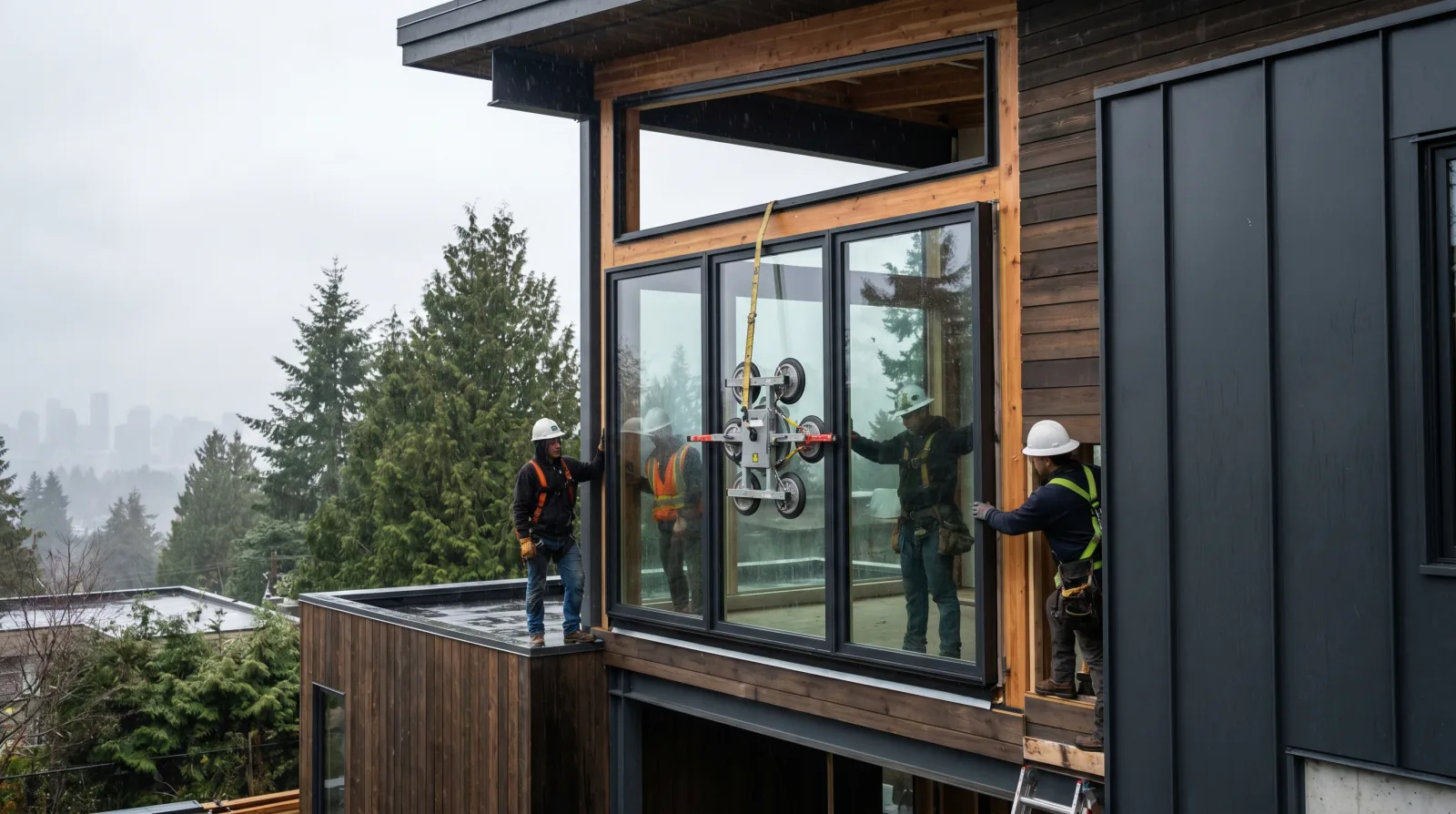
The product can be excellent. The install can ruin it. These are the details I won't compromise on:
- Sill pan. A waterproof tray under the window that drains any water that gets past the seal back to the exterior. Mandatory in best practice; missing in too many homes I've inherited. I use either a self-adhered membrane or a manufactured sill pan. Never a strip of caulking.
- Weather-resistive barrier (WRB) integration. The wall's WRB has to lap correctly with the window flanges, top flange behind, side and bottom in front. Reverse the lap and water gets driven inward, not out.
- Air sealing on the interior side. Backer rod and sealant, or a low-expansion foam, between the frame and the rough opening, full perimeter. This is the airtight seal that the Step Code blower-door test measures.
- Drainage to the exterior. The cavity between the frame and the rough opening has to drain outward. Stuffing it solid with foam without a drainage path is a slow leak waiting to happen.
- Flashing. Head flashing extends past the side trim, kicks water out, and is taped at the top into the WRB.
There's no shortcut here. The sill-pan project I mentioned at the top cost the owners and the original builder more in rework than the original window spec did. Get the install right the first time and the windows will outlive the mortgage.
Choosing a manufacturer
The right manufacturer for a Burnaby custom home has a track record on the BC south coast, accessible technical support when an installer hits an unusual condition, and a service network if a unit needs warranty work in year eight. I work regularly with a handful of BC-based manufacturers, Cascadia Windows, Innotech Windows + Doors, Westeck Windows + Doors, all with BC-based manufacturing, and with reputable U.S. and European brands depending on the project.
Lead times are real and seasonal. High-performance windows in 2026 are typically running ten to sixteen weeks from order to delivery. I confirm the schedule with the manufacturer at pre-construction so the framing crew isn't standing around a hole in the wall.
How window performance gets verified at Step Code compliance
On a Step 3 + EL-4 home in Burnaby, and even more so on the Step 5 homes we and some other builders deliver voluntarily, window performance isn't self-reported. The certified Energy Advisor runs a blower-door test at the end of construction to verify the whole-envelope airtightness target: 2.5 ACH50 at Step 3, 1.0 ACH50 at Step 5. Poor window installation is one of the most common reasons first blower-door tests come back high, the air leaks at the rough-opening perimeter find the tester faster than they find the homeowner.
The energy model submitted at permit specifies assumed U-factors, SHGCs and window-to-wall ratios for the building. If the products actually installed differ from what was modelled, which is what happens when the architect specs one product and a contractor substitutes a cheaper alternative, the energy advisor can require a remodel or, in some cases, reject the compliance file.
That's why I lock the window specification before permit, confirm manufacturer lead times at pre-construction, and verify the NFRC labels against the spec when the units land on site. Sounds like project-management overhead. It's actually the thing that prevents an envelope you paid serious money to design from failing compliance on the last day of construction.
A short selection checklist
When you sit down with the architect to specify windows, the questions worth answering for every opening:
- Frame material, what's the right call for this opening?
- Triple pane or double pane, does the energy model require triple here?
- U-factor target, what does the model require?
- SHGC target, does this orientation want gain or rejection?
- Operable or fixed, and if operable, awning, casement, slider, hopper?
- Egress requirement, is this a bedroom or a basement habitable room? (Section 9.9.10 of the BC Building Code defines minimum egress dimensions.)
- Manufacturer and lead time, can the schedule absorb the order?
This is also the moment to look at the doors, patio doors, entry doors, garage doors. They follow most of the same logic. The patio door in particular is often the largest window in the house.
For how envelope decisions stack at Burnaby's current Step 3 + EL-4, and at Step 5, our companion piece on the BC Energy Step Code in Burnaby covers the broader thermal envelope. For the long-term durability conversation, why we don't believe in builder-grade and materials that age beautifully cover what survives a wet coast and what doesn't.
If you're at the moment where window selection is on the table for a Burnaby, Vancouver or North Vancouver custom home, send me the schedule. I'll walk through the manufacturer options, the install detail for your specific climate exposure, and where the spec is going to land at Step Code compliance.
Related on the Journal
- BC Energy Step Code 5 reality
- Heat pumps and HRV integration
- Materials that age beautifully
- Triple vs double glazed windows in BC
Frequently asked questions
- Why do windows matter more in Burnaby than in a drier climate?
- In a Step 3 + EL-4 envelope, Burnaby's current code, windows are typically a tenth of a home's surface area but a third of its heat loss, so moving from a mid-tier to a high-tier window has more energy impact than most other single decisions on the project. Windows also have to survive roughly 200 days of horizontal, wind-driven rain a year, a demand a dry-climate window was never designed for.
- What frame material performs best for a Burnaby custom home?
- Fiberglass is the default for high-performance custom homes on the BC south coast because it expands and contracts with temperature at roughly the same rate as glass, keeping the seal between frame and glass intact through thermal cycling. Aluminum-clad wood offers a similar performance with a different aesthetic at a higher cost, thermally broken aluminum suits large openings, and vinyl works for some applications but has real dimensional-movement and structural limits.
- What do U-factor, SHGC, and VT mean when choosing windows?
- U-factor measures how well a window resists heat loss, with lower being better; a high-performance triple-pane unit runs U-0.18 to U-0.22 against a code-minimum of U-0.30 or higher. Solar Heat Gain Coefficient measures how much solar energy the window admits, and Visible Transmittance measures how much daylight passes through. All three appear on the window's NFRC label and should be specified per room orientation, not as one number for the whole house.
- Should a Burnaby home use a low-E coating that blocks heat or retains it?
- For most of the BC south coast, a low-E coating that prioritizes heat retention over solar rejection is the better choice, because the region's cooling load is small and its heating season is long. South- and west-facing rooms with genuine summer overheating exposure are usually better addressed with exterior shading or deep overhangs than with an aggressive solar-rejecting low-E coating.
- What is a sill pan and why does it matter for window installation?
- A sill pan is a waterproof tray installed under a window that drains any water getting past the seal back to the exterior, using a self-adhered membrane or a manufactured pan, never a strip of caulking. Icon Projects has taken over a Burnaby project where every window was installed without one, and the only honest fix was removing and reinstalling every unit, underscoring why this detail is treated as mandatory.
- How long do high-performance windows take to order in 2026?
- High-performance windows are typically running ten to sixteen weeks from order to delivery in 2026. Icon Projects confirms the schedule with the manufacturer at pre-construction so the framing crew is not left standing around an open rough opening waiting on delivery.
- How does window installation affect a home's blower-door test result?
- Poor window installation is one of the most common reasons a first blower-door test comes back higher than expected, because air leaks at the rough-opening perimeter are exactly what the test is designed to find. A Step 3 home in Burnaby needs to hit 2.5 ACH50 or better, and a Step 5 home needs 1.0 ACH50, targets that depend heavily on correct sill pan, WRB lap, air sealing, and flashing details around every window.
- What happens if installed windows do not match what was submitted in the energy model?
- The energy model submitted at permit specifies assumed U-factors, SHGCs, and window-to-wall ratios for the whole building. If a contractor substitutes a cheaper product than what the architect specified, the energy advisor can require a remodel of the compliance file or, in some cases, reject it outright, which is why Icon Projects verifies NFRC labels against the spec when units land on site.