Most Burnaby owners only learn about the tree bylaw the day a notice arrives in the mail. Here's how the 20 cm rule, the replacement requirements, and the cash-in-lieu option actually shape a custom-home design.
The single most common surprise on a Burnaby custom-home project isn't the soils, the slope, or the permit timeline. It's the trees. We've sat across from owners who bought a Burnaby Heights lot expecting to clear it for a fresh build, only to learn that two-thirds of the mature trees on the property are protected under municipal bylaw and have to either stay, be replaced one-for-one, or trigger a payment to the City for every tree that comes down. That conversation is much easier to have at the lot tour than at the design-review meeting.
This piece is what we tell every new Burnaby custom-home client about the tree bylaw before a single design line gets drawn. We work primarily in Burnaby, with regular projects in Vancouver, Coquitlam, North Vancouver, and out into the Fraser Valley, and Burnaby's tree rules are the strictest of the bunch in ways that surprise people.
What "Protected Tree" actually means in Burnaby
Under the Burnaby Tree Bylaw, a tree's protected status depends on two things: the diameter of the trunk and whether the property is the subject of a development application.
For a property under a development application, which means any custom-home build, any teardown-rebuild, any major renovation requiring a building permit, a Protected Tree is any tree with a trunk diameter of 20 cm (8 inches) or larger. That threshold is much lower than most owners assume. A 20 cm trunk is roughly the size of a healthy fifteen-year-old conifer. On a typical central Burnaby lot, that captures almost every mature tree on the property and most of what sits on the property line.
For properties not under a development application, meaning a homeowner who wants to remove a tree from their existing yard without otherwise touching the building, the threshold is higher. Coniferous trees become protected at 30 cm diameter, and deciduous trees at 45 cm. The intent of the lower 20 cm rule for development sites is to make sure the building permit process actively considers tree retention rather than letting a project clear the lot first and design later.
Why the threshold matters at design
Once you understand that a 20 cm tree is protected, the implications cascade through the design. We've seen owners walk a lot with the assumption that the south edge will be where the principal living space goes, only to discover that a row of three Douglas firs on that edge, each 25 to 35 cm in diameter, would have to be designated for retention or replacement. Suddenly the building footprint is shifted thirty feet north, the relationship to the view changes, and the entire massing of the house has to be reworked.
The owners who avoid this surprise are the ones who do a tree inventory as part of the lot tour, before the design brief is locked. We treat the tree inventory the same way we treat the soils report: a non-negotiable upfront input, not an afterthought.
How the bylaw works inside the permit process
A useful piece of detail. According to the City of Burnaby New Home Construction page, you don't apply for a tree-cutting permit separately. The tree permit is auto-generated as part of the building permit application. The implication is straightforward: the City reviews your tree plan in tandem with your architectural and structural set, and any protected trees you propose to remove have to be justified in writing as part of the same package.
Three things the tree-cutting plan needs to show:
- An inventory of every protected tree on the lot, with its species, location, trunk diameter, and condition assessment from a qualified arborist
- The intended status for each tree: retain (with protection during construction), remove (with replacement plan), or relocate (rare but sometimes possible)
- A replacement plan showing the species, size, and location of every replacement tree that satisfies the bylaw's replacement count
Skip any of those and you can submit, but the City will hold the file until it's complete. On a digital intake, which Burnaby fully transitioned to in 2026, that hold is visible on day one.
The replacement requirement is more demanding than people expect
When a protected tree has to come down, it must be replaced. The Burnaby Tree Bylaw is specific about what counts as an acceptable replacement, and the size requirements are larger than the saplings most people picture.
According to City of Burnaby guidance and the Tree Removal & Replacement page:
- Replacement coniferous trees (Douglas fir, hinoki cypress, spruce, and similar species) must be a minimum of 2 metres tall at planting
- Replacement deciduous trees (redbud, dogwood, snowbell, maple, magnolia) must have a minimum trunk diameter of 5 cm at planting
- The number of replacement trees required scales with the size of the protected tree being removed; larger trees demand more replacements
Two metres is a real tree. It's the size of a small specimen tree from a quality nursery, not a one-gallon sapling from a big-box retailer. The cost-per-replacement number we plan around is meaningful, and on lots where five or more protected trees are coming down, the replacement count alone can dictate where on the lot the landscape budget gets concentrated.
The cash-in-lieu option
Sometimes a lot just doesn't have room for the required replacement count. Smaller infill lots in Edmonds or Highgate, lots with tight grade or set-back constraints, lots where the building footprint plus the driveway plus the side yards leaves no plantable area large enough for the required replacements. In those cases, the City accepts a cash-in-lieu payment in place of on-site planting.
Cash-in-lieu sounds like a clean exit, but it isn't always the cheaper option. Two reasons:
- The per-tree cash-in-lieu amount is set by the City and is intended to fund tree planting elsewhere in the municipality at full retail cost, including labour. It is not a discount.
- Once you opt for cash-in-lieu, you've also lost the trees themselves. On lots where the existing tree canopy was part of the appeal, and most central Burnaby lots are bought in part because of the trees, the lot post-construction reads differently than the lot you fell in love with.
We almost always advise clients to design with the trees, not around them, if the lot allows. The math frequently lands in favour of retention even when retention complicates the floorplate.
Tree protection during construction is a real construction discipline
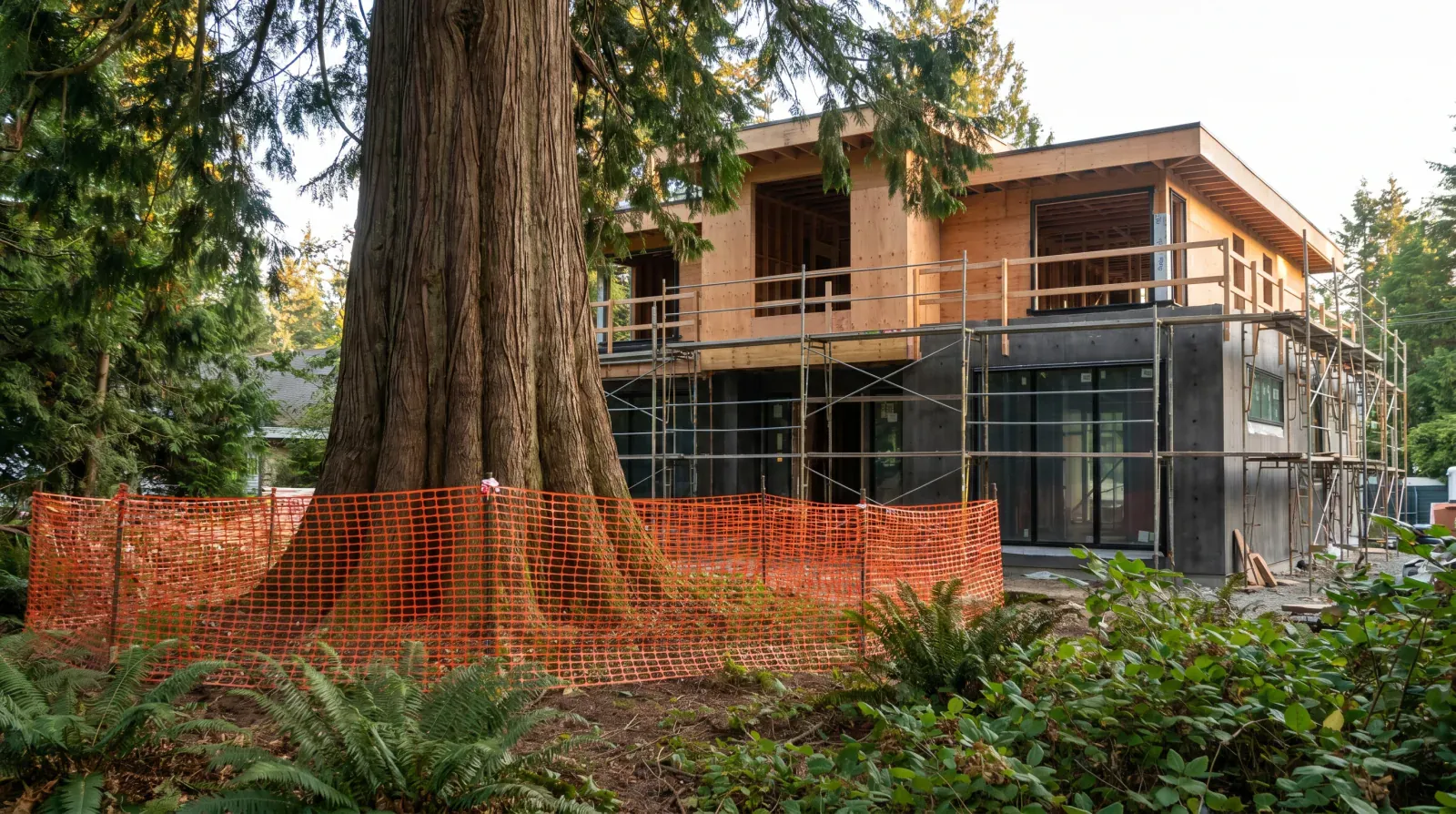
Once a tree is designated for retention, the work to protect it during construction is not symbolic. The standard practice is a fenced tree-protection zone extending out to the drip line of the canopy, the radius from the trunk where the canopy ends, with no excavation, no equipment, no material storage, and no soil compaction inside the fence for the duration of the build.
Three failure modes we've seen:
- Mechanical damage to the trunk or buttress roots from a backhoe that gets too close. Once the bark layer is breached the tree is on a clock.
- Soil compaction inside the drip line from lumber stacks, gravel deliveries, or a temporary parking spot for the framer's truck. Compaction kills the fine root hairs that the tree relies on for water uptake. It can take three to five years for the tree to die from this, and by then it's the new owners' problem.
- Grade changes around the trunk. Even six inches of fill or cut inside the drip line can compromise root health. Burnaby's hillside neighbourhoods, Capitol Hill, Burnaby Heights, Forest Glen, are particularly prone to this because grade changes are part of every site plan.
The tree-protection plan is part of the building permit package, and the inspectors check it.
Half the time we save a Burnaby owner from a tree-bylaw fight, the saving happens at the lot tour. We point at three trees, say "those stay," and the design starts with that as a constraint rather than a complication.
Icon Projects Team
What this means at the brief stage
For a custom-home owner buying a Burnaby lot, the practical takeaways are short:
- Get a tree inventory done before you firm up the design brief. A qualified arborist can produce one in a single site visit, and it tells you which trees are likely to retain, which are likely to remove, and what the replacement implications are.
- Walk the lot with a builder, not just an architect. Builders see the structural and grading implications of working around mature trees. Architects see space.
- Treat the tree plan as part of the same package as the geotechnical report and the survey. A complete pre-design package gives you a much more accurate cost and timeline read.
- Ask early whether cash-in-lieu makes sense. Sometimes it does, small infill lots where retention isn't realistic are the clearest case, but it's a decision worth pricing both ways.
A note on adjacent municipalities
Burnaby's tree bylaw is among the strictest in Greater Vancouver, but it's not unique. Vancouver, Coquitlam, North Vancouver, and West Vancouver all have municipal tree bylaws with development-stage protections, each with its own thresholds and replacement formulas. If you're considering a custom build in any of them, the same upfront process applies: inventory first, design around retention where possible, plan replacements properly, and get the tree plan into the building permit application as part of a clean digital submission.
In Burnaby, the rule that catches most owners is the 20 cm threshold. Once you know that number, the rest of the bylaw stops being a surprise and starts being a design constraint, which is what it was designed to be.
Frequently asked questions
- What is a Protected Tree in Burnaby?
- Under the Burnaby Tree Bylaw, any tree with a trunk diameter of 20 cm (8 inches) or larger becomes a Protected Tree once a property is under a development application, which includes any custom home build or major renovation requiring a building permit. Icon Projects recommends a certified arborist inventory before design begins, since the 20 cm threshold captures most mature trees on a typical Burnaby lot.
- What are the replacement requirements when a protected tree is removed in Burnaby?
- Every protected tree removed under a Burnaby development application must be replaced. Replacement coniferous trees must be a minimum of 2 metres tall at planting. Replacement deciduous trees must have a minimum trunk diameter of 5 cm. The replacement count scales with the size of the removed tree. Cash-in-lieu payment to the City is accepted when the lot cannot accommodate the required replacements on site.
- What is the cash-in-lieu option for Burnaby tree replacement?
- Cash-in-lieu allows a property owner to pay the City instead of planting replacement trees on site. The amount is set by the City at full retail cost for planting elsewhere in the municipality, it is not a discount. Icon Projects evaluates cash-in-lieu for tight infill lots where there is no realistic planting area, but recommends retention-first design whenever the lot allows it.
- How does the Burnaby tree bylaw affect a custom home footprint?
- Protected trees must either be retained with a construction-phase protection zone (fenced to the drip line, no excavation or soil disturbance inside), replaced per the bylaw's size requirements, or trigger a cash-in-lieu payment. On lots with several protected trees, the tree plan can shift the building footprint. Icon Projects includes a tree inventory review at the lot tour stage, before design begins.
- What is the protected-tree threshold on a Burnaby lot that is not under a development application?
- For a Burnaby property that is not the subject of a development application, meaning a homeowner removing a tree from an existing yard without touching the building, the protected threshold is higher than for a development site: coniferous trees become protected at 30 cm trunk diameter and deciduous trees at 45 cm. Once the same property applies for a building permit, the lower 20 cm threshold takes over, which is why the rule catches so many owners at the start of a custom home project.
- How does the tree-cutting permit fit into a Burnaby building permit application?
- In Burnaby, a tree-cutting permit is not a separate application. According to the City of Burnaby's New Home Construction page, the tree permit is auto-generated as part of the building permit application, so the City reviews the tree plan alongside the architectural and structural drawings in the same package. Any protected tree proposed for removal has to be justified in writing within that same submission.
- What does a Burnaby tree-cutting plan need to include?
- A Burnaby tree-cutting plan needs three things: an inventory of every protected tree on the lot with its species, location, trunk diameter, and a condition assessment from a qualified arborist; the intended status for each tree, whether it will be retained, removed and replaced, or relocated; and a replacement plan showing the species, size, and location of every replacement tree required under the bylaw. If any part is missing, the City holds the file until it is complete.
- What construction-phase protection does a retained tree need on a Burnaby lot?
- A tree designated for retention on a Burnaby build needs a fenced tree-protection zone extending to the drip line of its canopy, with no excavation, equipment, material storage, or soil compaction allowed inside that fence for the whole build. Mechanical damage from equipment, soil compaction from stacked materials, and grade changes inside the drip line are the three failure modes that most often kill a retained tree years after construction, and Burnaby's building inspectors check the protection plan as part of the permit package.