
Fraser Valley · Builder's Edition
Building in Abbotsford, by the builder whose home market it is.
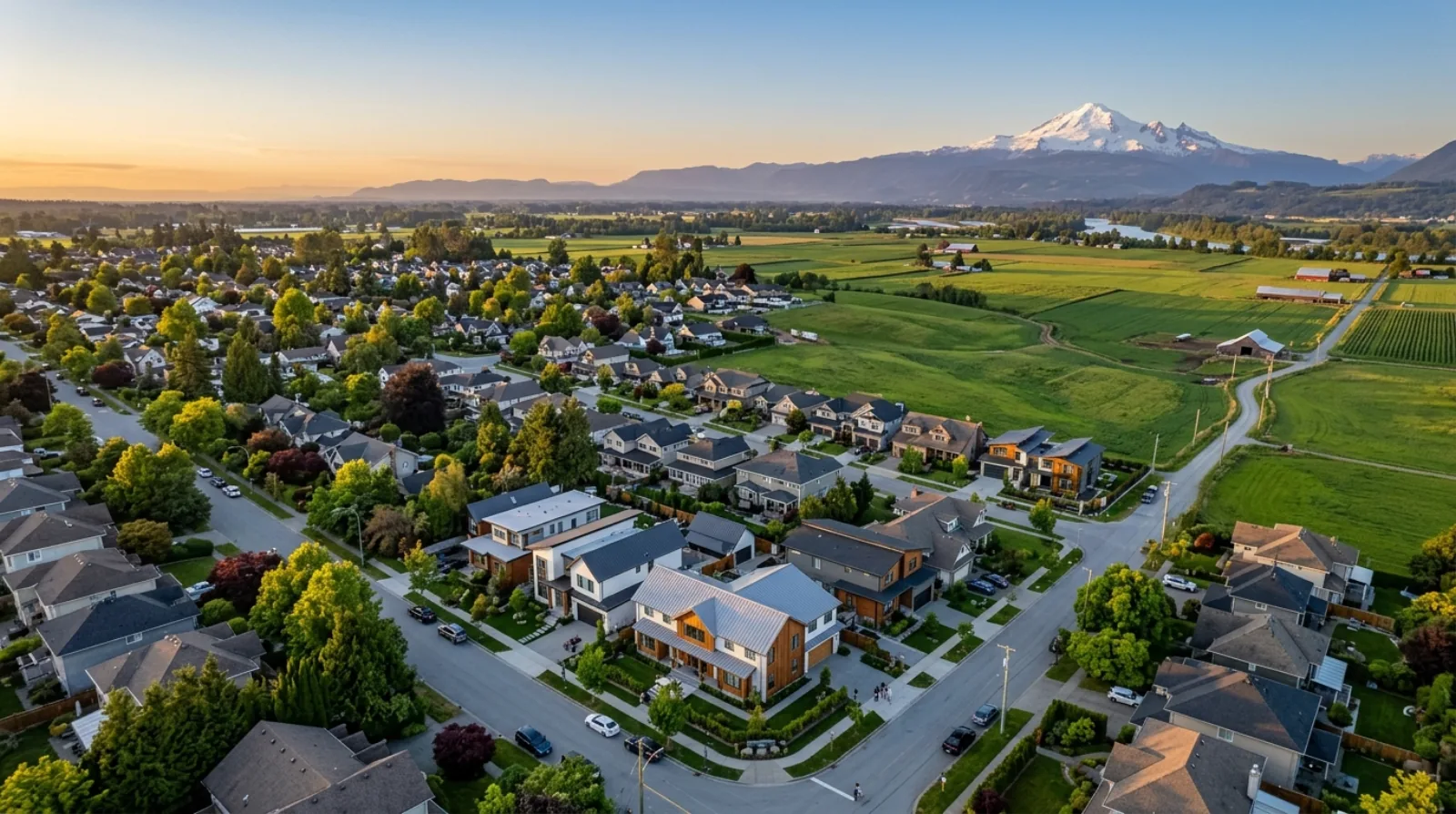
Abbotsford builds nothing like Burnaby. The lots are larger, the soils change block to block, and the regulatory weight lives in riparian setbacks, the Agricultural Land Reserve and the Sumas Prairie floodplain, not a strict urban tree bylaw. And after the December 2025 zoning rewrite, most single-family lots now allow up to four homes. This is our working read on how a custom home, multiplex or rowhome actually gets built here.
Last updated 2026-06-22 · Refreshed each time we permit a new Abbotsford build.
Homes per lot
Up to 4
Most single-family lots under 4,050 m², under Abbotsford's December 2025 zoning. The six-unit transit bonus doesn't apply here yet.
Energy requirement
Step 3 + EL-1
BC Energy Step Code Step 3 plus Zero Carbon EL-1, lighter carbon than Burnaby's EL-4, but the envelope still locks at design.
Flood construction level
Up to 10.9 m
Post-2021 floodproofing elevation across the Sumas Prairie floodplain. The first number to pull on a prairie-adjacent lot.
What this guide is
This is a working builder's guide to residential construction in Abbotsford and the wider Fraser Valley. Abbotsford is our home market, we've built custom homes here, a contemporary new build, and now fee-simple rowhomes at Trio on McCallum. Most of what's here came out of those builds, not a code book.
It isn't a replacement for site-specific engineering or legal advice. Every Abbotsford lot has its own soils, its own water, and its own regulatory overlay. What this guide does is help you ask the right questions before you write an offer, before you commit to a design, and before the city opens your file.
The four questions every Abbotsford lot has to answer
Greater Vancouver lots come back to setbacks, trees and slope. Abbotsford lots come back to a different four. Answer them in this order and the design follows.
1. What does the zoning now allow?
On December 16, 2025, Abbotsford adopted a new Official Community Plan and a rewritten zoning bylaw aligning the city with the province's Small-Scale Multi-Unit Housing rules. Most single-family lots under 4,050 m² now allow up to four homes. We work through what that means for a single lot, and why four, not six, is the realistic ceiling today, in our multiplex & SSMUH sub-guide.
2. Where does the water go, and is any of it fish-bearing?
Many Fraser Valley lots back onto creeks, ditches or seasonal watercourses, and a lot of those are fish-bearing. BC's Riparian Areas Protection Regulation applies within 30 metres of a fish-bearing stream and can reshape the buildable footprint. On flatter lots, drainage and grading still need a clear discharge route designed from day one.
3. Is the lot in the ALR or near the floodplain?
The Agricultural Land Reserve limits residential development to a single dwelling per parcel on ALR land, and the Sumas Prairie floodplain carries flood construction levels that drive the whole ground-floor strategy. Both can be knowable before you commit. We cover them in the floodplain & ALR sub-guide.
4. What are the soils actually doing?
Abbotsford's geology is genuinely mixed, alluvial deposits, glacial till, peat and bedrock outcrops, sometimes within one neighbourhood. A geotechnical assessment is the cheapest insurance on the project. On the slopes of Sumas Mountain and the Eastern Hillsides it's baseline scope; see our Sumas Mountain hillside field note.
In this hub
Two sub-guides go deeper on the parts of an Abbotsford build that most change what's possible, the new density rules, and the land and water rules that override them.
Sub-guide · Density
Multiplexes, SSMUH & fee-simple rowhomes in Abbotsford
What the December 2025 zoning rewrite actually allows, why four units (not six) is the ceiling today, and what a fee-simple rowhome is, the model behind our Trio on McCallum build.
Read the sub-guideSub-guide · Land & water
The Sumas Prairie floodplain & the Agricultural Land Reserve
Flood construction levels after 2021, the area-of-refuge rule, and how ALR status changes what you can build on a Fraser Valley parcel.
Read the sub-guideWhere we build in Abbotsford
Each part of the city builds differently, slope, soils, lot scale and the kind of project that fits all change neighbourhood to neighbourhood.
- , Abbotsford (city overview) the full picture, custom homes to rowhomes.
- , Auguston master-planned, lower Sumas Mountain slopes.
- , Sumas Mountain & Eastern Hillsides hillside view builds, engineered foundations.
- , Sandy Hill established, generous lots, active rebuild rotation.
- , West Abbotsford & Clearbrook flatter, central, strongest multiplex ground.
- , McMillan one of the city's oldest, mature spacious lots.
How to plan an Abbotsford build
Six steps, in the order we walk every Abbotsford client through.
- 1
Pull the lot's regulatory layers before you write an offer
Before subjects come off, find out three things: the zoning and what it now permits under the December 2025 bylaw, whether any part of the lot is in the Agricultural Land Reserve, and the flood construction level if the property is anywhere near the prairie. Any one of these can change what the lot can become.
- 2
Check riparian applicability
Walk the lot and look for creeks, ditches or seasonal watercourses on or near the boundary. If there's water within 30 metres, assume RAPR may apply and budget for a Qualified Environmental Professional assessment. A ditch you'd barely notice can reshape the buildable footprint.
- 3
Commission survey, geotechnical and drainage reads early
Abbotsford's soils vary lot to lot. Get a current survey with grades, a geotechnical assessment, and a drainage strategy before the architect commits to a footprint. On acreage, add septic and well siting. This front-end work is where an Abbotsford build is won or lost.
- 4
Decide the form: custom home, multiplex, or rowhome
The new zoning means most lots can carry up to four homes, but they don't have to. Decide early whether the project is a single custom home, a multiplex, or fee-simple rowhomes, because the design, financing and permit path differ. Our multiplex & SSMUH sub-guide walks through the options.
- 5
Design the envelope to Step 3 plus EL-1 from the start
Every new Abbotsford home needs a stamped energy model proving Step 3 and the Zero Carbon EL-1 requirement. The envelope detailing, mechanical sizing and air-sealing are design decisions, not framing decisions, you can't value-engineer them back later without failing the compliance path.
- 6
Assemble a complete permit file for Abbotsford's own review
Abbotsford runs its own review on its own calendar, through a smaller planning team than a big-city department. A complete, coordinated, code-current file moves smoothly; a file with a gap gets flagged immediately by the provincial Building Permit Hub. The discipline of arriving complete is the whole game.
Related field notes
The working notes behind this guide, specific conditions on specific Abbotsford and Fraser Valley lots.
Field note
Building in the Fraser Valley vs Burnaby: what actually changes
Soils, drainage, permitting, trades, climate, what a Burnaby owner discovers when they trade an inner-city lot for a Fraser Valley acreage.
Read the field noteField note
The Abbotsford building permit timeline, phase by phase
How a custom-home permit actually moves through the city, the work before the city sees anything, the energy model, the Building Permit Hub, and why we don't quote a week count.
Read the field noteField note
What a Sumas Mountain hillside build actually demands
Geotech, engineered foundations, retention, drainage and view design on Abbotsford's Eastern Hillsides, the lot is the lead architect.
Read the field noteField note
Building near the Sumas Prairie floodplain
Flood construction levels, the post-2021 elevation increases, the habitable area-of-refuge rule, and the ALR overlap on prairie lots.
Read the field noteFAQ
The questions we field most from owners building in Abbotsford.
- What makes building in Abbotsford different from Greater Vancouver?
- The lots are larger, so more of the design moves outside the building footprint, orientation, driveways, future buildings, drainage. Burnaby's strict tree bylaw is largely replaced by riparian setbacks, the Agricultural Land Reserve and the Sumas Prairie floodplain rules. The soils vary more from one lot to the next, the energy carbon requirement is lighter (Zero Carbon EL-1 versus Burnaby's EL-4), and Abbotsford runs its own permit calendar.
- How many homes can I build on an Abbotsford lot?
- Abbotsford adopted a rewritten zoning bylaw and a new Official Community Plan on December 16, 2025, bringing the city into line with the province's Small-Scale Multi-Unit Housing rules. Most single-family lots under 4,050 m² now allow up to four homes. The province's six-unit transit bonus does not currently apply anywhere in Abbotsford, because the city has no bus stops meeting the frequent-service standard, so four is the practical ceiling on a standard lot.
- What energy code applies to a new Abbotsford home?
- Step 3 of the BC Energy Step Code applies to new Part 9 residential, detached and semi-detached homes, garden suites, townhouses and low-rise, and Abbotsford added the Zero Carbon Step Code at EL-1 as of March 10, 2025. Every build needs a stamped energy model from a registered professional before the city will issue. Step 3 locks the envelope detailing, mechanical sizing and air-sealing in at design.
- Do I need a geotechnical report to build in Abbotsford?
- On most lots, yes, and it matters more here than on a flat urban infill. Abbotsford's geology is genuinely mixed: alluvial deposits along the Fraser, glacial till on the higher ground, peat in the low-lying areas and bedrock outcrops on the slopes. The variability within a single neighbourhood can be substantial, which makes a geotechnical assessment the cheapest insurance on the project.
- What is the Riparian Areas Protection Regulation and does it apply to my lot?
- RAPR is a provincial regulation that applies to residential development within 30 metres of a fish-bearing stream. It triggers an assessment by a Qualified Environmental Professional, a Streamside Protection and Enhancement Area between 10 and 30 metres wide, and setback conditions baked into the permit. Many Fraser Valley lots back onto creeks, ditches or seasonal watercourses that turn out to be fish-bearing, so it is in the brief far more often here than in Burnaby. Check it at the lot tour.
- Is my Abbotsford lot in the Agricultural Land Reserve?
- A meaningful share of Abbotsford touches the ALR, administered by the Agricultural Land Commission. On ALR land, residential development is generally limited to a single dwelling per parcel, with additional dwellings subject to ALC approval. We check ALR status with the Commission directly, not just the municipal counter, before a site is committed.
- How does the Sumas Prairie floodplain affect building?
- After the November 2021 Nooksack flood, Abbotsford raised its floodproofing construction elevations, to 10.9 metres in the Sumas Lake bottom, Sumas Prairie West and the Sumas River floodplain, and to 9.8 metres in Matsqui Prairie. Where an owner builds at a reduced elevation, the bylaw requires a habitable second storey at or above the full floodproofing level as an area of refuge. If a lot is anywhere near the prairie, the flood construction level is the first number to pull.
- Does Icon actually build in Abbotsford, or just serve it from Vancouver?
- Abbotsford is our Fraser Valley home market, not a city we visit. We've built custom homes, a contemporary new build, and now fee-simple rowhomes here, Trio on McCallum, three rowhomes on McCallum Road, completes in August 2026. We know the local trades and the city's permit process.
- Do you build acreage and rural homes in the Fraser Valley?
- Yes, acreage builds toward Bradner, Mt. Lehman and out through Mission and Chilliwack are a real part of our work. The brief changes on a larger rural lot: orientation across all four seasons, driveway turning for trailers, septic and well siting where there's no municipal service, and a site plan that accounts for future buildings. Many rural lots also touch the Agricultural Land Reserve, which we check with the Commission directly before committing.
- What changed with the 2024 BC Building Code?
- Every permit application in BC submitted on or after March 8, 2024 falls under the 2024 BC Building Code, regardless of municipality. In practice that means your drawings and documents have to reflect the current code edition, an older set will bounce at intake. It applies the same way in Abbotsford as everywhere else in the province.
- Do I need my own architect, or do you coordinate the design?
- Either works. Some owners arrive with an architect and a concept; others want us to coordinate the whole team, architect, structural and geotechnical engineers, the energy professional, the surveyor, from the first feasibility study. On a Fraser Valley lot, where soils, drainage and riparian questions all feed the design, having the builder involved early tends to produce fewer surprises.
- What is the trade situation like out in the Fraser Valley?
- Strong for the core trades and a little different for the specialists. Fraser Valley framers, mechanical and most finishing trades tend to be loyal and repeat-engaged, the same crews work a builder's projects for years. The most specialised millwork and stone fabrication often travels out from Vancouver or Burnaby, which affects scheduling rather than capability. We plan that hybrid trade stack honestly into the schedule.
Official sources
- , City of Abbotsford, Building Permits.
- , City of Abbotsford, BC Energy Step Code.
- , City of Abbotsford, Flood Response & floodproofing elevations.
- , Agricultural Land Commission, ALR rules.
- , BC Housing, builder licensing and 2-5-10 warranty registry.
Verify all values against the bylaws and code editions in force on your permit date. Abbotsford construction is site-specific by nature, nothing in this guide replaces site-specific engineering or legal advice.