
Sub-guide · Land & water
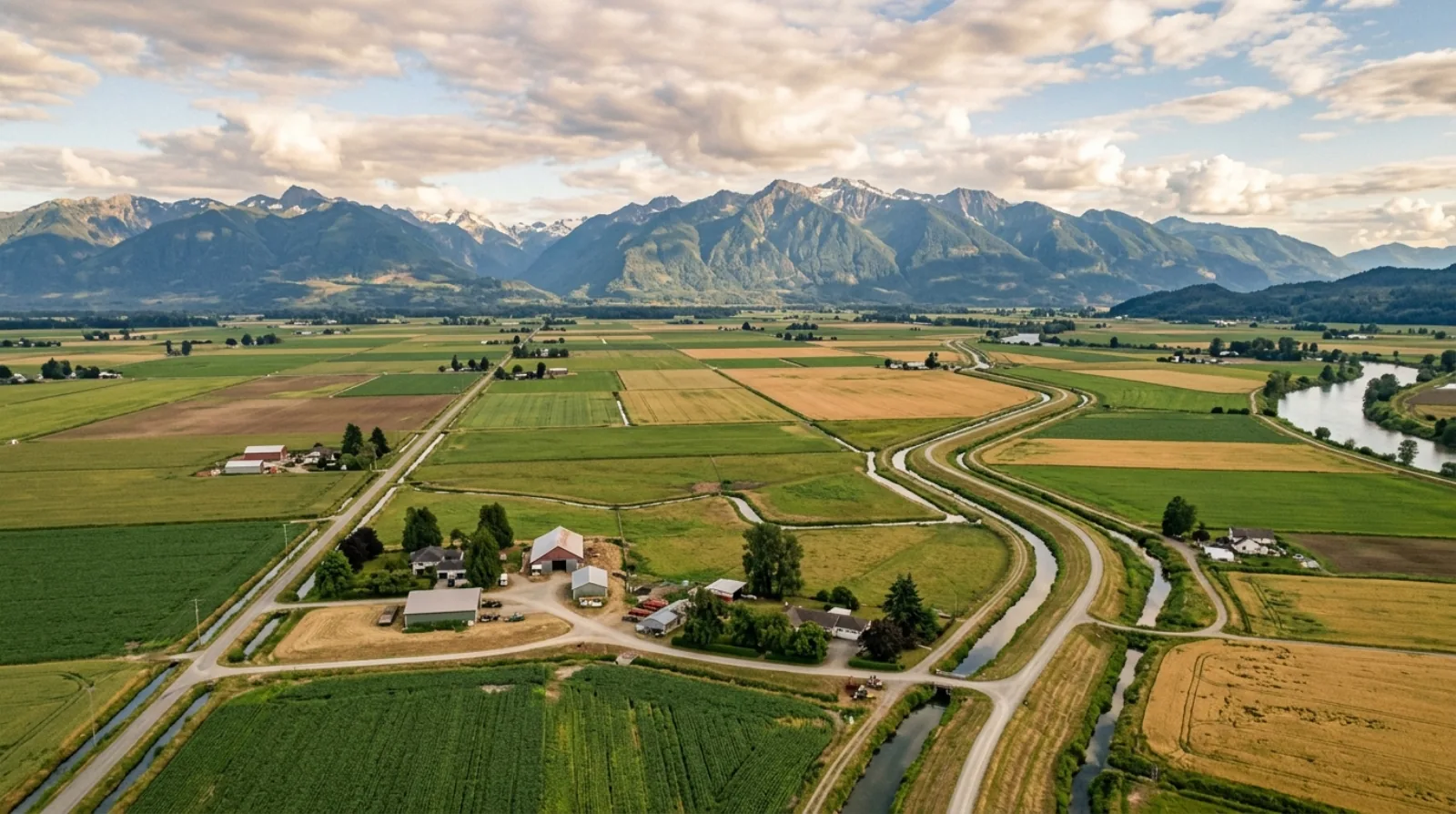
The Sumas Prairie floodplain and the Agricultural Land Reserve.
Two regulatory layers shape a large share of Abbotsford's land, and both can override the zoning. If your lot is near the prairie or touches the ALR, these are the first numbers and rules to pull, before a floor plan, before an offer.
What 2021 changed
In November 2021, the Nooksack River overflowed across the border, breached the dikes, and flooded the Sumas Prairie in one of the largest flood disasters in Canadian history. The rules under any prairie-adjacent lot today exist because of that event.
In response to new flood modelling, the City of Abbotsford raised its floodproofing construction elevations. Full floodproofing was raised to 10.9 metres in the Sumas Lake bottom, Sumas Prairie West and the Sumas River floodplain, and to 9.8 metres in Matsqui Prairie. Those are geodetic elevations, so the gap between your existing grade and the required level is lot-specific, and on low ground it can be significant.
The area-of-refuge rule, and how it shapes the home
Abbotsford's bylaw includes a provision that's easy to miss. Where an owner builds at a reduced floodproofing elevation lower than the full FCL, the city requires a habitable second level at or above the full floodproofing elevation. If the main floor sits lower, there has to be living space high enough to be a safe area of refuge if water rises.
That single rule shapes the whole massing. It pushes designs toward a true two-storey with the upper floor as genuine living space, and it changes where bedrooms, mechanical and the things you'd most want to keep dry are located. The approach and entry, the garage, the service locations and the site drainage all get designed around the elevated structure. Done well, a floodplain home reads as a confident, lifted house, not a box on stilts. Our field note on building near the Sumas Prairie floodplain walks through the practical detailing.
The Agricultural Land Reserve
A meaningful share of Abbotsford touches the Agricultural Land Reserve, administered by the Agricultural Land Commission. On ALR land, residential development is generally limited to a single dwelling per parcel, with additional dwellings, secondary suites, coach houses, subject to ALC approval. Accessory farm buildings, farm-worker housing and agri-tourism structures each have their own rule sets.
The key interaction owners miss: the ALR's single-dwelling rule isn't overridden by Abbotsford's four-unit SSMUH zoning. A lot in the reserve generally can't become a multiplex regardless of its municipal zone. And placing fill to raise a building pad, common on floodplain land, touches both floodplain and ALR rules at once. We check ALR status with the Commission directly, not just the municipal counter, before committing to a site.
Building a multiplex on a lot clear of both constraints? See the multiplex & SSMUH sub-guide for how the four-unit allowance actually works.
FAQ
- What is a flood construction level?
- A flood construction level (FCL) is the minimum elevation at which the underside of a home's habitable floor system must sit. It's set above the modelled flood level so living space stays dry in an event. On a prairie lot, the gap between existing grade and the required FCL can be substantial, and it defines the whole ground-floor strategy of the home.
- How high are Abbotsford's flood construction levels after 2021?
- Following the November 2021 Nooksack flood, Abbotsford raised its floodproofing construction elevations. Full floodproofing was raised to 10.9 metres in the Sumas Lake bottom, Sumas Prairie West and the Sumas River floodplain, and to 9.8 metres in Matsqui Prairie. These are geodetic elevations, not heights above your lot, so the practical impact depends on your existing grade.
- What is the 'area of refuge' rule?
- Where an owner builds at a reduced floodproofing elevation, lower than the full FCL, Abbotsford's bylaw requires a habitable second level at or above the full floodproofing elevation. In plain terms, if the main floor sits lower, there has to be living space high enough to be a safe refuge if water rises. This pushes designs toward a genuine two-storey with the upper floor as real living space.
- Can I build on Agricultural Land Reserve land?
- You can, but the rules are restrictive. The ALR, administered by the Agricultural Land Commission, generally limits residential development to a single dwelling per parcel, with additional dwellings, including secondary suites and coach houses, subject to ALC approval. Accessory farm buildings and farm-worker housing have their own rule sets. We check ALR status with the Commission directly before a site is committed.
- Does Abbotsford's four-unit SSMUH zoning apply on ALR land?
- No. The Agricultural Land Reserve's single-dwelling rule isn't overridden by the city's Small-Scale Multi-Unit Housing zoning. A lot in the ALR generally can't be developed as a multiplex regardless of its municipal zone. This is one of the first things we check before any multiplex feasibility on a Fraser Valley parcel.
- How do I find out if a specific lot is affected?
- The flood construction level and ALR status of a property are both knowable before you commit. The City of Abbotsford's flood response and environmental regulations pages, and the city's mapping, are the authoritative sources for flood designation; the Agricultural Land Commission's ALR maps confirm reserve status. We confirm both at the lot tour, not at the permit application.
- What does 'geodetic elevation' mean for my lot?
- A geodetic elevation is measured against a provincial vertical datum, a fixed reference, not against your lot's existing ground level. So a flood construction level of 10.9 metres geodetic doesn't mean 10.9 metres above your yard; it means the floor system has to reach that surveyed elevation. The gap between your existing grade and the required level is lot-specific, which is why a surveyed elevation read is one of the first things we commission on a prairie lot.
- Can I place fill to raise my building pad?
- Sometimes, but it's not automatic. Raising a pad with fill touches both the floodplain provisions and, on Agricultural Land Reserve land, the ALC's rules on placing fill on farmland. The two can interact, and the more restrictive applies. It's exactly the kind of question that's inexpensive to resolve before an offer and expensive to discover after, we check it as part of the lot assessment.
- Can I build a basement on a floodplain lot?
- Usually not in the conventional sense. The whole point of a flood construction level is to keep habitable space above the modelled flood level, so below-grade living space is generally restricted on a floodplain lot. The design tends to push usable space up rather than down, which is also why the area-of-refuge rule favours a genuine two-storey. We design the program around the FCL rather than fighting it.
- Does a floodplain or ALR designation affect insurance or financing?
- It can, and it's worth checking early with your insurer and lender, flood designation in particular can affect coverage and terms, and these are decisions specific to your situation that we're not the right party to advise on. What we can do is make sure the home is built to or above the required flood construction level and properly floodproofed, which is the part that's within a builder's control.
Official sources
- , City of Abbotsford, Flood Response & Recovery.
- , City of Abbotsford, Environmental Regulations.
- , Agricultural Land Commission.
Flood designations and ALR boundaries are property-specific and change. Confirm against the City of Abbotsford mapping and the ALC before relying on anything here.