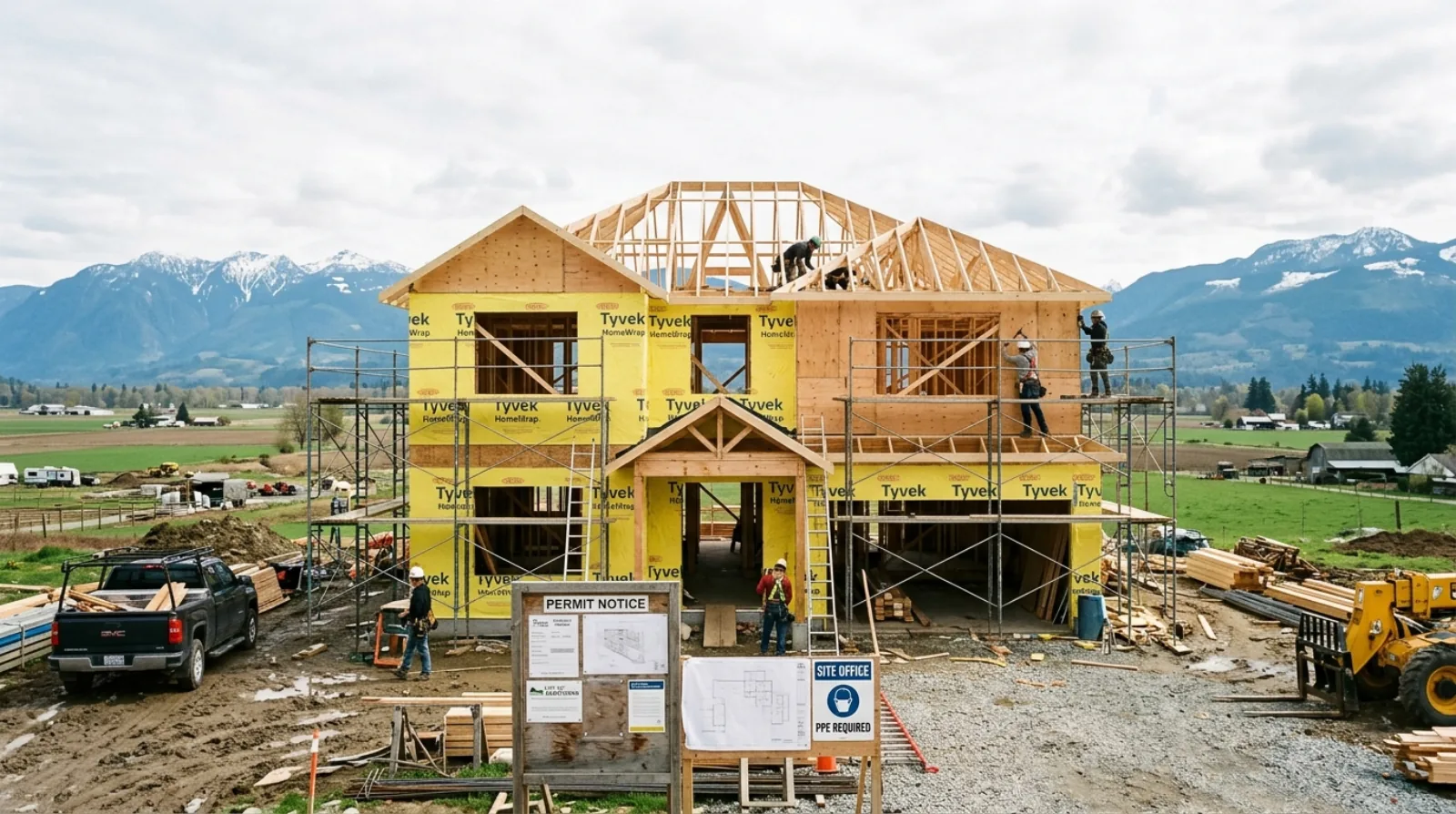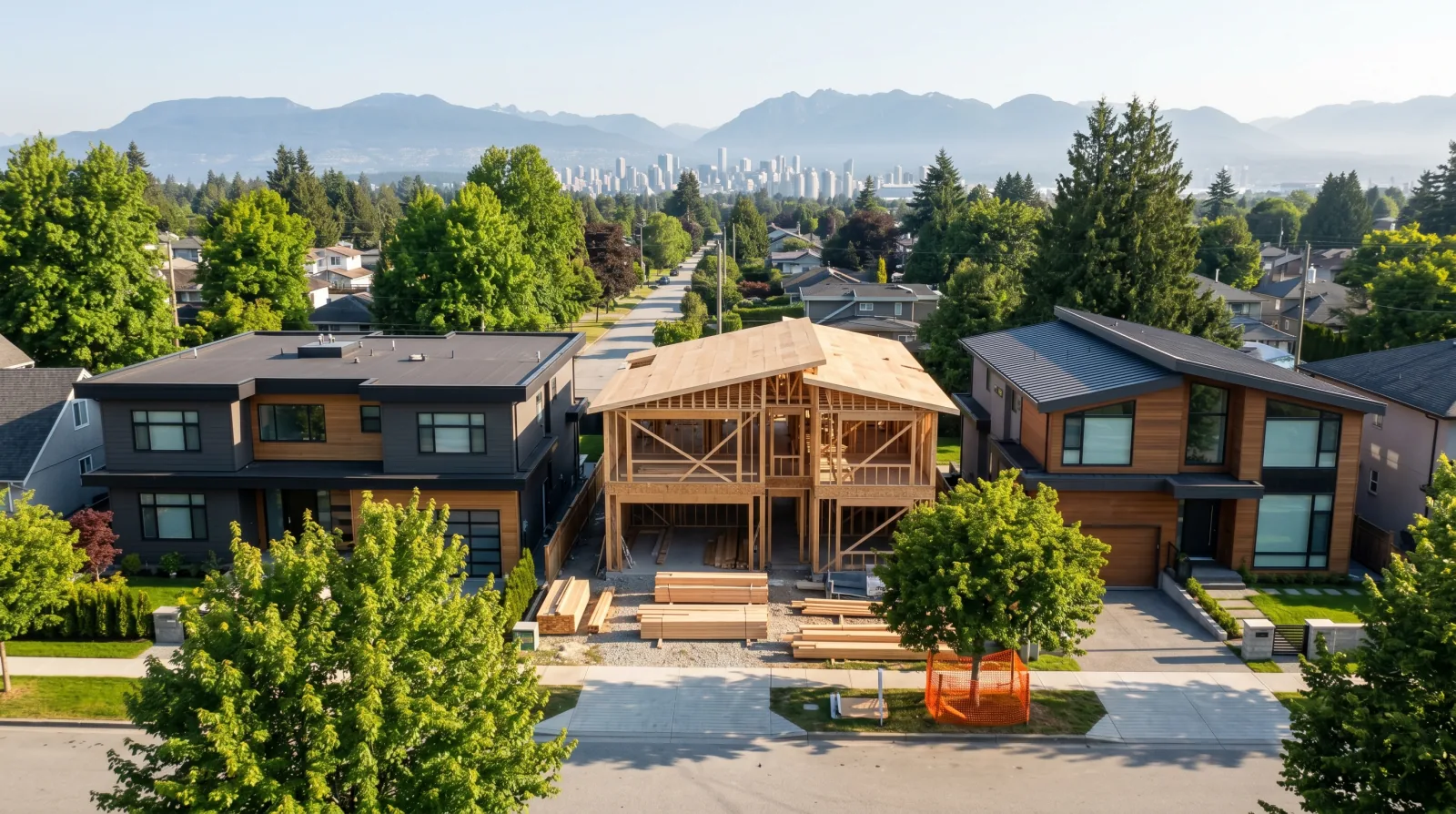
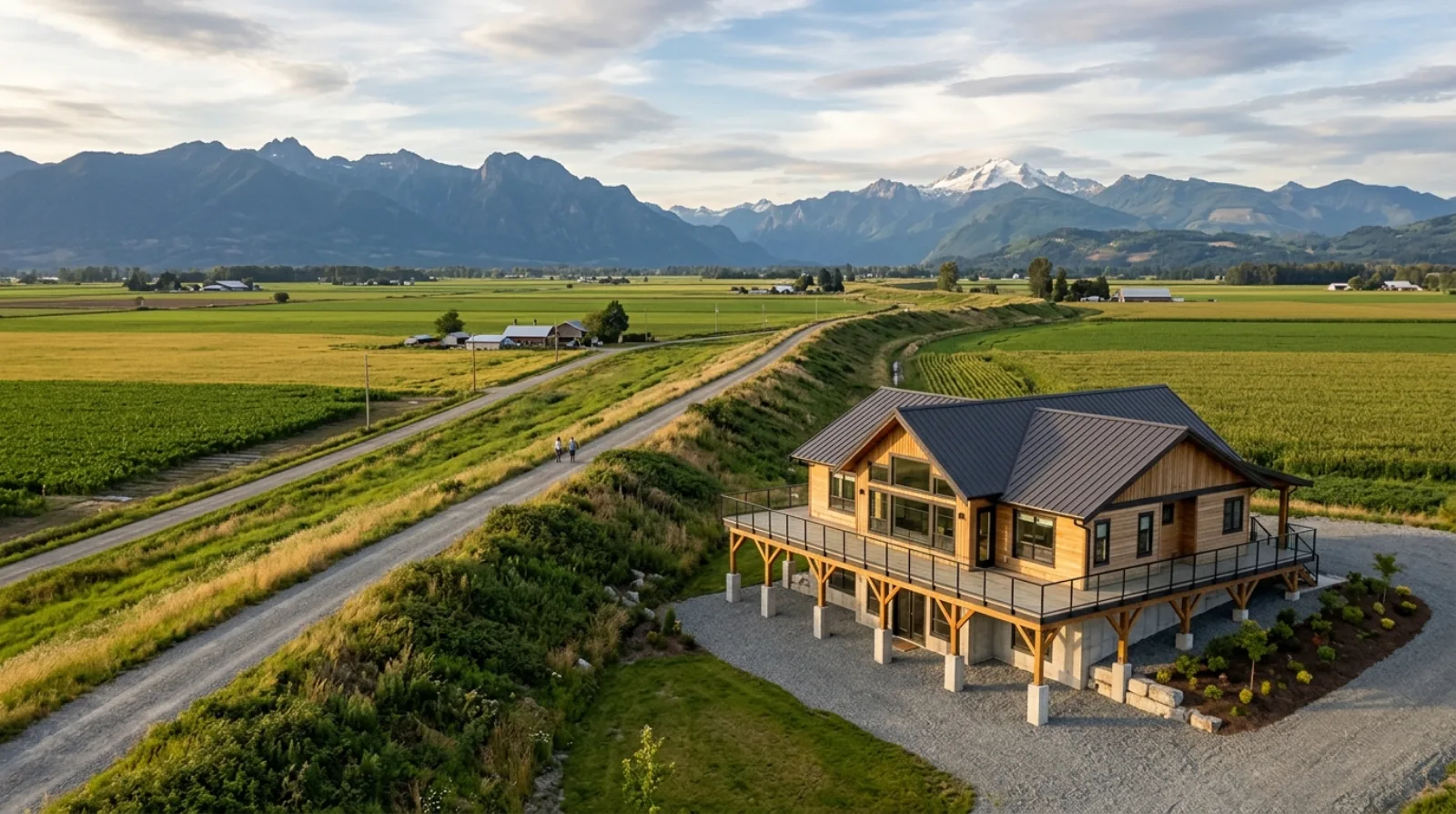
After the November 2021 flood, Abbotsford raised its floodproofing construction elevations across the Sumas Prairie. If your lot is anywhere near the prairie, the flood construction level is the first number we pull, because it drives the whole design.
In November 2021, the Nooksack River overflowed across the border, breached the dikes, and sent floodwater straight into the Sumas Prairie. It became one of the largest flood disasters in Canadian history, farms, homes and the whole agricultural heart of Abbotsford underwater. If you're building anywhere near the prairie now, that event is the reason the rules under your lot look the way they do.
For a new home on or adjacent to the Sumas Prairie, the flood construction level is the single most important number on the project. We pull it before square footage, before a floor plan, before anything, because it shapes what the home can be.
What "flood construction level" actually means
A flood construction level (FCL) is the minimum elevation at which the underside of your home's habitable floor system has to sit. It's set above the modelled flood level so that, in an event, living space stays dry. On a prairie lot that number doesn't just nudge the foundation up a few inches, it can define the entire ground-floor strategy of the home.
After 2021, the City of Abbotsford raised its floodproofing construction elevations in response to new flood modelling. The increases that matter most for anyone building out there:
- In the Sumas Lake bottom, Sumas Prairie West and the Sumas River floodplain, full floodproofing was raised to 10.9 metres
- In Matsqui Prairie, full floodproofing was raised to 9.8 metres
Those are geodetic elevations, not heights above your lot, so the gap between your existing grade and the required FCL is lot-specific. On low ground it can be substantial.
The "area of refuge" rule
Abbotsford's bylaw includes a provision that's easy to miss and important to understand. Where an owner builds at a reduced floodproofing elevation, lower than the full FCL, the city requires a habitable second level at or above the full floodproofing elevation. In plain terms: if the main floor sits lower, there has to be living space up high enough to be a safe area of refuge if water rises.
That single rule shapes the whole massing of the home. It pushes designs toward a true two-storey, with the upper floor as genuine living space rather than an afterthought, and it changes where bedrooms, mechanical and the things you'd most want to keep dry are located. Designing for it from the first sketch produces a home that feels intentional. Discovering it at the permit stage produces a redesign.
How it changes the design, practically
Building to a real flood construction level isn't just "make the foundation taller." It ripples through the whole project:
- The approach and entry. A raised main floor means steps, ramps and grade transitions that have to be designed, not bolted on. Done well, it reads as a confident, lifted home. Done badly, it looks like a house on stilts.
- The parking and garage. Often the most flood-vulnerable spaces, so their placement and finish level get real thought.
- The mechanical and electrical. You don't put the things that fail in water at the lowest point of a floodplain home. Service locations move up.
- The site and drainage. Grading, fill and stormwater management all have to work with the elevated structure and the surrounding agricultural drainage rather than against it.
The Agricultural Land Reserve usually overlaps
A lot of the Sumas Prairie sits within the Agricultural Land Reserve, administered by the Agricultural Land Commission. On ALR land, residential development is generally limited to a single dwelling per parcel, with additional dwellings subject to ALC approval, a different rulebook from urban Abbotsford. So a prairie build often has two regulatory layers stacked: the floodplain provisions and the ALR rules. We check both directly with the relevant authority, not just the municipal counter, before a site is committed.
There's also the matter of fill. Raising a building pad on agricultural land touches both floodplain and ALR considerations, and the rules around placing fill on ALR land are specific. It's exactly the kind of question that's cheap to answer before an offer and expensive to discover after.
Foundation and fill strategy on a prairie lot
Reaching the required flood construction level in the Sumas Prairie typically involves one of three approaches, or a combination of them. Understanding which applies to your lot changes the cost estimate and the structural design before a single column is sized.
Engineered fill under the building pad. On flatter ground with good load-bearing capacity, compacted structural fill raises the pad to the required elevation. The fill itself has to be engineered, volume, compaction specification, settlement analysis, and on ALR land the quantity and source of the fill triggers its own approval process with the Agricultural Land Commission.
Deep foundation into competent bearing material. Where settlement risk makes engineered fill impractical, or where the soil profile is poor, piles or grade beams carry the structure down to competent bearing and the building sits elevated above the pad rather than on filled ground. This approach is more expensive upfront but avoids the long-term settlement monitoring that some engineered fill pads require.
Concrete perimeter with an elevated first floor. The main-floor structural system is framed above grade, with the enclosed space below treated as non-habitable, storage, mechanical, or simply left open. This is the approach that most cleanly separates habitable space from flood risk and often produces the most legible architecture: a clearly lifted building with a purposeful plinth.
On any Sumas Prairie lot, a geotechnical investigation is the document that determines which of these approaches is appropriate, and sometimes which ones are structurally ruled out. We commission it before feasibility is complete, not after design starts.
The driveway and access approach
An often-overlooked design consequence of the flood construction level is the driveway and entry approach. When the main floor sits significantly above the surrounding grade, sometimes by a metre or more on lower prairie ground, the approach from the street and from the garage becomes a design problem in its own right.
A garage at the elevated first-floor level requires a ramped approach whose grade has to stay within what's buildable and safe. A garage at natural grade with a ramped interior connection to the main floor is another option, but introduces a below-grade space that may itself be subject to floodproofing considerations. A detached garage at grade, fully separated from the main dwelling, is often the cleanest solution and keeps the most vulnerable attached structure out of the flood zone, but requires its own setback, access, and lot-coverage assessment.
This is one of the decisions that has to be resolved at the design stage, not improvised at the permit stage. It drives the whole entry sequence and the relationship between the home and the street.
Insurance and the ongoing conversation
Floodplain construction is not solely a design and permit question. The insurance picture for a Sumas Prairie home has changed significantly since 2021, and it continues to evolve. Some insurers are writing overland flood coverage in this area; others have withdrawn from it entirely. Premium ranges vary enough that what you pay annually is worth modelling before you buy the lot, not after you've built the house.
This is a conversation to have with an insurance broker who understands BC flood risk specifically, and it's worth having it early. The FCL you build to, the type of construction, the presence or absence of a second-storey refuge, and the drainage design of the site all affect insurability. A home that meets the bylaw minimum isn't automatically insurable at a reasonable cost, and a home designed with flood resilience in mind, sealed below-grade penetrations, elevated electrical and mechanical, a detached garage kept separate from the main structure, positions better.
Why this is a "check it at the lot tour" item
The pattern we see is consistent: owners fall in love with the openness of a prairie lot, the sky, the farmland, the quiet, and start designing the home before anyone has pulled the flood designation. Then the FCL comes in higher than the daydream assumed, the area-of-refuge rule forces a two-storey where they'd imagined a rancher, and the whole thing gets redrawn.
It's avoidable. The flood construction level, the ALR status, and the preliminary geotechnical picture for a property are all knowable before you commit. They should be part of the lot-tour conversation, not a permit-stage discovery. For the authoritative, current flood designation on a specific property, the City of Abbotsford's flood response and environmental regulations pages are the place to start, and we confirm it against the city's mapping before feasibility.
A home built honestly for the floodplain isn't a compromise. Lifted properly, oriented to the light and the view across the fields, with the living space where it belongs and the mechanical and structure where they belong, it's one of the most distinctive homes you can build in the Fraser Valley. The design follows from taking the water seriously at the beginning, which is the only time it costs relatively little.
Related on the Journal