Abbotsford runs its own permit review on its own calendar, and after the December 2025 zoning rewrite, the rules under your file have changed. Here's how a custom-home permit actually moves through the city, phase by phase.
Most owners think of a building permit as a single event, you submit, you wait, the city says yes. On an Abbotsford custom home it's nothing like that. It's a sequence, and a long stretch of it happens before the City of Abbotsford ever opens your file. The owners who feel like their permit "took forever" almost always had a gap in that earlier sequence, not a slow reviewer.
Abbotsford also runs its own review process, on its own calendar. It doesn't move on Burnaby's clock or Vancouver's, and the rules under your file shifted at the end of 2025. Here's how the whole thing actually moves.
Before the city sees anything
The work that decides your timeline starts months before submission. On a Fraser Valley lot, where the soils change block to block and water is a first-class problem, this front-end work matters more than it does on a flat urban infill.
What has to be in hand before a complete application goes in:
- A current survey of the lot, with grades
- A geotechnical assessment, not optional on Abbotsford's mixed geology of alluvial deposits, glacial till, peat and bedrock outcrops
- A drainage and lot-grading strategy with a clear discharge route
- Riparian confirmation where a creek, ditch or seasonal watercourse is anywhere near the lot
- The architectural and structural drawings, coordinated
- A stamped energy model from a registered professional
Miss one of these and the file either doesn't get accepted as complete or comes back with a request that resets your place in the queue. We sequence all of it deliberately, because a survey that arrives three weeks late pushes everything behind it.
The zoning question changed in December 2025
On December 16, 2025, Abbotsford Council adopted a new Official Community Plan and a rewritten zoning bylaw, bringing the city into line with the province's Small-Scale Multi-Unit Housing rules. Most single-family lots under 4,050 square metres now allow up to four homes.
For a single custom home that doesn't change much, but it changes the zoning analysis. The setbacks, coverage and height rules your designer works to have to match the current bylaw, and the City's SSMUH application guidance is the reference point, not whatever was true a year ago. The honest caveat: the province's six-unit transit bonus doesn't apply anywhere in Abbotsford yet, because the city has no bus stops meeting the frequent-service standard. So four is the practical ceiling, and we confirm the math against the current maps before any design is committed.
The 2024 BC Building Code and the energy model
Every permit application in BC submitted on or after March 8, 2024 falls under the 2024 BC Building Code. Your drawings and documents have to reflect the current edition, an older set will bounce.
On energy, Abbotsford applies Step 3 of the BC Energy Step Code to new Part 9 homes, detached and semi-detached houses, garden suites, townhouses and low-rise, and added the Zero Carbon Step Code at level EL-1 as of March 10, 2025. In plain terms: a registered professional has to build an energy model, stamp it, and submit it, and the city can ask for the model files to audit. Step 3 isn't a checkbox you tick at the end. It locks the envelope detailing, the mechanical sizing and the air-sealing approach in at design, try to value-engineer those back at framing and you'll fail the compliance path.
The Building Permit Hub
The province launched its Building Permit Hub on May 27, 2024 and is rolling it out across BC, the Fraser Valley included. The Hub runs automatic completeness and code-compliance checks before a file reaches a human reviewer. That's genuinely useful, it catches the missing-document problems that used to surface weeks into a review, but it also means a half-complete submission gets flagged immediately rather than sitting in a queue. Another reason the front-end discipline pays off.
Review, comments, revisions
Once a complete file is in, the city's reviewers work through it and come back with comments. This is the phase owners imagine when they think "permit," and it's usually the most predictable part, provided the file arrived complete. The back-and-forth on a clean submission tends to be about specifics: a structural detail, a drainage clarification, a setback measurement.
Where it slows down is when a comment exposes a gap that should have been resolved earlier, a riparian setback nobody checked, a geotechnical recommendation the foundation design didn't account for. Those send you back to a consultant and then back into the queue. We'd rather spend the extra two weeks up front than discover a fish-bearing ditch at the comment stage.
Abbotsford's smaller planning team is worth understanding here. In a big-city department you're a file number. In Abbotsford you're often working with the same coordinator across the whole project, which makes the relationship matter. A builder who's worked the city before knows how that team likes a file assembled, and a clean file from a known builder moves more smoothly than a messy one from a stranger.
Inspections during construction
Once the permit is issued, the inspection sequence begins, and in Abbotsford, as in any BC municipality, progress depends on each stage being signed off before the next begins. The critical inspection gates on a new single-family home are:
Foundation inspection before the slab is poured or the walls are backfilled. Burnaby's inspection sequence is similar but the Abbotsford team runs their own review. If a geotechnical report was part of the permit, the geotech engineer may be required to attend this inspection or provide a letter confirming the foundation conditions match the report.
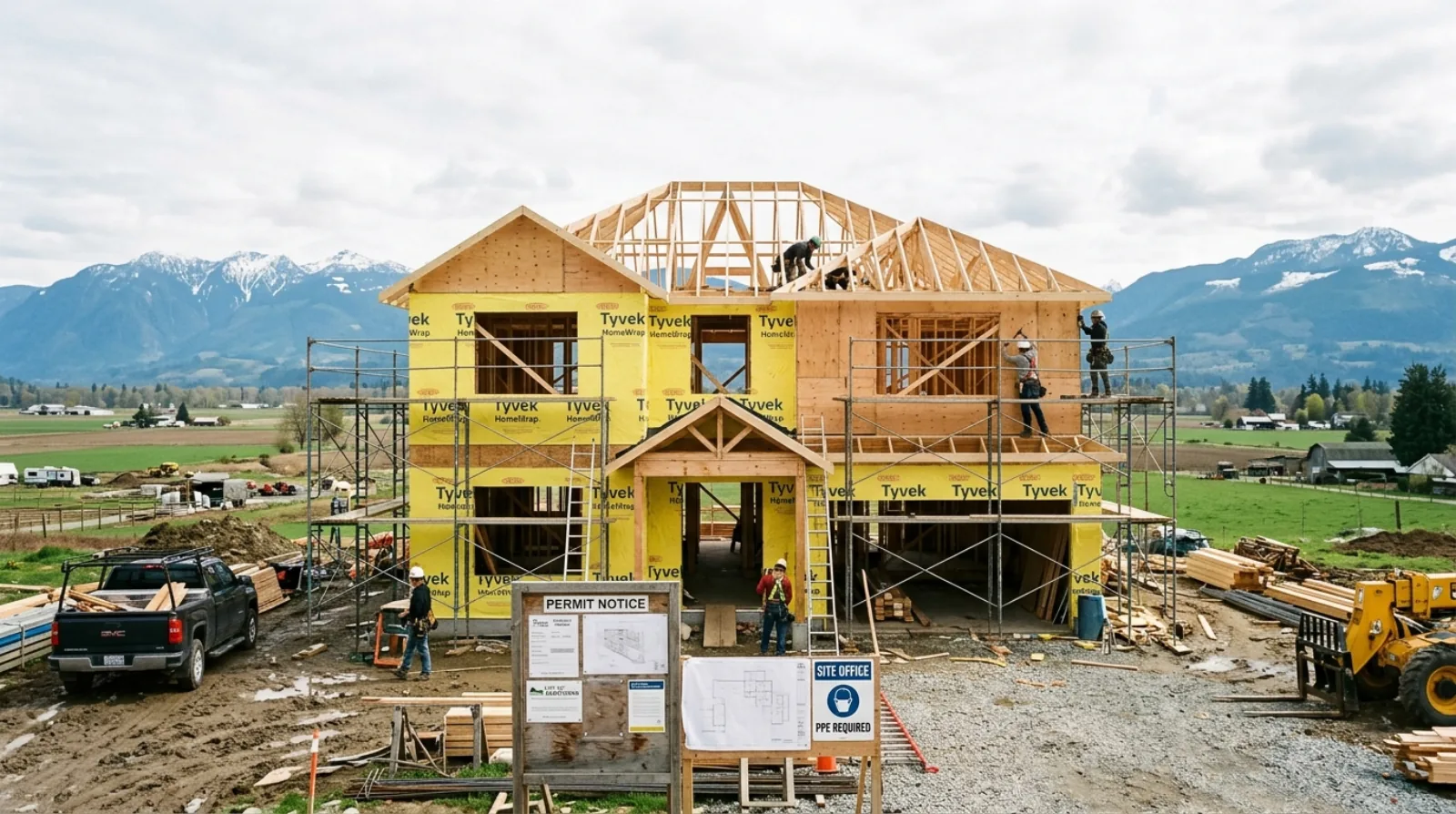
Framing inspection once the structure is up and mechanical rough-ins are in but before insulation or drywall. This is typically the longest inspection appointment because there's the most to review, structure, fire blocking, penetrations, rough-in for plumbing, electrical, mechanical, and the preliminary air-sealing details.
Insulation and air barrier inspection for Step Code compliance. This stage confirms that the air barrier is installed correctly before it's covered. An inspector may probe for continuity at penetrations, at the plate-to-sheathing connection, and at window and door rough openings. A poorly done air barrier is not correctable after drywall goes up, it becomes a permanent energy performance problem.
Final / occupancy inspection once construction is complete. This triggers the occupancy permit and, on a new home, starts the 2-5-10 warranty clock. In Abbotsford as in Burnaby, the final inspection doesn't happen until all outstanding comments from earlier inspections are addressed.
Scheduling inspections takes forethought. Abbotsford's inspection calendar runs on a booking system and demand can push waits to several business days. We build inspection scheduling into the construction schedule explicitly so a missed or delayed booking doesn't push a milestone by two weeks.
Floodplain and riparian overlays
Abbotsford has a meaningful amount of developable land that carries an additional regulatory overlay, floodplain (particularly the Sumas Prairie area) and riparian (creek setbacks under BC's Riparian Areas Protection Regulation, which applies to virtually any watercourse, including seasonal ditches).
Both of these overlays can trigger reviews that run in parallel with the standard permit review but may involve provincial regulators, not just the City. A site near a fish-bearing creek requires a Qualified Environmental Professional (QEP) report before the riparian setback can be confirmed, and the setback drives the buildable area, which drives the whole project footprint. Discovering a fish-bearing ditch at the comment stage doesn't just push the file back in the city queue; it can require a fundamental redesign.
We check both overlays at the first lot assessment, before any design work begins. The City of Abbotsford's environmental regulations guidance is the starting point; the provincial Riparian Areas Protection Regulation information is at BC's Fish and Wildlife offices.
Why we don't quote you a week count
You'll notice we haven't put a number of weeks on any of this. That's deliberate. Abbotsford's review windows depend on the season, the current volume, the complexity of your file and whether riparian or floodplain review is in the mix, and we won't hand you a figure we can't stand behind. What we will do is map every phase into your project schedule from week one, sequence the consultant work so nothing waits on a missing survey, and give you a milestone-by-milestone plan once design is locked. For a current read on the city's posted timelines and fees, the City of Abbotsford building permits page is the authoritative source.
The permit isn't the hard part of building in Abbotsford. The discipline of arriving at the permit with a complete, coordinated, code-current file is. Get that right and the city is rarely the bottleneck.
What slows an otherwise well-prepared file
Even a complete, well-sequenced submission can stall for reasons outside the applicant's control. Staff turnover at the city, seasonal volume spikes when many projects submit around the same window, and provincial regulator involvement on a riparian or floodplain overlay all add time that no amount of front-end preparation eliminates entirely. The difference between a well-prepared owner and one who isn't shows up in how the file responds to that friction, a complete package moves back through review quickly once the outside factor clears, while an incomplete one compounds the delay on top of it.
This is also where working with a builder who has an existing relationship with Abbotsford's planning team pays off in ways that are hard to quantify but real in practice. Knowing how the team likes a file assembled, and having a track record of clean submissions, shortens the informal back-and-forth that happens around the formal review process. Our Abbotsford custom home builder page lists the neighbourhoods we build in and the kinds of homes we take on there.
Frequently asked questions
- What documents does Abbotsford require before a permit application is considered complete?
- A current survey with grades, a geotechnical assessment given Abbotsford's mixed alluvial, glacial till, and bedrock geology, a drainage and lot-grading strategy with a clear discharge route, riparian confirmation where a creek or seasonal watercourse is nearby, coordinated architectural and structural drawings, and a stamped energy model from a registered professional. Missing any one of these means the file either isn't accepted as complete or comes back with a request that resets its place in the queue.
- How did Abbotsford's December 2025 zoning rewrite affect a custom home permit?
- On December 16, 2025, Abbotsford Council adopted a new Official Community Plan and rewritten zoning bylaw aligning the city with the province's Small-Scale Multi-Unit Housing rules, opening most single-family lots under 4,050 square metres to up to four homes. For a single custom home the entitlement doesn't change much, but the setback, coverage, and height rules the designer works to have to match the current bylaw, not what was true a year earlier.
- What BC Building Code applies to an Abbotsford permit in 2026?
- Every BC permit application submitted on or after March 8, 2024 falls under the 2024 BC Building Code, and drawings and documents have to reflect that edition or the submission bounces. On energy, Abbotsford applies Step 3 of the BC Energy Step Code to new Part 9 homes and added the Zero Carbon Step Code at level EL-1 as of March 10, 2025, both locked in at design, not adjustable at framing.
- What is the Building Permit Hub and how does it affect an Abbotsford file?
- The Building Permit Hub is a provincial tool, launched May 27, 2024 and rolling out across BC including the Fraser Valley, that runs automatic completeness and code-compliance checks before a file reaches a human reviewer. It catches missing-document problems immediately instead of letting them surface weeks into review, which means a half-complete submission gets flagged right away rather than sitting in a queue.
- What are the key construction inspection gates for an Abbotsford custom home?
- Foundation inspection before the slab pours or backfill; framing inspection once structure and mechanical rough-ins are in but before insulation or drywall; insulation and air barrier inspection to confirm Step Code compliance before it's covered; and final or occupancy inspection once construction is complete, which triggers the occupancy permit and starts the 2-5-10 warranty clock. Each stage has to be signed off before the next begins.
- Does Abbotsford have floodplain or riparian overlays that affect permitting?
- Yes. Abbotsford has significant developable land carrying floodplain overlay, particularly around Sumas Prairie, and riparian overlay under BC's Riparian Areas Protection Regulation, which applies to virtually any watercourse including seasonal ditches. A site near a fish-bearing creek needs a Qualified Environmental Professional report before the setback can be confirmed, and that setback drives the buildable footprint of the whole project.
- Why won't a builder quote an exact number of weeks for an Abbotsford permit?
- Abbotsford's review windows depend on the season, current volume, the complexity of the specific file, and whether riparian or floodplain review is in the mix, factors that shift file to file. A responsible builder maps every phase into the project schedule and sequences consultant work so nothing waits on a missing document, rather than quoting a week count that can't be stood behind.
- Is Abbotsford's permit process slower than Burnaby's?
- Not inherently. Abbotsford runs its own review on its own calendar with a smaller planning team than a large city department, which often means working with the same coordinator across a whole project. The most common cause of a slow Abbotsford permit isn't the city's pace, it's an incomplete file arriving at the city's desk, the same front-end discipline that determines timeline in any BC municipality.