The kitchen is the most-used room in a Burnaby custom home and the most expensive to redo. Here's how we lay out work zones, size the island, plan the scullery, and coordinate ventilation so it still works in twenty years.
The kitchen is the most-used room in a Burnaby custom home and the single most expensive room to ever rip out and redo. That combination is why I spend more time at the table on the kitchen than on almost any other space, and why the conversation I want to have isn't about the tile.
I've handed over homes in Burnaby Heights, Capitol Hill, and Brentwood where the owners cooked in the kitchen for a decade and never changed a thing. I've also walked back into homes (not ours) where the island was beautiful and useless, the hood roared like a jet, and replacement air whistled under every interior door. The difference between those two outcomes is decided long before anyone picks a finish. It's decided in the layout, the ventilation, and the durability choices.
So let me walk through how we actually think about a kitchen that has to work for twenty years, not just photograph well the week the stager leaves.
Forget the work triangle. Think in work zones.
For decades the rule was the "work triangle": sink, stove, fridge, three points, keep the distances tidy. It made sense when one person cooked in a galley and a fridge was the only major appliance.
It doesn't describe a modern kitchen. Today you've got a primary sink and a prep sink, a cooktop and a wall oven and sometimes a steam oven, a fridge and a separate beverage column, a dishwasher, a microwave drawer, and two people working at once while a third grabs a drink. A triangle can't hold all that.
We plan in zones instead: a prep zone, a cook zone, a clean zone, and a store zone. Each one gets its own landing counter, its own light, and its own logical adjacency. Prep sits between the fridge and the cooktop, because that's the path food actually travels. Clean-up clusters the main sink, the dishwasher, and the bin pull-out so you're not carrying drips across the room. Store splits into cold (fridge), dry (pantry), and daily-dish storage near the dishwasher so unloading is one turn, not a lap.
The test I use is simple: stand at the cooktop and ask what you can reach without taking a step. Oil, salt, a spoon rest, a landing spot for the hot pan. If the answer is "nothing, it's all on the island four feet away," the layout failed and no amount of stone fixes it.
The island: the one mistake almost everyone makes
The island is where most Burnaby kitchens go wrong, and the mistake is always the same, people try to make it do everything.
They want the cooktop in it, and the prep sink, and seating for four, and the microwave drawer, and the dishwasher, and a wine fridge. Then they're surprised there's nowhere to actually set a cutting board down. An island stuffed with appliances has no usable counter left. You've built a gorgeous obstacle.
My rule: pick the island's job and protect its landing space. If it's a prep-and-gather island, keep a long clear run of counter and don't bury it in fixtures. If you genuinely want the cooktop in the island, you've now committed to running the range hood down through the ceiling or up from the island, plus the makeup-air question I'll get to, and you've lost a chunk of the prep run to the cooktop. That can be the right call. Just make it on purpose.
Clearances matter more than people expect on a Burnaby lot, because square footage is finite and the temptation is to oversize the island until the aisles pinch. An aisle where two people pass while a dishwasher door and an oven door both open needs real room, and the same aisle, if it's also a path through the house, has to clear the circulation widths the BC Building Code requires for routes through a dwelling. Get it wrong and every dinner party turns into a traffic jam. We mock the island up in the drawings at true size and walk it before anyone fabricates a slab.
And seating: if the island is the eating spot, the knee space and the working counter compete for the same depth. Decide which side wins before the cabinets are ordered, not after.
The scullery: when the back kitchen earns its space
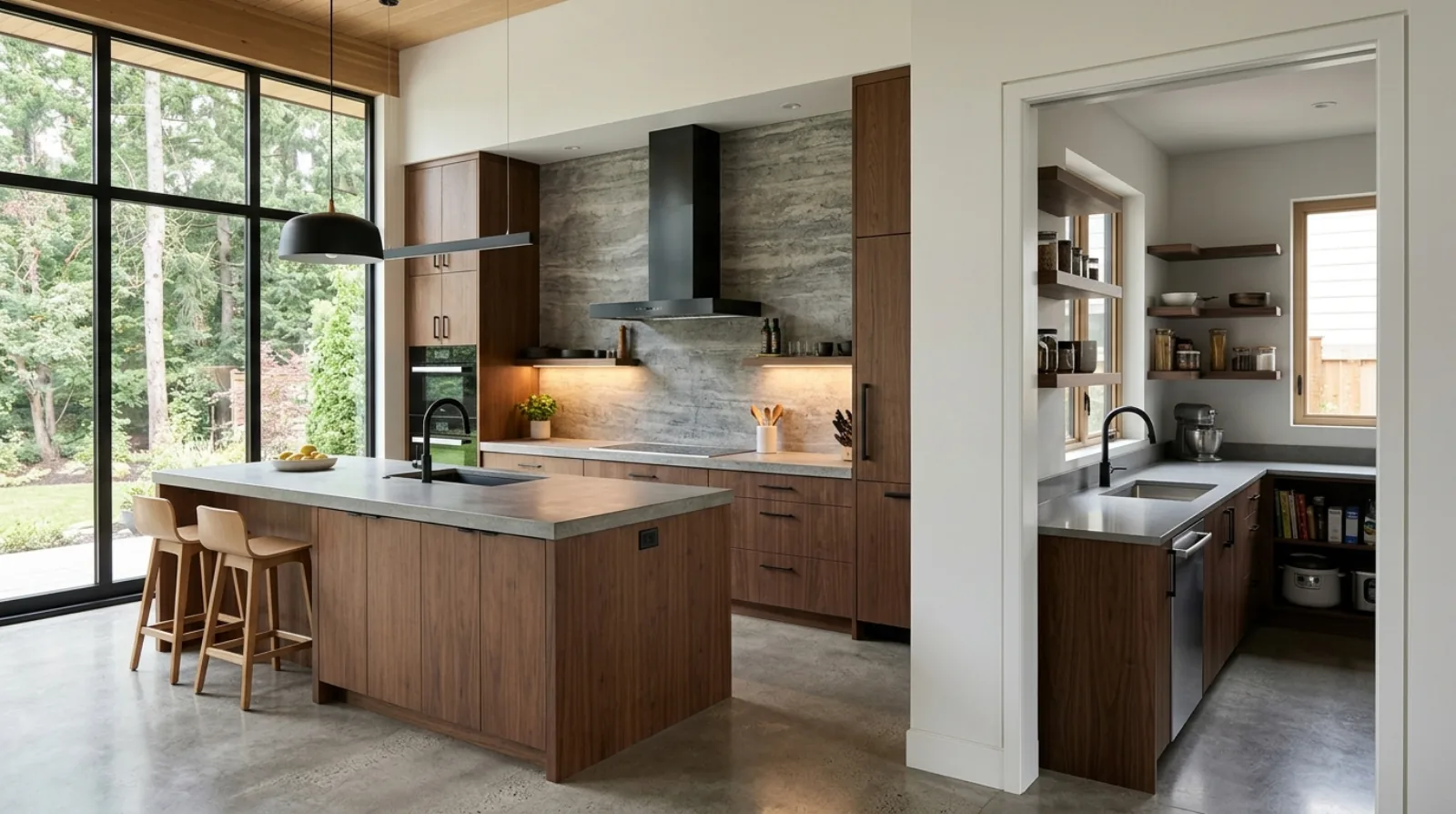
The scullery, the working back kitchen, sometimes called a prep kitchen or spice kitchen, has gone from a rare luxury to something a lot of Burnaby owners ask about by name. It's a second, smaller kitchen tucked behind or beside the main one: a sink, counter, often a second dishwasher, sometimes a second cooktop, and the messy storage.
The case for it is honest. The show kitchen stays clean. The mess, the soaking pots, the small appliances, the heavy cooking that throws grease and steam, happens behind a cased opening, out of sight of the people sitting at the island. For households that cook seriously, or cook food that produces a lot of aromatics, it's genuinely useful. In multigenerational Burnaby homes, where two generations cook different cuisines, I'd often argue the scullery is the more important kitchen of the two.
But I won't pretend it's free or always right. A scullery costs you floor area, a second run of cabinetry, extra plumbing, and often a second ventilation path, and on a tight Edmonds or Metrotown infill lot, that area might be better spent on the main kitchen itself. If the back kitchen is so good that the front kitchen becomes a showroom nobody touches, you've built a museum. The version that works keeps the main kitchen as the real kitchen and uses the scullery for the overflow and the mess. Get the layout drawn so the scullery is steps from the cooktop and the main sink, not down a hall.
If you want to see how we weigh this kind of "is it worth the money" call across a whole house, that's the heart of our piece on the custom-home features actually worth investing in.
Appliances and the electrification shift: induction or gas?
This used to be an easy preference question. In Burnaby right now it's closer to a settled one, and the reason is code.
New Part 9 homes in Burnaby are built to Step 3 of the BC Energy Step Code plus EL-4, the "Zero Carbon Performance" level, of the Zero Carbon Step Code, see the City of Burnaby's adoption. EL-4 effectively pushes space heating and water heating to zero-emission equipment, which is why the heat pump has become the default. The cooktop is a separate appliance and isn't heating the house, but once a home is wired and ventilated around all-electric mechanicals, the path of least resistance for the kitchen is electric too.
I steer most Burnaby clients to induction, and not as a green talking point, it cooks better. Instant response, precise low simmer, a flat surface you wipe clean, and far less waste heat thrown into the room (which matters more now that the 2024 BC Building Code requires every home to keep at least one living space at or below 26 °C during heat events, Section 9.33.3.1). A kitchen that dumps heat is fighting that requirement on the worst days of the year.
If you cook with a wok over a high flame or you simply prefer gas, say so early, because gas changes the ventilation math and the appliance circuit planning, and it's a much harder retrofit later. Which brings me to the detail that catches almost everyone.
Range-hood ventilation: the makeup-air problem nobody warns you about
Here's the part of kitchen design that gets skipped in every glossy plan I've ever seen handed to a client.
A modern Burnaby home is built tight. Step 3 of the Energy Step Code holds airtightness to 2.5 air changes per hour at 50 pascals, and Step 5, the provincial target for 2032, tightens that to 1.0. A tight house doesn't leak air the way a 1980s home did. So when you fire up a powerful range hood and it tries to throw a large volume of air out of the house, the house has no easy way to replace it. Pressure drops. Interior doors get hard to open, exhaust fans elsewhere stall, and the hood itself can't move the air it's rated for.
In a home with a naturally aspirating, back-draft-prone fuel-fired appliance, think a gas water heater or a draft-hood gas furnace, that depressurization is a safety issue, and BC code addresses it directly. The BC Building Code, Section 9.32.4.1, requires additional powered makeup air for any appliance that discharges air to the exterior at an installed rate exceeding 0.5 air changes per hour, when it's in a dwelling that contains such a back-draft-prone appliance. The makeup air has to come from a supply fan interconnected with the exhaust, and tempered before it reaches occupied space, at least 12 °C if it's delivered to a room people use.
Now here's the nuance most builders get wrong in both directions. In a fully electric Burnaby home, EL-4, heat pump, electric water heater, no gas at all, that specific code clause usually isn't triggered, because there's no back-draft-prone fuel appliance for the negative pressure to endanger. But the physics of depressurization don't care about the code trigger. A strong hood in a tight all-electric house still needs a path for replacement air, or it gets loud, underperforms, and pulls air down every other vent. So we plan a makeup-air strategy on the powerful-hood kitchens regardless of whether the code clause technically forces one. Sometimes that's a dedicated interlocked supply with a small tempering coil; sometimes it's a more modest hood matched honestly to how the house breathes. What we don't do is spec a big hood and hope.
The lesson: pick the cooktop, the hood, and the home's mechanical and electrical plan together, with the mechanical designer in the room. A range hood is not a finish you choose at the end. It's a system decision you make at the start.
Cabinetry, countertops and the surfaces that age well
The kitchen takes more daily abuse than any room in the house, water, heat, knives, kid hands, cleaning chemicals. So material choices here aren't aesthetic, they're durability decisions, and they're the ones owners regret fastest when they go cheap.
On cabinet boxes I want plywood, not particleboard, anywhere near water, under the sink especially, where a slow leak turns particleboard to mush and turns plywood into a wipe-up. Hinges and drawer slides are where I tell clients to spend: good soft-close hardware rated for heavy cycles is the difference between drawers that still glide in fifteen years and drawers that sag and rattle. Hardware is invisible until it fails, and then it's all you notice.
Countertops are the visible durability call. We lean toward natural stone and high-quality engineered surfaces that take heat and resist staining, and we steer owners away from anything that looks great on day one and scratches, etches, or dulls on a normal cooking schedule. The full reasoning, why some surfaces look better at year ten than year one, and which ones quietly fail, is in our post on materials that age beautifully. The short version: the kitchen is the worst place to chase a bargain finish.
This is also why we're so blunt about builder-grade kitchens in spec homes. The cabinet box, the slide, the hinge, the counter substrate, the parts you can't see at a showing are exactly where the cost gets cut, and exactly what fails first. It's the whole argument in why we don't believe in builder-grade, and the kitchen is Exhibit A.
Lighting, storage and the details that make it livable
Two more things separate a kitchen that works from one that just looks finished.
Light it in layers. A single ceiling fixture leaves you working in your own shadow at the counter, your head blocks the light, and you're chopping in the dark. We plan task lighting under the upper cabinets and over the island so the actual work surfaces are lit, then ambient light for the room, then sometimes a warmer accent layer for evenings. Put them on separate switches or scenes. The cook wants bright; the dinner party wants soft.
And storage has to be storage people actually use. Deep blind corners where pots go to die, an overhead cabinet nobody can reach without a stool, a drawer too shallow for the things it's meant to hold, those are wasted volume. We'd rather build fewer, smarter pull-outs sized to real items (the tray cabinet, the deep pot drawers near the cooktop, the spice pull-out by the prep zone) than a wall of doors that look like storage and function like decoration. Walk the dishwasher-to-cupboard path in the drawing. If unloading clean dishes takes more than a turn or two, redraw it.
Get the zones, the airflow, and the surfaces right, and the kitchen disappears into daily life the way a good one should, you stop noticing it and just cook. That's the room worth building. Whether you're planning a build in Burnaby, North Vancouver, Coquitlam, or New Westminster, it's the conversation we want to have early, and it's central to how we approach every custom home. If you're renovating an existing kitchen rather than building from scratch, our kitchen renovation service follows the same principles. And if the kitchen is part of a larger whole-home overhaul, replacing mechanical, opening up the floor plan, or adding a second floor, our full home renovation service covers how we scope and sequence that work.
Frequently asked questions
- Do I really need a scullery in a Burnaby custom home?
- No, it's a useful option, not a requirement. A scullery (back kitchen) earns its space when you cook seriously, cook food that throws a lot of steam and aromatics, or run a multigenerational household where two generations cook different cuisines. It costs floor area, a second run of cabinets, and extra plumbing, so on a tight Edmonds or Metrotown infill lot that square footage might serve better in the main kitchen. The version that works keeps the front kitchen as the real working kitchen and uses the scullery for overflow and mess, not the other way around.
- Does a powerful range hood need makeup air in a Burnaby home?
- It depends on the rest of the house. Under the BC Building Code, Section 9.32.4.1, powered makeup air is required for an exhaust appliance discharging air at more than 0.5 air changes per hour when the home also contains a naturally aspirating, back-draft-prone fuel-fired appliance, like a gas water heater or draft-hood furnace. In a fully electric Burnaby home with no such appliance, that clause usually isn't triggered, but a strong hood in an airtight house still needs a path for replacement air or it gets loud and underperforms. A makeup-air strategy is worth planning on powerful-hood kitchens either way.
- Induction or gas in a new Burnaby kitchen?
- For most new Burnaby builds, induction. The city's homes are built to EL-4 of the Zero Carbon Step Code, which pushes mechanicals to zero-emission electric equipment, so the home is already wired and ventilated around all-electric. Beyond code, induction cooks well: instant response, precise simmer, easy cleanup, and far less waste heat thrown into the room. A genuine preference for gas or a high-flame wok should be raised early, because gas changes the ventilation and circuit planning and is a hard retrofit later.
- What's the biggest island mistake in kitchen design?
- Overstuffing it. Owners often try to fit the cooktop, prep sink, dishwasher, microwave drawer, wine fridge, and seating for four into one island, then find nowhere left to set down a cutting board. The fix is to pick the island's main job and protect a long clear run of landing counter. Putting the cooktop in the island commits to a more complex hood and makeup-air plan and gives up prep space, sometimes the right call, but it should be made on purpose.
- How do you plan a kitchen layout if not with the work triangle?
- By planning in work zones: prep, cook, clean, and store. Each gets its own landing counter, its own light, and a logical adjacency to the next. Prep sits between the fridge and cooktop because that's the path food travels; clean-up clusters the sink, dishwasher, and bin; store splits into cold, dry, and daily-dish storage near the dishwasher. The old work triangle was built for one cook in a galley kitchen, so it can't describe a kitchen with two sinks, three ovens, and two people working at once.
- What countertop and cabinet materials hold up best in a kitchen?
- For cabinet boxes near water, plywood outperforms particleboard, since a slow under-sink leak ruins particleboard and just wipes off plywood. Soft-close hinges and drawer slides rated for heavy cycles are worth spending on, since hardware is what fails first in a cheap kitchen. For counters, durable natural stone and high-quality engineered surfaces that take heat and resist staining beat finishes that scratch or etch on a normal cooking schedule. The kitchen is the worst room in a custom home to chase a bargain surface.
- Why does a tight new home make kitchen ventilation harder?
- Because it doesn't leak air the way an older home did. Burnaby's Step 3 energy code holds airtightness to 2.5 air changes per hour at 50 pascals, and Step 5, the 2032 provincial target, tightens that to 1.0. When a powerful hood tries to exhaust a large volume of air, a sealed house has no easy way to replace it, so pressure drops, doors get hard to open, other fans stall, and the hood can't move its rated air. Hood selection needs to be coordinated with the home's airtightness and mechanical plan, not chosen last.
- How do you plan kitchen lighting so you're not working in your own shadow?
- By layering the light rather than relying on one ceiling fixture. Task lighting goes under the upper cabinets and over the island so the actual work surfaces are lit, ambient light covers the room generally, and a warmer accent layer handles evenings, each on its own switch or scene. A single overhead light leaves the cook's head blocking the light right where they're chopping, which is one of the most common lighting mistakes in kitchens that otherwise look finished.