What happens on a Burnaby teardown lot between the day subjects come off and the day the first concrete is poured. Disconnections, abatement, demolition, tree protection, shoring and excavation, the work most owners never see.
What happens after a Burnaby teardown closes?
After closing on a Burnaby teardown, the site moves through utility disconnections, a hazardous materials survey and abatement, a demolition permit with waste-diversion plan, tree protection fencing, hoarding, then demolition itself, then site clearing, excavation, shoring on slope lots, dewatering, and a geotechnical sign-off before the first concrete is poured. On a clean lot this takes four to eight weeks; on a slope lot with abatement, longer.
The lot evaluation conversation ends the day subjects come off. What starts the next morning is a different category of work, and it's the part of building in Burnaby most owners have never seen. Our lot evaluation post covers the pre-purchase walk. This piece picks up where that one ends, keys in hand, an old house on the lot, and a long calendar of work before a foundation can pour.
I want to walk through it the way we actually run it on Capitol Hill, Brentwood, Burnaby Heights, and the older Government Road and Buckingham Heights stock. The sequence matters. The order is not the order an owner expects, and skipping a step costs more than doing it.
Utility disconnections come first, and they take longer than you think
Before a single wall comes down, every service into the existing house has to be safely terminated at the property line. Gas, electricity, water, sewer, telecommunications. Each one is owned by a different agency, each one has its own application form, and each one has its own lead time.
Gas disconnection is the one that surprises owners. FortisBC requires a separate application and on-site visit. Electrical disconnection runs through BC Hydro, and the timing depends on whether the service is overhead or underground; an overhead drop is faster, but an underground service may need a coordinated cut at the transformer. Water and sewer disconnections are City of Burnaby, done through Engineering, and the inspection sign-off is part of the demolition permit conditions.
If a builder tells you disconnections take a week, ask which utility. The honest answer is closer to three to six weeks of coordinated lead time for the slowest service, which is usually gas. We start that paperwork the day after subjects come off, not the day before demolition is scheduled.
The hazardous materials survey is non-optional
If the house was built before about 1990, assume asbestos until a qualified survey says otherwise. WorkSafeBC's guidance on this is unambiguous: "Never assume a building material is free of asbestos. You can't tell just by looking at it," and "If asbestos is found, the law requires employers to hire a qualified abatement contractor to remove it" (WorkSafeBC, Asbestos). A hazardous materials report, covering asbestos, lead, mercury, PCBs, mould, and other regulated materials, is required before a demolition permit is issued in Burnaby for any building old enough to have these materials.
Burnaby's stock is full of buildings that need this. The 1950s through 1970s Capitol Hill and Brentwood bungalows almost always have asbestos in vinyl floor tiles, mastic adhesives under linoleum, sometimes in popcorn ceilings, occasionally in pipe insulation in the crawl space, and frequently in vermiculite insulation in the attic. Vermiculite from this era, the Zonolite brand in particular, is treated as asbestos-containing until proven otherwise. Lead paint shows up on window trim and exterior siding in pre-1980 homes.
A licensed hazardous materials consultant walks the building, takes samples, and produces a report identifying every material that needs abatement. The abatement contractor then removes those materials under controlled conditions, sealed work areas, negative-pressure containment for friable materials, proper disposal manifests. A Notice of Project is filed with WorkSafeBC before any asbestos work begins.
This is not a place to cut corners. The risk isn't financial, it's that the owner inherits responsibility for any future health claim if the work was done improperly, and the City inherits a problem with the next inspector who notices residual material. We use the same two abatement contractors on every Burnaby project for a reason.
The demolition permit and the waste diversion plan
Once disconnections are scheduled and abatement is planned, the demolition permit application goes in. Burnaby's demolition waste diversion program requires a Waste Diversion Plan with the permit application, the City requires "a minimum of 70% diversion of demolition waste to an approved disposal and recycling facility." That's a real number, and it shapes how the demolition is sequenced.
In practice it means deconstruction, not just demolition. Cabinets come out before the walls come down. Wood framing gets separated from drywall and from metal. Concrete is sent to a crusher, not landfill. A demolition contractor who doesn't have weight tickets and disposal manifests at the end of the job cannot close out the permit, and the City holds a refundable deposit against that outcome.
A waste diversion plan that's actually achievable starts with the building you're tearing down. A 1950s wood-frame bungalow with cedar shingles separates well. A 1970s house with a built-in masonry chimney and brick veneer requires more crusher time. The plan has to be honest at intake or it doesn't survive the post-demolition Compliance Report, the City requires receipts and weight bills within ninety days of completion.
Tree protection fencing has to be up before any heavy equipment
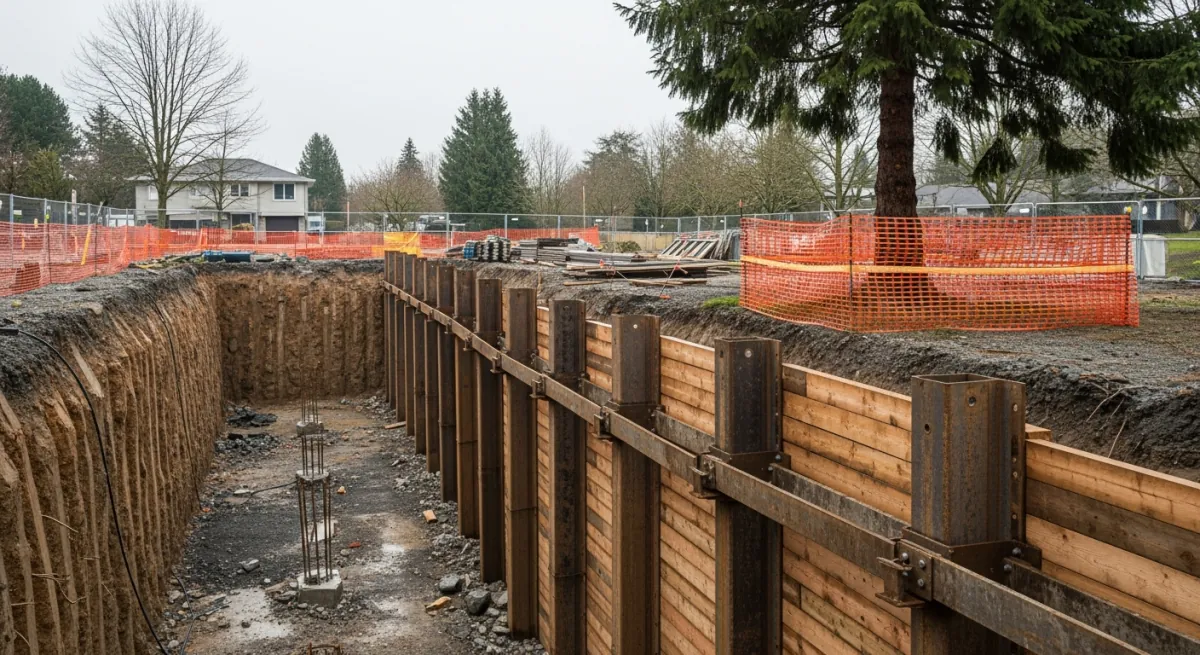
Burnaby's tree bylaw protects every tree 20 cm or greater in diameter on a development property. Trees designated for retention need physical protection fencing installed before demolition equipment arrives, not after. The fencing has to enclose the full root protection zone, which is generally the area under the dripline of the canopy, sometimes wider depending on the species. Equipment, soil stockpiles, construction materials, and parked vehicles all stay outside the fence for the duration of the project.
The City's parks team walks lots and notices. A tree retention plan that exists on paper but not on the ground produces a stop-work order, and the replacement counts under the bylaw go up sharply if a protected tree is killed by construction activity rather than removed under permit. The arborist who wrote the protection plan should be the one who confirms the fencing is correctly installed before demolition starts. A photo for the file is not optional.
Tree protection drives the demolition sequence on lots with significant canopy. Hand-demolition near retained trees, careful equipment routing, soil compaction protection over the root zone, these are decisions the demolition contractor needs in writing before they mobilise. We've covered the bylaw mechanics in the deeper Burnaby tree bylaw post.
Hoarding, dust control, and neighbour notification
Demolition in residential Burnaby is loud, dusty, and visible. A construction fence around the property line, hoarding, is required before demolition begins. The fence does three things: it controls site access, it provides a place to install dust screening, and it puts a visible boundary between the work and the neighbours.
Dust control matters more than owners expect. Wetting the structure during demolition keeps respirable particulate down and keeps debris from drifting onto neighbouring properties. Wind-borne debris from a sloppy demolition is the fastest way to get every neighbour on the block calling the City about your project. We walk the perimeter every morning of demolition.
Neighbour notification is partly courtesy and partly self-protection. A printed letter delivered to every house within sight of the project, two weeks before demolition starts, with the contractor's contact number and a working timeline, costs nothing and prevents three quarters of the calls that would otherwise come to the City. On corner lots and panhandle access, talk to the immediate neighbour about how their daily routine, driveway use, sleep schedules, school drop-off, intersects with your work hours.
The demolition itself
Demolition is mostly a logistics exercise. The structure comes down, the slab and foundation come out, the basement is broken up and crushed, and the lot is left at approximately existing grade with all imported soils and debris removed. A small Burnaby teardown, a 2,000 sq ft single-family home with a basement, typically takes three to five working days on site for the demolition itself once the building is open and abatement is complete.
What watch-list items belong here:
- The slab. Old basement slabs in Burnaby sometimes sit directly on undocumented fill, and what comes out from underneath is what tells you the soil conditions for the new foundation. The crew lead should be photographing the subgrade and flagging anything unexpected for the geotech.
- Underground tanks. Pre-1970s homes in Burnaby Heights and Capitol Hill occasionally have buried oil tanks left from when the original furnace was decommissioned. An undisclosed tank is an environmental site contamination problem with its own reporting and remediation pathway. We have a tank scan run on any lot with that vintage of home.
- Surprise stormwater. Old roof drains and weeping tile sometimes terminate in places the survey didn't show. Find them on the way down, not on the way up.
When the slab is out and the site is clear, the geotech does the first real lot walk, undisturbed soil, no structure obscuring grade, and a clean read on the runoff path. This is the conversation that often shifts the foundation strategy.
Shoring, dewatering, and the slope-lot specifics
On a flat infill lot in Brentwood or central Burnaby Heights, excavation is direct: open the hole to the design depth, slope the sides to a safe angle, get the geotech sign-off, pour the footings. On a sloped lot in Capitol Hill, Buckingham Heights, or along Government Road, the work is more involved.
A daylight-basement excavation against a 6-metre grade change usually requires temporary shoring, soldier piles with timber lagging, soil nails, or a shotcrete face, to hold the cut while the new foundation goes in. The shoring is engineered, inspected, and removed (or left in place as part of the permanent retaining system) according to the geotechnical and structural drawings. None of this is optional. A 3-metre vertical face in saturated coastal soil is not stable on its own.
Dewatering is the second slope-lot reality. Burnaby's coastal soils carry water for most of the year. An excavation that bottoms below the local water table needs a dewatering system, wellpoints, sump pumps, sometimes both, running for the duration of the foundation work. The discharge has to go somewhere the City accepts, which usually means a sediment-control setup before connection to the storm system, not directly into a neighbour's yard.
Protecting the neighbour's lot is the third piece. A new foundation cut at the property line can undermine the neighbour's existing foundation if the soil conditions allow lateral movement. The geotech specifies the protection, sometimes underpinning the neighbour's footing, sometimes a step-down in the excavation profile, sometimes a tieback that has to be agreed in writing. This is the part of Burnaby construction with the highest litigation exposure if it's done casually. We've covered the foundation mechanics in foundations on Burnaby hillside lots and geotechnical reports for Burnaby slope lots.
The soil itself
The excavation tells you what the structural design has been assuming. The geotech does a final field verification, soil bearing capacity, presence of fill or organics, groundwater elevation, frost depth, and either confirms the design assumptions or flags a change. On most Burnaby lots this is uneventful. On filled lots, lots with buried debris, or lots near old creek channels, the geotech sometimes calls for a revised footing detail.
The City wants this on file. Engineering's expectation is that the structural and geotechnical professionals sign off on the excavation before any concrete is placed, and the inspector confirms it on a site visit. The file the inspector wants to see contains the geotech's verification letter, the structural's confirmation, and the excavation photos. If you're using the Burnaby lot eligibility tool earlier in the process, the slope and overlay information it surfaces is exactly what the geotech is going to ask about now.
What this looks like on the calendar
For a Burnaby teardown going through a custom homes build, the realistic site-prep timeline from subjects-off to first concrete is:
- Utility disconnections coordinated: 3 to 6 weeks lead, in parallel with abatement planning
- Hazardous materials survey and abatement: 2 to 4 weeks
- Demolition permit issuance: 2 to 4 weeks after the application is clean
- Tree protection fencing and hoarding: 2 to 3 days
- Demolition and site clearing: 1 week on a typical lot
- Excavation, shoring (if needed), dewatering setup, geotech sign-off: 2 to 4 weeks
That's roughly six to twelve weeks of site work between the closing and the first concrete pour on a typical Burnaby teardown. Slope lots, lots with abatement complexity, or lots that surprise the geotech can run longer. None of this work is exciting. All of it is the difference between a clean foundation and a problem you live with for thirty years.
Where we sit in this
We coordinate it. On a typical Burnaby project we're running the utility paperwork, the abatement contract, the demolition permit, the tree-protection install, and the excavation crew against a single calendar, so the day the foundation is ready, the structural and geotech sign-offs are in hand and the file is clean. The work is invisible when it's done well, and visible when it isn't.
If you're at the offer stage on a Burnaby lot and want a realistic read on what the first three months after closing look like, that's the conversation to start before you remove subjects, not after.
Related on the Journal
- A lot evaluation checklist before you buy a Burnaby teardown
- Foundations on Burnaby hillside lots
- Geotechnical reports for Burnaby slope lots
- Capitol Hill and Burnaby Heights hillside custom homes
Frequently asked questions
- How long does site preparation take on a Burnaby teardown lot?
- Site preparation from closing to first concrete typically runs four to eight weeks on a clean flat lot, and longer on a slope lot that needs abatement or shoring. Icon Projects breaks this into utility disconnections, a hazardous materials survey and abatement, demolition permit issuance, tree protection fencing, demolition itself, and excavation with geotechnical sign-off, roughly six to twelve weeks of work between closing and the first concrete pour.
- Why do utility disconnections take longer than most owners expect?
- Gas, electricity, water, sewer, and telecommunications each belong to a different agency with its own application and lead time. Gas disconnection is usually the slowest, requiring a separate FortisBC application and an on-site visit, with a realistic lead time of three to six weeks. Icon Projects files that paperwork the morning after subjects come off rather than waiting until demolition is scheduled.
- Is a hazardous materials survey required before demolishing a Burnaby home?
- Yes, if the house was built before about 1990, a licensed hazardous materials survey is required before a demolition permit is issued, covering asbestos, lead, mercury, PCBs, and mould. WorkSafeBC is explicit that a building material cannot be assumed asbestos-free just by looking at it, and a Notice of Project has to be filed with WorkSafeBC before any asbestos abatement work begins.
- What waste diversion rate does Burnaby require for demolition?
- Burnaby's demolition waste diversion program requires a minimum of 70% diversion of demolition waste to an approved disposal and recycling facility, documented in a Waste Diversion Plan submitted with the permit application. In practice this turns demolition into deconstruction: cabinets come out before walls come down, wood is separated from drywall, and concrete goes to a crusher rather than landfill.
- When does tree protection fencing need to go up on a Burnaby teardown lot?
- Tree protection fencing has to be installed before any demolition equipment arrives on site, not after. Burnaby's tree bylaw protects every tree 20 cm or greater in trunk diameter, and the fencing has to enclose the full root protection zone, generally the area under the canopy dripline. A retention plan that exists only on paper, without fencing installed correctly on the ground, can produce a stop-work order.
- What is dewatering and when does a Burnaby excavation need it?
- Dewatering is the process of pumping groundwater out of an excavation, using wellpoints, sump pumps, or both, so foundation work can proceed. Burnaby's coastal soils carry water for most of the year, and any excavation that bottoms below the local water table needs a dewatering system running for the duration of the foundation work, with discharge routed through a sediment-control setup before it reaches the storm system.
- What does shoring do on a sloped Burnaby excavation?
- Shoring temporarily holds back the earth cut so a foundation can be built safely, using methods like soldier piles with timber lagging, soil nails, or a shotcrete face. A daylight-basement excavation against a 6-metre grade change on lots in Capitol Hill, Buckingham Heights, or Government Road usually requires engineered shoring, since a vertical face of that height in saturated coastal soil is not stable on its own.
- What happens to underground oil tanks found on older Burnaby teardown lots?
- Pre-1970s homes in Burnaby Heights and Capitol Hill occasionally have a buried oil tank left from a decommissioned furnace, and an undisclosed tank is treated as an environmental contamination problem with its own reporting and remediation pathway. Icon Projects runs a tank scan on any lot of that vintage before demolition begins so a buried tank does not surprise the crew mid-excavation.