Fibre cement, cedar, brick, metal, stucco. The cladding decision is more about the assembly behind it than the panel on the wall, and on the BC south coast the assembly is what fails first.
Cladding is the part of a custom home that owners want to talk about first and builders want to talk about last. Every brief arrives with a Pinterest board of facades, vertical cedar with blackened metal accents, board-form concrete, a "warm modern" stucco-and-wood combination. Every one of those facades is a perfectly defensible choice. None of them survive on the BC south coast unless the assembly behind the panel is right.
This post is about how to choose cladding for a Burnaby custom home, fibre cement, wood, brick, metal, stucco, and, more importantly, what the assembly behind the panel has to do for the cladding to last. We're a Burnaby custom home builder working across the Lower Mainland, and cladding is the surface we end up explaining the most because the failures owners encounter five or eight years in are almost always about the wall, not the panel.
What the Burnaby climate actually does to cladding
The BC south coast is a temperate maritime climate. Mild winters, cool summers, wet autumns and early winters, persistent humidity. The City of Burnaby sits inland from Burrard Inlet, close enough that the coastal salt influence drifts onto Capitol Hill, Burnaby Heights and Westridge in detectable amounts, far enough that it eases as you move toward Brentwood and Metrotown.
Three forces act on cladding in this climate, and they act constantly:
- Wind-driven rain. Pacific frontal systems push rain horizontally against west and north exposures from October through March. The cladding's job is not just to keep rain off the wall; it's to manage water that has already gotten past the surface. Water moves sideways and upward on exposed elevations, not just downward.
- Persistent humidity through the cool months. Average outdoor relative humidity in Burnaby sits in the 80% range from November to February. A wall assembly that allows moisture to enter without a drying path traps water in the cavity, and trapped water at 8 to 12°C cycles into rot rather than evaporating out.
- UV and thermal cycling in the warm months. Summer sun on a south or west elevation moves cladding surface temperatures through 30 to 40°C swings between dawn and mid-afternoon, every day, for four months. Materials that move differently than the wall behind them stress every joint.
The cladding that lasts on the BC south coast is the cladding that handles all three at once. The cladding that fails, and we see plenty of failures on homes built in the last fifteen years, usually fails at the assembly, not the panel.
Rainscreen is the through-line, not the option
Every cladding conversation in Burnaby starts and ends at the rainscreen. A rainscreen assembly is an exterior wall built with a continuous drainage and ventilation gap between the cladding and the weather-resistive barrier (WRB), so that any water that gets past the cladding can drain down and dry out before it reaches the structure.
The BC Building Code requires a "second plane of protection": the rainscreen cavity, on exterior walls in the coastal climate zone. BCBC Section 9.27.2.2 requires it for any Part 9 housing in a location with annual rainfall greater than 1,000 mm, which captures Burnaby and the rest of the Lower Mainland comfortably. The City's development and construction permit process reviews wall assemblies as part of the building permit submission, and an assembly without a properly detailed rainscreen will be flagged.
What a real rainscreen looks like in the field:
- A continuous WRB behind the strapping, lapped shingle-style and taped at penetrations. Self-adhered membranes outperform mechanically fastened housewraps on exposed elevations, but either is acceptable when detailed correctly.
- Vertical strapping (typically 3/8" to 3/4" thick) creating the drainage and ventilation cavity behind the cladding. The cavity has to be open top and bottom so air can move and water can drain.
- Insect screen at top and bottom of the cavity so the ventilation doesn't become a wasp habitat.
- Detailed terminations at openings, soffits, and parapets. The hardest details are not the field of the wall, they're the corners, the head and sill of every window, the meeting of cladding and roof. Every one of those is its own drawing.
A wall built without these details is not a custom home wall. It's a wall waiting to fail. We've torn open enough five- and ten-year-old walls in Burnaby and East Vancouver to know the failure pattern by name: water at the sheathing, rot at the bottom plate, mould behind the panel where the homeowner never saw it. The cost of the rainscreen is meaningfully smaller than the cost of removing the cladding to do it properly later.
For the building science behind the assembly, RDH Building Science is the BC-based firm that has published more on rainscreen performance in the coastal climate than anyone else, and their work is the reference we use when we have to win an argument with an inspector or an owner.
Fibre cement, the workhorse
Fibre cement panels and lap siding (the James Hardie HardiePlank product line is the dominant brand in Canada, with comparable products from Allura and Nichiha) are the most-specified cladding in Burnaby custom homes for a reason. They handle the climate, they accept paint, they meet the rainscreen logic without complaint, and they do not rot, swell, or burn.
What fibre cement does well on the BC south coast:
- Dimensional stability. Movement under thermal and moisture cycling is small. Joints stay closed.
- Fire resistance. Non-combustible substrate, which matters more in wildfire-influenced years and on lots close to the tree-lined neighbourhoods where ember exposure is now considered.
- Paintability. Factory pre-finished or field-painted, with a 15- to 30-year finish life depending on product and exposure.
- Compatibility with rainscreen. Designed and warrantied for installation over strapping with a ventilated cavity behind.
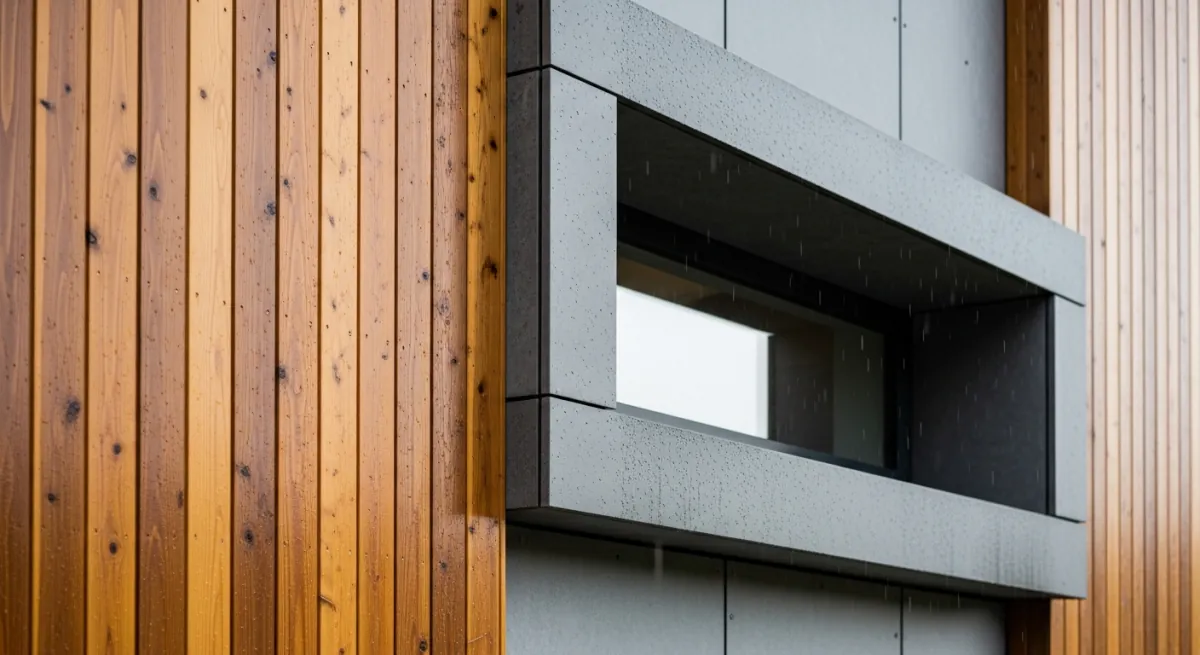
Where fibre cement struggles is mainly aesthetic. The lap profiles can read as suburban if not detailed with restraint. Large-format panel systems (Hardie Panel, Allura Vista) read better on contemporary architecture but demand careful joint planning, control joints, and a tighter installer than the lap product. We typically combine fibre cement with one or two accent materials, vertical wood at the entry, a metal-clad volume at the rear, so the entire facade does not read as a single product.
Lead time is generally workable: most stocking distributors carry the Canadian palette of pre-finished colours, and custom-colour orders run six to ten weeks. Verify the colour at the shop drawing stage; a sample chip in the studio reads differently than a finished wall in February light.
Cedar and pre-finished wood, the heart material
Western red cedar is the indigenous siding of the BC coast. Real, properly detailed cedar on a Burnaby custom home reads in a way no synthetic material does. It also demands more from the assembly and the maintenance schedule.
Two categories of cedar cladding come up on most custom-home briefs:
- Site-finished or unfinished cedar. Bevel, board-and-batten, tongue-and-groove, channel rustic, or shingle profiles. Resources at Real Cedar (the Western Red Cedar Lumber Association) cover the profiles, grades, and finishing options in detail.
- Factory pre-finished wood cladding. Maibec is the Canadian leader, with a factory-finish process that delivers a longer maintenance interval than site-finished material. Worth the premium when the alternative is a refinishing job in year five.
What cedar demands on the BC south coast:
- A real rainscreen cavity, not a token one. Cedar wants to dry from both sides. A flush install over WRB is a slow rot.
- End-grain sealing at every cut. Field cuts that expose untreated end grain are the first places water finds.
- Stainless or hot-dip galvanized fasteners. Standard fasteners stain and corrode against cedar's tannins.
- A maintenance plan the owner actually intends to follow. Site-finished cedar wants a refinish every five to eight years on exposed elevations. If the owner is not going to do it, factory pre-finished or fibre cement is the honest answer.
Cedar earns its place at the front door, the entry volume, the warm accent that fibre cement cannot deliver. We are cautious about cladding an entire elevation in cedar on a fully exposed Capitol Hill north-face lot, the maintenance burden compounds with the exposure. On a tucked Forest Glen or Buckingham Heights lot, a full cedar elevation reads beautifully for decades when the assembly is right.
Brick and stone veneer, heavy, durable, demanding
Brick veneer and natural stone veneer are the longest-lived cladding options. A properly detailed brick wall outlives every other material on this list. The constraints are weight, cost, and detailing.
The structural consequence is real: a brick veneer wall transfers weight back to a brick ledge that has to be designed into the foundation from the start. Adding brick to a wall partway through design means going back to the structural engineer. The detailing, flashing at every horizontal surface, weep holes at the base of every wall, expansion joints at the right intervals, is more demanding than fibre cement or wood.
Where brick and stone earn their cost on a Burnaby custom home:
- As a base material on a two-storey facade, with lighter cladding above. Reads as substantial, draws the eye to the entry, and protects the most water-exposed band of the wall.
- At the entry or chimney as a feature volume. A full brick chimney with a metal-clad upper level is one of the most durable combinations we build.
- On a single restrained elevation. Full brick on every elevation reads as institutional. Brick on one elevation, paired with restraint elsewhere, reads as a custom home.
The rainscreen logic applies, the cavity behind brick veneer is the same drainage and ventilation gap as behind any other cladding, just wider, with weep holes detailed at the bottom of every brick coursing.
Metal panel, modern, durable, exacting
Standing-seam and architectural flat-lock metal panels have moved from commercial into custom-home work over the last decade. Aluminum and pre-painted galvanized steel both perform well on the BC south coast when detailed correctly.
What metal cladding does well:
- Dimensional stability over decades. No swelling, no rot, no UV degradation of the substrate.
- Modern aesthetic. Clean shadow lines, narrow joints, a material vocabulary that pairs naturally with large glazing and concrete.
- Low-maintenance. A pre-painted finish on a quality substrate runs 30 to 40 years before any meaningful refinish.
What metal cladding demands:
- Tighter installer. Metal panel installation is closer to roofing than siding. The crew that installs it well is a different crew than the one that installs lap siding.
- Thermal movement detailing. Metal panels move more than fibre cement with temperature. The clips, hems, and end joints have to accommodate the movement.
- Careful avoidance of galvanic corrosion. Aluminum panels in contact with steel fasteners or steel flashings in a wet climate produce galvanic corrosion. The material specification has to keep dissimilar metals isolated.
We use metal cladding most often as an accent material, the upper volume of a stepped massing, a window wrap, a feature panel, rather than across an entire facade. Full metal facades are achievable but demand a level of detailing discipline that not every team brings.
Stucco, historically common, now a more careful conversation
Stucco was the dominant cladding on Lower Mainland custom homes through the 1990s and early 2000s. It was also the cladding most implicated in the "leaky condo" failures of that era, which means a stucco assembly today gets a more skeptical look from inspectors, insurers, and warranty providers.
Modern stucco can be built well. Two requirements separate the assemblies that perform from the assemblies that fail:
- A real rainscreen cavity. Face-sealed stucco on a paper substrate is the failure pattern. Stucco on strapping with a drained and vented cavity behind is a different assembly entirely.
- Control joints at appropriate intervals. Stucco cracks at corners, at floor levels, and at large uninterrupted spans. Control joints break the wall into stable panels.
The aesthetic case for stucco on a Burnaby custom home is real, properly executed lime-based or acrylic stucco has a depth and texture that fibre cement cannot replicate. We will specify it on projects where the owner understands the maintenance and assembly demands, and where the design has been drawn for stucco rather than retro-fitted to it.
Step Code envelope implications
Cladding choice interacts with the energy story. The cladding itself is not a thermal layer, the wall's R-value comes from the cavity insulation and the continuous exterior insulation outboard of the sheathing, but the cladding determines what continuous insulation strategy is achievable.
Burnaby's current BC Energy Step Code requirement for new single-family construction is Step 3 of the Energy Step Code plus EL-4 of the Zero Carbon Step Code, not Step 5 (which is the provincial target for 2032 and what some builders deliver voluntarily). Both Step 3 + EL-4 today and Step 5 tomorrow ask for high-performance wall assemblies that typically use continuous exterior insulation outboard of the sheathing to limit thermal bridging. The continuous insulation pushes the cladding plane two to four inches further from the structure, which changes the strapping detail, the window jamb depth, the trim profile, and the corner condition.
Three knock-on effects:
- Window installations sit deeper. The window has to be flashed and air-sealed to the structural rough opening, not to the cladding. The exterior trim covers the gap.
- Long fasteners through continuous insulation. Cladding fasteners now pass through 2 to 4 inches of rigid mineral wool or rigid foam before they hit the structure. Specialised fasteners and predictable installer technique matter.
- Heavier cladding choices get harder. Brick veneer with 4 inches of exterior insulation is structurally demanding. Lighter cladding choices, fibre cement, wood, metal, work more easily with the Step 5 envelope.
This is why we talk about envelope decisions at schematic design rather than at finish selection. The cladding looks like a finish decision, but its assembly is a structural and energy decision.
The panel on the wall is the part of the house the owner sees. The assembly behind it is the part that decides whether the panel is still there in twenty years.
Icon Projects Team
A short selection checklist
The questions worth answering when cladding is on the table for a Burnaby custom home:
- What is this elevation's exposure, wind, sun, rain direction?
- What is the rainscreen detail, and who is drawing it?
- What is the continuous exterior insulation strategy, and how does the cladding interact with it?
- Where does the cladding terminate at the roof, the foundation, the windows, the corners?
- What does the owner intend to do for maintenance in years five, ten, fifteen?
- What is the lead time on the specified product, and is the colour confirmed at shop drawing?
- Is there a fire-rating consideration for this lot's proximity to mature tree canopy?
The honest answer on a Burnaby custom home is rarely a single cladding. The strongest facades we build use two or three materials, each on the elevations they handle best, with the assembly behind each one detailed for the BC south coast specifically. Our custom homes service sequences this work at design, not at finish.
If you are choosing cladding for a Burnaby, Vancouver, or North Vancouver custom home and trying to read what your specific lot is asking for, the worth-it conversation is the one that happens at schematic, before the wall section is drawn, not at finish selection. The panel can be picked from a catalogue. The assembly has to be designed.
Related on the Journal
- BC Energy Step Code 5 reality for Burnaby
- Windows that survive Burnaby winters
- Materials that age beautifully
- Exterior and envelope renovation service
Frequently asked questions
- Why does a rainscreen matter so much for cladding on a Burnaby home?
- A rainscreen is a continuous drainage and ventilation gap between the cladding and the weather-resistive barrier, so water that gets past the cladding can drain and dry before it reaches the structure. The BC Building Code requires this second plane of protection under Section 9.27.2.2 for Part 9 housing in locations with annual rainfall greater than 1,000 millimetres, which includes Burnaby. Without it, water at the sheathing and rot at the bottom plate are the failure pattern seen in walls torn open at five to ten years old.
- What is the most commonly specified cladding on Burnaby custom homes?
- Fibre cement panels and lap siding, with James Hardie's HardiePlank line the dominant brand in Canada alongside comparable products from Allura and Nichiha. It offers dimensional stability under thermal and moisture cycling, fire resistance from its non-combustible substrate, a 15 to 30 year paint finish life, and straightforward compatibility with rainscreen installation over strapping. Most Burnaby custom homes combine it with one or two accent materials so the facade doesn't read as a single product.
- How does cedar cladding hold up on the BC south coast?
- Well, but only with a properly detailed assembly. Cedar needs a real rainscreen cavity so it can dry from both sides, end-grain sealing at every field cut, and stainless or hot-dip galvanized fasteners since standard fasteners stain and corrode against cedar's tannins. Site-finished cedar also needs a refinish every five to eight years on exposed elevations. Factory pre-finished wood cladding, such as Maibec, extends that maintenance interval and suits owners who want the look without committing to frequent refinishing.
- Does adding brick veneer to a Burnaby custom home affect the foundation?
- Yes. A brick veneer wall transfers its weight back to a brick ledge that has to be designed into the foundation from the start, so adding brick partway through design means returning to the structural engineer. Brick also needs the same rainscreen drainage cavity as any other cladding, just wider, with weep holes detailed at the bottom of every coursing. It tends to work best as a base material, an entry or chimney feature, or a single restrained elevation rather than covering the whole home.
- What does metal panel cladding demand that fibre cement or wood doesn't?
- A tighter installer, since metal panel installation is closer to roofing than siding, and careful thermal movement detailing because metal panels move more than fibre cement with temperature change. Aluminum panels also need to be kept isolated from steel fasteners or flashings to avoid galvanic corrosion in a wet climate. Metal is most often used as an accent, an upper volume or a window wrap, rather than across an entire facade, because full metal facades demand a high level of detailing discipline.
- Is stucco a safe cladding choice for a new Burnaby custom home?
- It can be, but it gets a more skeptical look from inspectors and warranty providers because stucco was heavily implicated in the Lower Mainland's leaky-condo failures of the 1990s and early 2000s. A stucco assembly that performs needs a real rainscreen cavity behind it, not face-sealed stucco on paper, plus control joints at appropriate intervals to manage cracking at corners and large spans. It should be specified and detailed for stucco from the start, not retrofitted onto a design drawn for something else.
- How does the BC Energy Step Code affect cladding choice in Burnaby?
- Burnaby's requirement for new single-family homes, Step 3 of the Energy Step Code plus EL-4 of the Zero Carbon Step Code, typically calls for continuous exterior insulation outboard of the sheathing. That insulation pushes the cladding plane two to four inches further from the structure, changing the strapping detail, window jamb depth, and fastener length. Heavier claddings like brick veneer become structurally demanding under a thick insulation layer, while fibre cement, wood, and metal work more easily with it.
- Why do cladding failures on Burnaby homes usually show up years after construction?
- Because the panel itself rarely fails first, the wall assembly behind it does. Wind-driven rain pushes water sideways against west and north elevations from October through March, and outdoor humidity sits around 80 percent from November to February, so water trapped behind the cladding without a drying path cycles into rot rather than evaporating. Walls opened up at five to ten years typically show water at the sheathing and rot at the bottom plate, which is why the assembly matters more than the finish material.