
Renovate vs Rebuild · Builder's Decision Guide
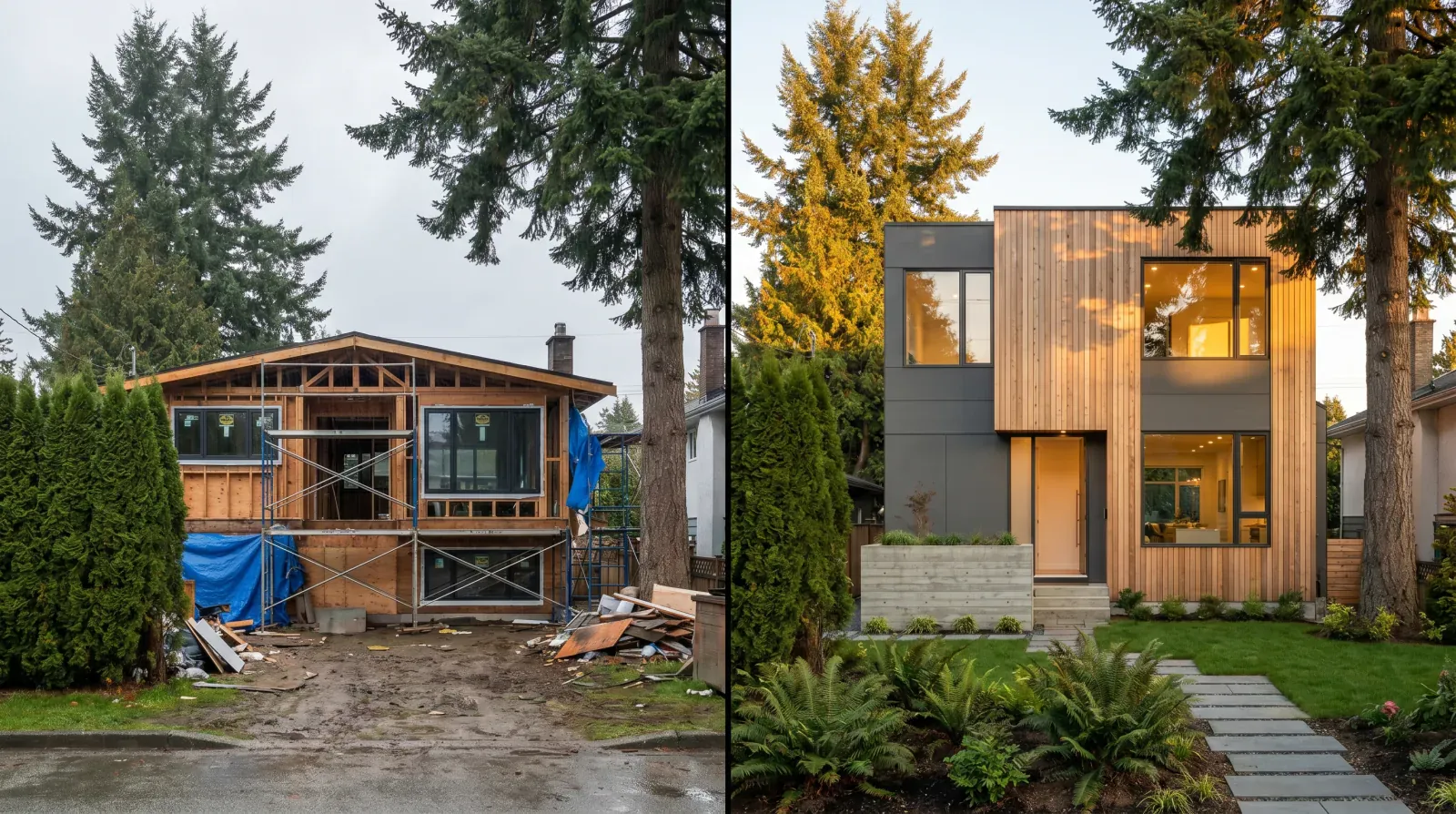
Renovate, add, or rebuild? The decision behind every Burnaby project.
Almost every Greater Vancouver owner starts here. The house has good bones, or doesn't. The lot allows more, or doesn't. The wishlist fits inside the existing footprint, or doesn't. This is the builder's read on how to pull those three threads apart and end up with the right answer, instead of the one you walked in with.
Last updated 2026-05-19 · Refreshed each time we walk a new owner through this conversation.
Working threshold
≈ 60% of replacement
When the renovation scope crosses ~60% of replacement cost, the math usually flips toward rebuild. Pattern, not a code.
Typical timeline gap
6 to 12 months
Tight renovations finish six months ahead of comparable rebuilds. The schedule cost is real and rarely costed.
Decisions that flip
≈ 1 in 3
Roughly a third of owners we walk through this arrive expecting one answer and leave with the other.
What this guide is, and what it isn't
This is a working builder's framework for the renovate-vs-rebuild decision on a Burnaby, North Vancouver, or West Vancouver lot. We've taken houses to the studs, added storeys to ranchers, torn down and rebuilt from grade, and on a handful of jobs talked owners out of all three after walking the lot. The framework below is the one we actually use.
It is not a list of dollar figures. Budget belongs in a planning conversation with a builder who has walked your lot, not in a public guide written before any of us have seen the property. What this guide does is help you ask the right questions in the right order, so the budget conversation, when it happens, is anchored to a real plan.
The three threads that decide it
Every renovate-vs-rebuild decision pulls on the same three threads. Walk them in this order. The first two are read off the house and the lot; the third is the one most owners underweight, and it usually carries the decision.
1. The bones of the existing house
Foundation, framing, envelope, mechanical. A sound foundation is the entry ticket to any renovation conversation, without it, the rebuild is effectively decided. From there you read the framing (is the geometry square, are the floors level, is the original quality good enough to be worth preserving), the envelope (can it be re-clad, or does the wall assembly need to come apart), and the mechanical (which is almost always getting replaced regardless). Our decision-by-house-age sub-guide walks the typical bones by era.
2. What the lot and zoning allow
Burnaby R1 was rewritten by the Provincial SSMUH legislation in 2024, and the redevelopment envelope on most lots is now materially larger than what's standing. North Vancouver City and District have moved in parallel. The delta between what's currently on the lot and what the zoning now allows is one of the strongest signals in the decision, a large delta tilts toward rebuild, a small delta toward renovation. Our lot-and-zoning-test sub-guide has the six checks we run on every prospect.
3. The gap between what you have and what you want
This is the thread owners underweight, and it carries the decision more often than the first two combined. A 1960s rancher with good bones on a great lot is still a rebuild conversation if the owner wants a four-bedroom two-storey with a primary suite on the main floor, there is no renovation that makes a single-storey footprint into a two-storey home without effectively rebuilding it. Get the wishlist on paper before you start scoring the existing house, not after.
How the threads decide
Renovation wins when the bones are sound, the lot delta is small, and the wishlist fits inside the existing footprint. Major addition wins when the bones are sound, the wishlist fits the existing footprint plus a defined extension, and there's a strong attachment to the original layout. Rebuild wins when any one of the three threads is broken, poor bones, large lot delta, or a wishlist that fundamentally cannot live inside the existing structure. In our practice, the rebuild conversation also opens whenever a serious renovation is going to require gutting two of the three anyway. When the read lands on renovation, our whole-home renovation service in Burnaby is how we scope and run it.
In this hub
Two sub-guides go deeper on the parts of the decision that owners get wrong most often, the zoning envelope on the lot, and how the bones actually read by era of construction.
Sub-guide · Lot test
The lot and zoning test, what your lot will actually allow
Six checks that decide what your lot can become under current Burnaby and North Vancouver zoning, and how to read the delta between what's standing and what's allowed.
Read the sub-guideSub-guide · House age
Decision by house age, pre-war to 2000s
How the renovate-vs-rebuild math actually shifts by decade. Pre-war heritage, 1950s post-war, 1970s splits, 1990s suburban, each era's bones rewards a different path.
Read the sub-guideDecision matrix, which path the project usually takes
A rough read on which way the threads usually pull. None of these are universal; every lot has its own story. But the pattern is consistent enough to be useful as a starting point.
| Situation | Typical answer | Why |
|---|---|---|
| Sound 1990s home, owner happy with layout, kitchen and bathrooms tired | Targeted renovation | Bones, lot, and wishlist all align. Lowest-risk path. |
| Sound 1970s rancher, family growing, needs second storey | Major addition | Foundation and main-floor framing usable; second storey adds the missing square footage. |
| 1960s home with cracked foundation, owner wants full four-bedroom layout | Rebuild | Foundation issue alone forces it; wishlist confirms it. |
| 1950s post-war, R1 lot now allowing twice the current floor area | Rebuild | Lot delta is too large to leave on the table; renovation under-uses the lot. |
| Heritage-character home in Burnaby Heights, owner attached to facade | Renovation + rear addition | Facade preservation closes the rebuild door; addition delivers the square footage. |
| 2000s home on a sloped Capitol Hill lot, owner wants modern aesthetic | Renovation | Bones too new to demolish; aesthetic renovation delivers the want at a fraction of the disruption. |
Patterns from our own jobs and the broader Lower Mainland custom-build community. Site-specific factors will shift any of these.
How the decision lands by Burnaby neighbourhood
The renovate-vs-rebuild math reads differently across the City. Where the original housing stock is, when it was built, and what the lot envelope now allows all push the answer in characteristic directions.
- , Burnaby Heights character stock, informal heritage cluster, additions favoured.
- , Capitol Hill slope drives engineering; rebuild more common on poor bones.
- , Buckingham Heights large lots, large lot delta, rebuild often dominant.
- , Deer Lake estate-scale, owner attachment to original character strong.
- , Cariboo 1960s-1970s stock, additions and rebuilds both common.
- , Government Road larger lots, rebuild often unlocks materially more square footage.
How to actually make the call
Seven steps, in the order we walk every owner through.
- 1
Write down what you actually want, before evaluating the house
Spend an evening with your partner or family and list, in plain language, what you want from the next house. Number of bedrooms, layout style (open plan vs separated), kitchen and dining configuration, basement use, accessibility for aging in place, energy performance, garage, outdoor space. Do this before you start evaluating the existing structure. Almost every owner who skips this step ends up retrofitting a wishlist onto a renovation that was never going to deliver it.
- 2
Walk the house with a builder for a structural read
Have a builder walk the house with you for an hour. Look at the foundation (cracks, water staining, original quality), the framing (level floors, square corners, original quality), the envelope (window age, insulation, air sealing), the roof structure, the mechanical age. This is not an engineer's report, it is the builder's pattern-recognition read on whether the structure is worth preserving.
- 3
Pull current zoning and check the redevelopment envelope
Look up the lot's current zoning, Burnaby R1, R5, or one of the higher-density categories. Note the maximum allowed floor area ratio, the height limit, the setbacks, and any tree-protection or slope overlays. Compare what's currently built to what the zoning allows. A large delta between the two is one of the strongest signals that rebuild deserves a serious look.
- 4
Sketch the new layout twice, once as a renovation, once as a rebuild
Get the architect or designer to produce two preliminary block plans. One that achieves your wishlist by renovating and adding to the existing structure. One that achieves it by rebuilding. They don't need to be detailed, just enough to see what the constraints of the renovation actually cost you in layout, and what the rebuild gains. The drawings make the trade-off visible in a way conversation never does.
- 5
Get a comparative cost framing from a builder who has done both
Bring both sketches to a builder for a comparative framing of the work. Not a fixed price, neither sketch is detailed enough for that, but a working read on what scope of work each option represents, what risks each carries, and what the schedule looks like. A builder who has done both renovations and rebuilds will tell you honestly which one fits the project; one who only does new construction will steer you toward rebuild every time.
- 6
Decide on the question, not the answer
Sit with the two options for at least two weeks. Walk the existing house every evening with the rebuild sketch in mind. Talk to neighbours who have done one or the other. The right answer is usually obvious once the wishlist, the zoning envelope, and the structural read are all on the same page, and it is almost always different from the answer the owner started with.
- 7
Commit, and stop second-guessing
Once the decision is made, commit. The most expensive thing in this entire process is changing direction mid-design, adding a rebuild option after the renovation is well into permit drawings, or trying to scale a renovation up into a rebuild after framing has started. Pick a path, write down why, and move forward.
Related field notes
Specific houses, specific lots, specific decisions we have walked. These are the working notes the sub-guides above summarize.
Reference
Evaluating a Burnaby teardown lot
What to look at before you write an offer on a knock-down candidate. Trees, slope, frontage, services, and the half-dozen lot conditions that change the rebuild conversation.
Read the field noteNeighbourhood
Renovate, add, or rebuild in Burnaby Heights
The specific calculus on the Heights, lot sizes, original housing stock, the heritage informal cluster, the slope. What the answer typically looks like here.
Read the field noteReference
Burnaby permit timeline for 2026
How long renovation, addition, and new-construction permits actually take through the Burnaby building department this year, with the back-and-forth most owners don't see coming.
Read the field noteFAQ
Ten questions owners ask us at this stage of the conversation.
- How do I know if my house is worth renovating or should be torn down?
- Three things decide it: the bones, the lot, and the gap between what you have and what you want. Bones means foundation, framing geometry, and envelope condition, if the foundation is sound, the framing is square, and the envelope can be re-clad without rebuilding walls, renovation is on the table. Lot means whether the zoning allows what you actually want to build; on most Burnaby R1 lots, the new home is materially larger than what's standing. The gap is what closes the question, a 1960s rancher when you want a four-bedroom two-storey is a rebuild conversation regardless of how good the bones are.
- What's the rough threshold where renovation stops making financial sense?
- Builders use a working rule that when the planned renovation scope exceeds about 60% of replacement cost, you are paying renovation prices for new-build outcomes, and that's the point where the math usually flips to rebuild. The number is not a code or a law; it's a pattern we see across our own jobs and across the BC industry. The threshold drops on a poor foundation, on a lot where the zoning unlocks much more square footage, or on a house whose layout fundamentally cannot become what the owner wants.
- What's a 'major addition' and when is it the right answer?
- A major addition extends the existing house, usually adding a storey on top, a substantial extension to the rear, or both, while keeping the original foundation and most of the original framing. It works best when the existing structure is sound, when the owner has lived in the house and likes the location and layout of the front portion, and when the lot allows the extra square footage under current zoning. It rarely works on slab-on-grade ranchers, on homes with chronic foundation issues, or where the existing roof has to be removed entirely to add the storey.
- Does Burnaby require different permits for a rebuild versus a major renovation?
- Yes. A rebuild requires a full building permit on new construction; a major renovation requires a building permit for alterations plus, frequently, a separate demolition permit for the portions removed. The renovation permit can be faster if the work is contained, or slower than a rebuild if the scope crosses the threshold where the City treats it as substantially new construction. North Vancouver City and District follow similar logic but use different thresholds. Confirm with the building department before assuming.
- Can I keep one wall standing to count as a renovation for tax or permit purposes?
- On the BC tax side, no, the GST treatment is based on the substantive nature of the work, not on a token wall. On the permit side, the City's plan reviewers look at whether the existing structure is substantively retained; one wall standing while everything else is rebuilt is treated as new construction. Don't design around a loophole that doesn't exist.
- What about heritage homes, can I rebuild a heritage-designated house?
- Only with a Heritage Alteration Permit, and usually not in the same form. A formally designated heritage property cannot be demolished without municipal approval, and where approval is given, it usually conditions on retaining specific elements, the facade, the front rooms, the original windows. Burnaby Heights, Capitol Hill, and parts of Vancouver have informal heritage clusters where neighbour pressure carries real weight even when there's no formal designation. Walk that conversation with a builder who has done it before.
- What if the lot is worth more than the house?
- Almost every detached-house lot in Burnaby and Vancouver is now worth more than the structure on it. That alone doesn't push the answer toward rebuild, what matters is the gap between the existing house and what would replace it under current zoning. The rebuild conversation gets interesting when the new home would be materially larger, materially more efficient, or fundamentally laid out differently than the original.
- Is a major renovation cheaper than rebuilding?
- Sometimes. A targeted renovation that keeps the foundation, the envelope, and most of the framing is cheaper per square foot than new construction. A major renovation that strips the house to studs, rebuilds the envelope, replaces the mechanical, and adds a storey is rarely cheaper than rebuilding, it's just an alternative that preserves an existing layout the owner wants. The fact that we're talking about a major renovation is usually a sign that the rebuild deserves a serious look.
- How long does each option take?
- A tightly scoped renovation that doesn't move structure runs three to six months on site, plus design and permitting. A major addition adds another three to six months on top. A rebuild on a Burnaby R1 lot, from design start to occupancy, is typically twelve to eighteen months, longer on a hillside or a complex zoning situation. The timing trade-off matters: a six-month gut renovation can keep the family in the house through the seasonal moves; a rebuild cannot.
- What's the single biggest mistake at this decision point?
- Anchoring on the wrong question. Owners ask 'can we save this house?' when the real question is 'what do we actually want to live in for the next twenty years?'. The first question optimizes for not losing what you have; the second optimizes for getting what you want. The second is the right question, and it makes the renovate-vs-rebuild call clearer in almost every case we have walked through.
- How does the Burnaby Tree Bylaw influence the renovate-versus-rebuild decision?
- It pushes the decision toward renovation for lots with mature trees. Any tree with a trunk diameter of 20 cm or larger on a property under a development application is protected, and a teardown-rebuild on a typical Burnaby Heights or Capitol Hill lot routinely captures four to seven mature trees over that threshold, each requiring one-for-one replacement or a cash-in-lieu payment. A renovation retains those trees almost by default, which is one of the strongest pulls toward renovating on a lot with established landscaping.
- Is there a middle option between renovating and building new?
- Yes: a deep gut paired with a substantial addition. This means stripping the existing house to its frame, reframing what needs to change, and adding the square footage the original plan couldn't carry. It keeps the lot-equity advantage of a renovation while landing close to a new build in outcome. It fits best when the existing foundation is sound but the floor plan needs major rework, or when the lot's orientation or mature trees are worth preserving.
- Does a renovation get the same home warranty coverage as a new custom home in BC?
- Not automatically. New construction in BC carries mandatory 2-5-10 home warranty insurance in full: two years on materials and labour, five years on the building envelope, ten years on structural defects. Renovations and reconstructions get partial warranty coverage depending on the scope of work, which is a real factor for an owner planning to stay in the home long term and worth raising with the builder before committing to either path.
Official sources
- , City of Burnaby, Building Permits.
- , Burnaby R1, Small-Scale Multi-Unit Housing the updated zoning that changed the redevelopment envelope on most R1 lots.
- , Province of BC, Small-Scale Multi-Unit Housing (SSMUH).
- , District of North Vancouver, Property and Development.
- , BC Housing, builder licensing and 2-5-10 warranty registry.
Bylaws and zoning are revised regularly. Verify the redevelopment envelope on your lot against the City rules in force on your permit date.