
Renovate vs Rebuild Hub · Sub-guide 1 of 2
What the lot will actually allow you to build.
The renovate-vs-rebuild decision is half a read on the existing house and half a read on the lot. This sub-guide is the lot half. Six checks, in the order we run them on every Burnaby and North Vancouver prospect, that tell you whether the lot is asking to be redeveloped or left mostly alone.
Last updated 2026-05-19
Why the lot half carries the decision
On a flat read of the existing house, almost every Burnaby detached home can be renovated. Bones are usually salvageable; foundations rarely fail outright; the envelope can be re-clad. The reason rebuilds dominate the conversation in 2026 is not the houses, it's the lots. The 2024 SSMUH legislation, combined with Burnaby's R1 rewrite, materially expanded the redevelopment envelope on most parcels. A lot that previously allowed 2,800 ft² now allows 4,000 ft² or more, sometimes with a coach house. Walking past that delta is a real decision; pretending it doesn't exist is a missed one.
The point of the lot test is not to force the rebuild answer. It's to put the envelope numbers next to the wishlist numbers, so the decision is made on what the lot can support rather than on what the current house looks like.
The six checks we run
In this order. Each one is cheap on its own; doing them all in this sequence is the part most owners skip and most builders pretend isn't necessary.
Pull the current zoning
Look up the lot's zoning class on the City's interactive zoning map. Note the base permitted floor area ratio, height limit, allowed unit count, and required setbacks. Burnaby R1, R5, R9, RM-1 each have different envelopes; assume nothing.
Map the buildable envelope on paper
Take the lot dimensions from a current survey (or the LTSA plan if no survey exists) and physically draw the buildable envelope after subtracting front, rear, and side setbacks. The square footage you see inside that envelope, multiplied by the allowed storeys, is the upper bound the zoning permits.
Layer in the overlays
Check for slope-hazard, flood-hazard, SPEA (streamside), tree-protection, and heritage overlays. Each one shrinks the buildable envelope from a different direction. Burnaby's interactive map shows them; North Vancouver District's natural-hazards layer is the equivalent.
Measure what's currently built
Pull the original building permit or BC Assessment record for the existing home's gross floor area. Compare it to the upper bound from step 2. The gap is the lot delta, small (< 25%), moderate (25 to 60%), or large (> 60%).
Check the title for covenants and rights-of-way
Order a current title search from the LTSA. Statutory rights-of-way for drainage, sewer easements, building schemes that pre-date current zoning, and registered covenants can all materially limit what the base zoning otherwise allows. We have seen lots where a 1970s building scheme caps the floor area below what the City would permit today.
Walk it with a builder and an architect together
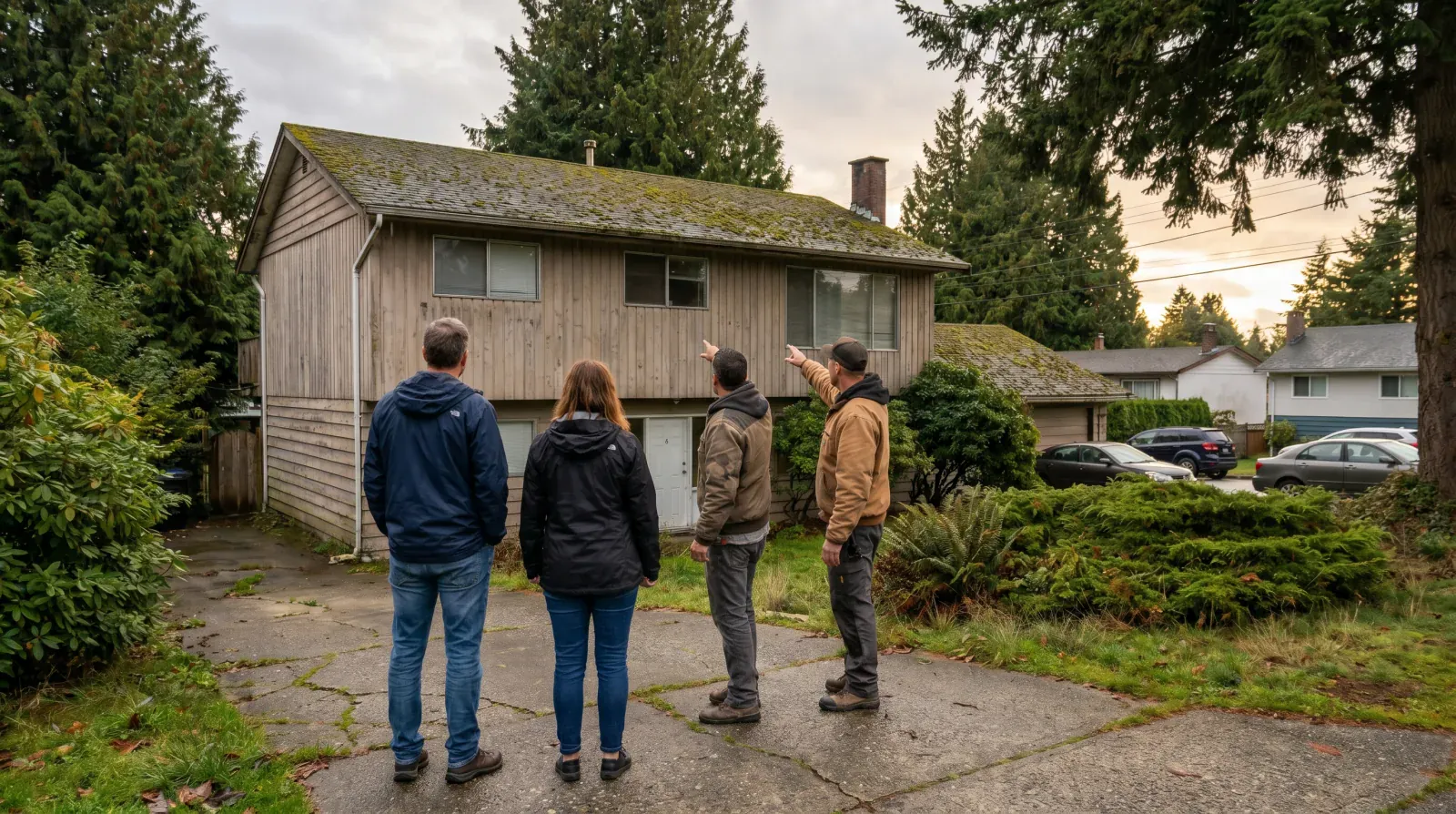
Once you have the envelope and the overlays on paper, walk the lot with a builder and an architect at the same time. The architect reads the constraints from the design side; the builder reads them from the construction-sequencing side. The conversation between the two of them, on the actual lot, is the part the desk analysis cannot replicate.
Reading the lot delta
Once you have the upper-bound envelope and the existing floor area on the same page, the gap between them is the lot delta. It is not the only signal in the decision, but it's the one that quietly carries most of the weight.
| Lot delta | What it usually means | Decision tilt |
|---|---|---|
| Small (under 25%) | Existing home is close to what the lot allows. Rebuild gains little new square footage. | Renovation or addition |
| Moderate (25 to 60%) | Meaningful additional square footage available, but renovation may capture most of it. | Major addition or rebuild |
| Large (over 60%) | Lot will support a materially larger home. Existing structure under-uses the parcel. | Rebuild |
| Negative | Existing home is over the current zoning envelope (legal non-conforming). Renovation possible; expansion restricted. | Renovation only |
The brackets above are working ranges from our own jobs. Site-specific factors, overlays, neighbourhood character, owner attachment, will shift the answer.
Common lot-test failures
Three things go wrong on the lot test more often than anything else, and each of them is easy to catch on the second pass if you know to look for it.
- Reading the zoning without reading the title. The base zoning permits something; a registered covenant against the title prohibits it. We have seen this on lots where a 1960s building scheme caps floor area below the current R1 envelope.
- Ignoring the overlays. Slope-hazard, SPEA, and flood-hazard overlays all eat into the buildable envelope. Walk the City's interactive map with the overlays turned on, not off.
- Confusing floor area ratio with usable square footage. FAR is calculated against a defined methodology, basements, garages, stairwells, and covered porches each count differently. A 0.7 FAR doesn't translate one-for-one to liveable space. Ask the architect to model it.
Related
Next in this hub
Decision by house age, pre-war to 2000s.
Once the lot side is clear, the existing-house side is next. How the bones actually read by decade of construction, and where each era usually lands on the renovate-vs-rebuild call.
Read sub-guide 2Field note
Evaluating a Burnaby teardown lot.
The longer field note this sub-guide summarizes. Trees, frontage, services, easements, the specifics that decide whether to write the offer.
Read the field noteCompanion guide
Burnaby R1 and SSMUH, explained.
The 2024 zoning rewrite that changed the lot test. What the new envelope actually permits, and how the City reads it in practice.
Read the explainerThe service
Whole-home renovation in Burnaby.
When the lot test points toward keeping and renovating the existing home, this is how we scope and run a full whole-home renovation.
See the serviceFAQ
- What is the redevelopment envelope on a Burnaby R1 lot in 2026?
- Burnaby's R1 zoning was rewritten in 2024 to comply with the Provincial Small-Scale Multi-Unit Housing (SSMUH) legislation. On a typical R1 lot, the City now permits up to four units, with site-specific setbacks, height, and floor-area-ratio limits that vary by lot frontage and depth. The redevelopment envelope on a 50-by-120 R1 lot is materially larger than the single-family home that currently sits on most of them. Check the current bylaw against your specific lot, the envelope keeps moving.
- Does SSMUH force me to build multiple units?
- No. SSMUH expanded what is permitted; it did not require it. You can still build a single detached home on an R1 lot. The point of the test below is to understand what the lot now allows, regardless of which option you ultimately choose. A lot that allows materially more than what's standing changes the renovate-vs-rebuild conversation even if you only ever want one unit.
- How do I find my lot's current zoning?
- Burnaby's interactive zoning map (burnaby.ca/property-info) shows the zoning by parcel. Pair it with a current title search from the LTSA to catch covenants, statutory rights-of-way, and building schemes that override the base zoning. For North Vancouver City and District, use their respective property-information portals. Always cross-check with the building department before making a decision, the maps are accurate but the application-of-bylaw to a specific lot benefits from a planner's read.
- What does 'lot delta' actually measure?
- The lot delta is the gap between the floor area, height, and units allowed by current zoning and what's currently built on the lot. A lot where the existing 1,800 ft² rancher could be replaced by a 4,000 ft² home (plus a coach house) has a large delta. A lot where the existing 3,200 ft² 1990s home is already close to the allowed envelope has a small delta. Large delta tilts the decision toward rebuild; small delta tilts it toward renovation.
- Do trees on the lot kill the rebuild option?
- Not usually, but they constrain the building footprint and the construction sequence. The Burnaby Tree Bylaw protects most trees over 20 cm DBH, and protected trees inside or near the new building envelope have to be retained or replaced under a permit. The arborist's report runs in parallel with the architect's massing, get them on the same drawing early.
- What about flood hazard, slope hazard, or environmentally sensitive areas?
- Any of these overlays narrows the buildable envelope and adds engineering requirements. Slope-hazard overlays trigger geotechnical review (see our hillside hub). Flood-hazard overlays affect minimum building elevation. Streamside Protection and Enhancement Area (SPEA) overlays push the building away from any creek or watercourse on or adjacent to the lot. Pull the overlays before you commit to a path.
- Does the lot's frontage matter as much as its area?
- Often yes. Burnaby R1 setbacks scale with frontage, and a narrow lot, say 33 feet wide, produces a much tighter building footprint than a 50-foot lot of the same area. Setbacks, side-yard requirements, and parking access all read off frontage first.
- Can I do the lot-and-zoning test myself, or do I need a professional?
- You can do the first pass yourself with the zoning map, a measuring tape, and an afternoon. What you cannot do without a professional is the second pass, the part where the architect models the actual buildable envelope inside all of the applicable overlays. The first pass tells you whether the conversation is worth having; the second pass tells you what the lot can actually support.
Official sources