
Renovate vs Rebuild Hub · Sub-guide 2 of 2
How the bones read, decade by decade.
The lot test tells you what the parcel can support. This sub-guide tells you what the existing house is actually made of. The renovate-vs-rebuild math reads differently on a 1925 bungalow than on a 1975 split, and the difference is the framing, the envelope, the mechanical, and the layout-trap that each era built into the housing stock.
Last updated 2026-05-19
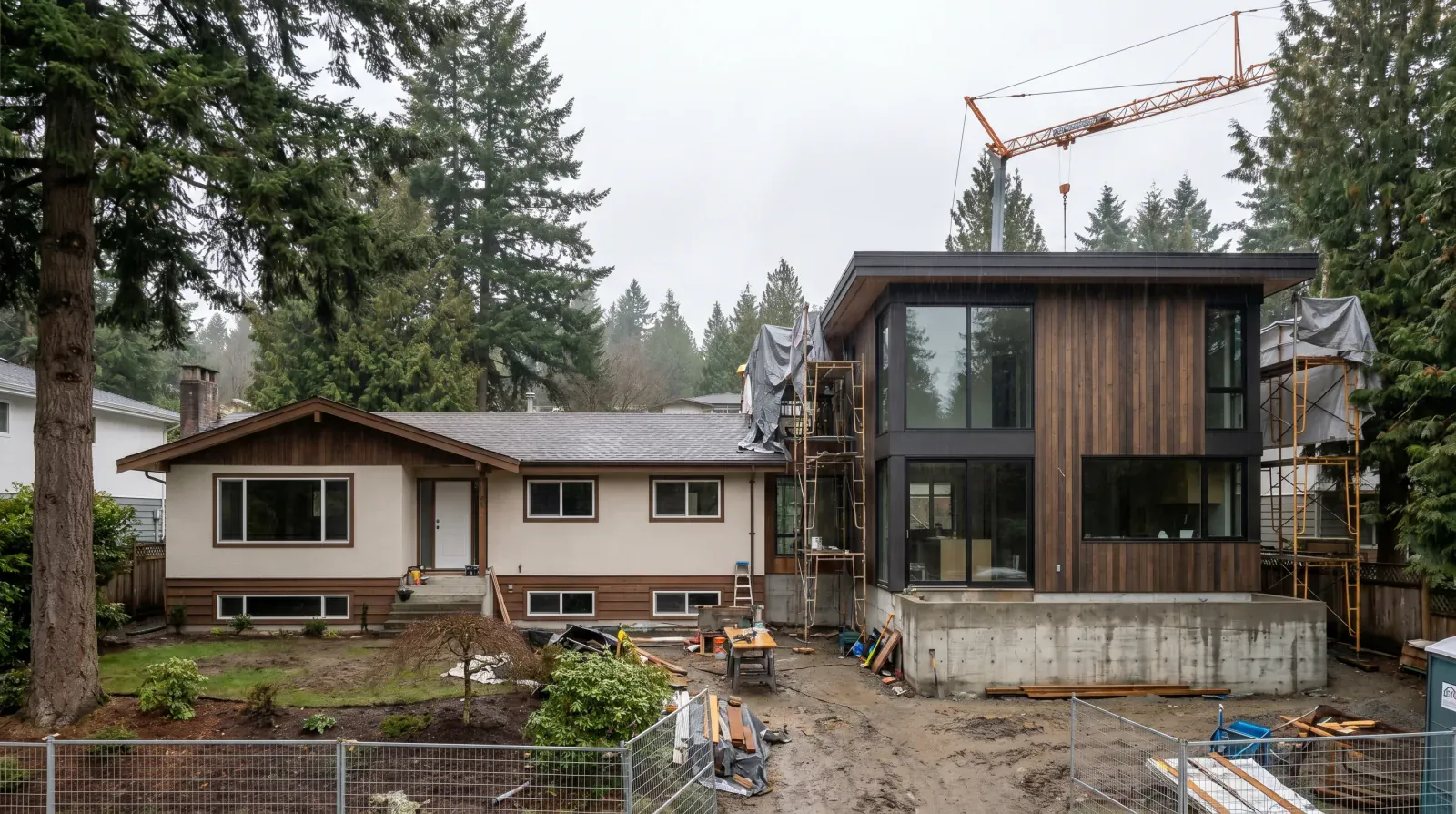
Why the era of construction matters
The City of Burnaby's housing stock spans roughly a hundred years, and each twenty-year window of that century is characteristic. Materials, structural standards, energy assumptions, layout conventions, and even lot geometry change era to era. When we look at an existing home, the age is the first variable we read, it tells us, before we walk inside, what the project is likely to look like.
The summary below is a generalization. There are exceptionally well-built 1970s homes and exceptionally poorly-built 1990s ones. But the patterns hold often enough to be useful as a starting frame.
The six eras we read
Each card below summarizes the bones, the typical issues, the most common decision tilt, and the practical notes we carry into the planning call.
Pre-1940 (Pre-war)
Bones: Full-depth dimension lumber, plaster-and-lath walls, Douglas-fir flooring, full-depth basement common. Foundations vary, earliest are unreinforced concrete or brick.
Typical issues: Knob-and-tube wiring, galvanized supply lines, asbestos in pipe wrap and old flooring. Envelope under-insulated and undermined by modern moisture levels.
Decision tilt: Renovation (with envelope and systems overhaul)
Notes: Character preservation matters in these neighbourhoods. Permitting bodies and neighbours both expect the original to be retained.
1940s-1950s (Post-war)
Bones: Dimension lumber framing, simple gable roofs, modest footprints. Concrete strip foundations, usually intact.
Typical issues: Cramped rooms, low ceilings, single-pane windows. Asbestos in vermiculite attic insulation. Wiring may be knob-and-tube or early aluminum.
Decision tilt: Major addition or rebuild
Notes: Footprint and ceiling height are the binding constraints. Owners who want modern open layouts almost always rebuild; those willing to live with the original geometry can add to it.
1960s-1970s (Splits & ranchers)
Bones: Standard 2x4 stud framing, basic concrete foundations, asphalt-shingle roofs. Splits use half-storeys with stairs at each level.
Typical issues: Aluminum windows, minimal envelope insulation, dated mechanical, layout-trapped on splits. Galvanized supply lines on the early end, copper or PEX on the late end.
Decision tilt: Rebuild (especially splits) or major addition (on simple ranchers)
Notes: The era most likely to land on rebuild in 2026. Lot deltas are typically large; layout limitations are severe; modernization scope often exceeds replacement value.
1980s
Bones: 2x6 wall framing arrives, better truss roof systems, basements more common. Foundations generally sound. Some flat-roof modernist styles in pockets.
Typical issues: Envelope marginal by current standards, vinyl windows of the era are at end-of-life, mechanical is dated. Layout tighter than 1990s but better than 1970s.
Decision tilt: Major addition or substantial renovation
Notes: The bones support significant renovation; the cosmetic and mechanical scope is large. Decision often hinges on whether the lot delta justifies starting over.
1990s
Bones: Modern framing standards, engineered roof trusses, generally well-built. Foundations sound. Envelope assemblies functional but below current Step Code.
Typical issues: Original double-pane windows now at end-of-life, mechanical aging out, kitchens and bathrooms dated. Some face-sealed stucco assemblies have moisture issues.
Decision tilt: Renovation, occasionally major addition
Notes: Most 1990s Burnaby homes are renovation projects. Bones, layout, and envelope are all in the salvageable range. Rebuild only when lot delta is exceptional or aesthetic preference is decisive.
2000s-2010s
Bones: Code-compliant construction, modern framing, engineered components, generally tight envelopes. Foundations sound by design.
Typical issues: Cosmetic and feature-level dating. Mechanical and finishes may need updating in the 15 to 25-year range; structure rarely does.
Decision tilt: Renovation only
Notes: Effectively never a rebuild candidate. If a 2010s home is being considered for teardown, the decision is being driven by something other than the structure.
What we actually look at on the walk-through
Once we know the era, the walk-through is the read on whether the typical pattern holds for this specific house. Six things we check, in order, on the first walk:
- The foundation. Walk the perimeter from inside the basement or crawl space. Look for cracks, water staining, efflorescence, and any sign of settlement. The foundation determines whether renovation is even on the table.
- The floor levels. Roll a marble. Standard ranchers that are out of level by 25 mm across a room signal framing movement. Less than that is normal aging; more than that is a structural conversation.
- The wall and roof framing. Look at exposed framing where possible (basement ceiling, attic). Quality of original workmanship is the strongest predictor of whether the renovation will hit hidden issues.
- The envelope. Window age, exterior cladding condition, evidence of past leaks. A 1970s home with original aluminum windows is getting all of those replaced regardless of which path the project takes.
- The mechanical. Furnace, hot-water tank, electrical panel, water service. Almost always replaced on a major renovation; the question is just whether replacement is in scope.
- The layout. Walk it as if you already lived there. Where do you eat, where do you work, where do the kids do homework, where do you put the car. The layout walk-through frames the wishlist more honestly than any conversation in the kitchen does.
Era-specific mistakes we see
Each era has a characteristic mistake owners make when they decide what to do with the house. Knowing the mistake doesn't always mean avoiding it, but it sharpens the conversation.
- Pre-war: over-restoring. Spending heritage-restoration money on a house that wasn't formally designated, when an honest contemporary renovation would have served the owner better.
- Post-war: renovating without expanding. The cramped rooms and low ceilings are the binding constraint; renovating without addressing them rarely closes the wishlist gap.
- 1970s split: trying to make the half-storeys work. The split-level layout was a product of its era and rarely converts gracefully into a modern primary-suite-on-the-main configuration.
- 1980s: renovating one room at a time. The envelope and mechanical needed simultaneously; sequential renovations end up costing more than one coordinated project.
- 1990s: rebuilding when renovation would have served. The era's bones rarely demand rebuild; aesthetic preference dressed up as structural necessity is the trap.
- 2000s: over-renovating. Tearing into structure that didn't need tearing into.
Related
Back to hub
Renovate, add, or rebuild? The decision guide.
The pillar guide that ties this sub-guide to the lot-and-zoning test, the decision matrix, and the seven-step planning sequence.
Back to the hubSub-guide
The lot and zoning test.
Before the era of the house decides the answer, the lot itself might. Run this test first to see what your zoning actually allows.
Run the zoning testField note
Renovate, add, or rebuild in Burnaby Heights.
The neighbourhood-specific read on this exact decision. Heights housing stock skews pre-war and post-war; the era patterns above shape the conversation in characteristic ways here.
Read the field noteThe service
Whole-home renovation in Burnaby.
When the era read lands on renovation rather than rebuild, this is how we scope and run a full renovation, the honest assessment first, then the build.
See the serviceFAQ
- Why does the decade of construction matter so much?
- Each construction era used a characteristic structural system, a characteristic envelope assembly, and a characteristic mechanical layout. Those choices determine how renovation work actually proceeds, what comes apart easily, what doesn't, and where the hidden costs live. A 1920s home and a 1990s home of identical square footage produce wildly different renovation projects.
- Are pre-war homes always worth preserving?
- Architecturally and in neighbourhood-character terms, often yes. Structurally and energy-wise, it depends. Pre-war Burnaby homes built well, bungalows with full-depth dimension lumber framing, original Douglas-fir floors, lath-and-plaster walls, have bones that can outlast another century if the foundation is intact. The renovation cost is in the envelope upgrade and the mechanical replacement. The decision usually comes down to how much character preservation matters to the owner.
- What's the biggest issue with 1950s post-war homes?
- Two issues: undersized everything (rooms, ceilings, windows) and asbestos in original materials. The post-war housing boom built quickly to serve returning families, and the spaces feel cramped by modern standards. Asbestos in vermiculite insulation, pipe wrap, and original flooring requires abatement that adds cost and schedule to any renovation that opens walls. On the upside, the framing is usually sound and the foundation, while basic, is rarely defective.
- Why do 1970s splits and ranchers come up for rebuild so often?
- Three things converge. The original framing and footprint don't suit modern open layouts; the envelope is poorly insulated and uses original aluminum windows that leak air and heat; and most 1970s lots in Burnaby now have a large redevelopment delta under current zoning. Splits in particular are layout-trapped, the half-storeys that defined the era are hard to make work with modern primary-suite expectations.
- Are 1990s homes ever rebuild candidates?
- Rarely on bones alone. 1990s construction is typically structurally sound, envelope-functional (though below current Step Code), and dimensionally close to modern expectations. The rebuild conversation on a 1990s home is almost always driven by aesthetic preference or by a lot delta, the house itself is not asking to be torn down.
- What about 2000s and newer homes?
- Almost never rebuild candidates. Construction is generally sound, the envelope meets a closer-to-current standard, and the layout typically suits modern living. Most of these projects are renovations focused on kitchens, bathrooms, basements, and energy upgrades. A 2010s home being torn down for a new build is unusual enough that we treat it as a signal that something else is going on.
- What about leaky-condo-era detached homes from the 1990s?
- The leaky-condo crisis primarily affected multi-family construction, but some detached homes from the same period have envelope assemblies that don't drain well, face-sealed stucco over inadequate flashing, in particular. If the envelope is leaking on a 1990s detached home, the renovation conversation pivots from interior to envelope, and the cost gets serious. Worth confirming before assuming renovation is the cheap path.
- How does heritage designation interact with the age decision?
- A formal heritage designation forecloses the rebuild option without a Heritage Alteration Permit. Informal heritage clusters, Burnaby Heights, parts of Capitol Hill, the older streets of Vancouver, exert similar pressure even without designation, through neighbour opposition, character review, and the social cost of being the one who tore down the 1920s bungalow. Factor it in.
Official sources
- BC Building Code, current and historical editions.
- BC Energy Step Code the modern envelope benchmark.
- WorkSafeBC, asbestos in residential renovation.
- City of Burnaby, heritage permits.