Decision
Custom Home vs Major Renovation in Burnaby: When Does Each One Win?
Most Burnaby owners walk in with their mind made up. About a third leave with the opposite plan. Here's how the BC Building Code, the tree bylaw, and the lot itself usually decide it for them.
On site with Sanj
Most people think they're choosing between two homes, the real choice is what each one will cost you over the next twenty years.
Open Reel on Instagram →Custom home or renovation: which one is right?
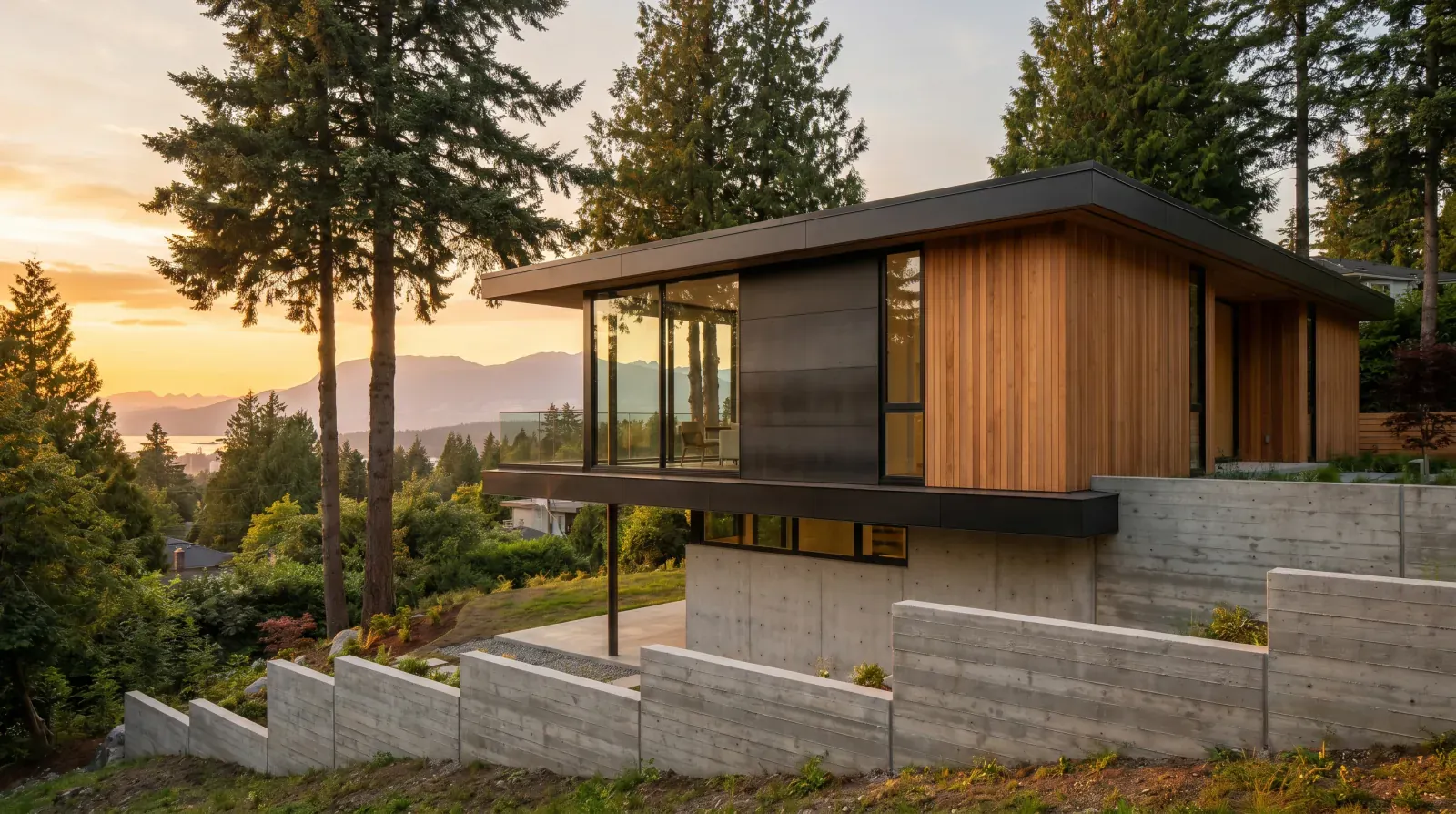
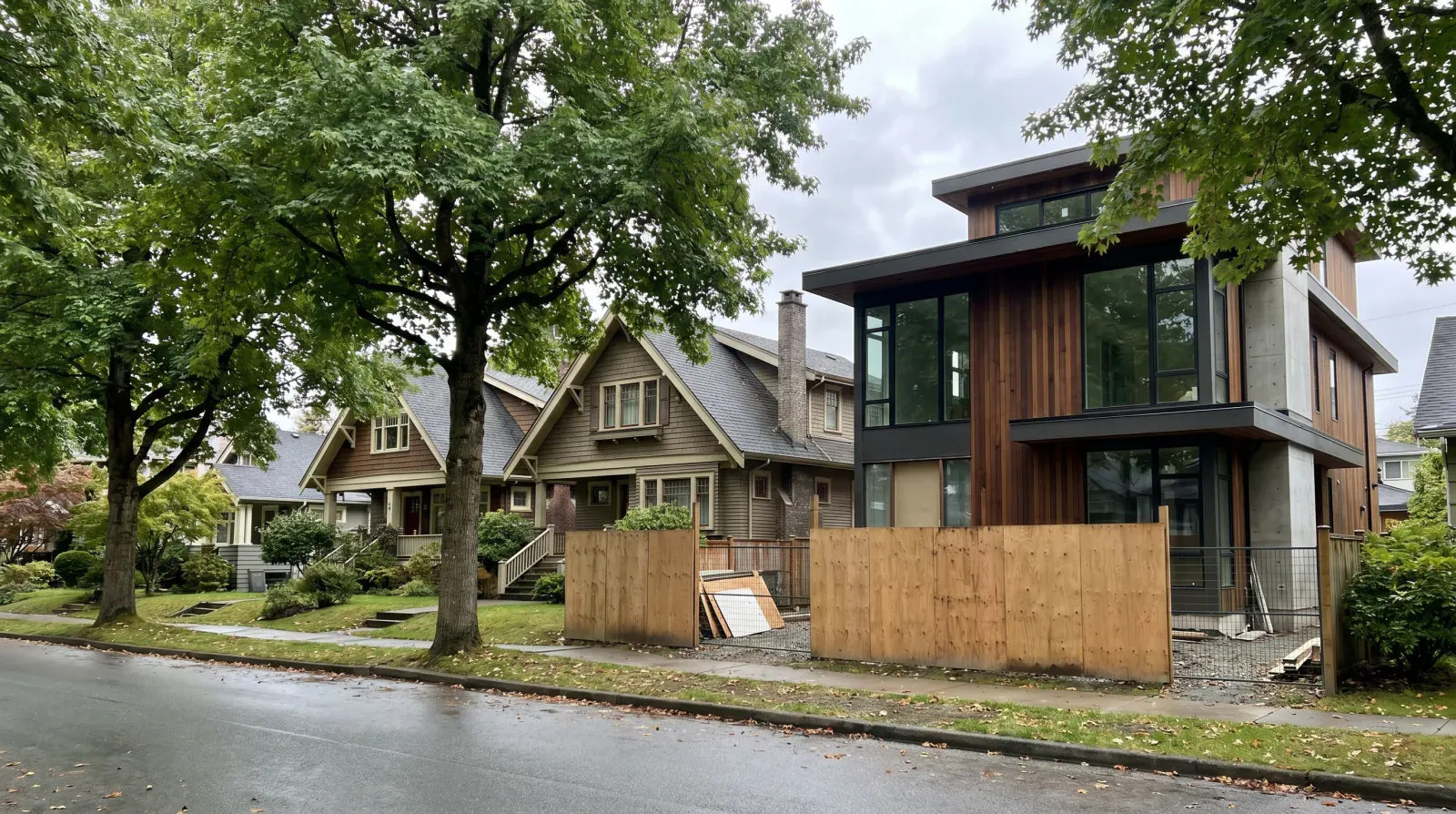
Renovation wins when the structure, footprint, and ceiling heights are already good. A custom home wins when the existing structure can't support the brief, the lot allows more density under SSMUH (room for a laneway or coach house, for example), or the owner wants a fully engineered building optimized for energy performance. The Burnaby tree bylaw and lot conditions often decide it.
Most Burnaby owners walk in with their mind made up. About a third leave with the opposite plan.
Cheaper or faster isn't really the question. At the upper end of the renovation spectrum, the two paths land in roughly the same place. What matters is what each one delivers, and what each one quietly costs you that never makes it onto a quote. We work primarily in Burnaby, with regular projects in Vancouver, Coquitlam, North Vancouver, and the Fraser Valley, and the decision logic is consistent across all of them. The variables that change are the bylaws and the lot.
When a renovation wins
Renovation tends to be the right call when the bones of the house are already good. Decent orientation, ceiling heights you can live with, a floorplate that mostly works. If the foundation, structure, and most of the envelope can stay, what you're doing is replacing finishes and rearranging walls. Less mud, less mess, a finished house that reads as new from the curb.
There's a second reason that gets overlooked. Some lots are simply irreplaceable. The mature trees, the established hedge, the way the light lands in the back garden at 4pm in February. Tearing down the house often means losing what took decades to grow around it, and that loss never shows up on a spreadsheet.
The Burnaby tree question pushes this consideration harder than most municipalities. Under the Burnaby Tree Bylaw, any tree with a trunk diameter of 20 cm or larger on a property under a development application is a Protected Tree. A teardown-rebuild on a typical Burnaby Heights or Capitol Hill lot routinely captures four to seven mature trees in that protection threshold. Each one removed has to be replaced one-for-one (replacement coniferous trees minimum 2 metres tall; replacement deciduous trees minimum 5 cm trunk diameter), or the City accepts a cash-in-lieu payment that funds replanting elsewhere. A renovation often retains those trees almost by default. A new build forces an explicit decision on every one of them.
A renovation makes more sense when
- The existing footprint and ceiling heights already work for the family
- The lot has mature trees, hedges, or landscape features that took decades to develop
- The character of the existing home is part of the appeal, particularly in heritage-rich pockets of Burnaby and Vancouver where 1920s and 1930s craftsman bones are worth keeping
- The owners want to stay on the lot through the build, or come back to it within a few years
- The structural systems are sound and code-compliant for the proposed scope
When a new build wins
A new build wins when the existing structure fights you at every step. Cracked foundations. Undersized footings. Asbestos somewhere awkward. Layouts where every wall is load-bearing. The moment a renovation has to touch structure, the gap to a new build closes faster than most owners expect.
It also wins when the brief is specific. Modern energy targets, deep window reveals, real continuous insulation, accessibility planning, integrated mechanical with proper service access. The 2024 BC Building Code and the BC Energy Step Code push every new home to at least Step 3 of the Step Code with a Zero Carbon Performance EL-4 floor (in effect for new Part 9 homes since January 1, 2025), and Step 5 (effectively Passive House) becomes the standard for new homes by 2032.
Retrofitting any of those into an older home can be done. It is rarely the cheapest path, and it is almost never the best one. The wall assemblies, the windows, the ventilation strategy, the airtightness numbers all want to be designed from the foundation up rather than bolted into a 1960s shell.
A new build makes more sense when
- The existing structure has compromised foundations, undersized framing, or persistent water history
- The brief includes high energy performance, accessibility, or generational flexibility
- The original layout is fundamentally wrong for the family (a Brentwood split-level reorienting toward a south-facing yard, for instance)
- The cost gap to renovation has narrowed because of structural touchpoints
- The lot is suitable for the kind of home you want to build twenty years from now
The hidden third option
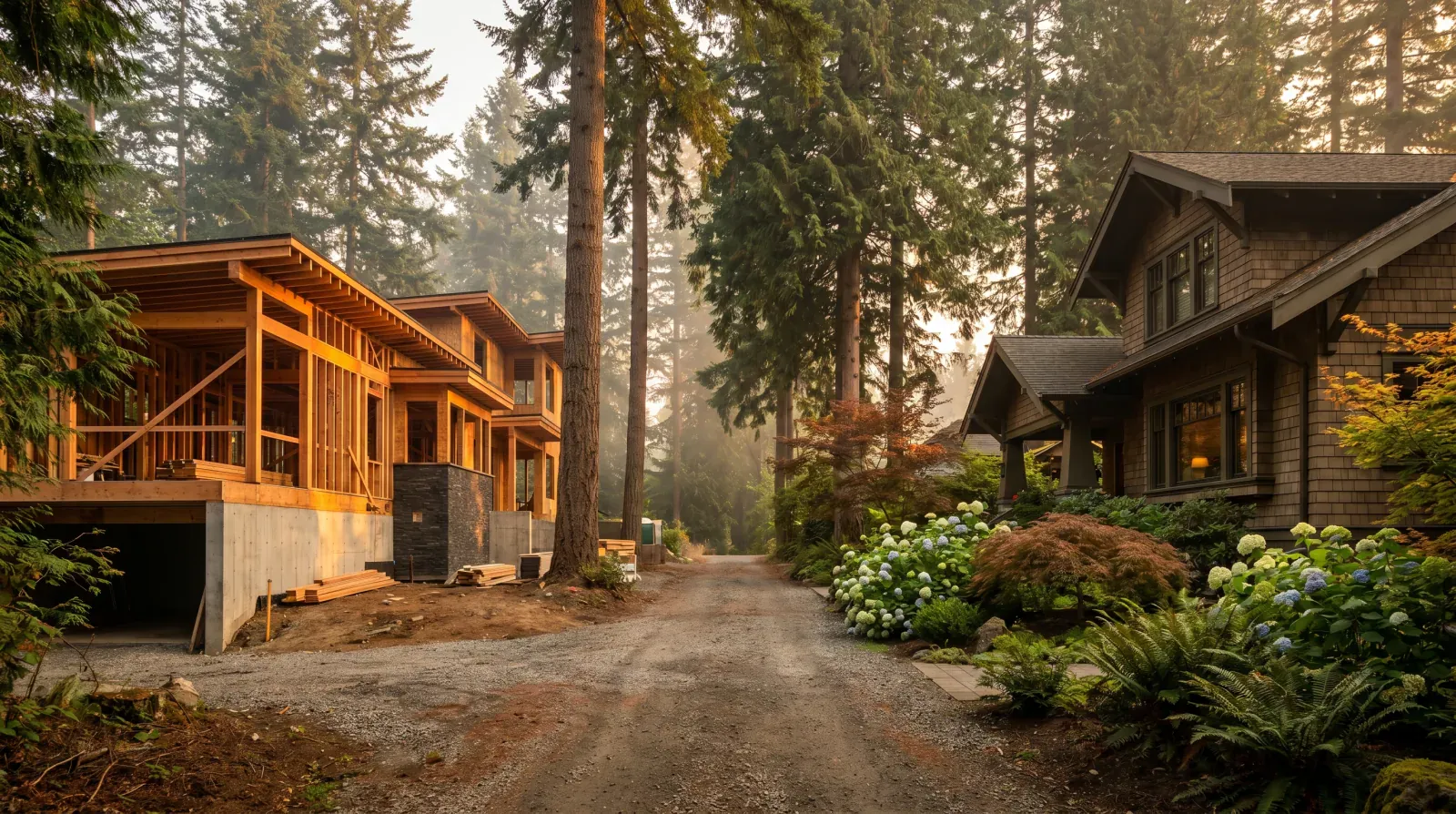
There's a path between the two that most owners don't know exists. A deep gut paired with a substantial addition. Strip the existing house to its frame, reframe what needs to change, and add the square footage the original plan couldn't carry. Lot equity of a renovation. End result close to a new build. We've done this on lots in Burnaby Heights, in Forest Glen, and in pockets of Coquitlam where the existing footprint had limits but the lot itself was worth keeping.
It isn't always right. Sometimes the existing structure isn't worth keeping at all. But it belongs on the table whenever neither pure path quite fits, specifically when:
- The existing foundation is sound but the floor plan needs major rework
- The lot orientation, view, or trees are reasons to keep the existing siting
- The owners want a phase-able project where they can occupy part of the home through portions of the build
We don't tell clients which path is right. We tell them what each one actually involves. Most of the time, that's enough.
Icon Projects Team
The 2026 regulatory environment shifts the math
Three regulatory factors that change the renovation-vs-new-build calculation in Burnaby and across BC right now.
Permits go digital-only in Burnaby. All building permit applications submitted to the City of Burnaby on or after January 1, 2026 are processed digitally, and any permit issued on or after March 31, 2026 is provided exclusively in digital format per the City of Burnaby New Home Construction page. The implication for a renovation-vs-new-build decision is that the documentation overhead is now consistently demanding for both paths. A clean digital intake matters more than it used to.
Energy code applies on substantial reconstructions. Substantial reconstructions in BC trigger the same Step Code requirements as new construction. If a renovation involves enough envelope work, the project ends up needing a certified Energy Advisor's modeling submission as part of the building permit. That requirement narrows the gap to a new build for any major renovation that touches walls, windows, or roof in volume.
Mandatory home warranty. Under BC's Homeowner Protection Act, 2-5-10 home warranty insurance is mandatory on every new home built by a licensed residential builder: two years on materials and labour, five years on the building envelope, ten years on structural defects. New construction carries the warranty automatically. Renovations and reconstructions get partial warranty coverage depending on scope. For an owner planning a long-term home, the warranty profile is a real factor in the decision.
How to actually decide
- Walk the existing house with a builder as well as an architect. Builders see structure. Architects see space. You need both reads.
- Get a tree inventory and a soils read on the lot before the brief is locked. In Burnaby specifically, the tree bylaw can shift the design conversation more than owners expect.
- Ask what the renovation cannot deliver. The answer to that question is usually the deciding factor, not anything on a balance sheet.
- Compare the paths over a 20-year horizon. Forever-home math runs differently from flip math, and the BC Step Code trajectory toward Step 5 by 2032 is a 20-year decision today.
- Count the soft costs of staying. Disruption, decision fatigue, eighteen months of dust. Real costs, even when they don't appear on any quote.
- Talk to a builder who has done both at scale. The honest reads come from people who don't have a structural bias toward one outcome.
A note on the third path: phasing the project
For owners staying in the home through the work, a phased approach can sometimes bridge the gap. A first phase that handles structural issues and brings the envelope up to code. A second phase, two or three years later, that completes interior work and finishes. Phasing is more expensive than doing everything at once because of the repeated mobilization costs, but it can be the right answer when an owner can't displace for a full eighteen-month build and the existing structure is too compromised for a single-phase renovation.
Phasing is most often the right answer in:
- Multigenerational households where displacing the family isn't feasible
- Working professionals with young children where eighteen months of disruption is genuinely costly
- Owners who want to test design decisions before committing to a full build
It is almost never the cheapest answer in raw dollar terms.
What the lot is asking for
Stuck between the two paths? Don't run another spreadsheet. Walk the existing home for an hour with a builder who has done both, on the lot you actually own, and look at the same five things together: the structure, the envelope, the orientation, the trees, and what the family actually needs from the result. That conversation almost always settles it.
The decision is rarely between cheap and expensive. It's between a path that respects what's on the lot already and a path that starts fresh because the lot is asking for it. In Burnaby, in Vancouver, in the North Shore, in the Fraser Valley, the same logic holds. The bylaws change. The principle doesn't.
Related on the Journal
- The renovate, add, or rebuild decision guide, the pillar guide that frames this whole conversation.
- Our whole-home renovation service in Burnaby, how we scope, price, and run a full renovation.
- Additions service, when a well-placed addition beats a full rebuild.
- The renovate-add-rebuild decision in Burnaby Heights
- Lot evaluation before a Burnaby teardown
- 12 questions before signing a BC builder contract