Burnaby's roof problem isn't snow, it's water. Pitch, material, ventilation, drainage, and fire-rating decisions that determine whether a custom-home roof carries you for forty years or fails in twelve.
The roof is the part of a Burnaby custom home that most owners think about last and that fails first when it fails. Asphalt, metal, membrane, slope, vent, drain, the language is unfamiliar to anyone who hasn't built before, and the decisions get delegated to the contractor without the conversation a roof actually deserves. By the time a leak shows up in a ceiling at year nine, the original choices are buried under fifteen tonnes of material and a year of warranty arguments.
This post is what we walk a Burnaby owner through when the roof comes up on a custom home brief. Pitch and form. Materials and where each one earns its place. Ventilated versus unvented assemblies. The fire-rating conversation as wildfire seasons creep into the Lower Mainland. Step 5 envelope demands at the roof line. Drainage and overflow for a climate that has more water than it has snow. We are involved in building in Burnaby every week, and the roof is where the wet coast quietly punishes weak decisions.
Burnaby is a rain roof, not a snow roof
The roof load story on the BC south coast is the opposite of the Canadian roof story most builders trained outside Vancouver carry in their heads. The BC Building Code snow loads for Burnaby, taken from the Climatic and Seismic Data appendix sourced from Environment and Climate Change Canada, are modest, typically in the 1.8 to 2.4 kPa range depending on elevation and exposure, well below the loads engineered into a Calgary or Winnipeg roof. The rain load, however, is real and constant. Annual rainfall in central Burnaby sits in the 1,100 to 1,200 mm range, concentrated in the cool half of the year, with intense events that can move 50 to 80 mm of water in a 24-hour window.
What that means for design:
- The roof's structural job is easier than the prairie equivalent.
- The roof's drainage job is harder than most owners expect.
- The roof's vulnerability is wind-driven rain across long fetches, not snow load at parapets.
A roof that performs in Burnaby is a roof designed for water moving sideways and upward under wind, not just downward under gravity. Detailing that survives in Saskatoon can leak in Burnaby Heights on the first westerly storm.
Pitch and form, what each one gives you
The two dominant roof geometries we build on Burnaby custom homes are a pitched roof (3:12 to 8:12 slopes, sometimes higher) and a low-slope or flat roof (1/4:12 to 2:12 with parapets, drained to internal scuppers). A third hybrid, a pitched primary roof with flat sections over secondary volumes, is increasingly common on contemporary architecture.
Each geometry has consequences.
A pitched roof at 4:12 to 6:12 is the classic west-coast residential form. It sheds water aggressively, accommodates asphalt or metal cladding easily, ventilates naturally if detailed correctly, and forgives small detailing errors because gravity is doing most of the work. The trade-off is volume, a pitched roof produces an attic that has to be insulated and either ventilated or sealed.
A low-slope or flat roof is the contemporary architectural choice. It expands the building envelope, allows large continuous ceilings on the upper level, and reads cleanly from the street. The trade-off is that gravity is no longer your friend, every drainage and termination detail is now load-bearing, and a parapet without a proper cap is an invitation to a leak.
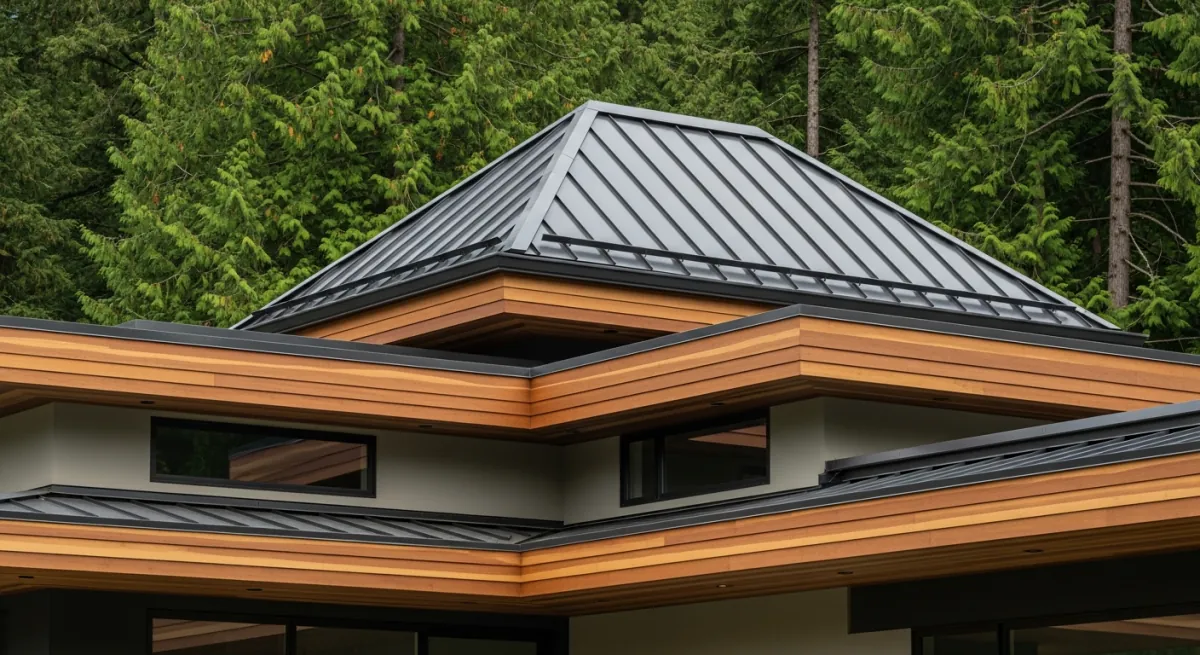
A mixed pitched-and-flat roof is where most modern Burnaby custom homes actually land. A primary pitched roof over the principal volume, with flat sections over the entry, the garage, a rear extension, or a deck above the garage. Each junction between pitched and flat is a detail that has to be drawn and reviewed.
The pitch decision also interacts with the view-lot design conversation, a steep pitch consumes view-line height that a flat roof preserves, but a flat roof creates parapets that read more massive from the street. We negotiate this at schematic, not at construction.
Material, where each one belongs
Five roofing materials show up regularly on Burnaby custom homes. Each one belongs somewhere and not everywhere.
Architectural asphalt shingles
The most common pitched-roof material in residential construction. Modern architectural ("dimensional") shingles from manufacturers like IKO and CertainTeed carry 30- to 50-year limited warranties and Class A fire ratings. On the BC south coast a quality architectural shingle over a properly detailed underlayment is a 25- to 35-year roof in real-world performance, less if the underlayment skipped corners or the ridge ventilation was wrong.
Where asphalt belongs:
- Pitched roofs at 3:12 or steeper (manufacturers usually require higher pitches above 4:12 for full warranty coverage).
- Volumes where the roof is not the dominant architectural element.
- Re-roof and value-conscious new builds.
Where asphalt does not belong: pitches below 3:12, exposed coastal elevations with persistent driving rain on long fetches, contemporary architecture where the asphalt texture clashes with the design language.
Standing-seam metal
Pre-painted galvanized steel or aluminum standing-seam roofing has moved from agricultural and commercial into residential custom-home work over the last fifteen years. A standing-seam metal roof on the BC south coast has the longest demonstrated service life of any common residential roofing material, 40 to 60 years for the panels themselves, with the painted finish typically the limiting factor.
Where standing seam belongs:
- Contemporary architecture, where the clean shadow lines pair naturally with the building's vocabulary.
- Exposed elevations and coastal lots where asphalt's wind and UV vulnerability matters.
- Pitched roofs at any slope down to about 2:12 (the panel system has to be specified for the slope).
- Volumes where the roof reads as a finished surface, not a covering.
What metal demands: a skilled installer (closer to a sheet-metal trade than a shingler), careful flashing and isolation from dissimilar metals, and a thicker premium on day one that pays back over the longer service life.
Single-ply membrane on low-slope sections
For the flat or near-flat sections of a mixed roof, over garages, entry volumes, decks above conditioned space, single-ply membrane (TPO, PVC, or modified bitumen) is the standard. A modern TPO or PVC roof, fully adhered with seam welding done correctly, performs reliably for 25 to 35 years.
What the flat sections demand more than the pitched sections:
- A continuous, properly tapered slope to drain. "Flat" is never actually flat, there has to be a positive slope to scuppers or drains, even if it's only 1/4:12.
- Detailed terminations at parapets, edges, and penetrations. The parapet cap flashing is its own design problem.
- Walkway pads where any maintenance access is anticipated.
We see more leaks in residential flat-roof sections than in any other roof type, almost always because the detailing at parapets, scuppers, and roof-to-wall junctions was treated as a field decision rather than a drawn detail.
Cedar shake, the retreat
Cedar shake roofing was the indigenous BC coastal roof for decades. It is also the roof type that has progressively retreated from new construction. Fire-rating concerns, insurance availability, and a 20- to 25-year practical service life on the BC south coast (against a 50-year metal roof) have all pushed cedar shake out of most new custom-home briefs.
We will install cedar shake on a heritage restoration or a project where the architectural character genuinely demands it, with the owner having gone through the insurance conversation and accepted the maintenance cycle. We do not recommend it as a default for new construction.
Clay or concrete tile, rarely the right call
Heavier than other roofing, with significant structural implications for the framing. Clay and concrete tile have a long Mediterranean and Californian residential pedigree, but the climate match for the BC south coast is awkward, the colour palette and the architectural language usually don't belong, and the weight forces structural decisions that cost more than they earn back. We have built tile roofs on the right architectural projects; they are exceptions, not defaults.
Ventilated versus unvented assemblies
A pitched-roof attic on a Burnaby custom home is built one of two ways: vented (with cold air moving through the attic above the insulation) or unvented (a sealed, conditioned-or-quasi-conditioned attic with insulation at the roof deck).
A vented attic is the traditional approach. Soffit vents at the eaves bring outside air in, ridge vents at the peak let it out, and the insulation sits at the ceiling plane below the attic. The system relies on continuous airflow through the attic to carry moisture away before it condenses on cold roof sheathing. When it works, it works for decades.
What kills a vented attic on the BC south coast:
- Air leaks from the conditioned space below. Warm humid air leaking up around recessed lights, attic hatches, and bath fan ducts hits cold roof sheathing in February and condenses. The fix is air-sealing the ceiling plane, not adding more vents.
- Compressed insulation at the eaves. Where the insulation gets pushed into the soffit and blocks the ventilation path. Baffles at every rafter bay are mandatory.
- Inadequate vent area. BCBC Section 9.19.1 requires a minimum unobstructed vent area of 1:300 of the insulated ceiling area for typical pitched roofs, with at least 63 mm of clear space between the top of the insulation and the underside of the roof sheathing, and a stricter 1:150 ratio for low-slope roofs (slopes less than 1 in 6) or roofs framed with roof joists. The total area is split between high and low vents. Skip any of this and the attic stops working.
An unvented attic is the alternative, and increasingly the default on high-performance builds. Insulation moves to the roof deck (typically a combination of closed-cell spray foam against the sheathing and air-permeable batt or dense-pack below). The attic becomes a semi-conditioned space within the thermal envelope. No vents at the eaves or ridge.
Unvented works well at Step 3 + EL-4 and Step 5 because it removes a long list of air-sealing penetrations from the ceiling plane and lets the building's continuous air control layer wrap the roof. It demands more careful detailing, vapour control, attic fire-blocking, and a builder fluent in the assembly. We use it more often than not on new Burnaby builds now.
Step Code envelope demands at the roof
The BC Energy Step Code at Burnaby's current Step 3 + EL-4 requirement, and the Step 5 builds we and some other builders deliver voluntarily, drives a roof assembly with high effective R-values (typically R-50 to R-60 on Step 5 work; less on Step 3 but still well above old prescriptive minimums) and a continuous air-control layer integrated to the wall system.
What that means in practice:
- Roof insulation depth. A vented attic with R-60 of loose-fill is straightforward but consumes attic volume. An unvented assembly with closed-cell foam at the deck and dense-pack below hits the same R-value with less depth.
- Air sealing. Every roof penetration, vent stack, exhaust fan, recessed light if any survive the spec, is a leak point. The continuous air-control layer detailed across the entire envelope is the single most important roof decision on any Step Code home.
- Blower-door performance. A roof that leaks shows up on the blower-door test. We've seen well-detailed wall assemblies undone by ceiling penetrations. The pre-drywall test catches this when it can still be fixed cheaply.
- Vapour control. A high-performance roof traps the wrong moisture pattern if vapour control is wrong for the climate. The BC south coast wants the vapour profile detailed for cool, persistently humid winters, which is different from interior dry-cold regions.
The roof's energy performance is also where heat-pump and HRV penetrations land. The mechanical layout has to coordinate with the roof framing and the air-control layer at design, not at rough-in.
Fire-rating and wildfire context
Wildfire risk in the Lower Mainland is no longer hypothetical. Insurance availability and building-permit considerations now factor wildfire resilience in ways they did not a decade ago. For roofs:
- Class A fire rating is the highest residential roofing fire classification. Modern architectural asphalt shingles, metal roofing, and most membrane systems achieve Class A. Cedar shake without treatment does not.
- Ember intrusion at vents and soffits. Ember-resistant soffit vents and ridge vents are increasingly specified on lots near treed corridors, Capitol Hill, the Burnaby Mountain flank, the green belts behind Buckingham Heights.
- Defensible-space landscape considerations. Mature trees within metres of the roof create different ember exposure than open lawn. The Burnaby tree bylaw limits tree removal, which means the design has to accept the proximity and respond at the roof envelope.
For owners on or near treed corridors, specifying Class A roofing, ember-resistant vents, and non-combustible eaves and fascia detailing is a low-incremental-cost decision that materially changes the home's wildfire vulnerability.
Drainage, the part most roofs get wrong
The wet half of the year in Burnaby moves real volumes of water across the roof. Drainage is not a finish decision; it is a structural decision that gets specified at design and installed during framing.
What proper drainage looks like:
- Gutters sized for actual rainfall intensity. A standard 5-inch K-style gutter handles most residential rain events, but on a roof with a large catchment area or steep pitch, 6-inch gutters and 3x4 downspouts are not optional.
- Downspout placement that carries water away from the foundation. Downspouts dumping at the base of the wall are a hillside-lot disaster. Connect to a managed discharge, a stormwater connection, a rain garden, a graded swale, at design, not at the back end.
- Scuppers and overflow scuppers on flat roofs. Every flat-roof drainage path needs a primary drain and an overflow at a higher elevation. The primary can clog; the overflow keeps water from ponding and overloading the structure. Code requires it; some installers still forget.
- Heat trace cable at problem locations. North-facing eaves and shaded valleys can ice up briefly in the colder weeks. Where the geometry creates an ice-dam risk, electric heat trace at the eaves is a small line item that prevents a recurring failure.
- Crickets at chimneys and other large penetrations. A cricket is the small triangular roof element that diverts water around the upslope side of a chimney or skylight. Skip it and water finds the flashing.
A roof leak is rarely a roof problem. It is almost always a detailing problem the roof exposed. The drawings made before the shingles went on are what determines whether the roof survives.
Icon Projects Team
Coordinating the roof with the rest of the envelope
Roofs do not exist in isolation. The roof-to-wall junction is one of the highest-failure details in residential construction, and on a Burnaby custom home it has to coordinate with:
- The cladding system and its rainscreen cavity, so water leaving the cladding does not get driven back into the roof.
- The continuous air-control layer, so the wall's airtightness and the roof's airtightness are actually continuous.
- The window head detail, where the highest windows often sit just below an eave or parapet.
- The mechanical penetrations, plumbing vent stacks, and any solar provision the design anticipates.
The drawings at this level matter more than the products. We have rebuilt eaves on homes where the windows, the cladding, the soffit and the fascia were each individually competent and the junction between them was a leak. The work is in the drawing, the review, and the field execution. Our custom homes service treats the roof and envelope as a coordinated package rather than separate trades.
A short brief for a Burnaby roof
When the roof comes up on a custom-home brief, the questions worth answering before any shingle is specified:
- What is the roof form, pitched, flat, mixed, and why?
- What material is on each section, and does each one belong where it is?
- Vented attic or unvented assembly, and how does the choice integrate with Burnaby's Step 3 + EL-4 envelope (and the Step 5 it's heading toward)?
- Where does water go from every drainage point, and is the path managed all the way to the property line?
- What is the fire-rating story given the lot's tree exposure?
- Who is drawing the roof-to-wall, roof-to-window, and roof-to-cladding details, and when are they reviewed?
- What is the maintenance access plan for the parts of the roof that will need it?
The roof that survives forty years on a Burnaby custom home is the roof that was designed, not just installed. The materials matter less than the detailing, the drainage matters more than the slope, and the coordination with the rest of the envelope matters more than any single specification. The wet coast does not forgive shortcuts at the roof line.
If you are early in the process for a Burnaby, Vancouver, or North Vancouver custom home and the roof has not been part of the conversation yet, it should be. The hour at schematic that locks the roof form, the material strategy, and the drainage approach is the hour that saves the year-nine ceiling repair.
Related on the Journal
- Choosing exterior cladding for a Burnaby custom home
- Windows and glazing for Burnaby winters
- BC Energy Step Code 5 reality for Burnaby
- Metal roof vs asphalt shingle in BC
Frequently asked questions
- Why is drainage a bigger concern than snow load for a Burnaby roof?
- BC Building Code snow loads for Burnaby typically sit in the 1.8 to 2.4 kPa range, well below what a Calgary or Winnipeg roof carries, so the structural job is comparatively easy. Annual rainfall in central Burnaby sits in the 1,100 to 1,200 mm range, and a single storm can move 50 to 80 mm of water in a day, so the roof has to be designed for water driven sideways and upward under wind, not just downward under gravity.
- What roof pitch is best for a Burnaby custom home?
- There is no single best pitch, each geometry trades differently. A pitched roof at 4:12 to 6:12 sheds water aggressively and forgives small detailing errors, a low-slope or flat roof expands ceiling volume but makes every drainage and termination detail load-bearing, and a mixed pitched-and-flat roof, common on modern Burnaby custom homes, combines a primary pitched roof with flat sections over entries, garages, or decks.
- What roofing material lasts longest on the BC south coast?
- Standing-seam metal has the longest demonstrated service life of common residential roofing materials on the BC south coast, 40 to 60 years for the panels, with the painted finish typically the limiting factor. Architectural asphalt shingles perform for 25 to 35 years in real-world Burnaby conditions, and single-ply membrane on flat sections performs reliably for 25 to 35 years when the seams are welded correctly.
- Should a Burnaby custom home use a vented or unvented attic?
- Both work when detailed correctly. A vented attic relies on soffit and ridge vents to carry moisture away from cold roof sheathing, and BC Building Code Section 9.19.1 requires a minimum 1:300 unobstructed vent area for typical pitched roofs, or 1:150 for low-slope roofs. An unvented attic moves insulation to the roof deck and is increasingly the default on high-performance Burnaby builds because it removes air-sealing penetrations from the ceiling plane.
- Why do flat roofs leak more often than pitched roofs in Burnaby?
- Flat and low-slope roof sections see more leaks than any other roof type on Burnaby custom homes, almost always because the parapet cap, the scupper, and the roof-to-wall junction were treated as field decisions rather than drawn and reviewed details. A properly designed flat section needs continuous tapered slope to drain, detailed terminations at parapets and penetrations, and a primary drain plus an overflow scupper at every drainage path.
- How does the BC Energy Step Code affect roof design in Burnaby?
- Burnaby's current Step 3 plus EL-4 requirement drives roof assemblies with high effective R-values, typically R-50 to R-60 on Step 5 work and less but still well above old prescriptive minimums on Step 3, along with a continuous air-control layer integrated with the wall system. Every roof penetration, vent stack, exhaust fan, or recessed light is a potential leak point that shows up on the blower-door test if the air-control layer is not detailed properly.
- What roofing material has the best fire rating for wildfire-prone Burnaby lots?
- Class A is the highest residential roofing fire classification, and modern architectural asphalt shingles, metal roofing, and most membrane systems achieve it, while untreated cedar shake does not. For lots near treed corridors like Capitol Hill, the Burnaby Mountain flank, or the green belts behind Buckingham Heights, specifying Class A roofing along with ember-resistant soffit and ridge vents is a low-incremental-cost decision that materially reduces wildfire vulnerability.
- Why has cedar shake roofing fallen out of favour for new Burnaby custom homes?
- Cedar shake was the traditional BC coastal roof, but fire-rating concerns, insurance availability, and a practical service life of only 20 to 25 years on the BC south coast, against a 50-year metal roof, have pushed it out of most new custom-home briefs. Icon Projects will install cedar shake on a heritage restoration or where the architectural character genuinely demands it, but does not recommend it as a default for new construction.