A Burnaby view lot is not a flat lot with a horizon. It's a site with sightlines, overlook constraints, tree pressure, and exposure conditions that all want different things from the design, and they all have to be reconciled before the architect draws a window.
The first time we walk a Burnaby view lot with a client, the conversation almost always starts at the wrong end. The owner stands at the back of the property, looks north across Burrard Inlet, and points at the mountains. The view is real and the impulse to face the whole house at it is human. It is also the move that produces the most regrets at year five.
This post is about what a Burnaby view lot actually demands from a custom-home design, beyond the obvious. Sightline strategy. Overlook. Tree pressure on the view corridor. The structural and foundation implications of cantilevering toward the view. Exposure and wind. Glazing balance against the rest of the building's energy story. The privacy compromises tight lots force on you. We build custom homes in Burnaby and across Greater Vancouver, and view lots are the sites where the planning hour at the start saves the most pain at the end.
Where the view lots actually are
Burnaby has more view stock than people outside the city realise, and the character of each pocket changes what the design has to negotiate.
Capitol Hill is the iconic Burnaby view neighbourhood, the north and west aspects deliver inlet, North Shore and downtown sightlines from elevations between roughly 100 and 180 metres. Burnaby Heights wraps the west flank below Capitol Hill, with the better view lots concentrated on Boundary Road and the north-falling streets above Hastings. Forest Glen and the upper portions of Buckingham Heights pick up southern aspects toward the Fraser River and Mount Baker on a clear day. Westridge, on the east flank toward the SFU access road, looks across the inlet from a different angle entirely, Indian Arm and Belcarra rather than the downtown skyline.
Each of these neighbourhoods has its own grade pattern, its own tree canopy, and its own overlook geometry. A design move that works on a south-aspect Forest Glen lot can be exactly wrong on a north-aspect Capitol Hill lot facing into prevailing winter weather. The lot dictates more than the brief.
View framing, pick the moments, don't glass the wall
The single most common mistake on a Burnaby view lot is to treat the view as a single problem and solve it with a single wall of glass. North-facing curtain wall. South-facing patio doors stitched corner to corner. Every primary room oriented at the same horizon.
A view loses power when it is everywhere. It also loses power when it is consumed by the building rather than framed by it. The homes that hold up, the ones the owners still describe as their best decision at year ten, pick the moments and detail them, instead of trying to absorb the full panorama in one move.
What "pick the moments" looks like in practice on a Burnaby view lot:
- One primary view aperture per major living space, not three. The living room gets one large opening that frames the view as a composed scene. The kitchen gets a different aperture at a different elevation. The principal bedroom gets a third. Each is its own composition, not a continuation of the last.
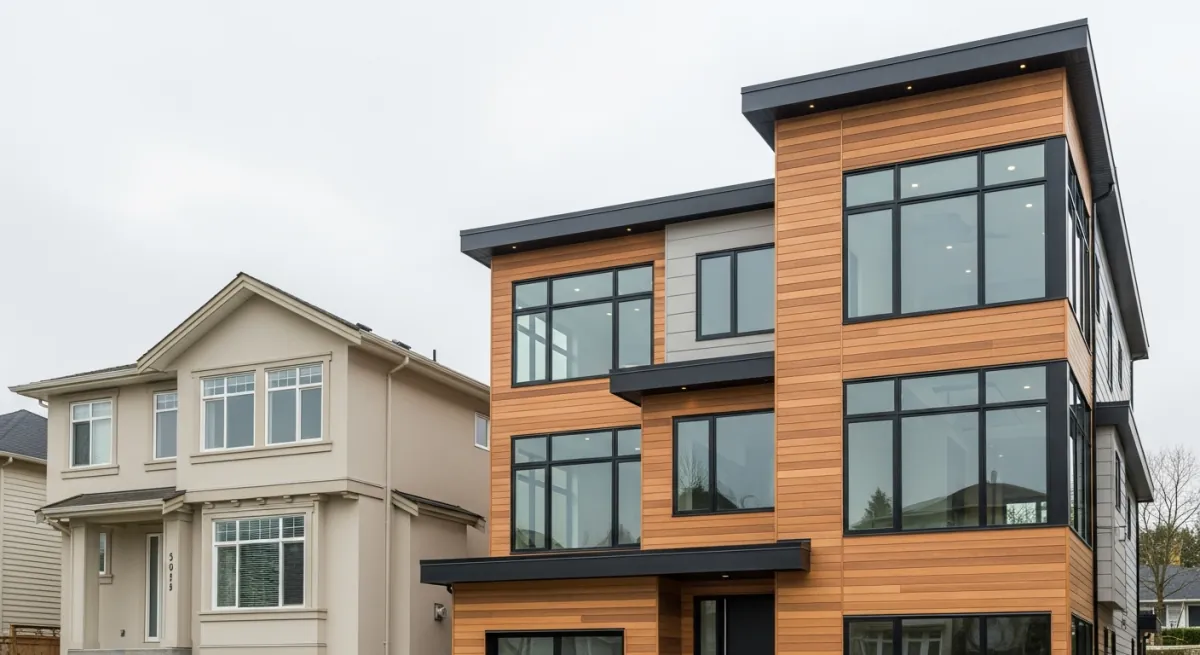
- Deep reveals on the view side. A window pulled back two to four inches from the cladding plane reads as a frame rather than a hole. The view inside the frame becomes a picture. The view in a flush window reads as exposure.
- Solid walls between view openings. The wall between the dining room and the living room view windows is doing real work. It gives the eye somewhere to rest, gives the structure somewhere to anchor, and gives the energy model somewhere to put insulation.
- One vertical slot rather than two squares. On the principal bedroom of a Capitol Hill build, a single tall slot window aimed at the inlet is often more powerful than a row of horizontal punched openings. Owners report standing at it more often.
There is a related decision about secondary spaces, the laundry, the powder, the corridors. On a view lot the temptation is to put a window in every room facing the view. The right move is usually to give those rooms a small high transom and save the major glass for the rooms that earn it.
This is also the conversation we have early about windows. Glazing on a view lot interacts directly with the Step Code envelope targets, a north-facing curtain wall of triple-pane glass loses meaningfully more heat than the same area of insulated wall, and the energy model has to pay for it somewhere. Our companion piece on windows and glazing for Burnaby winters covers the product side; the design conversation here is upstream of it.
Neighbour overlook is a real constraint
Burnaby view lots are usually not isolated. The same elevation that gives you the inlet view gives the lot above you a view straight down into your yard. The lot below you may have its principal bedroom window aimed at what you intended as your patio. Overlook cuts both directions.
The City's zoning and design review processes consider overlook in a few ways, setback rules, height envelopes, and the relationship between the building footprint and neighbouring rear yards, but the bylaws are a floor, not a finish. A design that meets the setbacks can still produce an overlook problem that the owner only discovers after move-in, when their neighbour mentions that their kitchen window looks straight onto your hot tub.
Three moves we use repeatedly to manage overlook on Burnaby view lots:
- Clerestory and high transom glazing on the side elevations. Side windows get raised above standing eye height, capturing light without giving the neighbour a sightline into the room or a sightline from the room into their bedroom.
- Privacy screens that double as architecture. Vertical wood slat screens, perforated metal panels, or planted hedgerows along the property line resolve overlook visually without reading as a fortress. We detail these as part of the building rather than the landscape budget so they actually get built.
- Floorplate offsets rather than direct face-offs. If the next-door house has a side window at the same elevation as your proposed primary bedroom, shifting the bedroom up or down a half-storey, or angling the wall a few degrees, can completely change the overlook relationship.
The other side of overlook is your own family's privacy from the street. On the steeper Capitol Hill and Burnaby Heights lots, the street is often two to three metres above the main living level. A passerby looking down can see straight into a daylight basement living room. The same screening logic applies, and again, it's a building decision, not a landscape decision.
The tree bylaw and the view corridor
Burnaby's tree canopy and Burnaby's view stock are in direct tension on a lot of these sites. The mature Douglas firs and big-leaf maples that anchor the lot are also the trees standing between you and the view. The owners we sit down with frequently ask the same question: can I just remove the two firs blocking the view?
The honest answer requires reading the Burnaby Tree Bylaw carefully. Any tree 20 cm or larger in trunk diameter on a property subject to a development application is a Protected Tree under the City of Burnaby Tree Bylaw. That captures most of the mature trees on a typical view lot. Removal triggers replacement at the rates set in the bylaw, replacement coniferous trees at a minimum of 2 metres at planting, replacement deciduous trees at a minimum of 5 cm trunk diameter, and the replacement count can quickly outstrip the lot's planting capacity.
Where the design conversation lands:
- Inventory first, design second. A proper tree survey before any architectural work starts identifies which trees can come down without triggering a replanting impossibility, and which trees are effectively load-bearing on the design.
- Branch management is not removal. Selective limbing or canopy raising on a protected tree is often permitted where outright removal is not. A high-canopy fir with the lower branches lifted reads as a frame for the view rather than an obstacle to it.
- Borrowed views from neighbour trees. Trees on the lot next door are outside your jurisdiction but inside your sightline. The design has to anticipate that a neighbour's tree might be removed, replaced, or grow into the view over time. Don't bet the entire glazing strategy on a tree you don't control.
Our deeper read on the bylaw and how it actually shapes design choices is in how the Burnaby tree bylaw reshapes design. On a view lot, the bylaw is doing more design work than most owners expect.
Cantilevering toward the view, when it earns its keep
A cantilever on a view lot is one of those moves that looks dramatic in the renderings and earns its expense only when it solves a real problem. The lots where it does:
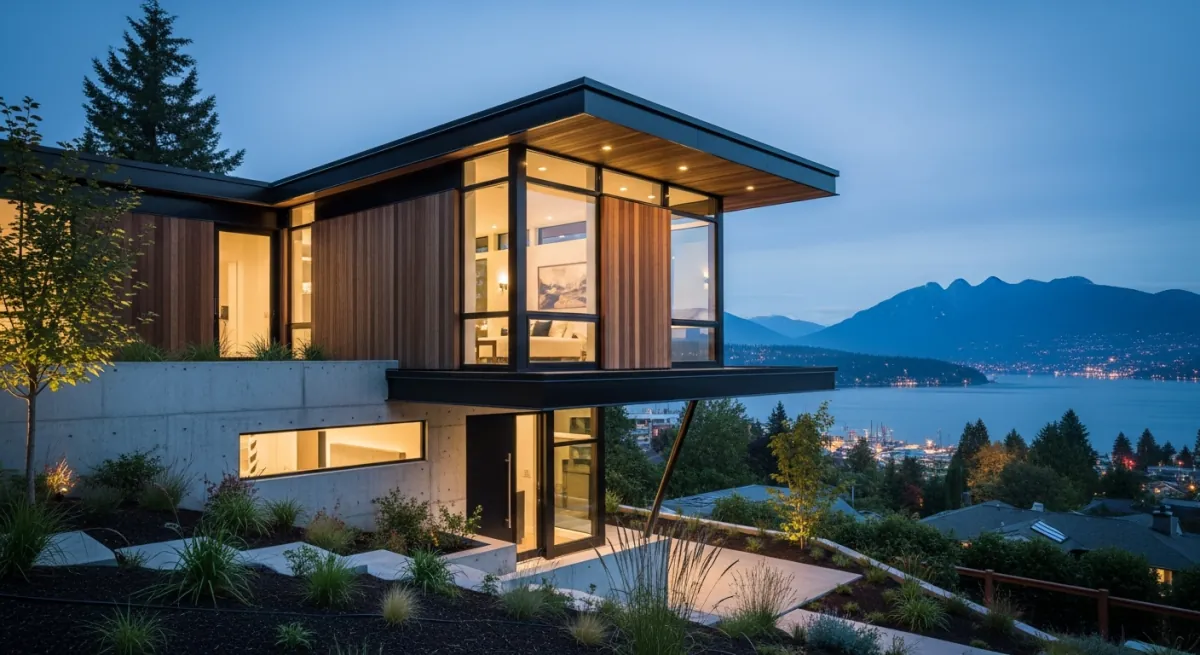
- Steep downhill grade. Extending the upper floor past the lower envelope reduces excavation, brings the floorplate out toward the view without further foundation work, and lets the building feel like it's reaching rather than crouching.
- Tree-protection zones in the rear. When a protected tree's drip line cuts into the buildable footprint at grade, lifting the upper floor over the protection zone preserves both the tree and the room area.
- View occlusion by lower-elevation neighbours. A cantilever raises the primary sightline a couple of metres, which on a tight lot can be the difference between an inlet view and a roofline view.
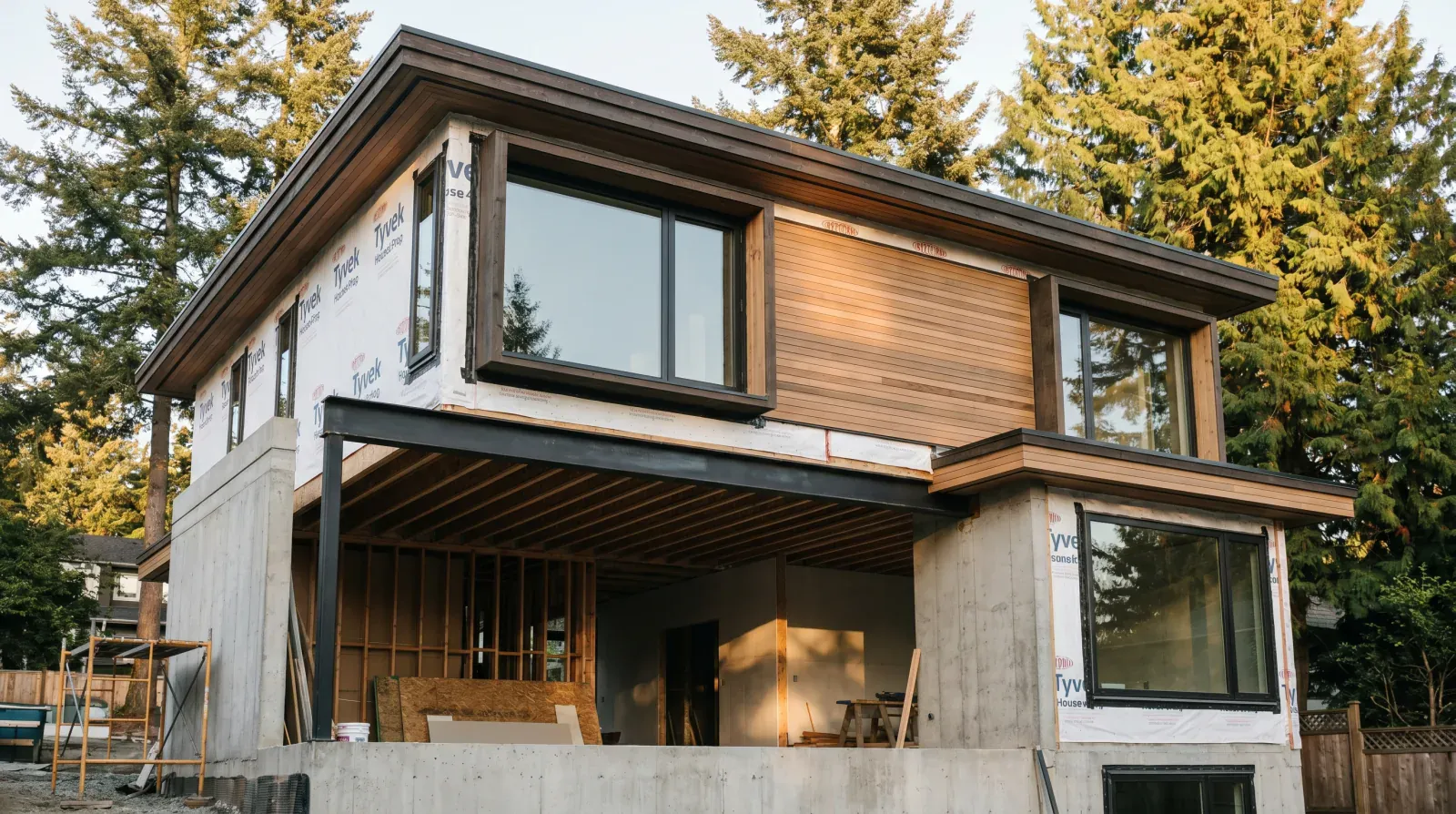
The structural cost is real. A cantilever past about 1.2 metres demands purposeful steel, deeper joists or beam pockets the framing has to coordinate around, and a structural engineer's involvement at concept design rather than just at permit. The energy model has to accommodate the soffit, the underside of a cantilever is an exterior assembly that has to be insulated and air-sealed to the same standard as a wall. On a Step 5 home, that detail is not trivial.
When a cantilever doesn't earn its keep: flat or gentle-grade lots, lots with no rear constraints, lots where the same view can be captured by a properly positioned upper floor with a deep balcony. We've seen cantilevers added late in design as a styling move and pulled back out at value engineering. The ones that survive are the ones that do work.
If you're earlier in the process and weighing whether your lot will support these kinds of moves at all, our Burnaby lot eligibility tool walks through the buildability questions before you commit to a design direction.
Wind, exposure, and the things owners forget
A Capitol Hill lot exposed to the north and west is in a different climate than a Forest Glen lot tucked behind the south flank. The exposure changes how the building gets detailed.
Three exposure conditions we plan for on view lots:
- Wind-driven rain. The same rain that falls evenly across the Lower Mainland gets driven horizontally against a north-facing Capitol Hill wall by westerly winter storms. Window head flashings, cladding rainscreen gaps, and parapet caps all need to be detailed for water moving sideways and upward, not just downward. The rainscreen detail is the same logic we cover in the cladding conversation but exposure multiplies the consequences.
- Solar gain mismatch with view. The best view on most Burnaby lots faces north or northwest. The best solar gain is south. On a north-aspect view lot, the design has to find south-facing apertures somewhere, clerestory ribbons over the kitchen, a south-light slot at the stair, or accept a heating bill that the energy model will catch.
- Wind uplift on roof and overhangs. Exposed elevated lots see real wind loads on the roof. Step Code and the BC Building Code require the structural design to account for it, but the architectural choices, deep overhangs, large flat-roof areas, cantilevered eaves, all interact with the engineering. A roof that performs in Brentwood at 60 metres elevation has to be re-engineered for Capitol Hill at 150 metres.
This is the detail that's invisible in the renderings and obvious in February. Done well, the owner never thinks about it. Done poorly, every storm is a reminder.
Foundation and structural decisions follow the view geometry
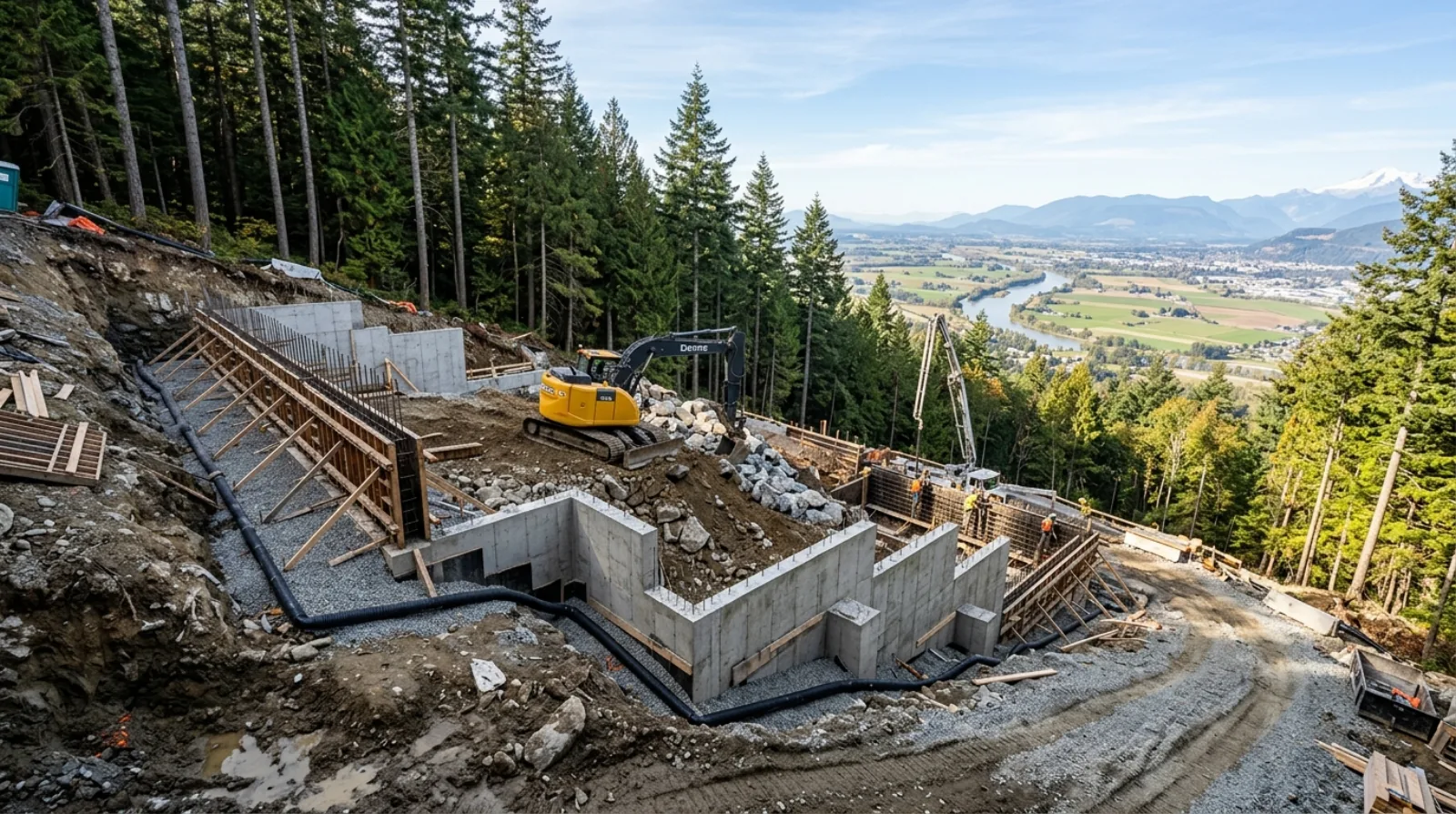
A view lot's design move, the cantilever, the daylight walkout, the stepped massing, propagates straight into the structural and foundation packages. The architectural decision to bring the upper floor 1.5 metres past the lower envelope shows up as a steel moment frame in the structural set, which shows up as a heavier footing pad in the foundation, which shows up as a more invasive excavation, which shows up on the geotechnical report's recommendations.
This is why on Burnaby view lots we sequence the work differently than on a flat infill site. The geotechnical report is one of the first investments, not one of the last. The foundation type the geotech recommends is locked before the design develops architectural details that depend on it. The structural engineer is in the room at schematic design, not at permit submission. On steeper Capitol Hill and Burnaby Heights lots the foundation strategy becomes a primary design driver rather than a downstream consequence.
The City of Burnaby's development permit and construction process treats the structural and geotechnical packages as part of the integrated submission. On a complex view-lot site, those packages have to be coordinated with the architectural set before anything goes through the digital intake, the City will hold a file at the door if the structural package and the geotechnical report don't agree with each other, and the resubmission costs weeks.
A view lot earns its name by being a more demanding site, not a more forgiving one. The view is the reward at year ten. The planning is the work at year zero.
Icon Projects Team
A short brief for a Burnaby view-lot design
When we start a custom home on a Burnaby view lot, the first conversation covers the same handful of items, in roughly this order:
- The geotechnical inventory and the foundation type the lot supports
- The tree survey and which trees the view depends on staying or leaving
- The exposure analysis, wind, weather direction, solar, and which elevations are doing what work
- The overlook study, which neighbour windows look in, and where your primary spaces should sit relative to them
- The view-framing strategy, which moments matter, and how they get composed
- The structural concept that the view-framing moves imply, before the architect develops the details
- The energy story the design produces, and where the glazing budget actually lands
That conversation is unglamorous, and it is the conversation that determines whether the home built on the view lot rewards its owner for thirty years or generates a list of regrets at year five. Our custom homes service page covers how we sequence the work; this is what the work actually looks like inside the first weeks.
If you're looking at a specific lot in Capitol Hill, Burnaby Heights, Forest Glen, Buckingham Heights, or Westridge and trying to read what it's asking for, walking it with a builder who has built on the grade and exposure you're looking at is the cheapest hour you'll spend on the project. The view is the easy part. Everything that earns it is the work.
Related on the Journal
- What hillside lots demand in Capitol Hill and Burnaby Heights
- How the Burnaby tree bylaw reshapes design
- Reading a geotechnical report on a slope lot
Frequently asked questions
- What's the biggest design mistake on a Burnaby view lot?
- Treating the view as a single problem solved with one wall of glass, a north-facing curtain wall or patio doors stitched corner to corner across the whole elevation. A view loses power when it's everywhere. The homes that hold up best pick specific moments, one primary aperture per major living space, framed with deep reveals, rather than trying to absorb the full panorama in a single move.
- Which Burnaby neighbourhoods have the most view-lot potential?
- Capitol Hill is the iconic Burnaby view neighbourhood, with north and west aspects delivering inlet, North Shore, and downtown sightlines from elevations roughly 100 to 180 metres. Burnaby Heights wraps the west flank below it. Forest Glen and upper Buckingham Heights pick up southern aspects toward the Fraser River and Mount Baker. Westridge, on the east flank, looks across the inlet toward Indian Arm and Belcarra from a different angle entirely.
- How does the Burnaby Tree Bylaw affect a view lot design?
- Any tree 20 cm or larger in trunk diameter on a property subject to a development application is a Protected Tree under the Burnaby Tree Bylaw, and that captures most mature trees on a typical view lot. Removal triggers replacement at set rates that can quickly outstrip a lot's planting capacity, so the design usually has to work with a tree survey done before any architectural work starts, sometimes limbing a tree rather than removing it to preserve the sightline.
- What is overlook, and why does it matter on a Burnaby view lot?
- Overlook is the way the same elevation that delivers your view can give a neighbouring lot a clear sightline into your yard, and vice versa. Zoning setbacks and height envelopes address it only as a floor, not a finish, so a design that technically meets the bylaw can still create a real overlook problem. Clerestory glazing, privacy screens built as architecture, and floorplate offsets are the moves used to manage it.
- When does a cantilever make sense on a Burnaby view lot?
- A cantilever earns its cost on steep downhill grades where it reduces excavation, over tree-protection zones where lifting the upper floor preserves a protected tree's root zone, or where it raises the primary sightline enough to clear a lower-elevation neighbour's roofline. Past about 1.2 metres it requires purposeful structural steel and a structural engineer involved at concept design, and the soffit underneath has to be insulated and air-sealed to the same standard as a wall.
- How does glazing on a view lot affect Step Code energy compliance?
- A large area of north-facing glass loses meaningfully more heat than the same area of insulated wall, so glazing choices on a view lot interact directly with the BC Energy Step Code envelope targets. The energy model has to make up that heat loss somewhere else in the assembly, which is why the view-framing conversation and the energy story get worked out together rather than one after the other.
- Why does wind exposure matter more on some Burnaby view lots than others?
- An elevated, north- or west-facing lot like Capitol Hill sits in a different exposure than a south-facing lot tucked behind Forest Glen's flank. Wind-driven rain gets pushed sideways and upward against exposed walls by westerly winter storms, which changes how window head flashings, cladding rainscreen gaps, and parapet caps need to be detailed, and exposed elevated lots see real wind loads on the roof that the structural design has to account for.
- Should the geotechnical report come before or after the architectural design on a view lot?
- Before. A view lot's design moves, cantilevers, daylight walkouts, stepped massing, all propagate into the structural and foundation packages, so the foundation type the geotechnical report recommends needs to be locked in before architectural details that depend on it are developed. The City of Burnaby's digital intake will hold a file at the door if the structural package and the geotechnical report don't agree with each other.