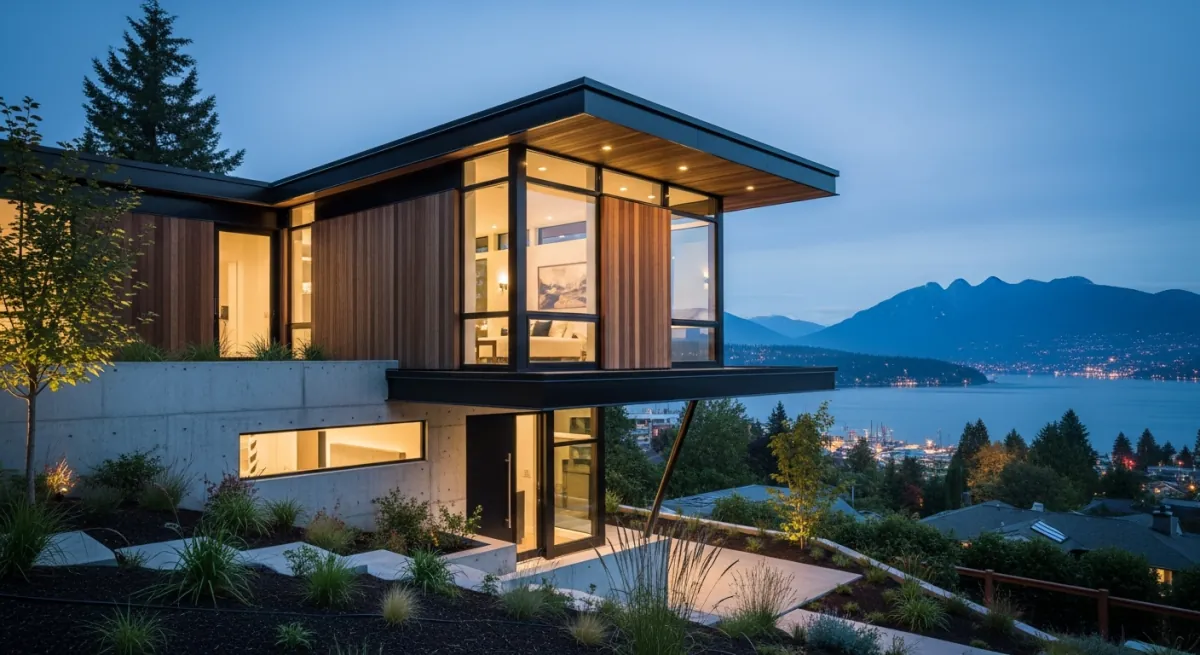
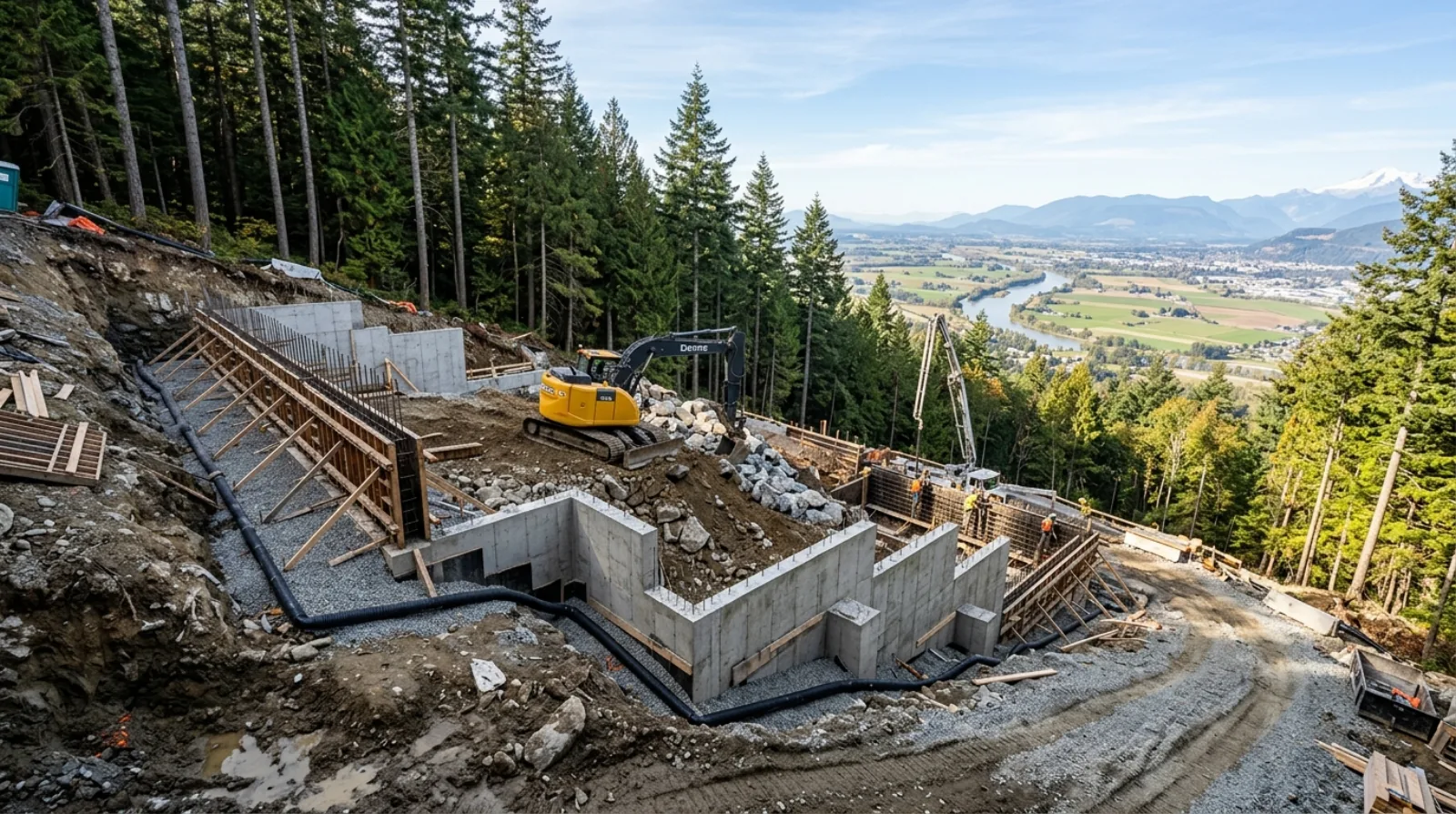
The view from Sumas Mountain across the valley to Mount Baker is the reason owners build there. The foundation, the retention and the drainage are what make the home stand for fifty years. Here's what a hillside build in East Abbotsford really asks for.
Stand on a building lot near the top of Sumas Mountain on a clear afternoon and you understand immediately why people build there. The valley opens out below you, the farmland of the prairie runs flat to the south, and Mount Baker sits on the horizon like it was placed for the view. That outlook is the brief. It's also the easy part.
The hard part is everything under your feet. A Sumas Mountain or Eastern Hillsides build lives or dies on how seriously the team takes the slope, and we've watched both outcomes. Here's what a hillside build in East Abbotsford actually demands.
The lot is the lead architect
On a flat McMillan or Clearbrook lot, you can draw the house you want and then make it work. On a hillside, that order is backwards and it bites. The grade, the soils and the drainage decide what's buildable before a single elevation makes sense, and a beautiful design committed before the geotechnical report comes back is a design that gets redrawn.
So we run it in the order the lot demands: survey first, then a preliminary slope assessment and a soils review, then a geotechnical report on the steeper parcels. Only when we know what the slope is sitting on does the architectural envelope get shaped. It feels slower at the front. It's far faster than discovering the foundation can't do what the drawings assumed.
Why the geotechnical report isn't optional
Sumas Mountain's geology runs to glacial till and bedrock outcrops on the higher ground, with the pocket variability that a walk-around won't reveal. One corner of a lot can be founded on competent rock and another on looser till twenty feet away. A geotechnical assessment reads what's actually there and tells the structural engineer what the foundation has to do.
On a steep Eastern Hillsides parcel, the report typically drives three things that owners underestimate:
- Shoring during excavation, so the cut holds while the foundation goes in
- Retention, engineered retaining walls or tieback systems that hold the grade once the home is in place
- Structured drainage that moves water through and around the site instead of letting it pool against the foundation or destabilise the slope
None of those are upgrades. On the right lot they're baseline scope, and pretending otherwise is how a hillside budget goes sideways.
Water is the quiet threat
Drainage is the thing that ruins hillside homes, and it does it slowly. Water moving through a slope finds the path of least resistance, and if that path runs under or against your foundation, you get the problems that show up years later, settlement, cracking, a wet basement that no one can explain.
A proper hillside drainage design captures roof water and sends it to a managed discharge, runs perimeter foundation drainage with a clear outlet, and intercepts subsurface water moving downslope before it reaches the building. On some lots that means a system of interceptor drains uphill of the home. Get it right at design and you never think about it again. Get it wrong and you think about it every November.
And if there's a creek, ditch or seasonal watercourse on or near the lot, more common on the mountain's flanks than people expect, BC's Riparian Areas Protection Regulation may apply, triggering a Qualified Environmental Professional assessment and a protected setback that can reshape the buildable footprint. We check that at the lot tour.
Designing for the view without giving up privacy
Once the structure is honest, the view becomes the design problem, and it's a better problem to have. The outlook from Sumas Mountain runs south and west across the valley to Mount Baker, and the instinct is to open the whole south face to it.
The catch is privacy. Hillside lots stack vertically, what you can see, the neighbour above you can often see of your roof deck and back terrace. Resolving that is detailing work: where the glass goes, where the terrace sits, how the side elevations are fenestrated so you get the view without the overlook. We do a sightline and orientation study before the design is locked, because the difference between a home that feels exposed and one that feels private is decided in those decisions, not after.
The envelope still has to perform
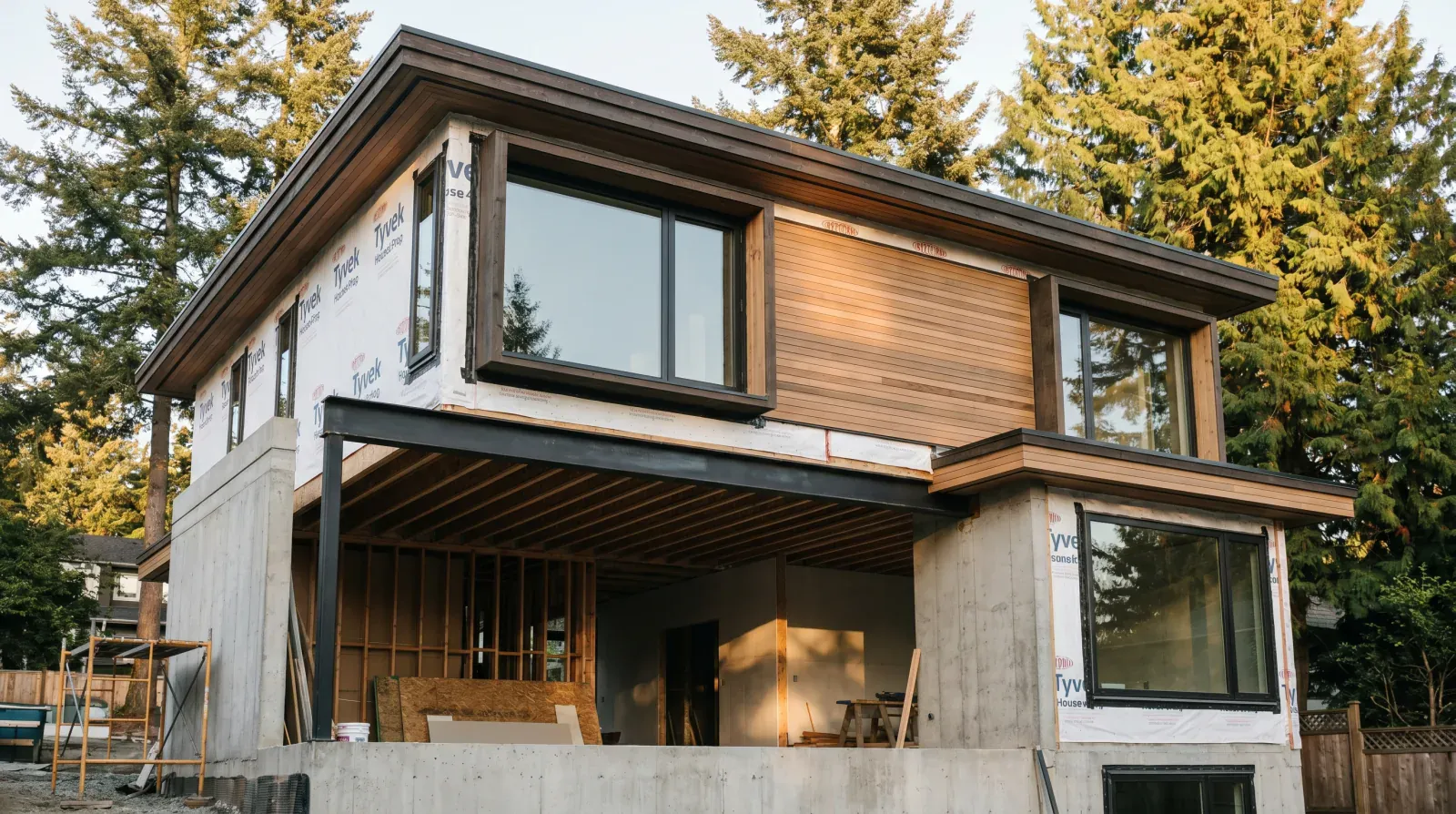
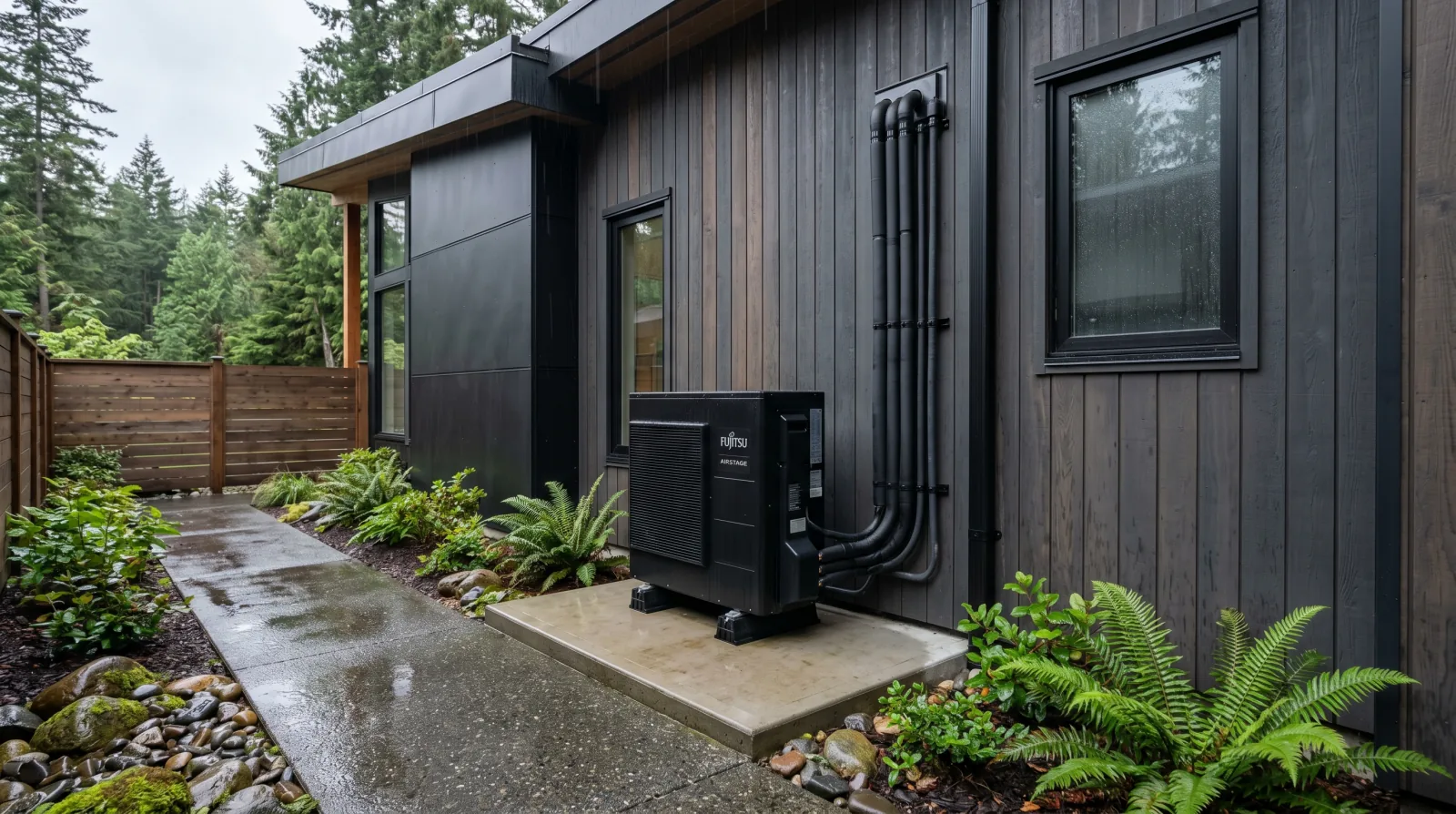
A hillside home in Abbotsford falls under the same Step 3 BC Energy Step Code plus Zero Carbon EL-1 requirement as any other new home in the city, and the exposure on an open mountain face makes the envelope work harder, not easier. Wind on the upper slopes is real. Continuous exterior insulation, careful air-sealing and properly specified glazing have to be designed in from the start, and a registered professional's stamped energy model has to prove it before the city issues the permit.
The big south-facing glass that makes the view possible is also the hardest part of the envelope to get right. High-performance glazing, properly detailed thermal breaks and shading that manages the summer heat gain are what keep that view from turning the living room into a greenhouse in July.
Permit requirements on Abbotsford's Eastern Hillsides
A Sumas Mountain build doesn't move through the permit process the same way a flat Clearbrook lot does. Several things add to the review load:
The geotechnical report has to be stamped by a professional geotechnical engineer registered with EGBC and submitted as part of the building permit application. In some cases, particularly where the report identifies slope instability or uncertain soil conditions, a geotechnical monitoring plan and a commitment to geotechnical inspection during construction are required conditions of the permit. The City of Abbotsford wants documentation that the professional who wrote the report will be involved through the build, not just at the design stage.
The BC Energy Step Code requirements apply fully to hillside lots, Step 3 plus Zero Carbon EL-1 as of 2025. An energy model from a registered professional has to be submitted with the permit application. On a south-facing mountain lot, passive solar gains can help the energy model or hurt it depending on how the glazing and shading are handled. A large south face without proper shading is a summer overheating problem that the model will flag.
The drainage design often requires a separate engineer's report when a lot has meaningful grade change, and the City may require the drainage consultant to be on-site during specific phases of construction. This is especially true where the drainage design intercepts subsurface water uphill of the building, since an improperly installed interceptor drain can create problems rather than solve them.
None of this is unusual for a hillside site anywhere in the Lower Mainland. The key is to have all of it sequenced, geotech first, drainage design second, energy model concurrent with architecture, so no permit document is waiting on another when the application goes in.
Lot selection: what separates the good sites from the complicated ones
Not every Sumas Mountain lot is the same project. Some variables that make a significant difference:
Slope angle and orientation. Lots that run steeply front-to-back can present challenges for both the foundation design and the driveway approach. BC Building Code sets requirements on driveway grades, and a steep approach can drive significant civil engineering to create something driveable and safe. South-facing lots are prized for views and passive solar but require the most careful shading design for summer months. East and west-facing lots offer views across the valley but get more variable light and shade conditions.
Treed lot clearing. Abbotsford's tree retention requirements apply, and clearing a heavily treed Sumas Mountain lot involves permits, professional assessment, and sometimes a replanting commitment. A lot with a mix of mature trees and open area is often better than a fully treed lot, which may have a longer clearing process.
Road access and servicing. Some upper Sumas Mountain roads are rural in character and may lack full municipal services. Septic versus municipal sewer is a material difference in cost, long-term maintenance, and what the lot will support in terms of building size. We check servicing availability at the first lot assessment.
What the right hillside home feels like
The Sumas Mountain homes that age well share a quality: restraint. The lots are generous and the setting is dramatic enough that the home doesn't need to compete. Real materials, stained cedar, board-formed concrete, blackened metal, settle into the landscape rather than fight it. The architecture lets the slope and the trees and the view do the talking.
That restraint is only possible because the unglamorous work underneath it was done right. Get the geotech, the retention and the drainage honest, and you've earned the freedom to make the rest beautiful. Skip them, and the most expensive view in Abbotsford sits on a foundation you'll worry about for as long as you own the home.
For the other kinds of Abbotsford projects we take on, from McMillan rebuilds to acreage homes out toward Bradner, see our custom home builder page for Abbotsford.
Frequently asked questions
- Why is a geotechnical report non-negotiable on a Sumas Mountain lot?
- Sumas Mountain's geology runs to glacial till and bedrock outcrops on the higher ground, with pocket variability a walk-around won't reveal, one corner of a lot can sit on competent rock and another on looser till a short distance away. A geotechnical assessment reads what's actually there and tells the structural engineer what the foundation, shoring, and retention have to do, which is why it comes before any elevation is finalized, not after.
- What does a hillside build in East Abbotsford typically require below grade?
- Three things owners often underestimate as baseline scope rather than upgrades: shoring during excavation so the cut holds while the foundation goes in, engineered retention such as retaining walls or tieback systems that hold the grade once the home is in place, and structured drainage that moves water through and around the site instead of letting it pool against the foundation or destabilize the slope.
- Can a riparian setback affect a Sumas Mountain lot?
- Yes. Creeks, ditches, and seasonal watercourses are more common on the mountain's flanks than people expect, and where one is on or near a lot, BC's Riparian Areas Protection Regulation may apply, triggering a Qualified Environmental Professional assessment and a protected setback that can reshape the buildable footprint. We check for this at the lot tour, before design begins.
- Does the BC Energy Step Code apply differently on a hillside lot?
- The requirement is the same, Step 3 of the BC Energy Step Code plus Zero Carbon EL-1, but an exposed mountain face makes the envelope work harder to hit it. Wind on the upper slopes is real, and continuous exterior insulation, careful air-sealing, and properly specified glazing all have to be designed in from the start, with a registered professional's stamped energy model proving it before the city issues the permit.
- Does the geotechnical engineer's involvement end once the report is submitted?
- Not on many Sumas Mountain sites. Where the report identifies slope instability or uncertain soil conditions, the City of Abbotsford can require a geotechnical monitoring plan and a commitment to geotechnical inspection during construction as a condition of the permit, documentation that the professional who wrote the report stays involved through the build, not just at the design stage.
- How does driveway grade factor into a Sumas Mountain lot choice?
- Lots that run steeply front-to-back can complicate both the foundation design and the driveway approach, since the BC Building Code sets requirements on driveway grades and a steep approach can drive significant civil engineering to make something driveable and safe. This is one of the site-specific variables worth evaluating before committing to a lot, not after purchase.
- Do all Sumas Mountain lots have municipal water and sewer?
- No. Some upper Sumas Mountain roads are rural in character and may lack full municipal services, which makes septic versus municipal sewer a material difference in cost, long-term maintenance, and what the lot can support in terms of building size. Confirming servicing availability is part of the first lot assessment, before design work starts.
- How does tree clearing on a Sumas Mountain lot affect the project?
- Abbotsford's tree retention requirements apply on the mountain the same as elsewhere in the city, and clearing a heavily treed lot involves permits, professional assessment, and sometimes a replanting commitment. A lot with a mix of mature trees and open area is often a simpler project than a fully treed lot, which can carry a longer clearing process before construction can start.