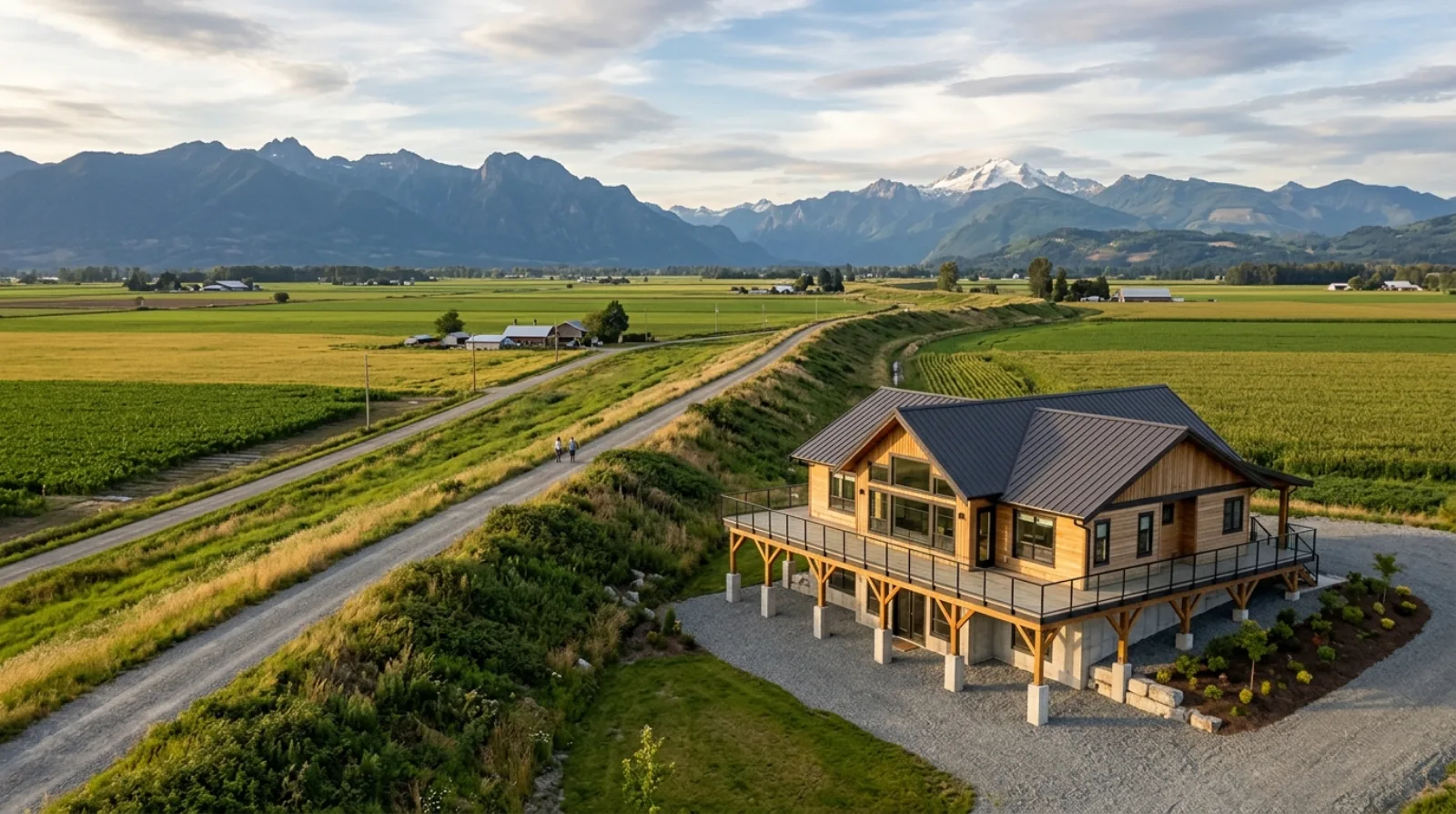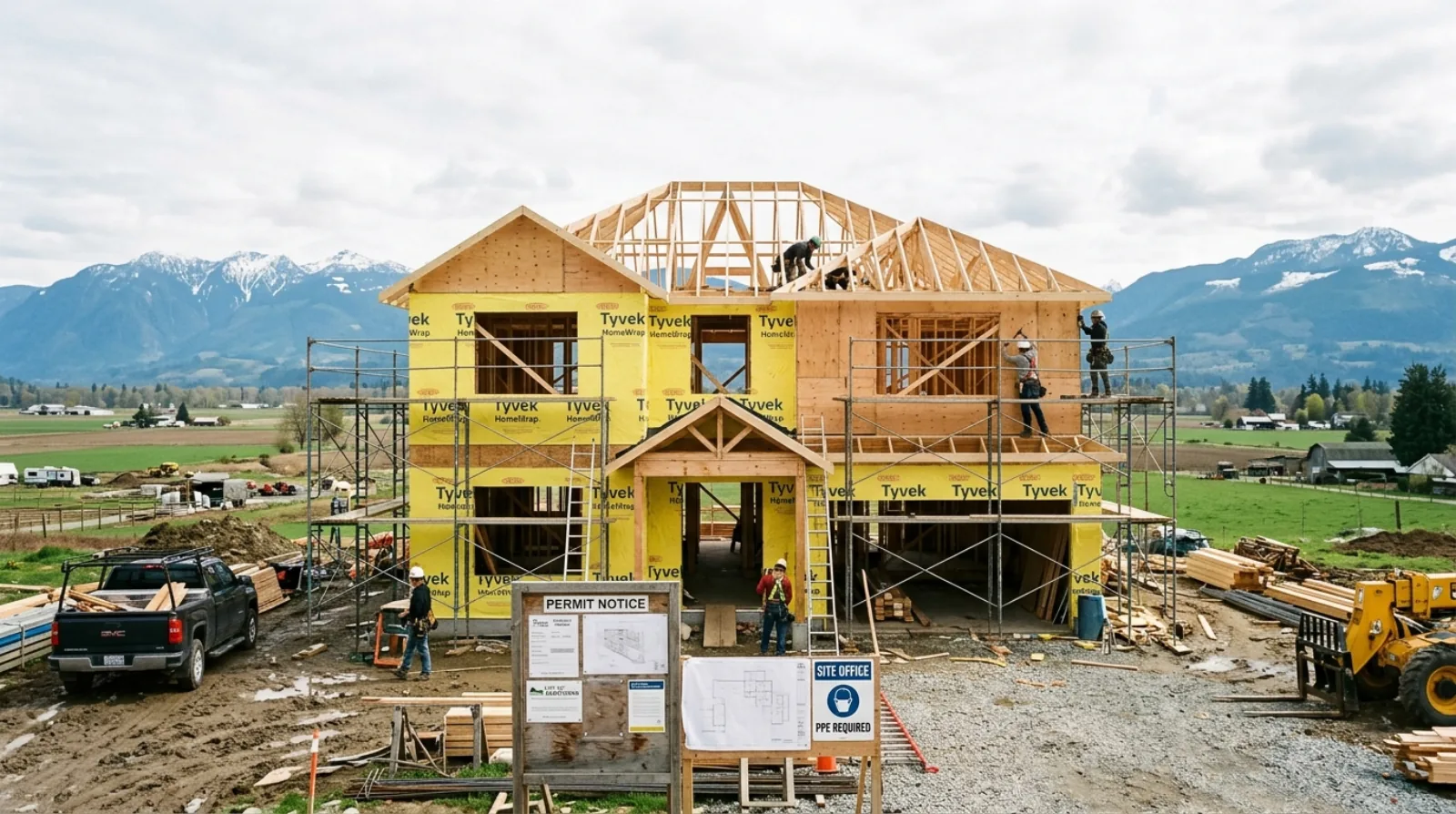
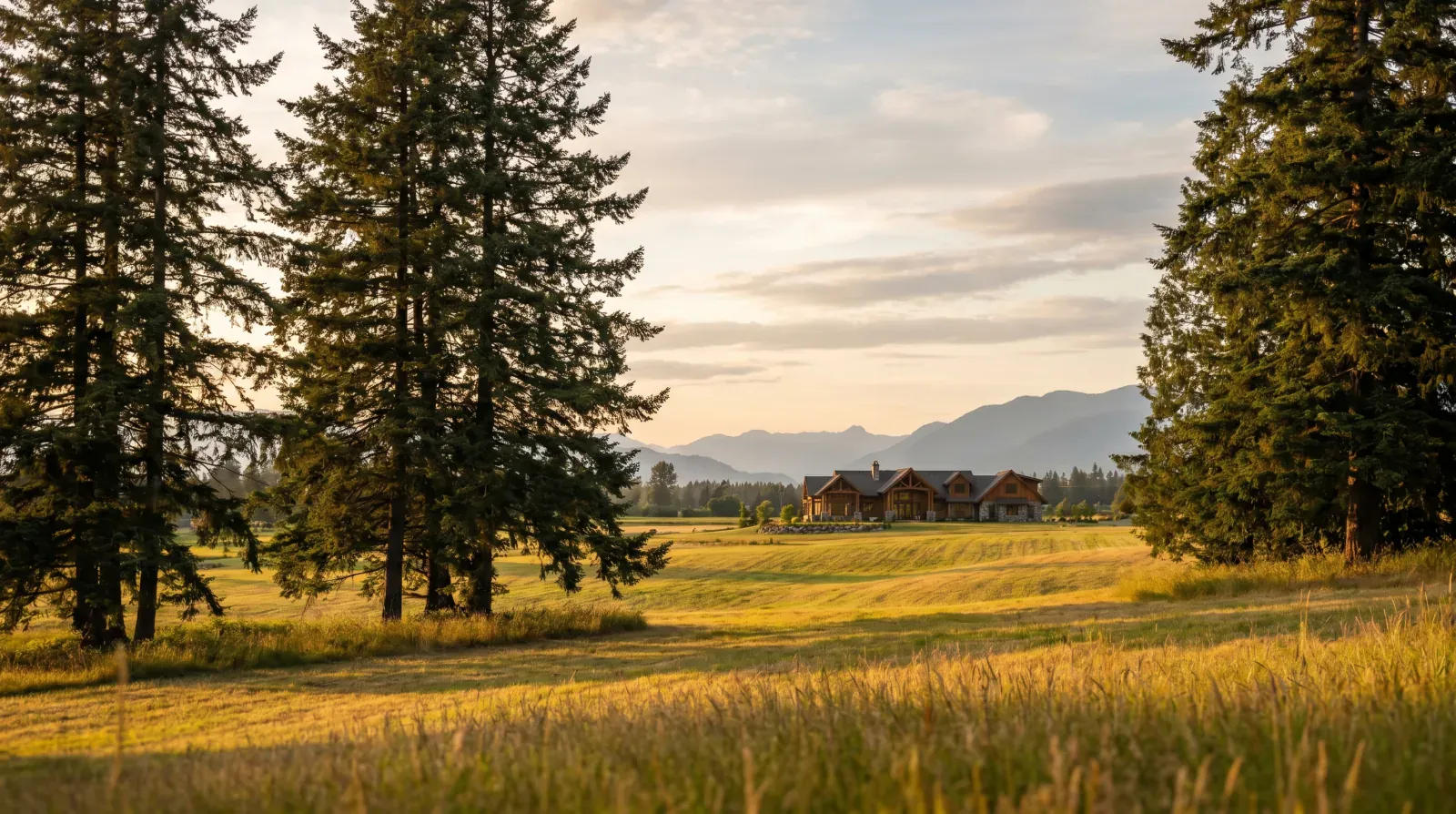
Burnaby and the Fraser Valley sit a 50-minute drive apart and feel like different building environments. Soils, drainage, permitting, trades, climate, here's what actually changes when a Burnaby owner considers a Fraser Valley acreage instead.
We work primarily in Burnaby and the inner suburbs of Greater Vancouver, but a meaningful share of our work is east of Langley, in Abbotsford, Mission, Chilliwack, and the Fraser Valley Regional District. The build environment out here is different from a Burnaby or Vancouver lot in ways most owners don't see until they're inside the project.
This piece is for the Burnaby owner, or the Vancouver, Coquitlam, or North Vancouver owner, who is considering trading the inner-city lot for an acreage further east. The trade-offs are real in both directions. The municipalities differ. The soils differ. The drainage differs. The permit process differs. The trade availability differs. So does the climate. Here's what changes, and what doesn't.
The lots are bigger, and so is the planning
A Burnaby Heights or Capitol Hill lot rewards density. The footprint is constrained by setbacks, the trees are protected by bylaw, the views demand specific orientation, and the design conversation operates within tight geometry.
A Fraser Valley acreage rewards orientation, separation, and long-term thinking instead. With more land, the design conversation has to think about which way the house faces (and the secondary buildings, and the driveway, and the future shed), how the views resolve across the lot, where the future workshop or guest suite would go, where the kitchen garden lives, where the orchard goes if there's going to be one. Owners moving from Burnaby often underestimate how much of the design work moves outside the building footprint when the lot grows from 6,000 square feet to several acres.
What this looks like in practice on a Fraser Valley site:
- A site plan that includes future buildings (workshop, secondary dwelling under the regional rules, garden structures), not just the principal residence
- Driveway and parking design that accounts for service vehicles, trailer maneuvering, and seasonal weather
- Orientation studies that look at solar exposure, prevailing winds, and view across all four seasons
- Septic and well planning when the lot is on private services rather than municipal hookup
- Tree retention strategy that's different from the urban Burnaby version, because the trees are typically more numerous and the relationships are different
The soils tell different stories, lot by lot
Lower Mainland soils vary dramatically depending on which part of the valley you're in. The geological story is genuinely different from one municipality to the next.
- Surrey sits on glacial tills and clay-rich layers. Clay layers trap water, which makes settlement and drainage real considerations. Many parts of Surrey have to deal with both.
- Langley runs on rolling sandy and silty soils. Groundwater management drives the foundation strategy on most lots. Lots can vary noticeably from one block to the next.
- Delta is built on deep river sediments and soft peat, widely considered one of the most settlement-prone areas in the province. Pile foundations are common.
- Abbotsford and Mission include a mix: alluvial deposits along the Fraser, glacial till on the higher ground, peat in low-lying areas, and bedrock outcrops on the slopes. The variability within a single neighbourhood can be substantial.
- Chilliwack and the rural FVRD continue the variability, with floodplain considerations adding to the geotechnical picture along the Fraser and its tributaries.
By contrast, Burnaby Mountain has its own profile. Soils on Burnaby Mountain are shallow on the steeper northern slopes and where construction has scraped away the original surface. Topsoils are generally underlain by silty sands and gravel. The mountain itself runs to about 370 metres at its summit, and Burnaby Heights, Capitol Hill, Forest Glen, and Buckingham Heights all sit on its lower flanks. The Burnaby profile is more uniform than the Fraser Valley, but it has its own slope-related complications.
The single most important point: a geotechnical assessment isn't optional in either environment. It's the cheapest insurance you'll buy on the entire project, and it's usually more important on a Fraser Valley acreage than on a flat Burnaby infill, simply because the variability is greater.
Drainage is a first-class design problem in the valley
Lower Mainland rainfall is real. Burnaby and Vancouver get on the order of 1,100 to 1,200 mm annually. East of Langley the numbers are similar but the drainage challenge is different because the lots tend to be flatter, the water tables higher, and the surface area larger.
The drainage strategy on a Fraser Valley lot has to think about:
- Roof drainage captured and discharged to a managed path (rain garden, dry well, stormwater connection where available, ditch where not)
- Perimeter foundation drainage with a clear discharge route
- Lot grading that moves surface water away from the building and toward managed drainage rather than to neighbouring properties
- Septic field drainage if the property is on private septic, separate from stormwater drainage and with its own setback rules
- Agricultural drainage if the lot is in or near the Agricultural Land Reserve, which has its own stormwater considerations
Get this right at planning and you'll never think about it again. Get it wrong, and you'll think about it every winter, sometimes literally every November-to-March stretch.
RAPR applies more often in the Fraser Valley
Plenty of Fraser Valley lots back onto creeks, ditches, or seasonal watercourses, and many of those watercourses are fish-bearing. BC's Riparian Areas Protection Regulation applies to any residential development within 30 metres of a fish-bearing stream and triggers an assessment by a Qualified Environmental Professional. The result is a Streamside Protection and Enhancement Area between 10 and 30 metres wide, plus site-specific setback and planting conditions baked into the building permit.
In Burnaby, RAPR applies in pockets, Stoney Creek, Brunette River, parts of Burnaby Lake, but it doesn't shape most lots. In the Fraser Valley, RAPR is much more frequently in the brief. A lot that backs onto a small creek that holds water seasonally can trigger a full QEP assessment, several weeks of review, and a meaningful setback that constrains the building footprint.
The practical implication: check RAPR applicability at the lot tour, not after the offer is in. The assessment cost and timeline are real and worth knowing about before commitment.
Permitting moves at a different pace
Abbotsford, Mission, Chilliwack, and the Fraser Valley Regional District all run their own permit review processes, with their own bottlenecks and their own faster windows. None of them runs on the same calendar as Burnaby or Vancouver.
Two things to know about the permit context across both regions:
- The 2024 BC Building Code applies provincially. Every permit application in BC submitted on or after March 8, 2024 falls under the 2024 BC Building Code, regardless of municipality. Designs and documents have to reflect the current code edition.
- The provincial Building Permit Hub is rolling out across BC. Launched on May 27, 2024 with twelve local government and two First Nation pilot partners, the Hub is being expanded province-wide. Burnaby is participating; several Fraser Valley municipalities are coming online. The Hub provides automatic completeness and code-compliance checks before a file reaches a human reviewer.
In Burnaby specifically, permits are now digital-only as of January 1, 2026 per the City of Burnaby New Home Construction page. Fraser Valley municipalities are moving toward digital intake on their own timelines.
Local relationships matter on a Fraser Valley project in ways they matter less in Burnaby, because the smaller municipalities run with smaller planning teams, and the same coordinator may be the person you talk to multiple times across the project. That's a feature when the relationship is good. It can be a complication when it isn't.
The trades story is genuinely different
Skilled trades east of the city tend to be loyal, repeat-engaged, and surprisingly accessible compared with a Vancouver or Burnaby project. The Fraser Valley has a stable, multi-generational tradesperson base, and the same framer or finisher will often work on the same builder's projects for years.
The trade-off is that the most specialised finishers, particular millworkers, certain stone fabricators, a few specific tile installers, the high-end mechanical contractors, often have to travel out from central Vancouver or Burnaby. That affects scheduling, not capability. A high-end Fraser Valley project sometimes ends up with a hybrid trade stack: local framers and mechanical, central-Vancouver-based finishers.
In Burnaby, the trade availability is broader but more competitive, particularly during peak summer. Burnaby and Vancouver both pull from the same labour pool, and that pool tightens in May through September.
The Burnaby tree bylaw vs Fraser Valley tree handling
The Burnaby Tree Bylaw is one of the strictest in the Lower Mainland. Any tree 20 cm in trunk diameter or larger on a development-application property is a Protected Tree. Most central Burnaby lots, Burnaby Heights, Capitol Hill, Brentwood, capture several mature trees in that threshold.
Fraser Valley municipalities and the FVRD generally have less restrictive tree-protection rules on private rural and acreage lots, though specific neighbourhoods within municipal boundaries (Abbotsford, Mission, Chilliwack proper) often have local rules that approach the urban model. ALR (Agricultural Land Reserve) lots have their own separate considerations around clearing and use.
The practical difference for a Burnaby owner considering a Fraser Valley acreage: the tree-bylaw constraint is usually lighter on the Fraser Valley lot, but the natural environmental considerations (riparian, ALR, fish habitat, agricultural drainage) are often heavier. The total regulatory weight is comparable; it just lives in different categories.
Agricultural Land Reserve implications
A meaningful share of Fraser Valley lots touch the Agricultural Land Reserve. The ALR is administered by the BC Land Commission under the Agricultural Land Commission Act, and the rules it creates affect what can be built, where, and at what scale on any property that is within or adjacent to ALR land.
For residential builds on ALR land (rare for a full custom home, but common for acreage lots with mixed ALR/non-ALR portions), the rules limit non-farm residential development to a single dwelling unit per parcel, with additional dwellings (including secondary suites and coach houses) subject to ALC approval. Accessory farm buildings, farm worker housing, and agri-tourism structures each have their own rule set. The Burnaby owner used to the more permissive urban residential code will find the ALR rules unfamiliar and worth checking with the ALC directly, not just the municipal planning counter, before committing to a site.
For lots adjacent to ALR land without being inside the Reserve, the main practical implication is drainage and setback. The ALC has setback guidance for residential buildings adjacent to farm operations to limit interface conflicts (noise, light, traffic). These setbacks interact with the municipal zoning setbacks, and the more restrictive of the two applies.
What the Fraser Valley gives you
More privacy. More flexibility on the building envelope. Often, more lot for the same brief. A different climate to design for, hotter summers, more decisive winters, more mature landscape options. None of those are minor. All of them shape what the right home for the lot actually looks like.
What the Fraser Valley does not give you: proximity to Burnaby's amenities, transit access, or the urban services that come with a central Lower Mainland address. The 50-minute commute to central Vancouver from Abbotsford is real. The 30-minute commute from Burnaby Heights is also real, and it's a different reality.
What this means for a Burnaby owner thinking about moving east
If you're considering trading a Burnaby Heights or Capitol Hill lot for a Fraser Valley acreage:
- Get the geotechnical and drainage reads done before commitment. The lot variability in the Fraser Valley is greater. Surprises are more expensive.
- Check RAPR applicability. Many Fraser Valley lots have water features that the urban Burnaby owner isn't used to thinking about.
- Plan the trade stack realistically. The local Fraser Valley trades are excellent for framing, mechanical, and most finishing work. The high-end specialists often travel out from Vancouver or Burnaby.
- Account for the commute reality. The lifestyle is different. The build itself is also different, site visits during construction take longer when the project is 90 minutes away by car.
Building in the Fraser Valley isn't building in Burnaby with a longer drive. It's a different practice. The homes designed for it, not in spite of it, are the ones that age the best.
Icon Projects Team
The same builder principles hold across both: design for the lot, respect the soils, plan the drainage, specify the envelope properly, build above the code rather than to it. The municipalities differ. The geology differs. The principles don't.
For a closer look at the Abbotsford projects themselves, from Auguston to Sumas Mountain, see our custom home builder page for Abbotsford.
Related on the Journal
- What 2026 changes for Burnaby custom homes
- Choosing a foundation on a sloped lot
- Realistic BC custom home timelines
Frequently asked questions
- What actually changes when building a custom home in the Fraser Valley instead of Burnaby?
- The biggest shifts are soils, drainage, and which regulations carry the most weight. Fraser Valley soils vary more from lot to lot than Burnaby's, ranging from Delta's soft peat to Abbotsford's mix of alluvial deposits and glacial till. The Burnaby Tree Bylaw's strict protection rules ease up on a Fraser Valley acreage, but the Riparian Areas Protection Regulation and Agricultural Land Reserve rules apply far more often out east.
- Why would a Fraser Valley property need a Qualified Environmental Professional when a Burnaby lot didn't?
- BC's Riparian Areas Protection Regulation applies to any residential development within 30 metres of a fish-bearing stream, which triggers an assessment by a Qualified Environmental Professional. Fraser Valley lots back onto creeks, ditches, and seasonal watercourses far more often than Burnaby lots do, and even a ditch that only holds water seasonally can turn out to be fish-bearing, requiring a Streamside Protection and Enhancement Area between 10 and 30 metres wide.
- How do soils differ between Burnaby and the Fraser Valley?
- Burnaby Mountain has a uniform soil profile: shallow on steeper northern slopes, with topsoils generally underlain by silty sands and gravel. The Fraser Valley varies by municipality. Surrey sits on glacial tills and clay-rich layers that trap water. Delta is built on deep river sediments and soft peat, one of the most settlement-prone areas in the province. Abbotsford and Mission mix alluvial deposits, glacial till, and peat within a single neighbourhood.
- Is the Burnaby Tree Bylaw stricter than Fraser Valley tree rules?
- Yes, for most private lots. The Burnaby Tree Bylaw protects any tree 20 cm or larger in trunk diameter on a development-application property, one of the strictest thresholds in the Lower Mainland. Fraser Valley municipalities and the Fraser Valley Regional District generally have less restrictive tree-protection rules on private rural and acreage lots, though the regulatory weight that eases on trees typically shifts into riparian, Agricultural Land Reserve, and agricultural drainage requirements instead.
- Does the 2024 BC Building Code apply the same way in the Fraser Valley as in Burnaby?
- Yes. The 2024 BC Building Code applies provincially, so every permit application submitted anywhere in BC on or after March 8, 2024 falls under the same code edition regardless of municipality. What differs between Burnaby and the Fraser Valley is the permit review process itself: Abbotsford, Mission, Chilliwack, and the Fraser Valley Regional District each run their own review timelines, separate from Burnaby's process and from each other.
- Are skilled trades harder to find on a Fraser Valley custom home build?
- Not for most trades. The Fraser Valley has a stable, multi-generational tradesperson base, and framers and mechanical contractors are often more accessible and loyal than in a Burnaby or Vancouver project. The exception is highly specialised finishers, certain millworkers, stone fabricators, and tile installers, who often have to travel out from central Vancouver or Burnaby, which affects scheduling rather than the quality of the work available.
- What does the Agricultural Land Reserve mean for a Fraser Valley custom home?
- A meaningful share of Fraser Valley lots touch the Agricultural Land Reserve, administered by the BC Land Commission. For residential builds on ALR land, non-farm residential development is generally limited to a single dwelling unit per parcel, with additional dwellings subject to Agricultural Land Commission approval. Lots adjacent to ALR land without being inside it still face setback guidance meant to reduce conflicts with nearby farm operations.
- Is drainage a bigger design problem in the Fraser Valley than in Burnaby?
- Rainfall totals are similar, roughly 1,100 to 1,200 mm annually in both regions, but the drainage challenge differs because Fraser Valley lots tend to be flatter with higher water tables and larger surface areas. A Fraser Valley drainage strategy has to account for roof drainage, perimeter foundation drainage, lot grading, and often septic field drainage or agricultural drainage, on top of the same considerations a Burnaby lot requires.