A legal secondary suite is a design decision, not a renovation you bolt on later. Here is how we plan a basement suite into a Burnaby custom home from the first drawings, the entrance, the windows, the plumbing stack, the fire and sound separation, so it works as a mortgage helper, an in-law space, or an aging-in-place option without a costly retrofit.
Most of the secondary suites I get asked to price are already built, somewhere else, in someone else's head, as a "we'll finish the basement later" line item. By the time the question reaches me, the house is designed, the foundation is in, and the suite has to fight the building for room it was never given.
That is the wrong order. A legal suite inside a custom home is one of the few features where the planning decision and the construction cost are almost entirely separate. Decide early and the suite is close to free to build into the structure. Decide late and you are cutting doors through finished walls, digging light wells against a poured foundation, and rerouting plumbing around framing that has already closed up.
So this is a planning post, not a renovation post, if you already own the house and want to add a suite to it, our whole-home renovation service covers that path instead. If you are building new in Burnaby, Brentwood, Capitol Hill, Government Road, anywhere in the R1 zone, and a suite might ever be part of the picture, here is what I make sure is on the drawings before we frame.
What actually makes a suite "legal"
A secondary suite, in the way the law means it, is a self-contained dwelling unit located inside your house. The City of Burnaby defines it as an accessory dwelling unit fully contained within a primary dwelling, one self-contained unit, with a separate entrance, containing not more than one kitchen (City of Burnaby, Secondary Suite Information Guide). That last detail matters more than people expect: a second kitchen is what turns a finished basement into a separate dwelling unit in the eyes of the code, and a separate dwelling unit triggers a whole set of safety requirements that a rec room never does.
Three facts shape everything else.
First, where a suite is even allowed. In Burnaby, a secondary suite is permitted in the R1, A1, A2, A3 and RM6 zoning districts, must be fully contained within a primary dwelling that has no other secondary suites, and contains not more than one kitchen (City of Burnaby). For a standard Burnaby single-family lot, most of the Heights, most of Capitol Hill, most of the Deer Lake and Government Road neighbourhoods, you are in R1, and a suite is on the table.
Second, the suite stays part of your house. You cannot strata-title a basement suite, carve it onto its own lot, or sell it to someone else. The Province is explicit: neither the secondary suite nor the other dwelling unit in a house can be strata-titled or otherwise subdivided under provincial legislation, both units are registered under the same title (Government of BC, Home Suite Home guide). Burnaby says the same thing from the zoning side: a suite cannot be subdivided from the principal dwelling into a separate parcel by strata plan, air space parcel plan, or otherwise (City of Burnaby Information Guide). This is the right answer for most families I work with, it keeps the suite flexible. It is a rental this decade, an in-law space the next, a teenager's first apartment the one after that, and it flips back to part of the main house whenever you want. One title, all options open.
Third, the suite has a ceiling on its size. Under the BC Building Code, a secondary suite has to stay under 90 m² (about 968 square feet) in floor area and stay under 40% of the total habitable floor area of the building (BC Building Code, Section 9.36 Secondary Suites, via BC Publications). On the Burnaby side there is also a floor: a suite has to have a minimum area of 32.52 m² (350 square feet) (City of Burnaby Information Guide). So you have a window, bigger than a bachelor apartment, smaller than the main house, and inside that window you can design something genuinely livable rather than a code-minimum box. Which one you build is a design choice you make on purpose, not a default you back into.
The separate entrance decides the floor plan
Every legal suite needs its own entrance, separate from the main dwelling's door (City of Burnaby Information Guide). Simple rule, big consequences for the plan.
A tenant, or your father-in-law, should never have to walk through your living room to get home. On a flat Burnaby lot that usually means a door on the side of the house with a short path to the street or driveway. On the hillside lots that define so much of Capitol Hill and Burnaby Heights, the grade often hands you a gift: the back or side of the basement is already at or near ground level, and the suite entrance becomes a genuine ground-floor walk-in instead of a stairwell down into a pit.
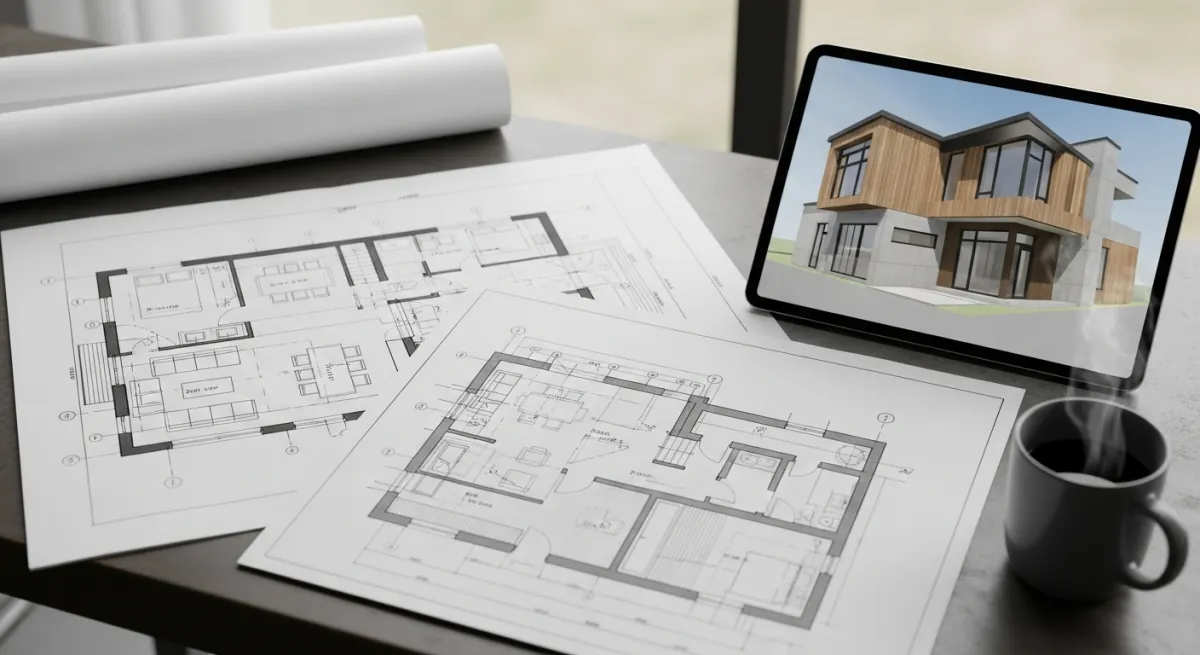
Here is where designing early pays off. The entrance location drives the interior layout of the suite, the kitchen wants to be near it, the bedrooms want to be away from it, the bathroom wants to be near the plumbing stack. Try to retrofit a separate entrance into a basement that was laid out without one and you usually end up cutting a new opening through a structural wall, pouring new exterior stairs, and giving up a chunk of the suite to a hallway that only exists because the door landed in the wrong place. Draw the entrance first and the whole suite organizes itself around it.
This is the same discipline we bring to multigenerational home design in Burnaby, the separate entrance is not a tenant convenience, it is what lets two households share a building without friction. A parent who has their own front door has their own life.
Light and air: the egress window nobody plans for
Every bedroom in the suite needs an escape window. Not a nice-to-have, a hard requirement. In Burnaby a bedroom egress window has to give an unobstructed opening of at least 0.35 m² (about 3.77 square feet) with no single dimension less than 380 mm (City of Burnaby Information Guide). The point is simple: a person has to be able to get out of that bedroom in a fire without using the suite's main door, and a firefighter has to be able to get in.
For a basement suite, that almost always means a window well, an excavated, retained pit against the foundation that drops the exterior grade low enough for a real, openable window. And a window well is a foundation decision. It changes where you place the footing drains, how you waterproof that section of wall, and how the site grades and drains around it. Add it during foundation design and it is part of the pour. Add it two years later and you are excavating tight against a finished, occupied house, breaking into waterproofing you already paid for, and praying you do not find a services run where the digger wants to go.
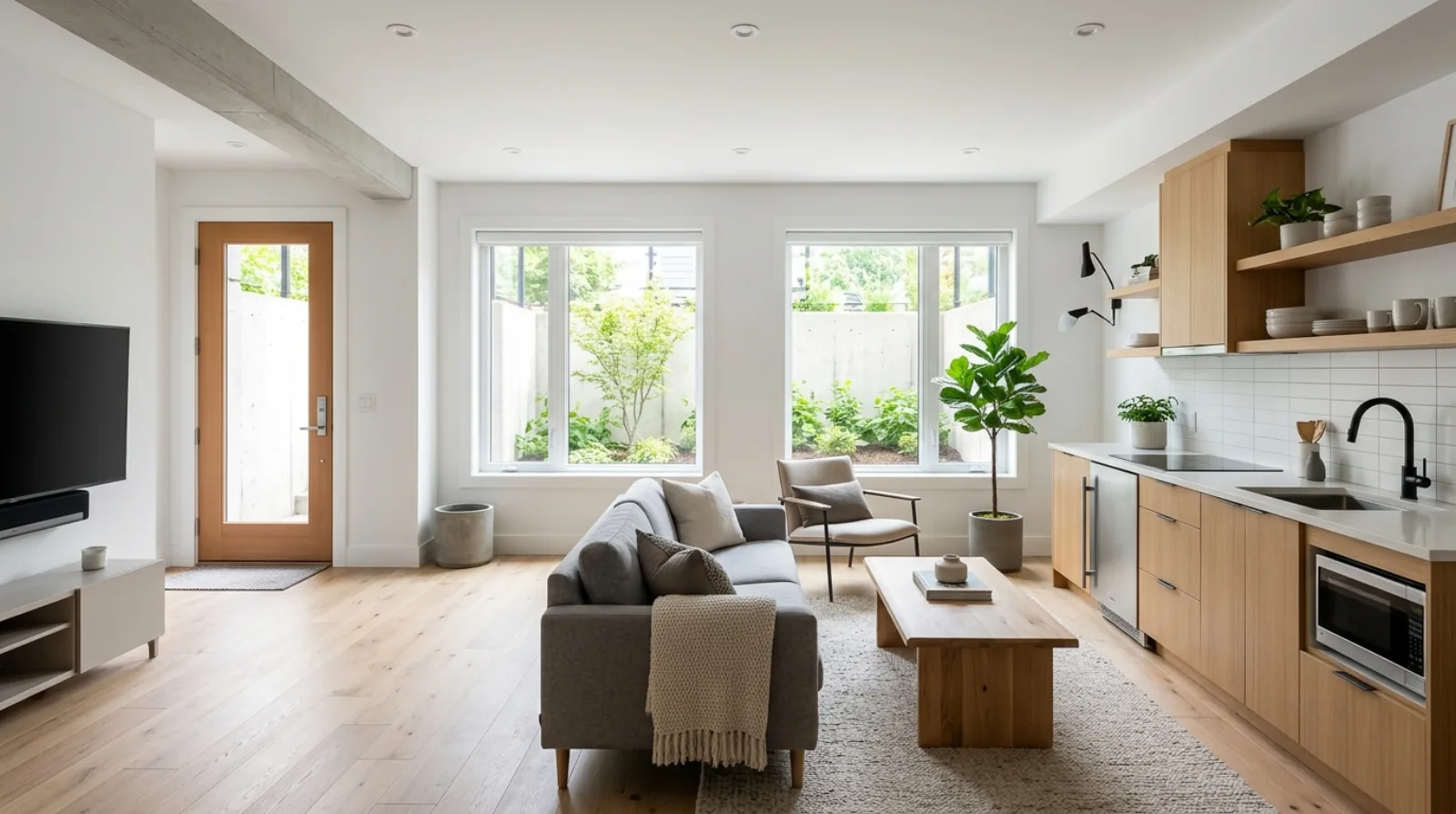
There is a quieter benefit, too. The same window wells that satisfy the code are what make the difference between a suite that feels like a basement and one that feels like a home. Oversize them past the minimum, point them where the daylight is, and the suite reads as bright and livable instead of dim and tolerated. On the rental side that is the difference between a unit that leases in a week and one that sits. On the family side it is the difference between a parent who is happy down there and one who is counting the days. Either way, you only get that result if the wells are drawn before the concrete is.
Fire and sound: the separation you cannot see and cannot skip
This is the part that separates a real suite from a finished basement, and it is the part owners most want to wave away. The wall and floor-ceiling assembly between the suite and your part of the house is a fire separation. It is there to give both households time to get out, and the code is specific about it.
Burnaby lays out the options clearly. The separation between the suite and the principal dwelling needs a minimum 45-minute fire-resistance rating for the walls and ceilings if there are no interconnected smoke alarms; a 30-minute rating is allowed if an additional interconnected photoelectric smoke alarm is installed in both units; and a 15-minute rating is allowed if every smoke alarm in the whole house is photoelectric and interconnected (City of Burnaby Information Guide). Either way, the principal dwelling and the suite must have interconnected smoke alarms, when one goes off, they all go off. All of this lives in Part 9 of the BC Building Code, which governs the construction of every secondary suite in the province (City of Burnaby Information Guide).
Sound is the separation the code also cares about, and the one occupants notice every single day. Burnaby requires the walls and ceilings between the two units to meet one of a few standards: sound insulation with a resilient channel on the ceiling and 12.7 mm drywall, or an STC rating of at least 43, or an ASTC rating of at least 40 (City of Burnaby Information Guide). I will be honest about what that buys you: code-minimum sound separation keeps you legal, but if the suite is for family, or if you want it to lease at the top of the market, I push clients past the minimum. Resilient channel, a denser assembly, plumbing isolated from the shared walls so a flushed toilet upstairs is not the soundtrack of the suite below. It is cheap to do in an open floor and ceiling. It is nearly impossible to add later.
A word on the mechanical, because it trips people up. Burnaby prefers that the suite have its own heating or ventilation system independent of the main house, and if shared forced-air ducts serve both units, you are into duct-mounted smoke detectors and fire dampers where the ducts cross the fire separation (City of Burnaby Information Guide). In a new build I would rather give the suite its own small system than thread shared ducts through a fire separation and bolt on the dampers and detectors to make it legal. The independent system is quieter, it is cleaner to control, and it sidesteps the whole problem. That decision belongs on the mechanical plan, not on a change order.
One more detail that only matters in new construction: in a new house, the suite has to be provided with its own separate electrical panel, or access to a panel in a common space (City of Burnaby Information Guide). If you want the option to meter the suite separately down the road, the time to set up the panel and the service for it is now, while the walls are open.
The plumbing stack, the parking, and the other quiet decisions
A few things that never make the brochure but make or break the build.
Stack the wet rooms. The suite's kitchen and bathroom want to sit under the main house's kitchen and bathroom, or at least near the same drainage stack. Plumbing runs down, and a stack that lines up between floors is a short, clean run. A suite bathroom on the opposite corner of the house from the main stack means long horizontal drain runs under the slab or in the floor, possible, but more expensive and more failure-prone. We lay the suite's wet rooms over the main stack on the first plan, and the whole plumbing budget gets easier.
Parking. This one is genuinely good news in Burnaby, and it is city-specific. Burnaby's rules state that a secondary suite does not require additional parking (City of Burnaby Information Guide). Do not assume that holds elsewhere, many municipalities across BC require at least one extra off-street stall for a suite. If you are weighing a build in Vancouver, North Vancouver, Coquitlam, or New Westminster instead, confirm the local parking rule before you commit the site plan, because an extra required stall can reshape your whole driveway and yard.
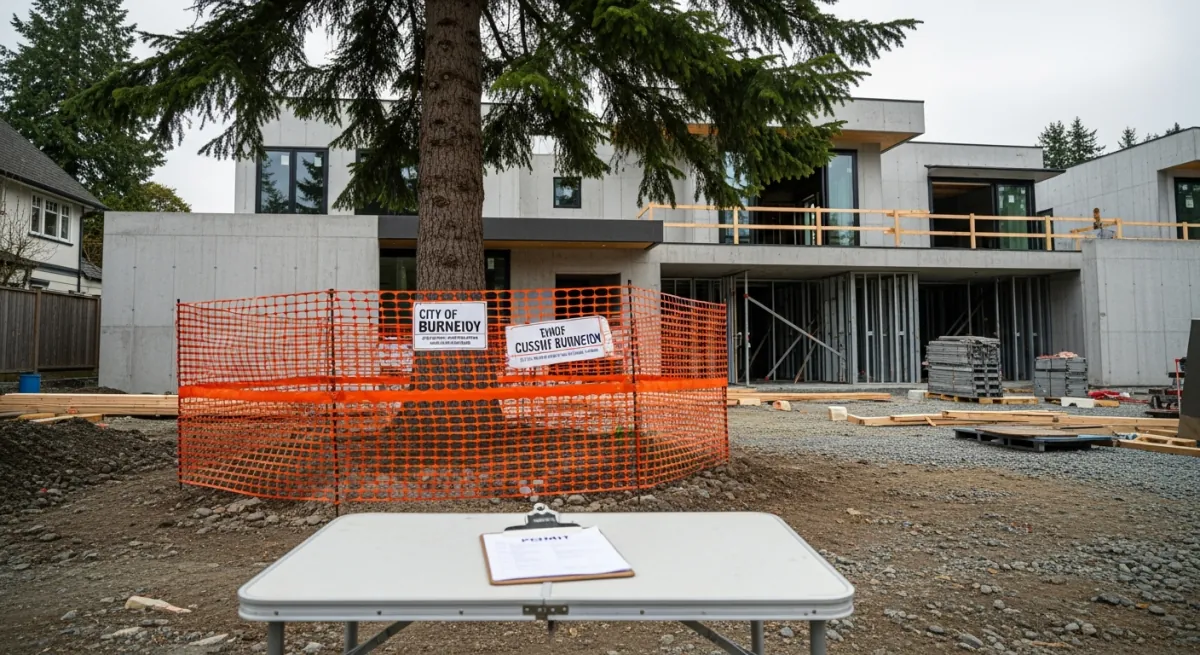
Register it. A legal suite in Burnaby is a registered suite. The city manages suites through a supplementary utility fee declaration, and renting an unregistered suite can bring a fine (City of Burnaby). On a new build this is paperwork, not construction, but it is the step that turns "I have a suite" into "I have a legal suite," and it is worth getting right at occupancy rather than discovering the gap later.
Build it so it can flip. The best suites I have built were designed with a second future in mind. A door, framed and finished, between the suite and the main house, kept locked while the suite is rented, opened up when a parent moves in and the family wants the run of the whole house. Plumbing and panel set up so the kitchenette can come out and the space rejoins the main floor without demolition. None of that costs much when it is on the original drawings. All of it is expensive when it is not.
Why this belongs in the planning conversation, not the framing one
Every requirement above, the separate entrance, the egress wells, the fire separation, the sound assembly, the aligned plumbing stack, the panel, is cheap when it is a line on a drawing and expensive when it is a change to a building. That is the whole argument for handling the suite at the planning stage rather than treating it as a phase-two project.
It also ties directly to the reasons most Burnaby families want a suite in the first place. A suite is a mortgage helper while the kids are young, an in-law space when a parent needs to be close, and an aging-in-place option when stairs in the main house stop being friendly. The same flexibility that makes a suite worth building only exists if the suite was designed in, separate entrance, ground-level access, a layout that does not trap anyone. Retrofit it and you usually get a compromise of all three. Design it and you get a feature that quietly changes what your house can do for your family across thirty years. That long view is exactly how we approach building a custom home in Burnaby, the decisions that look optional at sketch stage are the ones that define how the house lives.
If a suite might be part of your plan, the conversation to have is the early one, before the footprint is fixed, before the foundation is poured, while the entrance, the windows, and the stack are still just lines we can move.
Frequently asked questions
- How big can a secondary suite be in a Burnaby custom home?
- Under the BC Building Code a secondary suite must stay under 90 m² (about 968 square feet) in floor area and stay under 40% of the total habitable floor area of the building, whichever is more restrictive. On the Burnaby side, a suite also has to be at least 32.52 m² (350 square feet). So you have a defined window, larger than a bachelor apartment, smaller than the main house, and within it you can design a genuinely livable unit rather than a code-minimum box.
- Where are secondary suites allowed in Burnaby?
- Burnaby permits a secondary suite in the R1, A1, A2, A3 and RM6 zoning districts. The suite must be fully contained within a primary dwelling that has no other secondary suites, and it can contain only one kitchen. Most standard single-family lots across Burnaby Heights, Capitol Hill, Brentwood, Deer Lake and Government Road sit in R1, where a suite is permitted.
- Can you strata-title or sell a basement suite separately from the house in Burnaby?
- No. A secondary suite cannot be strata-titled, subdivided onto its own parcel, or sold separately from the main dwelling. The Province requires both dwelling units to be registered under the same title, and Burnaby's zoning rules say a suite cannot be subdivided from the principal dwelling by strata plan, air space parcel plan, or otherwise. That single-title structure is what keeps the suite flexible, rental one decade, in-law space the next.
- Does a secondary suite need its own entrance?
- Yes. A legal secondary suite in Burnaby must have its own entrance, separate from the main dwelling's door. A tenant or family member should be able to come and go without passing through your living space. On the hillside lots common in Capitol Hill and Burnaby Heights, the grade often lets that entrance be a true ground-level walk-in rather than a stairwell.
- Do bedrooms in a basement suite need egress windows?
- Yes. Each bedroom in the suite needs an escape window with an unobstructed opening of at least 0.35 m² (about 3.77 square feet) and no single dimension less than 380 mm, so a person can get out in a fire and a firefighter can get in. For a basement suite this usually means an excavated window well, which is a foundation decision best made during the original pour rather than retrofitted later.
- What fire and sound separation does a Burnaby secondary suite require?
- The wall and ceiling assembly between the suite and the main house is a fire separation. Burnaby allows a 45-minute fire-resistance rating with no interconnected alarms, a 30-minute rating with an added interconnected photoelectric alarm in each unit, or a 15-minute rating if every alarm in the house is photoelectric and interconnected, and the smoke alarms in both units must be interconnected. For sound, the separation must meet one of: resilient channel plus 12.7 mm drywall, an STC rating of at least 43, or an ASTC rating of at least 40.
- Does a secondary suite in Burnaby require extra parking?
- In Burnaby, no, the city's rules state that a secondary suite does not require additional parking. This is specific to Burnaby. Several other BC municipalities, including some in Vancouver, North Vancouver, Coquitlam and New Westminster, do require at least one additional off-street stall, so confirm the local rule before committing a site plan if you are building outside Burnaby.
- Does the suite need its own heating and electrical?
- Burnaby prefers the suite to have its own heating or ventilation system independent of the main house; if shared forced-air ducts serve both units, the ducts crossing the fire separation need duct-mounted smoke detectors and fire dampers. In a new house, the suite must also have its own separate electrical panel or access to a panel in a common space. In a new build it is usually cleaner and quieter to give the suite its own small system and panel from the start than to retrofit shared mechanicals.
Related reading: Multigenerational home design in Burnaby · Building a custom home in Burnaby: what 2026 changes · Planning services · Laneway and coach house construction