
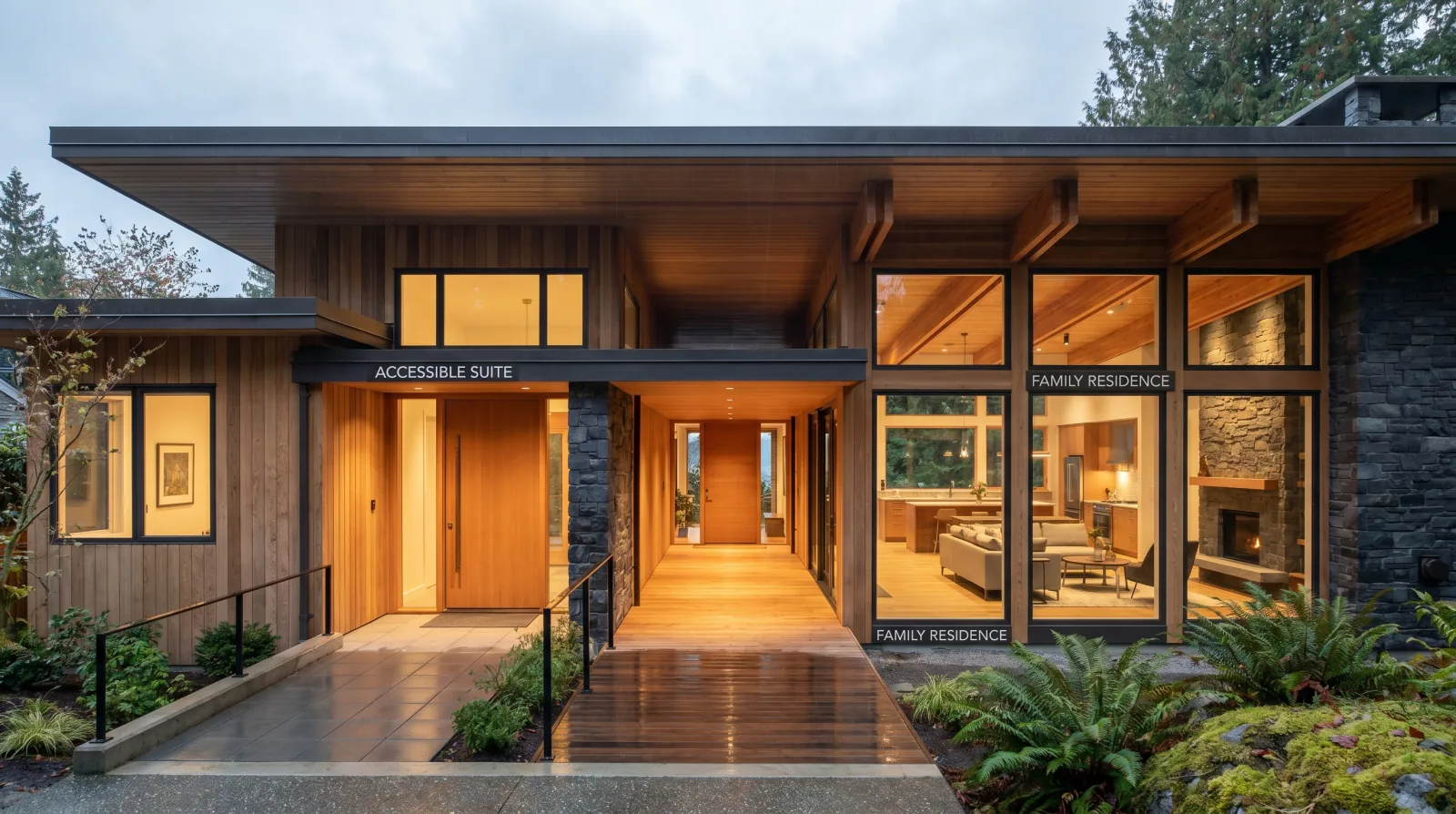
More Burnaby families are building homes for two or three generations on a single lot, aging parents, adult children, rental income, or all three. The design decisions that make multigenerational living genuinely functional are different from the ones that look good in renderings.
The demand for multigenerational housing in Greater Vancouver hasn't been a trend for a decade, at this point it's a structural feature of the market. High land and construction costs make multi-generational arrangements financially practical. An aging parent population makes them logistically sensible. And the cultural norm in many of Burnaby's communities has always been toward extended family living rather than away from it.
What's changed is that more families are approaching this intentionally at the design stage, rather than retrofitting an existing home or living in an arrangement that wasn't designed for it.
Here's what we've learned from building multigenerational homes across Burnaby, North Vancouver, and the Fraser Valley, what actually works, what sounds good but fails in practice, and what the Burnaby zoning context allows.
The three approaches, and which one fits your situation
Option 1: The legal secondary suite
A self-contained unit within the principal dwelling, typically in the basement, but not always, with its own kitchen, bathroom, bedroom, and separate entry. In Burnaby, secondary suites require registration with the city, must meet specific code requirements for fire separation, smoke and CO alarm interconnection, and minimum ceiling height, and require a separate entry that doesn't pass through the main dwelling.
Best for: A parent or adult child who wants significant privacy and independence, or a household that wants the flexibility to rent the suite when family use isn't needed.
The honest caveat: A secondary suite designed primarily for family use looks different from one designed for rental. Family suites tend to want better soundproofing, more natural light, a larger kitchen, and finishes that match the rest of the house. Rental suites optimise for durability and rentability. Decide which scenario you're primarily designing for before drawings start.
Option 2: The laneway home or coach house
A separate dwelling built on the rear of the lot, either attached to a laneway or detached as a garden suite. Burnaby's secondary dwelling rules allow laneway and coach houses on qualifying lots, subject to FSR limits, setback rules, and servicing requirements.
Best for: Situations where the family relationship benefits from genuine physical separation, different daily rhythms, a preference for separate outdoor space, or a desire for either party to feel fully at home in their own place.
The honest caveat: A laneway home or coach house is a separate construction project with separate permit, servicing, and construction costs. It requires an assessment of whether your lot supports it (size, configuration, servicing access) before getting attached to the idea. We run this analysis in the first conversation.
Option 3: The integrated multigenerational home
A single building designed from the start for two households, with shared and private zones built into the architecture. This might mean two primary suites at opposite ends of a floor, two separate kitchen areas, two living rooms with acoustic separation, and a single shared exterior entry.
Best for: Families who genuinely want proximity, shared meals, easy access between generations, but need acoustic and visual privacy within the shared building.
The honest caveat: An integrated multigenerational home requires significant design discipline to get right. The temptation is to add a second kitchen and call it done. The reality is that acoustic separation between living areas is a construction problem (wall assemblies, floor/ceiling assemblies, mechanical systems that don't transmit noise between zones), and it has to be solved at the design stage, not patched during construction.
Design features that actually matter
Separate entries
Every multigenerational arrangement that functions well long-term gives each household genuine control over their own front door. A parent who has to walk through their adult child's living room to reach their suite has lost something important, even if the relationship is excellent. The separate entry doesn't have to be elaborate: a covered door, a small landing, direct access to the suite. But it has to be real.
Acoustic separation
This is where most multigenerational homes fail. Wall assemblies between living units, floor/ceiling assemblies between stories, plumbing walls, mechanical rooms, all of these transmit sound in ways that designers underestimate and that occupants notice immediately. On any project with two households in one building, we specify floor/ceiling assemblies with resilient channel and mass-loaded elements, isolate plumbing rough-in from shared walls, and confirm the mechanical designer has addressed cross-unit sound paths through ductwork and equipment placement.
The cost of getting this right is modest in the context of the overall project. The cost of getting it wrong is years of friction.
Accessible design from the start
Even if the family member moving in is currently in good health, designing for accessibility costs little at construction and costs far more to retrofit. Wide doorways (minimum 900 mm, preferably 920 mm), no-step transitions at exterior thresholds, blocking in bathroom walls for future grab bar installation, a curbless shower in at least the accessible suite, these details are low-cost during construction and high-cost afterward.
If the purpose of the multigenerational arrangement includes aging parents, design for where they'll be in ten years, not where they are today.
Laundry strategy
Shared laundry is one of the most common sources of daily friction in multigenerational households that didn't plan for separate facilities. If separate laundry is possible, and it usually is, even if one unit gets a stacked unit in a closet, do it. The plumbing rough-in is cheap compared to the convenience gained.
Thermal separation
Two households in one building with one mechanical system are almost always unhappy about temperature. One household runs warm; one runs cold. One is home during the day; one isn't. Designing separate mechanical zones, or at minimum, separate thermostats on separate zones, is worth doing. On a heat pump system, zoning is straightforward. On a forced-air system, it requires more planning.
The Burnaby context: zoning and the Multigenerational Home Renovation Tax Credit
Burnaby's R1 Small-Scale Multi-Unit Housing District, adopted June 2024 to replace the City's former 12 residential R-districts, allows a secondary suite within the principal dwelling and a laneway or coach house on qualifying lots, with FSR and lot-coverage limits applied across the whole parcel. The December 2025 bylaw amendments reduced principal-building height to 10 m / 3 storeys and rear-building height to 7.5 m / 2 storeys, and lowered lot coverage by 5-10% depending on unit count. A large secondary suite plus a laneway home can push a project over the FSR cap, which may require variance applications or scope adjustments. We run this analysis before design begins.
For existing homeowners considering a multigenerational renovation, adding a suite or coach house to an existing home, the federal Multigenerational Home Renovation Tax Credit provides a refundable tax credit at 15% on up to $50,000 in qualifying renovation costs (maximum $7,500) for creating a self-contained secondary unit to allow a senior or an adult eligible for the disability tax credit to live with a qualifying relative. Consult a tax professional for the eligibility specifics, but the credit is worth factoring into the financial planning.
Questions worth settling before design starts
Who is this primarily for? A space designed for an aging parent who wants independence looks different from a space designed for an adult child who'll be there three to five years and then likely move out.
What's the rental strategy if the arrangement changes? Family circumstances shift. Designing the secondary unit to be rentable, with finishes, soundproofing, and layout that work for a tenant who doesn't know the owners, preserves optionality that pure family-suite design doesn't.
How connected do you want to be day-to-day? Some families want to share daily meals and have the kitchen on a shared floor. Others want to be able to go a week without encountering each other and prefer a configuration that requires effort to connect. Both are legitimate. The design reflects the honest answer, not the aspirational one.
What are the long-term care implications? If the arrangement includes an aging parent, what happens if their care needs increase beyond what the household can support? A suite that can accommodate a live-in caregiver, with adequate sleeping space and a bathroom, extends the life of the arrangement considerably.
The kitchen question
One of the most consistent pain points in multigenerational homes is the kitchen, not because anyone planned it badly, but because kitchen use is deeply habitual and two households have two sets of habits.
A shared kitchen works better than it sounds when the households genuinely share meals most of the time and have complementary rather than conflicting use patterns. It fails in households where one person is up at 5 AM, the other works evenings, or different cooking styles mean the kitchen is a site of recurring friction.
A full second kitchen in a secondary suite solves the problem cleanly but carries permit implications in Burnaby. A secondary suite with a full kitchen requires registration with the City and meeting specific requirements for fire separation, and the kitchen has to be designed as a kitchen, not improvised from appliances that weren't part of the original scope.
A middle option that often works: a kitchenette in the secondary space, full refrigerator, two-burner induction, microwave, small sink, that handles breakfast, light meals and coffee without triggering the full secondary-suite permit requirements. Shared access to the main kitchen for real cooking. This approach suits adult children or parents who value communal dinners but need daily independence from the main household's schedule.
Which model works depends on your family's actual patterns, not the aspirational version. We've designed all three approaches and the honest guidance is: whichever one matches how you actually live is the one worth building.
Permit implications in Burnaby for multi-unit arrangements
For anyone building a new home with a secondary suite from the ground up, the suite is permitted as part of the building permit application. Burnaby's secondary suite requirements are part of the R1 district zoning and are incorporated into the drawings at the design stage, not added at the end.
For owners adding a suite to an existing home through renovation, the process is different. A secondary suite added through renovation requires a separate permit, including fire and life-safety upgrades to the separation assembly, and in some cases triggers upgrades to the main building's systems (smoke alarm interconnection across the whole building, for example). The scope of that work depends on the age and condition of the existing building.
The City of Burnaby's secondary suite information is the starting point for anyone pursuing an existing-home addition. We run the feasibility assessment, what the existing building will support, what the permit will require, whether the arrangement is viable at reasonable cost, before any design work begins.
If you're considering a multigenerational build in Burnaby or the surrounding area and want to think through which approach fits your situation, a planning conversation is the right starting point. We've built these arrangements enough to have seen which decisions matter and which ones look important but aren't.
Related reading: Custom home process guide · Getting started chapter · Renovation process guide · Custom home vs major renovation
Frequently asked questions
- What are the three main approaches to multigenerational home design in Burnaby?
- A legal secondary suite within the principal dwelling, a separate laneway home or coach house at the rear of the lot, and an integrated multigenerational home designed from the start with shared and private zones for two households in one building. Each suits a different family situation: a secondary suite works well for privacy with some flexibility to rent, a laneway home suits families wanting genuine physical separation, and an integrated design suits families who want proximity with acoustic and visual privacy.
- Why do multigenerational homes most often fail on acoustics rather than layout?
- Because wall assemblies between living units, floor and ceiling assemblies between stories, plumbing walls, and mechanical rooms transmit sound in ways designers underestimate and occupants notice immediately once they move in. Addressing it means specifying floor and ceiling assemblies with resilient channel and mass-loaded elements, isolating plumbing rough-in from shared walls, and confirming ductwork and equipment placement don't carry sound between zones, all decided at the design stage rather than patched afterward.
- Why does a multigenerational home need a genuinely separate entry for each household?
- Because a parent or adult child who has to walk through another household's living room to reach their own suite loses a sense of independence, even within an excellent relationship. The separate entry doesn't need to be elaborate, a covered door and a small landing with direct access to the suite is enough, but every multigenerational arrangement that functions well long-term gives each household real control over its own front door.
- What accessible design features are worth including even if the family member moving in is currently healthy?
- Wide doorways of at least 900 millimetres, preferably 920 millimetres, no-step transitions at exterior thresholds, blocking in bathroom walls for future grab bar installation, and a curbless shower in at least the accessible suite. These details cost little during construction and are expensive to retrofit later, so when the arrangement includes aging parents, the design should account for where they'll be in ten years rather than where they are today.
- What does Burnaby's zoning allow for multigenerational housing on one lot?
- Burnaby's R1 Small-Scale Multi-Unit Housing District, adopted in June 2024, allows a secondary suite within the principal dwelling plus a laneway or coach house on qualifying lots, with FSR and lot-coverage limits applied across the whole parcel. December 2025 amendments reduced principal-building height to 10 metres over 3 storeys and rear-building height to 7.5 metres over 2 storeys, so a large secondary suite plus a laneway home can push a project over the FSR cap and require a variance.
- Is there a tax credit for adding a secondary suite to an existing home for an aging parent in BC?
- Yes. The federal Multigenerational Home Renovation Tax Credit provides a refundable credit at 15 percent on up to $50,000 in qualifying renovation costs, to a maximum of $7,500, for creating a self-contained secondary unit that allows a senior or a person eligible for the disability tax credit to live with a qualifying relative. Eligibility specifics should be confirmed with a tax professional, but the credit is worth factoring into the financial planning for an existing-home multigenerational renovation.
- Should a multigenerational home in Burnaby have a shared kitchen or two full kitchens?
- It depends on the households' actual habits rather than an aspirational plan. A shared kitchen works well when both households genuinely share most meals and have complementary routines, but fails when one person cooks at 5 a.m. and the other works evenings. A full second kitchen in a secondary suite solves this cleanly but requires registration with the City and fire-separation compliance, while a kitchenette handling breakfast and light meals, with shared access to the main kitchen, avoids triggering the full secondary-suite permit requirements.
- How does adding a secondary suite to an existing Burnaby home differ from including one in new construction?
- In new construction, the suite is part of the original building permit application and Burnaby's R1 district requirements are incorporated into the drawings from the start. Adding a suite to an existing home through renovation requires a separate permit, including fire and life-safety upgrades to the separation assembly, and can trigger upgrades to the main building's systems, such as smoke alarm interconnection across the whole building, depending on the age and condition of the existing structure.


