Burnaby's 10.0 m maximum building height is measured against average grade. On a sloped lot, average grade is a calculation, and where the surveyor takes the points can swing your roof line by a foot. Here's how it actually works.
On a flat Burnaby lot, the 10.0 m maximum building height is a number you can mark on a ruler. On a sloped lot, Capitol Hill, Buckingham Heights, Cariboo, the upper Burnaby Heights blocks, it is a calculation, and the calculation can swing the effective roof line by a foot or more depending on where the surveyor takes the points. We have watched permits stall for two weeks over a 20 cm dispute. We have watched architects redraw a roof because the surveyed average came in lower than the design assumed. This post is the version of the conversation we wish we could have with every owner before they engage a designer.
It is a companion to the longer hillside custom homes hub, which covers the full picture of building on slope.
What "average grade" actually means
The City of Burnaby R1 Small-Scale Multi-Unit Housing District, the single residential district that, as of June 2024, replaced the City's former 12 R-districts, measures the 10.0 m maximum height for principal front buildings against average grade. Not against the lowest point on the lot, not against the highest, but against the average of the surveyed natural grade taken at points around the perimeter of the proposed building.
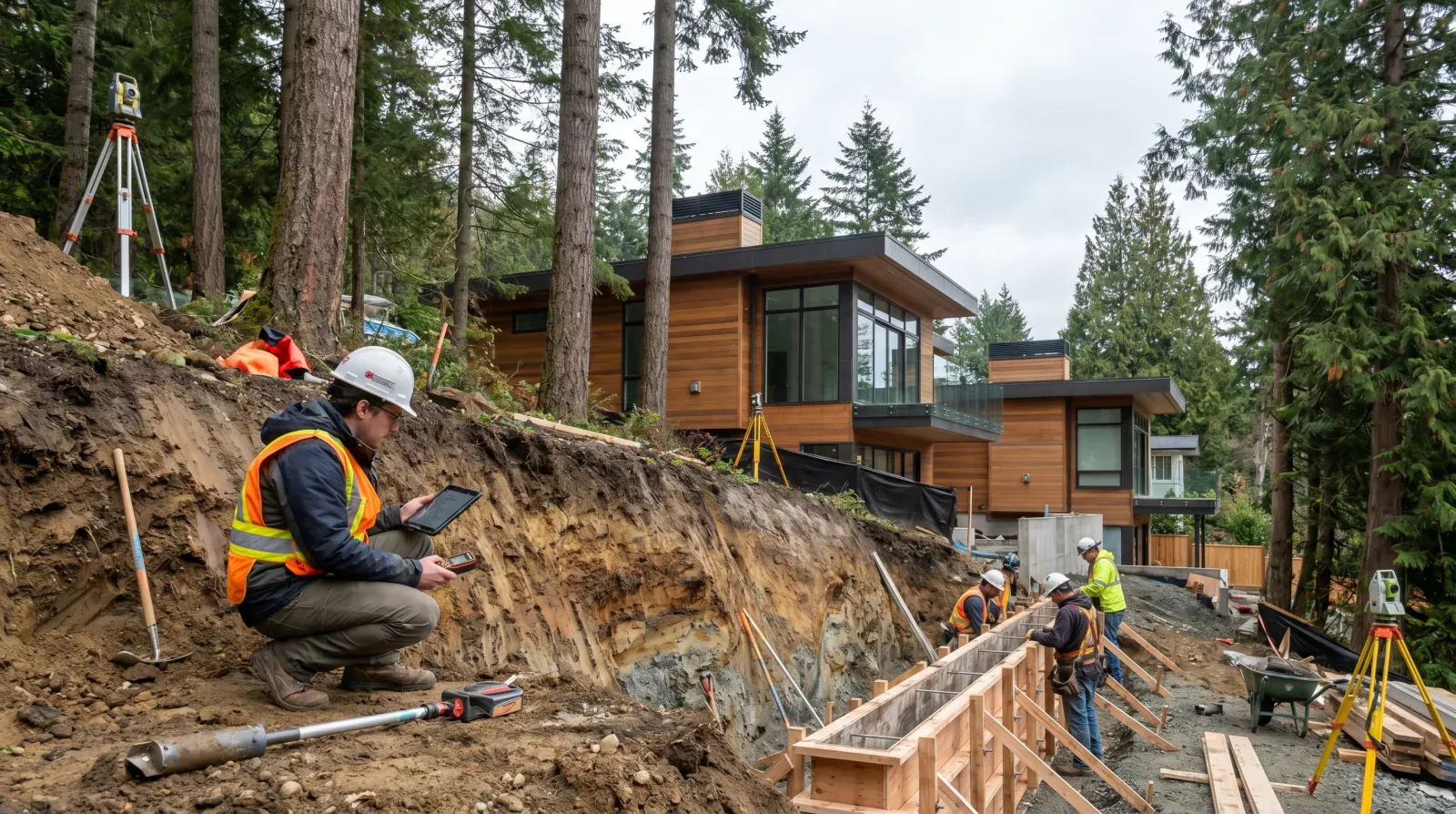
The exact methodology is set in the City of Burnaby building permit submission requirements and is referenced against the BC Building Code definitions. A BC Land Surveyor (BCLS) takes elevation readings at the corners of the proposed building footprint, sometimes at intermediate points along long faces, and reports the arithmetic mean. That mean is the datum from which the 10.0 m measurement starts.
On a level lot, every reading is roughly the same, so the average and any individual reading are interchangeable. On a sloped lot, the readings can range over two metres or more, and the average sits somewhere in the middle.
A worked example
Imagine a 15 m × 12 m building footprint on a lot that drops 2.4 m from the back property line to the front. The four corners might survey at:
- Upslope rear-left: 102.40 m
- Upslope rear-right: 102.30 m
- Downslope front-left: 100.10 m
- Downslope front-right: 100.00 m
The arithmetic average is 101.20 m. The maximum allowed building height puts the highest point of the roof at 111.20 m.
From the upslope corners (at 102.30 to 102.40 m), the roof is 8.80 m above grade, comfortable. From the downslope corners (at 100.00 to 100.10 m), the roof is 11.20 m above grade, visually taller than the City would allow if you measured from there.
That is the rule working as designed. The upslope grade and the downslope grade share the height budget. The downslope side of the house can stand taller than 10 m above local grade, because the upslope side stands less than 10 m. The total budget is the average.
Where this catches owners off guard
Three places, every time:
1. The roof "loses" a foot
An architect designs a three-storey house with a 9 ft main floor, a 9 ft second floor, an 8 ft third floor, and a low-slope roof. On paper, the wall-to-roof dimension is comfortably under 10.0 m. The surveyor produces the average grade, and it lands 30 cm lower than the architect assumed because the downslope corners pulled it down. The roof needs to come down 30 cm, usually from the third floor, because the lower floors are already framed in the drawings.
The fix is to commission the survey before the architectural sections are drawn, not after. We push this hard with every Burnaby slope client.
2. The neighbour's house looks taller
Two adjacent Burnaby lots, both with the same 10 m height limit. One owner builds on the upslope half of their lot, where local grade is high, the house looks short. The next-door owner builds in the same lot configuration but the prior owner had filled the lot to level the front yard, raising the average grade. The new house, designed to exactly the same 10 m, looks taller. Both are legal. Both are at the maximum. Only one looks like it.
This is the conversation that drives the most neighbour disputes during construction. The bylaw doesn't promise the new house will look the same height as the existing one, it promises 10 m above that lot's average grade, which is specific to that lot's surveyed surface.
3. Cut-and-fill regrading
A homeowner thinks they can lower the downslope side of the lot during excavation and "raise" the average grade, making 10 m feel taller. Burnaby's bylaw catches this directly: the average grade calculation is taken from existing natural grade, not from finished grade after excavation or fill. Cutting the lot down does not give back ceiling height. Filling it up does not either. The average is locked at the natural surface as it existed before any work.
The BC Building Code definitions of grade line up with this, what counts is the undisturbed surface, with reasonable allowances for the existing site conditions.
How to lock the calculation in early
We walk every hillside client through the same sequence:
- Engage a BCLS land surveyor before the architect produces sections. A topographic survey with 0.5 m contours and the perimeter grade points marked on it is the foundation document. Without it, the architect is guessing.
- Get the average grade calculated in writing. The surveyor produces a one-page calculation showing the perimeter points and the resulting mean. We submit this to the City planner during pre-application review.
- Confirm the calculation with the City planner. A 15-minute call with Burnaby's building department, with the calculation in front of them, surfaces any methodology disagreement before drawings are sealed. We have done this for every hillside permit we have submitted in the past three years.
- Design the building section to the confirmed average. Now the roof line can be drawn with confidence, the third-floor ceiling height can be locked, and the trades downstream know what to build.
Doing this work upfront costs roughly two weeks and one surveyor invoice. Discovering a grade dispute after the drawings are sealed costs months and a redesign.
What about the rear-building exception?
Burnaby's R1 SSMUH District sets a 10.0 m / 3-storey height limit on principal front buildings and a 7.5 m / 2-storey limit on rear buildings such as coach houses or detached secondary dwellings (the rear-building cap was reduced in the December 2025 bylaw amendments). The same average-grade methodology applies to both, but the calculation is taken across the individual building's footprint, not the lot as a whole. A rear coach house on the downslope half of a lot will have its own, lower, average grade, and a correspondingly lower roof datum.
This is one of the few places where a sloped lot delivers an advantage for a multi-building configuration: a coach house at the bottom of the lot doesn't fight the principal house for height budget. They are calculated separately.
How the building section interacts with the calculation
Once the average grade is confirmed, the architect draws the building section, the vertical slice that shows every floor level from the foundation up to the roof peak. The section is where the height calculation becomes real design constraint, and a few decisions made at that stage determine how successfully the home uses its full height budget.
Slab vs. crawlspace vs. basement. The choice of foundation type affects where the finished first floor sits relative to grade. A slab-on-grade foundation puts the first floor close to grade; a full basement lifts the first floor up. On a sloped lot, a daylight or walkout basement, where the lower level opens at grade on the downslope side, is one of the most effective ways to gain liveable area that doesn't count against building height, since it's below the average grade datum. We use this configuration frequently on Capitol Hill builds where the floor area has to be maximised.
Plate heights and ceiling height choices. A typical three-storey home uses plate heights of roughly 2.7 to 3.0 m per floor. On a three-storey under the 10 m limit, every centimetre of floor-to-ceiling height is earned from the total budget. Architects often work backwards from the 10.0 m ceiling to the desired third-floor ceiling height, then determine what's left for the lower floors. Getting the section drawn early, before the framing contractor quotes based on assumed plate heights, prevents cost surprises downstream.
Roof pitch and type. A steeper roof uses more of the height budget but can feel more architecturally appropriate on a hillside setting where the roofline reads against the slope. A low-slope or flat roof conserves the height budget but may require additional waterproofing design in Burnaby's wet climate. The section ties these decisions together with the calculation.
What to ask before you write an offer
If you are evaluating a lot to buy, three questions get you most of the way to knowing whether the height calculation is going to be friendly or hostile:
- What is the cross-fall across the building envelope? If the answer is "two metres or less", you're probably going to be fine. Three metres and up, the calculation starts pulling the average down hard.
- Is there fill on the lot? Previous fill counts as part of natural grade if it was placed before the bylaw datum, but recent fill placed to flatten the front yard typically doesn't. A geotechnical inspection can usually tell.
- Where will the building footprint sit? A footprint that hugs the upslope side of the lot will have a higher average than one that spans the full grade change. Sometimes a smaller, upslope-side house gives you more ceiling than a larger one that reaches downhill.
- Is the lot actively being monitored for recent fill? On some Burnaby hillside lots, previous owners have added fill to improve usability. Whether that fill is treated as "natural grade" depends on when it was placed and whether it was permitted. A geotechnical visit and a review of permit history can clarify this before an offer.
Common questions
Does a sunken living room help? No. Lowering part of the interior floor doesn't change the height calculation, which is measured from average grade to the highest point of the roof, not to the finished floor inside. The sunken portion is below grade, which is useful for other reasons but irrelevant to the height calculation.
What if the lot was regraded by a prior owner? This is fact-specific. The bylaw refers to existing natural grade, and significant regrading by a prior owner may have created a situation where the existing surface isn't the original natural grade. In contested cases, the City's practice is to use evidence, geotechnical investigation, historical survey data, permit records, to determine what the original surface was. We've encountered this on lots with obvious artificial fill on the front yard and it typically requires a City planner conversation before design begins.
Can I get pre-approval of the average grade calculation? Yes, and you should. A pre-application meeting with Burnaby's development and building department, with the BCLS survey and the calculated average in hand, is exactly the right use of the pre-application process. We use it on every hillside project.
Read next
- The hillside custom homes hub, the full picture of building on slope.
- Foundations & geotech, how the foundation choice interacts with the height calculation.
- Drainage & retaining walls, the water side of the same problem.
- Geotechnical reports on Burnaby slope lots, the report that determines the foundation type the height calculation has to work around.
Frequently asked questions
- How is building height measured on a sloped lot in Burnaby?
- Against average grade, not against the highest or lowest point on the lot. Burnaby's R1 Small-Scale Multi-Unit Housing District measures the 10.0 metre maximum height for principal front buildings against the average of surveyed natural grade taken at points around the perimeter of the proposed building footprint. A BC Land Surveyor takes elevation readings at the corners, and sometimes at intermediate points, and reports the arithmetic mean as the datum the 10.0 metre measurement starts from.
- Can excavating or filling a sloped lot change the average grade calculation?
- No. Burnaby's bylaw calculates average grade from existing natural grade, not from finished grade after excavation or fill. Cutting down the downslope side of a lot during construction does not raise the average and does not give back ceiling height, and filling the lot up does not either. The average is locked to the natural surface as it existed before any work began.
- Why do two Burnaby homes built to the same 10 metre height limit sometimes look like different heights?
- Because the 10 metre limit is measured against each lot's own average grade, and that average depends on the lot's surveyed natural surface, which can differ even between adjacent lots. An owner who builds on the upslope half of a lot where local grade is high produces a shorter-looking house, while a neighbouring lot with previously filled ground can support a taller-looking house, and both are legal at exactly 10 metres above their own average grade.
- What height limit applies to a coach house or laneway home on a sloped Burnaby lot?
- Burnaby's R1 SSMUH District sets a 7.5 metre, two-storey limit on rear buildings such as coach houses, compared with 10.0 metres and three storeys for the principal front building. The same average-grade methodology applies, but it is calculated across the individual building's own footprint rather than the whole lot, so a rear coach house on the downslope half of a lot gets its own, typically lower, average grade and roof datum, calculated separately from the principal house.
- Does a sunken living room help maximize ceiling height under Burnaby's height limit?
- No. The height calculation runs from average grade to the highest point of the roof, not to the finished floor level inside the home, so lowering part of the interior floor doesn't change it. A sunken portion of the home sits below grade, which can be useful for other design reasons, but it has no effect on the building height calculation itself.
- What happens if a Burnaby lot was regraded by a previous owner?
- It becomes fact-specific. Burnaby's bylaw refers to existing natural grade, and significant regrading by a prior owner may mean the current surface isn't the original natural grade. In contested cases the City's practice is to weigh evidence such as geotechnical investigation, historical survey data, and permit records to determine what the original surface was, which typically requires a conversation with a City planner before design begins on lots with obvious artificial fill.
- Can the average grade calculation be pre-approved before drawings are finalized?
- Yes, and doing so is recommended. A pre-application meeting with Burnaby's development and building department, with a BC Land Surveyor's survey and the calculated average grade in hand, lets a City planner confirm the methodology before the architectural sections are drawn. Confirming the number early costs roughly two weeks and one surveyor invoice, compared with months of redesign if a grade dispute surfaces after the drawings are sealed.
- What's a common mistake that causes a Burnaby hillside home's roof to be redesigned?
- Commissioning the architectural sections before the average grade survey is complete. An architect may design a three-storey home that appears comfortably under the 10.0 metre limit on paper, but if the surveyed average grade lands lower than assumed because the downslope corners pull it down, the roof has to come down, usually by cutting into the third floor since the lower floors are already framed in the drawings. Getting the BC Land Surveyor's average grade calculation before the sections are drawn avoids this.