
Hillside Hub · Sub-guide 2 of 2
Drainage, waterproofing and retaining walls on a Burnaby slope.
A hillside lot moves more water than a flat one, uphill runoff, roof discharge, perimeter foundation drainage, and groundwater all converging at the lowest point. The detail at the foundation wall is where most basements actually leak. This is the assembly we build, layer by layer, and the rules we use for retaining walls.
Last updated 2026-05-19
Where the water actually comes from
Before you design the drainage system you need to inventory the water it has to handle. On a typical Burnaby hillside lot, that's four sources: rainfall on the roof, surface stormwater from above the lot, perimeter water at the foundation wall, and groundwater under the slab. They arrive on different schedules and need separate paths to the discharge point.
Burnaby is wet, Environment and Climate Change Canada's 30-year normals for the Burnaby Mountain station show roughly 1,500 to 1,800 mm of annual precipitation across the residential parts of the city, concentrated in the October to March wet season. A roof that's not connected to storm puts every millimetre of that onto the lot. Multiply by footprint and you get the volume the perimeter drain has to handle on a January week.
The perimeter drainage assembly, layer by layer
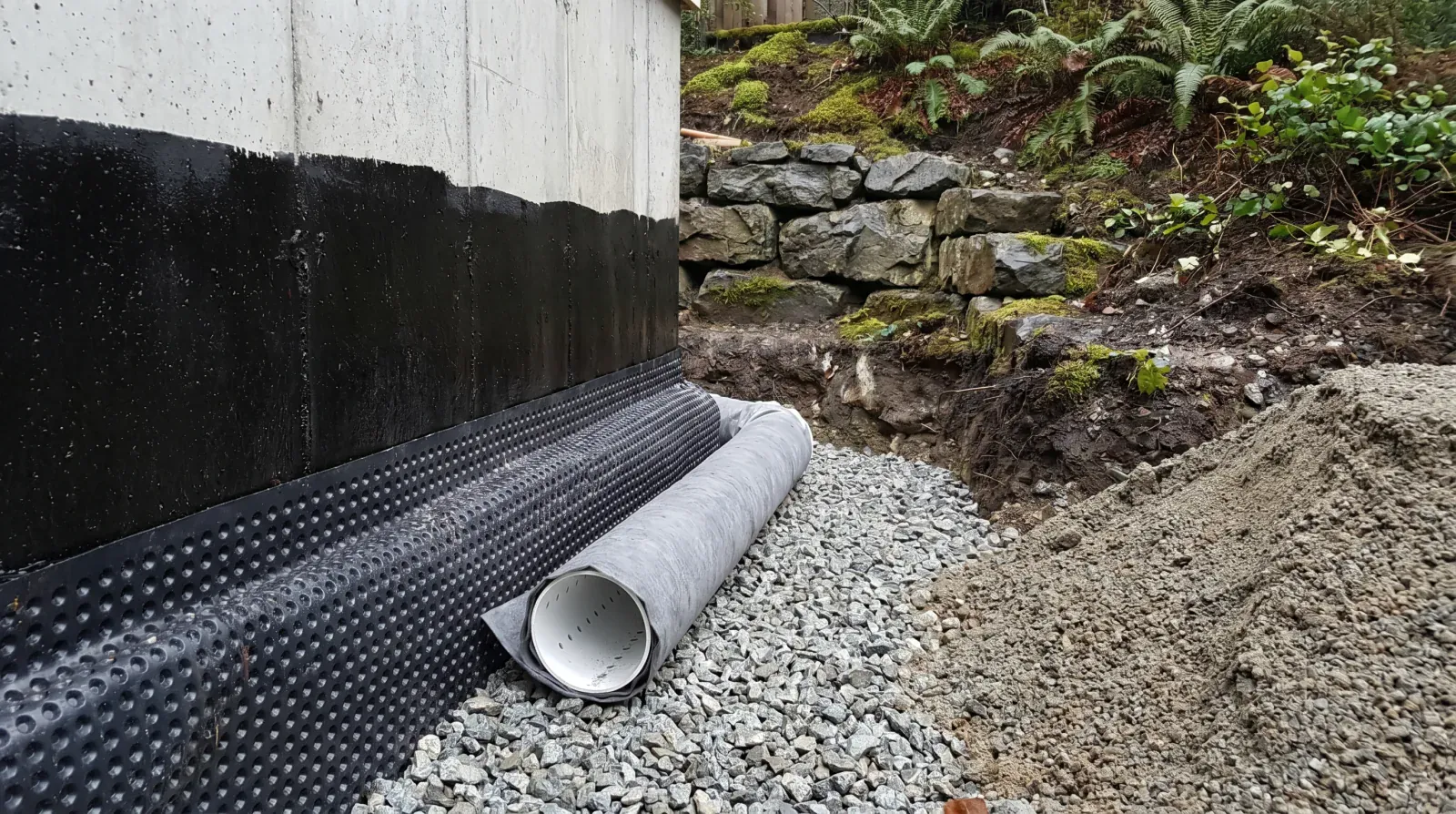
From the concrete face outward, the assembly has six layers. Skip one and the system stops being redundant, the moment one layer fails, the next is meant to catch the water.
Waterproof membrane
Stops liquid water at the concrete face, typically a bituminous or rubberized-asphalt coating, primed on cleaned concrete.
Dimpled drainage board
Creates an air gap against the wall so any water that arrives behind the membrane has a clear vertical path down to the tile.
Filter fabric (geotextile)
Wraps the drain rock to keep fines out. The single most overlooked layer, and the one that silts up the tile when it's missing.
Clean 19 mm round drain rock
The void space that lets water move freely to the perforated tile. Crushed rock is not a substitute, the fines pack and the system fails.
Perforated PVC drain tile (100 mm)
Carries collected water to the discharge point. Holes face down so silt-laden water has to drop into the tile; pitch a minimum 1%.
Free-draining backfill
Sand or pit-run above the rock so surface water moves to the perimeter system rather than ponding against the wall.
The filter fabric is the layer most field crews skip when they're behind schedule. It's the layer that determines whether the drain tile still works in ten years or silts up and floods the basement. We do not allow it to be omitted on any of our hillside builds.
Where it discharges
The perimeter drain has to go somewhere. On a built-up Burnaby lot, it ties into the municipal storm sewer at the lot line, via a connection sized by the engineering department during permit review. The tie-in usually runs through a sump pit with a duplex pump and a backwater valve if the storm main is uphill of the basement slab, which it often is on a downsloping lot.
Soak-pits at the bottom of the slope are no longer accepted as the primary discharge on most Burnaby slope lots. They concentrate water exactly where the geotechnical engineer wants the soil to stay dry. Where a soak-pit appears in a design today it is almost always as a secondary or overflow system, not the main outlet.
Retaining walls, when landscape becomes structure
The threshold most homeowners are surprised by: a retaining wall over 1.2 m in exposed height needs an engineered design and a permit. So does any wall, at any height, that retains soil supporting a building, a driveway, or another structure. Walls below that threshold can be designed as landscape, but on a hillside lot we engineer almost every wall.
The detailing that makes a retaining wall last is almost identical to the foundation drainage assembly, drainage board behind the wall, weep tile at the base, free-draining backfill above. A retaining wall that doesn't drain water behind it accumulates hydrostatic pressure, which is what tips walls over.
On steep lots we use one of four wall types:
- Poured concrete cantilever walls engineered, the most common for primary retaining at the foundation interface.
- Segmental retaining wall block (Allan Block, Versa-Lok and similar), engineered for walls up to roughly 3 m, with geogrid reinforcement.
- Natural stone gravity walls landscape only, generally under 1.2 m exposed.
- Soldier-pile and lagging engineered, for tight site conditions where shoring becomes permanent.
What we have seen go wrong
Three failures show up over and over on retrofits and second-owner inspections:
- No filter fabric on the drain tile. Silt enters the tile, the tile clogs in 5 to 10 years, the basement floods. Almost always invisible at handover. Almost always catastrophic when discovered.
- Roof leaders discharging at grade against the foundation. The roof system has to be tied directly to storm, not splashed onto the lot to "find its own way." Where we see this on inspections, the foundation moisture is always elevated.
- Backfill placed without a drainage path. Heavy clay backfill against a foundation wall holds water against the membrane. Use free-draining material from the bottom of the trench to grade, every time.
Related
Back to the hub
Hillside custom homes, the full overview.
Foundations, drainage, retaining walls, height calculations, trees and permit timeline, the integrated read.
Read the hubSub-guide
Foundations & geotech on Burnaby slope lots.
How the geotech report is read and how the foundation type gets chosen before drainage design starts.
Read the sub-guideFAQ
- What is a 'positive discharge' and why does it matter on a slope?
- Positive discharge means the perimeter drain tile around the foundation has a continuous downward slope to a designed outlet, almost always the municipal storm sewer. A soak-pit at the bottom of a slope is not positive discharge and is no longer accepted as the primary outlet on most Burnaby slope lots. Water that cannot escape will saturate the foundation backfill and find its way into the basement.
- Do I need an engineered retaining wall?
- Yes, once the exposed height exceeds 1.2 m, or when the wall retains soil supporting a building, road, or another structure. Below that height, a wall can be designed as landscape, but on a hillside lot we engineer almost every wall, the cost difference is small and the consequences of failure are not.
- What does the perimeter drainage assembly actually look like?
- From the foundation outward: a bituminous or rubberized-asphalt waterproof membrane on the concrete; a dimpled drainage board against the membrane; filter fabric; clean 19 mm round drain rock to a minimum 150 mm depth and 300 mm width; a 100 mm perforated PVC tile wrapped in filter fabric; backfill of free-draining material above. The drain tile is pitched a minimum 1% toward the discharge.
- Where does the discharge actually go?
- Into the municipal storm sewer, via a sump and a backwater valve if elevations require. Burnaby's engineering department will tell you the connection point at the lot line as part of the building permit servicing review. On lots without a storm connection, rare in built-up Burnaby, an engineered detention and dispersion system substitutes, designed by a civil engineer.
- How is groundwater handled when it's encountered below the footing?
- An under-slab drainage layer is added, typically a 200 mm bed of clean drain rock with a perforated tile network connected to the perimeter system. On lots with persistent groundwater the geotechnical engineer may require a sump pit with a duplex pump system and an alarm. We've installed these on a handful of Capitol Hill builds where the seasonal water table sits above the basement slab.
- Can I use a French drain at the top of the slope to keep water off the lot?
- Yes, interceptor drains at the top of a downsloping lot are common and effective. They divert hillside runoff before it reaches the building. The interceptor drain ties into the storm system independently of the perimeter drain so the two do not compete for capacity in a heavy rainfall event.
- How much rain does the drainage system actually have to handle?
- Environment and Climate Change Canada's 30-year normals for the Burnaby Mountain station show roughly 1,500 to 1,800 mm of annual precipitation across the residential parts of the city, concentrated in the October to March wet season. That volume, multiplied across a roof and driveway footprint, is what the perimeter drain and storm connection are sized against.
- Are soak-pits ever acceptable on a Burnaby hillside lot?
- Not as the primary discharge. Most Burnaby slope lots require positive discharge to the municipal storm sewer, and a soak-pit concentrates water exactly where the geotechnical engineer wants the soil to stay dry. Where a soak-pit still appears in a design, it's typically a secondary or overflow system, not the main outlet, and the civil engineer sizing the storm connection makes that call.
Official sources