
Hillside Hub · Sub-guide 1 of 2
Foundations and geotech on a Burnaby slope lot.
The foundation is the part of a hillside house that you cannot fix later. Everything above grade is rebuildable; the foundation is not. This is how we read the geotech, choose the foundation type, and detail the transitions between them.
Last updated 2026-05-19
Why the geotech comes before the architect
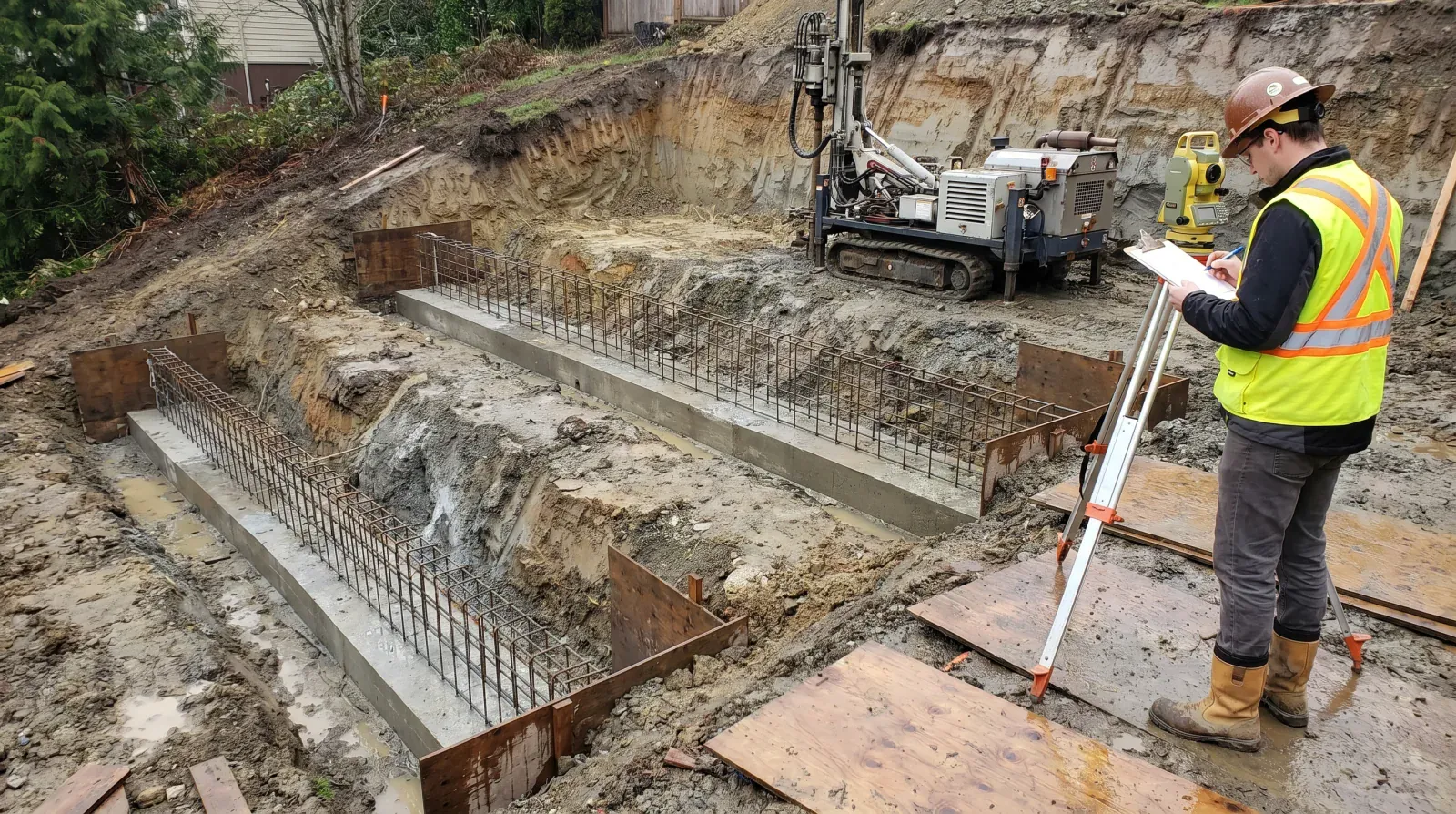
On a flat lot, the soil report follows the design, the architect draws what the owner wants, then the geotech verifies the bearing assumption. On a sloped lot we reverse the order. The geotechnical report tells us what foundation types are practical, and that constrains the structural grid, the basement layout, and the main-floor elevation. Architects who work on slope every day expect this; the ones who don't push back, and the project loses time.
A preliminary geotechnical assessment, done before full design, off a topographic survey and a couple of test pits, costs a fraction of the final sealed report and is enough to steer the architect. The full sealed report is commissioned once the building footprint is fixed and goes in with the permit submission. We walk through how to read a geotech report in a dedicated post.
What's actually in the report
A residential geotechnical report from a qualified Engineer registered with Engineers and Geoscientists BC under their professional practice guidelines follows a predictable structure. The sections that drive construction decisions:
- Site description and slope history. Topographic context, existing structures, evidence of past slope movement. A previous landslide nearby changes the design.
- Field investigation log. What was found at each test pit or borehole, soil type, depth, groundwater encountered, organic content.
- Allowable bearing pressure. The number that drives footing width. Typically expressed in kPa.
- Foundation recommendations. Spread, stepped, pile, or grade beam, with depth, embedment, and frost-protection requirements.
- Retaining-wall guidance. Wall heights, drainage requirements, and where the geotech wants the structural engineer to take over.
- Drainage and groundwater recommendations. Where the water is, where it needs to go, and what the perimeter drainage assembly should look like.
- Slope-stability assessment. The conclusion the City reads first. A factor of safety of 1.5 is the residential benchmark.
The five hillside foundation types
Almost every Burnaby and North Vancouver hillside foundation we permit falls into one of these five categories, or a hybrid of two adjacent ones. The geotech selects from this menu.
Standard spread footings
When it's right: Competent native soil (glacial till, dense sand-and-gravel), minimal grade change across the footprint.
Notes: Continuous strip footings around the perimeter, isolated pad footings under columns. The cheapest and fastest option when soil allows it.
Stepped strip footings
When it's right: Moderate slope across the footprint, typically up to 1 m grade change per 5 m horizontal, with competent soil throughout.
Notes: The strip footing steps down the slope in 600 mm or 900 mm increments. Each step requires a lap of horizontal reinforcement; the steps must align with the structural design above.
Helical piles
When it's right: Poor surface bearing, fill, peat, soft silt or clay, over competent material at depth. Steep lots where excavation would be impractical.
Notes: Galvanized steel piles drilled into the ground with hydraulic torque. Installation is fast (a day or two for a typical house) and the system is verifiable in real time by reading installation torque.
Drilled cast-in-place concrete piles
When it's right: Heavy structural loads, lateral capacity requirements, or sites where pile depth needs to be calibrated to actual conditions as the hole is drilled.
Notes: A hole is drilled (typically 450 to 900 mm diameter), a rebar cage is dropped in, and the hole is filled with concrete. More expensive than helical piles, but handles the heaviest loads on the most variable soil.
Stepped grade beams on piles
When it's right: Combining a pile foundation with a continuous concrete grade beam that ties the piles together and supports the framing above. Common on the steepest Burnaby and North Vancouver lots.
Notes: The grade beam itself steps down the slope. Detailing at the step is critical, both for structural continuity and for the waterproofing assembly that follows the foundation up the slope.
Reading the report as a homeowner
You do not need to be an engineer to read a geotech report, but you do need to know what to look for. Five things every owner should check personally before signing off on the foundation design:
- The slope-stability factor of safety. Below 1.5 is a problem; below 1.3 is a permit refusal in most cases.
- The allowable bearing pressure. The structural engineer designs the footings to this number, if the report changes, the footings change.
- The recommended foundation type. If the report names helical piles and the contractor's quote is for spread footings, the quote is wrong.
- The groundwater observation. Free water at any depth above the footing changes the drainage design.
- The slope-monitoring conditions. Some Burnaby permits require post-construction slope monitoring for one to three years, know about it before you sign.
Related
Next in this hub
Drainage, waterproofing & retaining walls.
Once the foundation is engineered, the water-management system around it is the next thing to get right. Layered drainage, dimple board, perforated tile, and the difference between a landscape wall and a structural one.
Read sub-guide 2Field note
Foundations on Burnaby hillside lots.
The longer field note this sub-guide summarizes. Specific soils, specific failures, specific fixes from Capitol Hill and Buckingham Heights builds.
Read the field noteFAQ
- What's in a geotechnical report?
- A site description and slope history, the field investigation (test pits, boreholes, or both), a logged subsurface profile, allowable bearing pressures, recommended foundation type and depth, retaining-wall guidance, drainage requirements, and a slope-stability assessment. The report is sealed by an Engineer registered with EGBC and submitted with the building permit.
- How many investigation locations does a Burnaby residential lot need?
- Most Burnaby residential geotech investigations sit between two and four test pits or boreholes, spaced across the building footprint. The number scales with lot size, slope severity, and whether bedrock depth is variable. Lots over 800 m² or with complex grade usually push to four or more.
- When are helical piles or drilled piles required instead of strip footings?
- When the soil cannot carry the design bearing pressure within a practical excavation depth. Marine clay, uncontrolled fill, and deep weathered material all trigger pile design. Helical piles are common in 60 to 120 kN loads per pile; drilled cast-in-place concrete piles handle heavier loads or where lateral capacity matters. The geotech specifies which one.
- Can I get a single design-build foundation package on a slope?
- Yes. Most of our hillside builds use one foundation contractor with in-house concrete, shoring, and pile capability. Splitting the work across multiple sub-trades on a sloped site reliably costs time and creates sequencing problems. The foundation contractor needs to own the work from the dirt up.
- Does the foundation type affect the height calculation?
- Indirectly. The foundation determines the elevation of the main floor, which determines where the roof lands relative to average grade. A deeper foundation that picks up more downhill grade can give back ceiling height upstairs. The architect and structural engineer should iterate on this together.
- What's the lead time on geotechnical work?
- Plan for 3 to 6 weeks from engagement to final sealed report. The field investigation is one day; the lab work on soil samples is 2 weeks; the engineering write-up is another 1 to 2 weeks. Pre-design preliminary assessments are faster (often 2 weeks) and are usually enough for the architect to start.
- What's the difference between stepped strip footings and stepped grade beams on piles?
- Stepped strip footings work on moderate slope, up to roughly 1 m of grade change per 5 m horizontal, when the soil is competent throughout, the footing itself steps down in 600 or 900 mm increments. A stepped grade beam on piles combines piles with a continuous concrete beam that ties them together, and it's the assembly we reach for on the steepest Burnaby and North Vancouver lots, where soil alone cannot carry the design load.
- How do I know if my foundation contractor is qualified for a slope lot?
- Ask whether they hold in-house concrete, shoring, and pile capability, and ask to see two or three completed hillside projects with similar grade change. Splitting foundation work across multiple sub-trades on a sloped site reliably costs time and creates sequencing problems, the contractor needs to own the work from the dirt up, including reading the geotech report themselves rather than working from a summary.
Official sources