How a working builder actually approaches Burnaby's planning and building departments, pre-application conversations, what makes a clean intake, when to push back, and what kills a permit. A playbook for homeowners deciding whether their builder knows Burnaby.
How do you actually work with the City of Burnaby planning department?
You work with Burnaby by treating the engineering pre-application as the real first review, getting your arborist and geotech engaged before any drawings the City sees, running eCheck against your zoning math before intake, and writing a clean digital submission that doesn't ask the reviewer to fill in your gaps. Burnaby is a sequenced city, skip a step, the file stalls.
A homeowner once asked me, halfway through a Burnaby custom home builder project, why "the City" was being so difficult. I asked which City. Was it the engineering coordinator who'd flagged the driveway curb cut, the arborist contact who'd asked for tree protection fencing on the survey, the plan checker reviewing the architectural set, or the energy advisor reviewing the step code submission. He looked at me like I was being pedantic. I wasn't. Burnaby isn't one department. It's six conversations, and the projects that move are the ones that respect each one.
This is the playbook we use on every custom home build we lead in the city, the actual approach, not the marketing version. If you're interviewing builders, the questions inside this piece are the ones you can ask to figure out whether your builder knows Burnaby or whether they're going to learn it on your project.
The first thing to understand: Burnaby is two departments, not one
People say "City of Burnaby planning" as if it's one office. It isn't. A custom home file in Burnaby moves through at least two departments before a single inspector ever shows up on site, and they ask different questions in different orders.
The Engineering Department owns the lot's relationship to the street: driveway location, servicing connections, frontage works, grading and drainage onto neighbouring properties, boulevard trees, sidewalk requirements. You see Engineering first. Since the 2023 process change, you can't even submit a building permit application until Engineering has signed off on the pre-application, that's explicitly required at intake. Owners who think of Engineering as "the building department's little sibling" get a lesson early.
The Building Department owns code compliance: zoning, BC Building Code, structural, plumbing, electrical, energy step code, and the assembled architectural set. Building reviews assume Engineering has already happened. They don't backstop each other.
For a Burnaby custom home, you also touch the parks/urban forestry team (tree bylaw declarations, protection fencing requirements), the energy and climate team (Step Code modelling and Zero Carbon Step Code compliance), and, on certain lots, the environmental services team (streamside protection near Brunette tributaries, Deer Lake catchment, the Stoney Creek system). When a builder tells you "Burnaby is fine, we deal with it all the time," ask which of those they spoke to most recently. The answer should be specific.
The pre-application conversation that actually matters
Burnaby's own published guidance is plain. The City recommends owners "contact the city to discuss any trees that may be affected by development prior to submitting your Engineering pre-application," and that "you engage a qualified design professional to navigate the process." Both are quoted directly from the New Home Construction page. That guidance reads like a polite suggestion. In practice, it's the gate.
The pre-application conversation I push for on every Burnaby project covers four things, in this order:
-
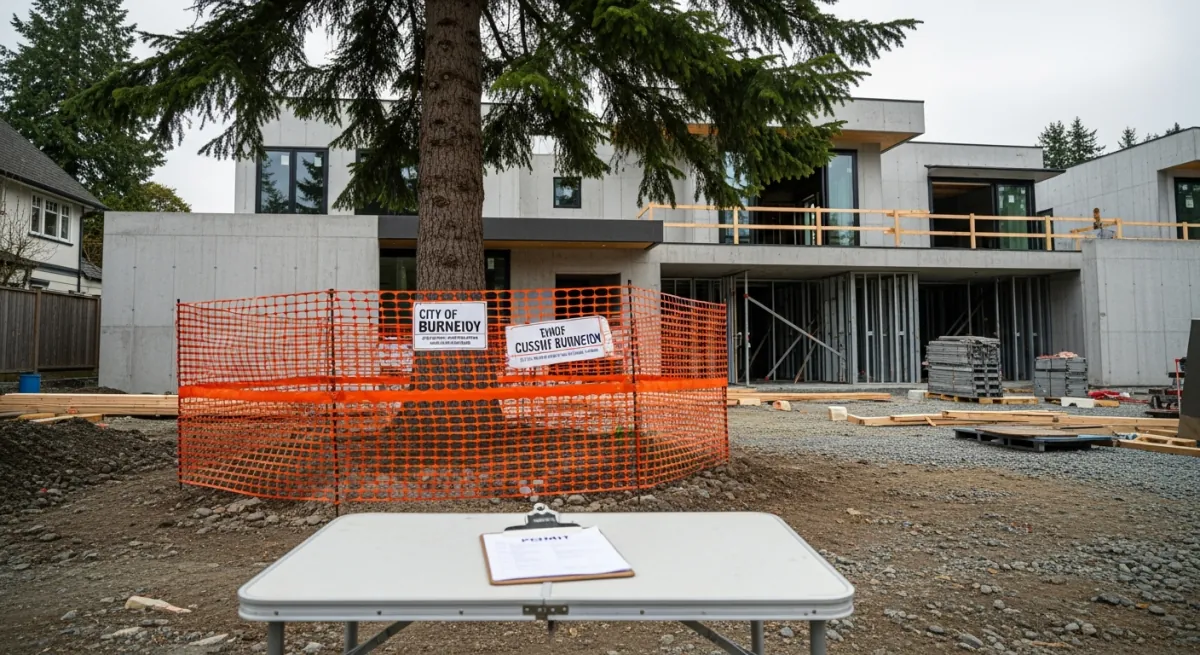
Tree inventory. Every tree on the lot above the protected threshold gets identified before we draw anything we care about. Burnaby's tree bylaw protects trees 20 cm in diameter or greater on any property subject to a development application, and the City notes that as a condition of a Tree Cutting Permit "you'll need to replace each tree you remove from your property." Working through replacement counts at concept stage, not after the architect has fallen in love with a layout, saves whole rounds of comment letters.
-
Engineering frontage and servicing. I want to know what the City wants from this lot's frontage before the architect commits to a driveway location. On corner lots in Brentwood and Burnaby Heights, the answer often involves a sidewalk requirement the owner didn't expect. On older Capitol Hill streets, the servicing may be a generation behind what a modern home needs.
-
Slope and soils. If the lot has any meaningful grade, Capitol Hill, Buckingham Heights, Cariboo Heights, the back edge of any Government Road lot, the geotechnical work needs to happen before structural concept, not after. Our deeper notes on this are in geotechnical reports for Burnaby slope lots and foundations on Burnaby hillside lots.
-
Streamside and environmental overlays. Pull the City's overlays before you draw. A piped tributary you can't see on the ground can still pull 10 metres of buildable depth off a Big Bend lot.
That conversation, run honestly, takes about a week of calendar time. It saves months later.
How to read a planner's comment letter
The first comment letter on a Burnaby file is usually the most important document in the whole permit cycle. Owners read it as a list of complaints. It isn't. It's a map.
Comments cluster by category. Zoning comments are usually arithmetic, a setback misread, a lot-coverage calculation that included something it shouldn't have, a height measurement taken from the wrong reference grade. Those are fixable in a tight resubmission. Building code comments are sometimes arithmetic and sometimes about understanding, a misread of the BC Building Code's cooling requirement, an egress window that doesn't meet dimension, a fire separation between the garage and the dwelling that doesn't work. Those are also fixable, but they sometimes require small design changes.
The comments to take seriously are the repeated ones. If round one and round two both circle back to height or to floor area, the design hasn't solved the underlying problem and the comment letter is just describing the symptom. At that point, stop responding line by line. Get the architect and the plan checker on a phone call. The fastest way through a stuck file is almost always a fifteen-minute conversation that twelve weeks of revised drawings won't replace.
The rhythm of comment letters in Burnaby in 2026 is also worth understanding before you submit. We've written about the realistic cadence in the Burnaby permit timeline post. What that piece doesn't cover, and what this one does, is the posture a builder takes inside that rhythm. The reviewer is reading dozens of files. They reward clean, organised resubmissions. They notice when responses match the comments line for line in the order they were issued. They notice when they don't.
eCheck: use it, don't worship it
Burnaby's eCheck tool runs your drawings against the objective parts of the zoning bylaw and returns "an easy-to-understand report within 2 business days." We run every Burnaby file through it before submission. It catches the dimensional and arithmetic mistakes that produce the most embarrassing comments, the kind where a planner has to write back saying your height is over by 18 cm.
What eCheck doesn't do, and the City says so plainly, is replace professional review. The tool "does not mean that we will necessarily approve your Content" and "doesn't replace professional designers and expertise." Builders who treat an eCheck pass as approval are setting up the owner for surprises at substantive plan check. Builders who skip eCheck entirely are wasting a free dress rehearsal.
If your builder doesn't know what eCheck is, that's a signal.
Working with the arborist and geotech on the City's terms
There's a builder posture I see fail in Burnaby more often than any other: treating consultants as a checkbox. The arborist's tree protection plan is not a piece of paper to attach to the permit. It's a working document the City reads carefully. Replacement counts, protection fencing locations, root protection zone depths, all of those come back as comments if the consultant didn't visit the lot and the report reads like a template.
Same for the geotechnical engineer. On a sloped lot, the City wants a real foundation strategy informed by real soils data, not a generic recommendation. Our experience on Capitol Hill and Buckingham Heights is that the geotech who walks the lot in February, when the soil is saturated and the runoff path is obvious, writes a better report than the one who shows up in August. Burnaby's plan checkers can tell the difference.
The City's lot eligibility tool is a useful starting point for an owner getting their head around what the zone permits. It is not a substitute for the consultants' work.
When to push back, when to concede
Not every comment is a correct comment. Plan checkers are reading dozens of files a week, and occasionally a comment lands on the wrong page or applies a code requirement to the wrong condition. The right posture is to respond with the BC Building Code reference and the drawing detail that addresses the comment, politely, with a citation, without arguing the larger point. Reviewers respect substance and ignore noise.
What you don't push back on, ever, is the tree bylaw. The replacement requirements are arithmetic, the protection requirements are observable, and the City's parks team has a long memory. Same for the energy step code. The modelling is the modelling. If your envelope assemblies don't reach Step 3 + EL-4, Burnaby's current floor, fixing the comment means changing the assemblies, not arguing about the model. We covered this in depth in BC Energy Step Code in Burnaby: Step 3 + EL-4 today, Step 5 by 2032.
The judgement call sits in the middle band: grading and drainage comments, frontage works conditions, occasional design observations on streets where the City has aesthetic concerns. Those are real conversations to have with Engineering, and the builder who can have them, courteously, with drawings, is the builder who keeps the file moving.
What kills a permit
A Burnaby permit dies for one of four reasons in our experience:
- The package wasn't ready at intake. Digital intake under the My Permits Portal doesn't forgive missing pieces the way the old counter did. An incomplete submission sits in triage and doesn't accumulate review time.
- The design refuses to solve a constraint. Height issues, FAR issues, slope drainage issues that the design team keeps trying to work around instead of redesigning. The City will hold a file on the same comment forever.
- The consultants didn't show up. A template arborist report, a generic geotech, a missing energy advisor. Each one stalls the file in its own category.
- Communication died. A comment letter sitting unanswered on the design team's desk for eight weeks is eight weeks the City was never going to give back, and reviewers' attention shifts to active files.
None of those are City failures. All of them are preparation failures.
A homeowner's evaluation checklist
If you're choosing a builder for a custom home in Burnaby, here are the questions that surface whether they actually know the planning environment:
- Who at the City did you last speak to about a project like mine, and what was the conversation about?
- How do you sequence the arborist and the geotech against the design schedule?
- Do you run eCheck before submission? Show me a recent report.
- When did you last work on a lot with streamside or slope overlays?
- How do you organise a resubmission package? Walk me through one you've sent.
- What's your relationship with Burnaby's engineering coordinators?
Builders who answer with specifics, names, file numbers, recent examples, are builders who work here. Builders who deflect to "we have a great relationship with the City" usually don't. The deeper context on builder selection is in 12 questions to ask before signing a custom home contract.
A permit isn't a document you receive at the end of a process. It's the residue of a conversation you've been having with the City all along. The builders who think of it as paperwork are the ones who get the letters.
Icon Projects Team
Where we sit in this
We sit on the owner's side of the table. On a typical Burnaby project we're coordinating the engineering pre-application, the consultants, the eCheck dry run, the building permit submission, the comment responses, and the pre-issuance conditions, so the owner spends their energy on the house, not on the file. The City isn't the adversary. The City is a careful reader, and the work is to write a file worth reading carefully.
If you're early on a Burnaby lot and want a working read on what your specific file looks like, the planning conversation is where we start. The first ninety days set the next two years.
Related on the Journal
- The Burnaby custom home permit timeline in 2026
- The Burnaby tree bylaw and how it reshapes design
- Geotechnical reports for Burnaby slope lots
- BC Energy Step Code in Burnaby: Step 3 + EL-4 today, Step 5 by 2032
- Burnaby Zoning Monitor and our original research
Frequently asked questions
- Is the City of Burnaby planning department a single office?
- No. A custom home file in Burnaby moves through at least two departments before an inspector ever visits the site: Engineering, which owns the lot's relationship to the street, driveway location, servicing, grading, and frontage works, and Building, which owns code compliance across zoning, the BC Building Code, structural, plumbing, electrical, and the energy step code. Depending on the lot, the parks and urban forestry team and environmental services may also be involved.
- Why can't a Burnaby building permit be submitted before Engineering signs off?
- Since Burnaby's 2023 process change, the Building Department's review assumes Engineering's pre-application review has already happened, and the two departments don't backstop each other. A building permit application literally cannot be submitted until Engineering has cleared the pre-application, which covers driveway location, servicing connections, and grading.
- What does Burnaby's eCheck tool actually check?
- eCheck runs a set of drawings against the objective parts of Burnaby's zoning bylaw and returns an easy-to-understand report within two business days. It catches dimensional and arithmetic mistakes, like a height measurement that's over by 18 centimetres, before they become embarrassing comment letters. The City is explicit that eCheck doesn't replace professional design review and doesn't guarantee approval of the submitted content.
- How should a Burnaby comment letter be read?
- As a map, not a list of complaints. Comments cluster by category: zoning comments are usually arithmetic, like a setback misread or a height taken from the wrong reference grade, while building code comments sometimes require small design changes. The comments worth taking seriously are the repeated ones. If the same category of comment shows up in round one and round two, the design hasn't solved the underlying problem yet.
- What are the four things a builder should cover before submitting a Burnaby pre-application?
- A tree inventory identifying every protected tree on the lot, engineering frontage and servicing requirements before the architect commits to a driveway location, slope and soils information if the lot has any meaningful grade, and a check of streamside or environmental overlays that might not be visible on the ground. Running through these in order, before drawings are finalized, saves entire rounds of comment letters later.
- What are the four most common reasons a Burnaby permit application stalls?
- The package wasn't ready at intake and sits in triage without accumulating review time, the design keeps working around a constraint like height or floor-area ratio instead of solving it, the consultants didn't do real site-specific work, such as a template arborist report, or communication broke down, with a comment letter left unanswered for weeks. None of these are failures on the City's part; all of them are preparation failures.
- Which Burnaby requirements should never be pushed back on?
- The tree bylaw and the energy step code. Tree replacement requirements are arithmetic and protection requirements are directly observable, so the City's parks team has little tolerance for disputing them. Energy step code modelling works the same way: if envelope assemblies don't reach the required step, the fix is changing the assemblies, not arguing about the model. Judgment-based comments on grading, drainage, or aesthetics are the ones actually worth a conversation.
- How does a homeowner evaluate whether a builder actually knows Burnaby's planning process?
- Ask specific questions: who at the City they last spoke with and about what, how they sequence the arborist and geotech against the design schedule, whether they run eCheck before submission and can show a recent report, and how they organise a resubmission package. Builders who answer with names, file numbers, and recent examples work here regularly. Builders who deflect to a general claim of a good relationship with the City usually don't.