Materials
Choosing door hardware for a BC custom home: levers, finishes, locks and hinges
Door hardware is the part of the house your hand touches most, and the BC Building Code sets rules for the front door lock, the hinge screws and the door to the garage. Here is how we choose levers, finishes, lock functions and hinges on a Burnaby custom home, and when each one has to be ordered.
Door hardware is the last thing most clients pick and the first thing they touch when they move in. A client can live with a paint colour they are unsure about. A lever that pinches the hand gets noticed every morning.
It also has more rules than people expect. The BC Building Code sets requirements for the front door lock, the screws in the hinges, the door between the garage and the house, and which way an exterior door has to open from inside. Here is how we work through the choices on a Burnaby custom home, in the order we make them.
Levers or knobs
We put levers on every door, and we tell clients that on the first day of selections.
The reason is the hand. A round knob needs a grip and a twist. A lever needs a push down, and that push can come from a closed fist, an elbow or two fingers. CMHC's list of low and no cost modifications for accessibility recommends a levered handle that can be opened without having to grip or twist the knob too tightly. The same page suggests swing-away hinges to gain clearance at a doorway for a wheelchair or walker, which we come back to below.
The BC Building Code writes the same idea into its accessibility section. Article 3.8.3.8 of the 2024 BC Building Code says controls must be operable with one hand in a closed fist position, without tight grasping, pinching with fingers or twisting of the wrist. Section 3.8 does not apply to detached houses (Article 3.8.2.1 lists them as an exception), so nobody will fail your inspection over a knob. We still use that sentence as the test for every lever a client brings us. If it works with a closed fist, it passes.
A family building on a Capitol Hill slope or in Coquitlam plans for stairs, grab bar blocking and a main-floor bedroom. Levers belong on the same list, and our post on aging in place in a Burnaby custom home covers the rest of it.
A few details separate a good lever from a poor one:
- Return levers. A lever whose end curves back toward the door catches fewer sleeves and bag straps.
- Spring strength. Push the lever down in the showroom. It should come back to level firmly.
- Height. For doors in a means of egress, Article 9.9.6.7 of the code puts door release hardware between 900 mm and 1 100 mm above the finished floor. We use the same height on every door in the house so the levers line up down a hallway.
Passage, privacy, dummy and keyed: the four functions
A lever set is sold by function, and each door in the house needs one of four.
Passage. Latches the door, never locks. Hallways, laundry, pantry, walk-in closets, most doors between rooms.
Privacy. Locks from inside with a push button or a turn, with an emergency release on the outside that opens with a small tool or a coin. Bathrooms, the powder room and bedrooms. We put privacy sets on children's bedrooms only when the parents ask, because a locked door with a toddler behind it is a real event.
Dummy. No latch. A fixed handle for pulling a door that stays shut with a ball catch or roller catch at the top. Reach-in closets, and the fixed leaf of a pair of doors.
Keyed. A lock that opens with a key from outside. Exterior doors, the door from an attached garage, and the entrance to a secondary suite, which counts as the entrance to a separate dwelling unit.
We build a door schedule, one line per door, with its size, swing, function and finish. The finishing carpenter installs from that sheet instead of guessing on site.
The front door and the garage door have code rules
This is where door hardware stops being a matter of taste. Article 9.7.5.2 of the 2024 BC Building Code covers resistance to forced entry for swinging doors. It applies to the entrance doors of a dwelling unit and to doors between a dwelling unit and an attached garage. For those doors it asks for:
- A deadbolt with a cylinder of no fewer than 5 pins and a bolt throw of at least 25 mm, protected by a solid or hardened free-turning ring or a bevelled cylinder housing.
- Wood doors that are solid core or stile-and-rail, at least 45 mm thick.
- Hinges fastened to a wood frame so that at least 2 screws per hinge reach at least 30 mm into solid wood.
- Deadbolt strike plates fastened with wood screws that reach at least 30 mm into solid wood.
- Bolts top and bottom, with at least 15 mm of engagement, on the inactive leaf of a double door.
- Hinges or pins that stop an outswinging door from being lifted off while it is closed.
- Solid blocking on both sides at lock height between the jambs and the framing, so the jambs cannot be spread apart.
A door assembly tested to at least Grade 10 under ASTM F476 is exempt from most of that list. We build to the list anyway, because blocking and long screws are easy to install while the wall is open.
Article 9.9.6.7 adds the rule that surprises people. Exterior doors of a dwelling unit must be openable from the inside without keys, special devices or specialized knowledge. A double-cylinder deadbolt, with a key on both sides, fails that test. Every exterior door we build has a thumb turn on the inside.
The door from the garage has one more set of rules. Article 9.10.13.15 requires it to be tight fitting, weather-stripped against gas and exhaust fumes, and fitted with a self-closing device, and it cannot open into a room intended for sleeping. That door gets a closer or spring hinges, a deadbolt, and a threshold seal. Our post on attached and detached garages in Burnaby covers the rest of that wall.
For the lockset itself, we look at the grade. The Builders Hardware Manufacturers Association rates hardware in three grades, with Grade 1 the highest. Under its standard for bored locks and latches, ANSI/BHMA A156.2, a Grade 1 lock has to pass one million open-and-close cycles with a 10 pound load applied, along with strength, security and finish tests. We specify Grade 1 on the front door and the garage door. Those are the two doors the whole household uses every day, and the two that keep people out.
The front door lock gets chosen before the front door is ordered. The door shop drills and routs the door for one specific lock, and changing the lock afterward means a new door.
Icon Projects Team
Finishes, and what the coast does to them
Clients spend the most time on finish. Hardware finishes fall into two groups.
Coated and plated finishes hold their colour. Polished nickel, satin nickel, chrome, black and most bronze tones are a metal plating or a colour layer under a clear protective coat. BHMA's standard for materials and finishes, ANSI/BHMA A156.18, gives each finish a code number (605, for example, is bright brass with a clear coat) and evaluates nearly every type of builders hardware with a salt spray test. A coated finish looks the same for years. Where it fails, it fails at the spot the hand lands every day, when the coat wears through.
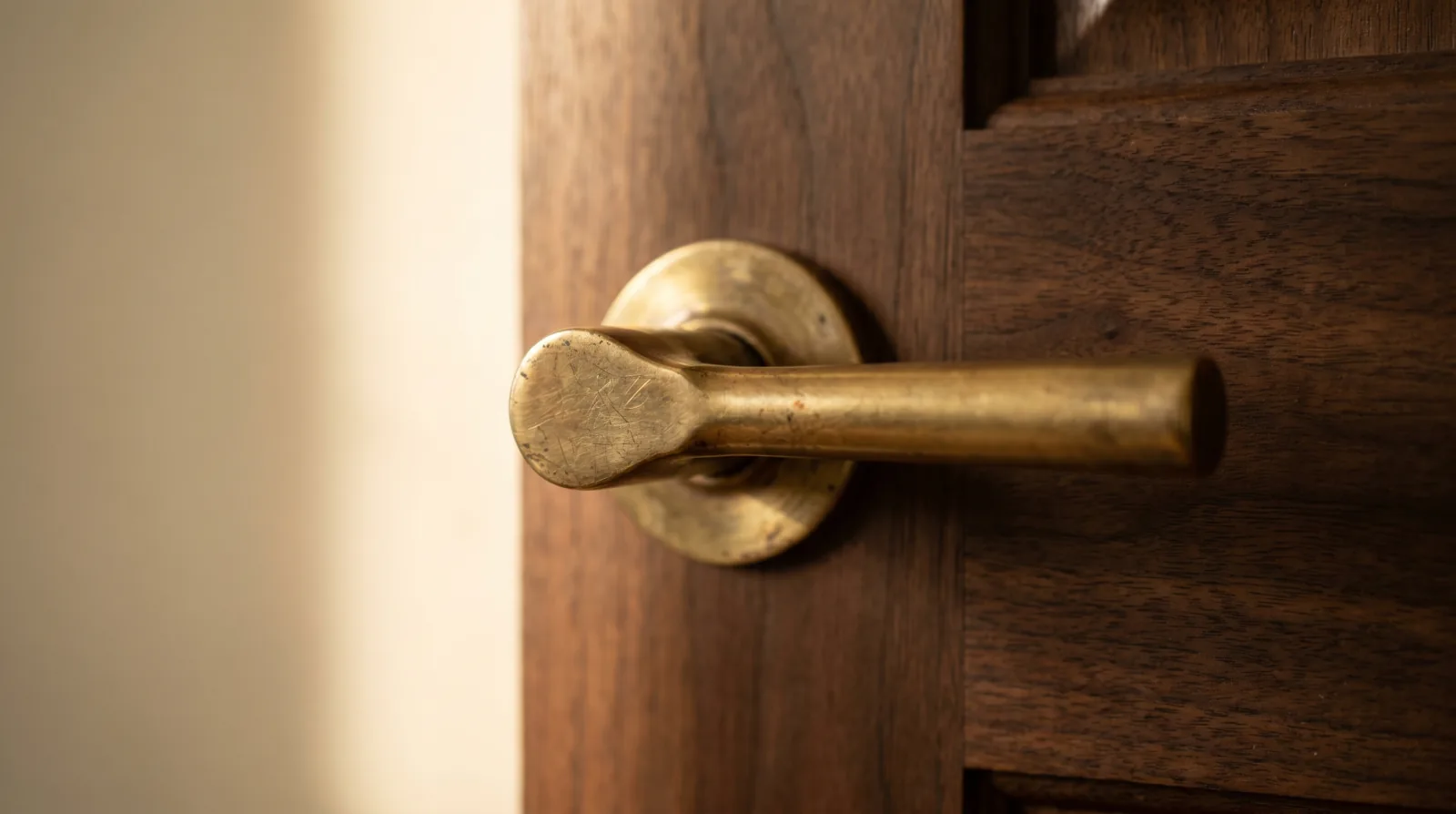
Living finishes change. Unlacquered brass, unlacquered bronze and raw copper have no clear coat. They darken with air and moisture, and the places hands touch stay brighter than the rest. Some clients choose these for exactly that. Others see it as tarnish. The mistake is choosing one while expecting the other.
The coast adds a condition. An exterior lever on a house in White Rock, above Semiahmoo Bay, or on the Burnaby Heights slope facing Burrard Inlet, takes wind-driven rain and salt in the air for months at a time. A living finish outside will change faster than the same finish on a bedroom door. A coated finish outside will show wear at the lever before the interior sets do. Where a client wants a living finish, we tell them the front door will soon look different from the interior levers.
Match the hardware finish to the plumbing fixtures where they sit in the same room. A bathroom with a nickel faucet and a black privacy lever looks like two selections made on different days.
Hinges, stops and closers
Hinges get chosen last and noticed first when they squeak. We match the hinge finish to the lever finish on every door, including the hinge pins, and we use ball-bearing hinges on heavy doors: the solid-core entry, the door from the garage, and any tall interior door. Tall and heavy doors also get an extra hinge in our specification.
CMHC's swing-away hinge, also sold as an offset hinge, moves the door fully out of the opening when it swings open. It adds usable width at a bathroom or bedroom door without reframing, so we note it on the door schedule for any client planning to age in the house.
Door stops screw into the baseboard or clip onto a hinge pin. We keep floor-mounted stops out of walking paths, because they catch toes.
Closers belong on two doors in most houses. The first is the garage door, where the code requires one. The second is any door in a rated fire separation between a main house and a secondary suite: Article 9.10.9.3 allows a door in a fire separation rated 15 to 45 minutes to be a solid core wood door at least 45 mm thick without its own fire rating, provided it has a self-closing device. Spring hinges are the neat way to do that on a residential door.
When hardware goes on the selections schedule
Door hardware looks like a finishing decision, and most of it is. Three pieces are due much earlier, and our selections schedule post sets out the full calendar.
Before the exterior doors are ordered: the entry lockset, the deadbolt and any handle set on the front door, the patio doors and the garage door. The door is machined for the specific lock, and on a Burnaby build the windows and doors are ordered early so they arrive for lock-up.
Before framing: pocket door frames and hardware, and any sliding barn door track. The pocket frame goes into the wall at framing, and the track needs solid blocking behind the drywall.
Before trim: every interior lever, hinge and stop, by door, from the door schedule. The interior doors arrive pre-hung, bored for a lever at a standard size. The hardware goes on after paint, so the finish is not sprayed or scratched.
Keying goes with the exterior order. We key all the exterior doors, the garage door and any suite entrance to the plan the owner wants, usually one key for the main house and a separate key for the suite.
Choose the hardware in that order and it installs in one visit at the end of the job. Choose it late and the carpenter returns for the missing doors while you are trying to move in.
Frequently asked questions
- Should a custom home in Burnaby have lever handles or door knobs?
- We recommend levers throughout. CMHC lists a levered handle as an accessibility change because it can be opened without gripping or twisting the knob too tightly, which matters for arthritis, a hand full of groceries, or a child. The BC Building Code's accessibility section describes controls that work with one hand in a closed fist, without tight grasping, pinching or twisting of the wrist, and a lever meets that description.
- What does the BC Building Code require for a front door deadbolt?
- Section 9.7.5.2 of the 2024 BC Building Code requires the entrance door to a dwelling unit to have a deadbolt with a cylinder of no fewer than 5 pins and a bolt throw of at least 25 mm, protected by a solid or hardened free-turning ring or a bevelled cylinder housing. The strike plate screws must reach at least 30 mm into solid wood on a wood frame. A door, frame and hardware assembly tested to at least Grade 10 under ASTM F476 is exempt from these specific rules.
- Can I install a double-cylinder deadbolt on my front door in BC?
- Not on a door that is an exit from the home. Section 9.9.6.7 of the BC Building Code says exterior doors of dwelling units must be openable from the inside without keys, special devices or specialized knowledge of the opening mechanism. A deadbolt that needs a key on the inside does not meet that rule, so we use a thumb turn on the inside of every exterior door.
- What is the difference between passage, privacy and dummy door hardware?
- A passage set latches the door but never locks, and suits hallways, closets you walk into and most interior doors. A privacy set locks from the inside with a push button or turn and has an emergency release on the outside, which suits bathrooms and bedrooms. A dummy set has no latch at all: it is a fixed handle for pulling a door that is held shut by a roller catch or ball catch, used on closet doors and on the fixed leaf of a double door.
- Does the door from the garage into the house need special hardware in BC?
- Yes. Section 9.10.13.15 of the BC Building Code requires the door between an attached garage and the home to be tight fitting, weather-stripped against gas and exhaust fumes, and fitted with a self-closing device, and that doorway cannot open into a bedroom. The same door falls under the forced-entry rules in Section 9.7.5.2, so it gets the same deadbolt, hinge screw and strike plate requirements as the front door.
- What do BHMA Grade 1, 2 and 3 mean on door locks?
- They are performance levels set by the Builders Hardware Manufacturers Association in its ANSI/BHMA standards, with Grade 1 the highest. For bored locks and latches under ANSI/BHMA A156.2, a Grade 1 lock has to pass one million open-and-close cycles with a 10 pound load applied, along with strength, security and finish tests. We specify Grade 1 on the entry door and the garage door.
- Will unlacquered brass door hardware tarnish near the ocean in White Rock or Richmond?
- Yes, and that is the point of it. Unlacquered brass has no clear coat, so it darkens and changes colour with air, moisture and hand contact, and faster on an exterior door near salt water. If you want a finish that holds its colour, choose a coated or plated finish; BHMA's finish standard, A156.18, evaluates nearly every type of builders hardware with a salt spray test.
- When should door hardware be chosen on a custom home schedule?
- The entry lockset has to be chosen before the front door is ordered, because the door is machined for that specific lock. Pocket door and sliding door hardware is needed before framing. Interior levers, hinges and stops are due before trim starts, and they are installed after paint so the finish is not damaged.