Most people build a custom home for the life they have at 45, not the one they'll have at 80. The decisions that let a Burnaby home work for both, without making it look like a hospital, are cheap during framing and expensive to add later. Here's how we build them in from the start.
A client once told me, near the end of a long planning meeting, that she didn't want her new house to "look like a hospital." She and her husband were in their early fifties, building what they fully intended to be their last home, and somewhere along the way the words "aging in place" had landed in her head as beige grab bars, raised toilets, and ramps bolted onto a front porch.
I understood the reaction. But it's the wrong picture. The home you build to carry you from forty-five to eighty doesn't have to look like anything in particular. Done well, you can't tell it apart from any other well-designed custom home, until the day someone needs it to be more, and it quietly becomes more, without a contractor opening up walls.
That gap between "designed for it now" and "retrofitted for it later" is the whole story. Almost every feature that makes a home work across a lifetime is cheap to build during framing and expensive, sometimes impossible, to add afterward, which is exactly the retrofit our whole-home renovation team gets called in for. This is different from designing a multigenerational home in Burnaby, which is about fitting two or three separate households onto one lot. This is about one owner, or a couple, building a single home that works for the person they are today and the person they'll be in three decades.
Aging in place is just good design with a longer time horizon
The phrase the industry uses for this is "universal design" or "adaptable design": building so a space works for the widest range of people and abilities without special modification, or so it can be modified easily when needs change. The Canada Mortgage and Housing Corporation frames it the same way: flexibility built in at the start extends the usable life of a home and lets people stay in their community as long as possible (CMHC, Accessible and adaptable housing).
The reason this matters for a custom home specifically is timing. When you're building from a clean sheet, the marginal cost of doing it right is small. You're already framing the walls, adding backing inside them is a sheet of plywood and a few minutes. You're already pouring the entry, getting the grade right so there's no step is a planning decision, not an added expense. You're already laying out the main floor, putting a real bedroom and full bathroom on it is a floor-plan choice. None of these are upgrades you bolt on. They're decisions you make once, at the start, and then forget about until you need them.
CMHC's own guidance on visitable and adaptable housing makes this point directly: when the features are planned at the outset, the additional cost is minimal, while retrofitting later can be major. That's the entire argument for thinking about this now rather than promising yourself you'll deal with it later.
The bathroom wall is now a code requirement, and the cheapest insurance you'll buy
Here's a change a lot of homeowners don't know about yet. As of projects that apply for a building permit on or after March 10, 2025, the BC Building Code 2024 includes adaptable dwelling requirements (Province of BC, 2024 BC Codes). The headline provisions get a lot of attention for large apartment buildings, but a piece of it reaches ordinary houses too.
For smaller housing types, the kind we build most often, the requirement is focused: at least one bathroom must have its walls reinforced to allow future installation of grab bars (Province of BC, Accessibility requirements in the BC Building Code). The Canadian Home Builders' Association of BC describes the same thing for smaller homes: the modest requirement is reinforcement of bathroom walls so grab bars can be added later (CHBA BC, Province Adopts Changes to the BC Building Code).
I'll be honest: this is something a careful builder was already doing. We've put blocking in bathroom walls on custom homes for years, because the cost is trivial and the value shows up the first time a client slips, has surgery, or simply gets older. What the code change does is make the floor non-negotiable. The ceiling, how thoroughly you plan for the future, is still up to you and your builder.
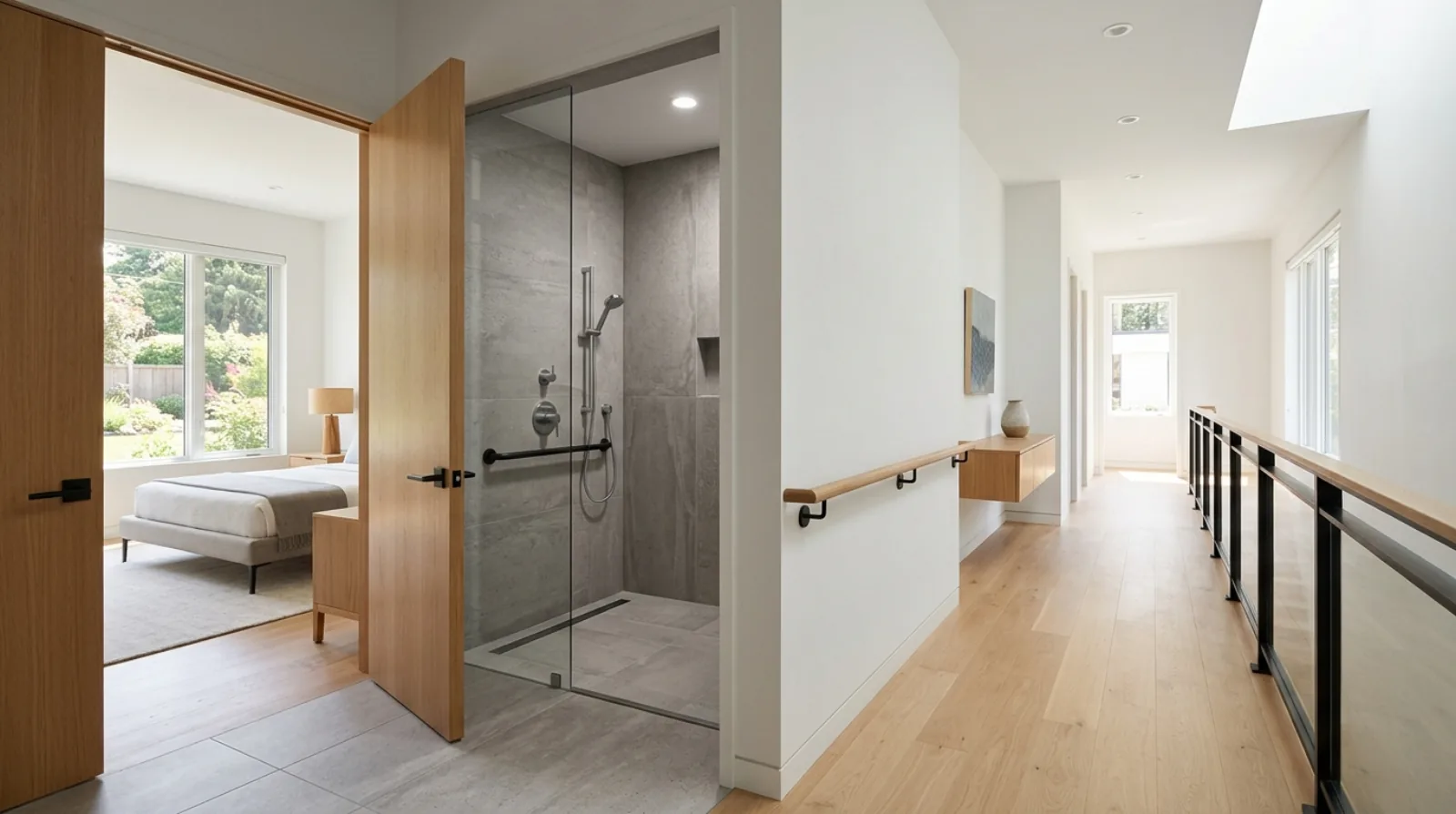
A grab bar isn't just a strap screwed to tile. Done properly, it has to anchor into solid backing behind the wall, in the right place, at the right height, near the toilet and inside the shower or tub. If that backing isn't there, you're either drilling blindly and hoping you hit a stud where you need one, which you rarely do, or you're opening the wall, adding the backing, re-tiling, and repainting. We frame the backing in continuous plywood across the wet wall so a grab bar can later land anywhere it's needed, not just where a stud happens to fall. For the actual dimensions and heights, the recognized Canadian reference is CSA/ASC B651, Accessible design for the built environment, which sets out the technical clearances and positioning for things like grab bars, washrooms, and circulation space (Accessibility Standards Canada, CSA/ASC B651).
Single-level living is the decision that matters most
If I could get a client to make only one aging-in-place decision, it would be this: put a real bedroom and a full bathroom on the main floor, on the same level as the kitchen and the front door.
Stairs are the single biggest reason people are forced out of homes they love. A recovering hip, a bad fall, a walker, a wheelchair, any of these turns a staircase from a non-issue into the thing that decides whether you can live in your own house. A home where the essential daily functions, sleeping, bathing, cooking, getting in and out, all happen on one level can carry someone through a period of limited mobility, temporary or permanent, without a renovation and without moving.
This doesn't mean building a single-storey home. Burnaby lots, especially the sloped ones up in Capitol Hill, the Heights, and toward Burnaby Mountain, often push toward two or three storeys to make the most of the buildable area and the views. The point isn't to avoid the upper floor, it's to make sure the home still fully functions if the upper floor ever becomes unreachable. The kids' rooms, the office, the media room can all live upstairs. The primary suite shouldn't be the thing trapped up there.
When clients tell me they want the primary bedroom upstairs for the view, I'll often suggest a main-floor guest suite designed so it can quietly become the primary suite later, full bathroom, generous closet, room for a bed with space to move around all sides of it. For years it's "the guest room." The day it needs to be more, it already is.
Stairs, when you have them, should be built to be safe at eighty
You won't eliminate stairs entirely on most Burnaby builds, so the next best thing is building the ones you have to be as safe as possible for someone who isn't as steady as they used to be.
The BC Building Code's Part 9 rules for stairs, ramps, handrails, and guards set the baseline. Section 9.8 requires handrails on stairs, specifies handrail height, and requires that handrails be continuously graspable along the run (BC Building Code, Section 9.8, Stairs, Ramps, Handrails and Guards). "Continuously graspable" matters more than it sounds, a rail you can actually wrap your hand around and slide along is what catches you, not a flat ledge or a chunky timber you can only rest a palm on.
Beyond meeting the rule, there are choices that make a stair genuinely kinder over a lifetime. Handrails on both sides rather than one. A consistent, comfortable rise rather than the steepest the code allows, because a shallower, even stair is far easier on a tired or unsteady leg. Good, even lighting top and bottom, with switches at both ends so nobody navigates stairs in the dark. And where the layout allows, framing in two vertically stacked closets, one on each floor, directly above each other, that could one day be converted into a shaft for a small home elevator or lift. You don't install the elevator. You just don't make it impossible to add one, which a normal floor plan usually does without anyone meaning to.
No-step entry: a planning problem, not a ramp
A zero-step or no-step entry, a way into the home with no threshold to trip over and no step to climb, is one of the most useful long-term features there is, and one of the most commonly botched. The mistake is treating it as a ramp you add later. Done right, it's a grading and threshold decision made before the foundation goes in.
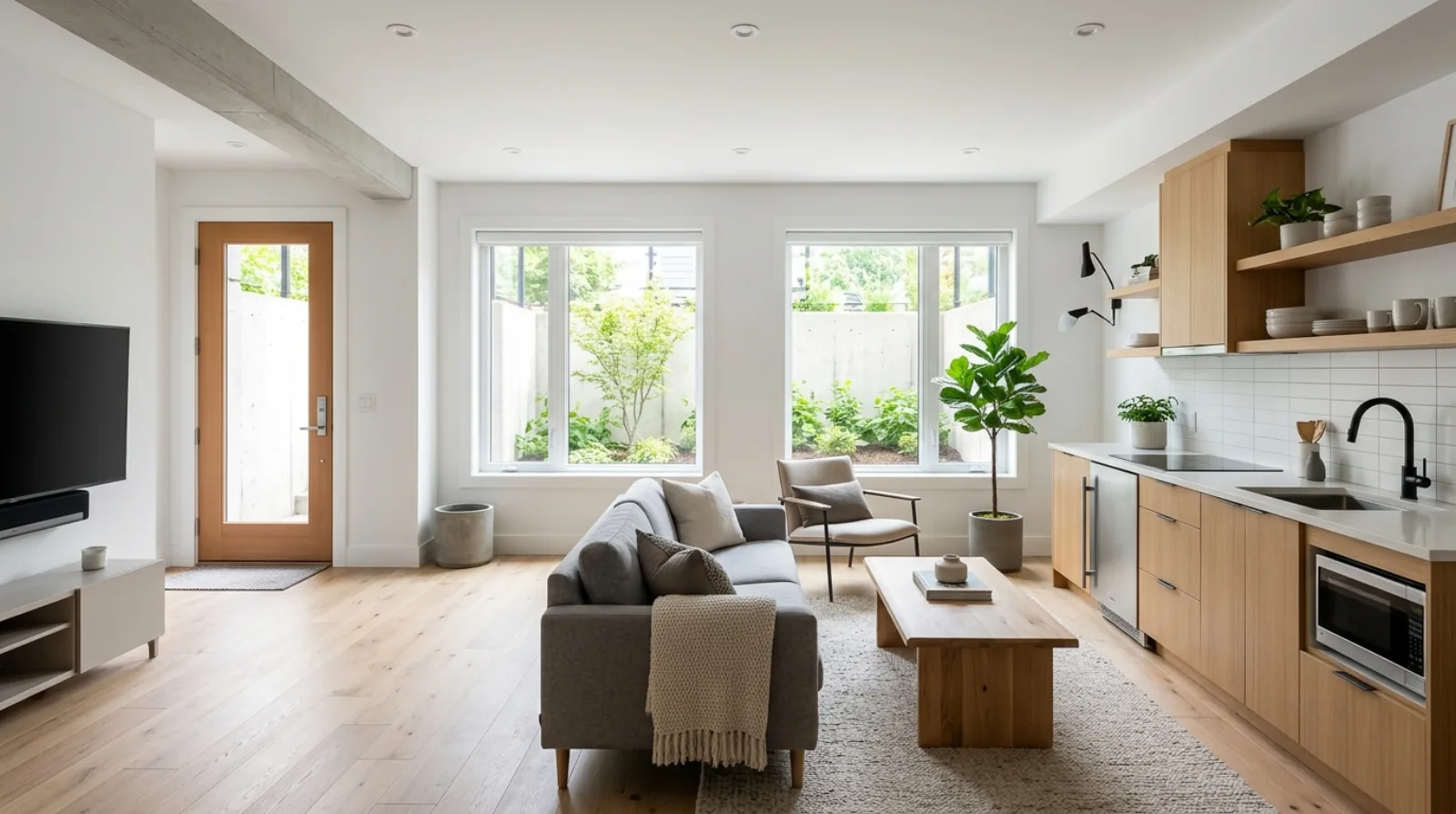
On a flat lot it's straightforward: set the floor height and the exterior grade so at least one entrance comes in level, with a flush or low-profile threshold at the door. On a sloped Burnaby lot it takes more thought, but it's doable. CMHC's guidance notes that a site can be graded so the slope between the street and the house delivers an accessible, no-step entry on whichever side of the home suits it best (CMHC, Accessible and adaptable housing). Often the answer on a hillside lot isn't the front door at all, it's a side or rear entrance, or an entry off a garage that sits at the right elevation, where the natural grade can be brought up flush without an obvious ramp.
This is exactly the thing that has to be caught during the planning and design phase, because it shapes the foundation, the entry location, and the site grading. Try to add a no-step entry after the house is built and graded, and you're regrading, re-landscaping, and possibly rebuilding a porch. Plan it in, and it costs essentially nothing and looks like a deliberate, clean architectural entrance, which it is.
The small details that disappear into good design
Most of what makes a home work across a lifetime isn't a single dramatic feature. It's a collection of small, quiet choices that add up, none of which makes the house feel like a care facility.
Wider doorways and hallways. Wider openings and circulation paths make a home easier to move through with a walker, a wheelchair, or just an armful of groceries. CMHC's accessible housing guidance lists wider doorways and hallways among the core features that let a home adapt over time. Generous circulation reads as spacious, not medical.
Lever handles instead of knobs. Levers on doors and faucets work for hands that can no longer grip and turn a round knob, and they're easier for everyone, every day, including anyone carrying something. CMHC includes lever handles on doors and plumbing fixtures in its accessible-design features.
Rocker switches and thoughtful controls. Wide rocker light switches are easier to operate than small toggles, and placing switches, outlets, and thermostats at heights reachable from a seated position is a no-cost decision at rough-in. CMHC's guidance similarly points to accessible-height controls and reinforced walls as part of an adaptable home.
Curbless showers with blocking. A curbless, or barrier-free, shower, one you walk straight into with no lip to step over, is safer for everyone and essential if a wheelchair or shower chair ever enters the picture. Built from the start, it's a waterproofing and drainage decision. Combined with the grab-bar backing already required in the wall, it future-proofs the most fall-prone room in the house. Done with good tile and glass, it reads as a high-end spa shower, not an accessibility fixture.
Slip-resistant flooring and contrast. Floor finishes with better traction in wet areas, and visual contrast between the floor and the wall and at stair edges, reduce falls and help anyone whose eyesight has changed read a space correctly. These are material and finish selections, not structural ones, they cost nothing extra to choose well.
Lighting that's bright and even. Vision changes with age, and older eyes need more light and dislike harsh shadows and glare. Layered, even lighting, especially at entries, stairs, hallways, and bathrooms, is one of the simplest long-term improvements, and it makes any home feel better at any age.
None of these announces itself. A visitor sees a generous, well-lit, beautifully finished home. The owner has a home that will still work when the rest of their cohort is reluctantly touring condos with elevators.
Build it in now, not later
The honest summary of all of this is a cost-and-timing argument, not a moral one. You are going to build the walls once. You are going to pour the entry once. You are going to lay out the floors once. Every decision in this post is cheap or free when it rides along with work you're already doing, and disproportionately expensive, occasionally impossible, to introduce after the fact.
We have these conversations early, during planning, because that's when they're free to act on and most of them touch the foundation, the framing, or the layout. A client doesn't have to commit to every feature. But they should make each call deliberately, knowing what it costs to defer it. A grab bar you might never need costs a sheet of plywood today. The same grab bar fifteen years from now, in a wall with nothing behind the tile, costs a small renovation and a few weeks of one bathroom being out of service, assuming the wall can take it at all.
We build custom homes across Burnaby, Vancouver, North Vancouver, Coquitlam, and New Westminster, and the families who are happiest a decade in are almost always the ones who thought about the long term while it was still cheap to do something about it. If you want to walk through which of these decisions are worth making for your build, and which genuinely don't matter for your situation, that's the thing a planning conversation is for. It also pairs naturally with thinking through your custom home design timeline, since several of these choices have to be settled before drawings are finalized.
Frequently asked questions
- Does the BC Building Code now require grab-bar reinforcement in bathrooms?
- Yes. For projects that apply for a building permit on or after March 10, 2025, the BC Building Code 2024 adaptable dwelling provisions apply. For smaller housing types like single-detached and townhouse-style homes, the requirement is that at least one bathroom must have its walls reinforced so grab bars can be installed in the future (Province of BC; CHBA BC). It's a low-cost requirement during framing and a sensible minimum to build in.
- What is an 'adaptable dwelling' under the BC Building Code?
- An adaptable dwelling is one designed so it can be modified as the occupant's needs change, through illness, injury, or aging, without major reconstruction. The 2024 BC Building Code adaptable provisions, effective for permits applied for on or after March 10, 2025, cover features such as accessible clearances through doorways and paths of travel, accessible-height controls, and reinforced bathroom walls for future grab bars, with broader requirements for larger residential buildings and a more focused set for smaller homes (Province of BC).
- How do you build a no-step entry on a sloped Burnaby lot?
- It's a grading and entry-location decision made before the foundation is poured, not a ramp added later. On a hillside lot, the site can be graded so the slope between the street and the house delivers a level, no-step entry on whichever side suits the design, often a side, rear, or garage-level entrance where the natural grade can be brought up flush (CMHC). Planned in early, it costs essentially nothing and looks like a deliberate, clean entrance rather than an accessibility add-on.
- What is CSA B651 and why does it matter for accessible home design?
- CSA/ASC B651, Accessible design for the built environment, is the recognized Canadian standard for accessibility dimensions, the clearances, heights, and positioning for things like grab bars, washrooms, doorways, and circulation space. The current edition is CSA/ASC B651:23 (Accessibility Standards Canada). When we plan where backing goes and how a future grab bar or barrier-free shower should be laid out, B651 is the reference for getting the dimensions right.
- Will building for aging in place make my home look institutional?
- No, if it's designed thoughtfully. The most valuable features, a no-step entry, main-floor primary suite, wider hallways, lever handles, a curbless shower, good lighting, and blocking hidden inside the walls, are invisible or read as high-end, clean design. Grab bars only get installed when they're actually needed, and even then they can be specified to look like a deliberate fixture rather than a hospital fitting. Universal design and good design are the same thing done with more foresight.
- Why build aging-in-place features now instead of renovating later?
- Cost and feasibility. Nearly every feature, backing in the walls, a level entry, a main-floor suite, a future elevator shaft framed as stacked closets, is cheap or free when it rides along with construction you're already doing, and disproportionately expensive or even impossible to add afterward. CMHC notes that when these features are planned at the outset, the added cost is minimal, while retrofitting later can be a major undertaking. Building from scratch is the one moment when doing it right is also the cheap option.
- What single decision matters most for aging in place?
- Putting a real bedroom and a full bathroom on the main floor, level with the kitchen and an entrance. Stairs are the most common reason people are forced out of homes they love. A home where sleeping, bathing, cooking, and getting in and out all happen on one level can carry someone through limited mobility, temporary or permanent, without a renovation. The upper floor can hold everything else; it just shouldn't hold the essentials.
- Can two stacked closets really become a future home elevator?
- Yes, if they're framed with that purpose in mind from the start. Two vertically stacked closets, one directly above the other on each floor, leave a clear shaft that a small home elevator or lift can later be installed into. The closets work as normal storage for years. No elevator gets installed at construction, the framing simply avoids making one impossible to add later, which a standard floor plan usually does without anyone intending it.
Related reading: Custom home design timeline in Burnaby · Multigenerational home design in Burnaby · Planning your custom home