An outdoor tap where the hose actually reaches, an outlet for the pressure washer, power for the lights and the irrigation timer: small services that make a yard work, and that are easy to forget on the drawings. Here is what the plumbing and building codes ask for, and how we plan outdoor services on our Burnaby builds.
Owners rarely think about outdoor taps and outlets until the first summer. That is when the hose will not reach the planter at the back of the yard, the pressure washer needs an extension cord through the kitchen window, and the patio heater has nowhere to plug in.
These are small services. They cost little to plan and rough in during the build, and a lot to add once the cladding, the patio and the landscaping are finished. So we plan them on the drawings, with the owners, at the same time as the landscape design. This post covers what the codes ask for, and how we decide where each tap, outlet and light goes on our Burnaby builds.
Outdoor taps: what the plumbing code requires
In BC, the plumbing rules are the BC Plumbing Code 2024, which builds on the National Plumbing Code of Canada 2020. Two articles in the national code cover outdoor taps, often called hose bibbs.
Frost protection. Article 2.6.1.4 says a pipe that passes through an exterior wall to supply water outside must have either:
- a frost-proof hydrant, or
- a stop-and-waste cock inside the building, close to the wall, so the outside section can be shut off and drained before winter.
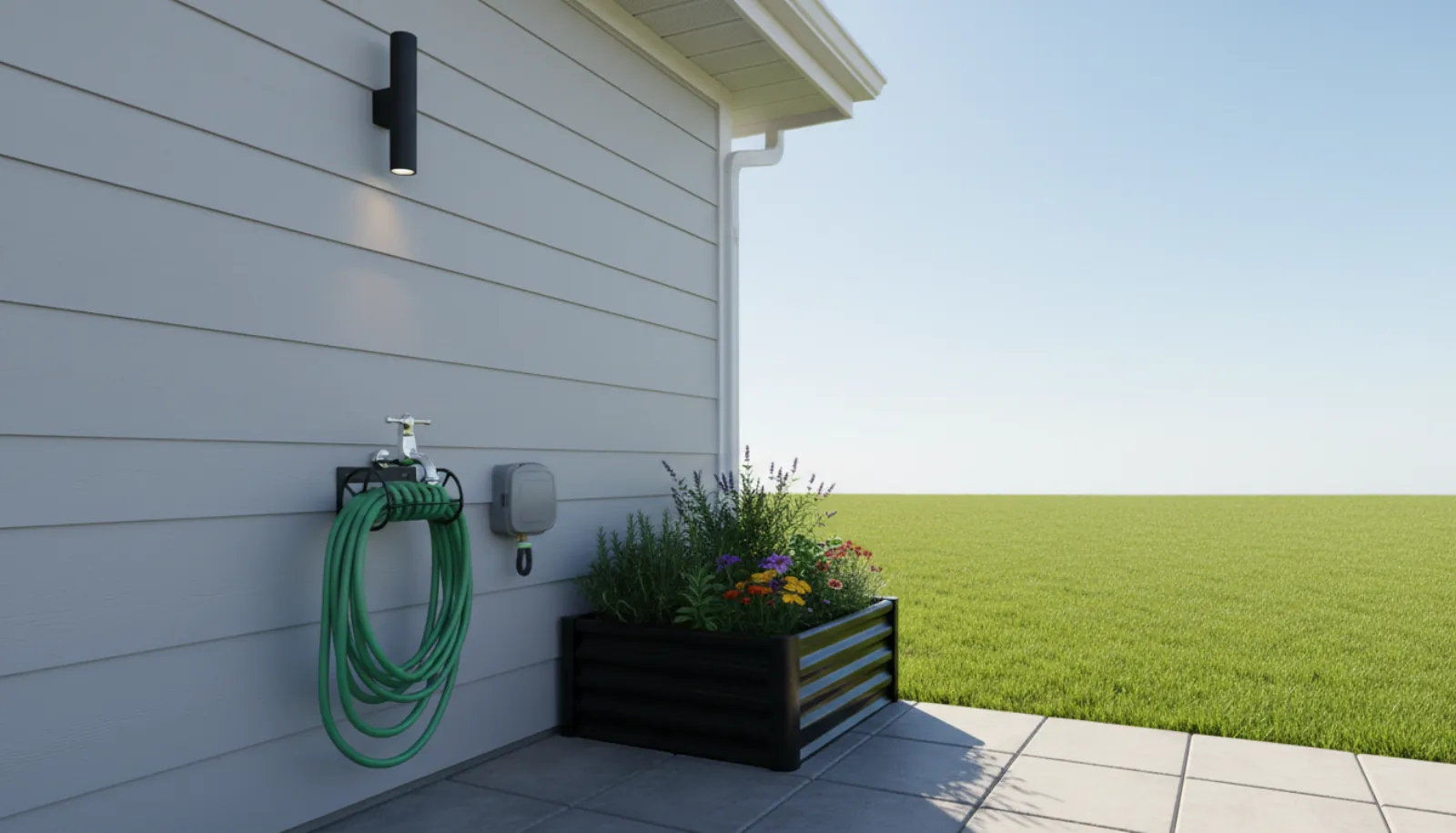
On our builds we use frost-proof hose bibbs. Their valve sits inside the heated wall, and the long body slopes to the outside, so the water left in it drains out when the tap is closed. A cold snap can split a standard tap and the pipe behind it, inside the wall, where the leak may not show until spring.
Backflow protection. Article 2.6.2.7 requires the potable water system to be protected against backflow through any hose bibb installed outside, inside a garage, or in an area with an identifiable risk of contamination. A hose attached to a fertilizer sprayer, or left lying in a puddle, could otherwise draw dirty water back into the house supply if the water pressure drops. The usual protection is a vacuum breaker built into the hose bibb or fitted to its outlet.
Outdoor services cost little before the cladding goes on and a lot after. We walk the yard on paper with owners, hose length in hand, before the plumbing rough-in.
Icon Projects Team
Where the taps go
We place taps where they will be used:
- Front of the house, near the driveway and the front garden beds, for washing the car and watering.
- Back of the house, near the lawn, the vegetable beds and the patio.
- Near a deck, balcony or roof deck with planters. On a roof deck, the tap is placed close to the door, and the plumbing is detailed through the membrane. Our post on roof decks and balconies covers those details.
- In the garage, for washing bikes, boots and the floor. The garage tap needs backflow protection too.
A common test: a standard hose should reach every planted area from at least one tap, without crossing a driveway or a doorway. We measure the reach on the landscape plan with the hose length the owner plans to buy, and add a tap where it falls short. A tap on each side of a long house also means a shorter hose to drag and coil. On a long, narrow Burnaby lot, that usually means taps at both ends of the house.
Hot and cold outdoor taps are an option near a garage or a dog wash area. Our post on pet-friendly design covers dog wash stations.
Outdoor outlets
Outdoor outlets serve tools, lights, holiday decorations, a pressure washer, an electric lawn mower charger, a patio heater and a hot tub. We plan outlets:
- At the front entry, for seasonal lights and tools.
- At the back patio and any deck or balcony, for lights, heaters and a speaker.
- Near the garden beds, for landscape lighting transformers and an irrigation controller if it sits outside.
- Near the hose taps, for a pressure washer.
- On the roof deck, wired before the membrane goes down, so no wires pass through it later.
- Near the soffit, on a switched circuit, for seasonal lights along the roofline.
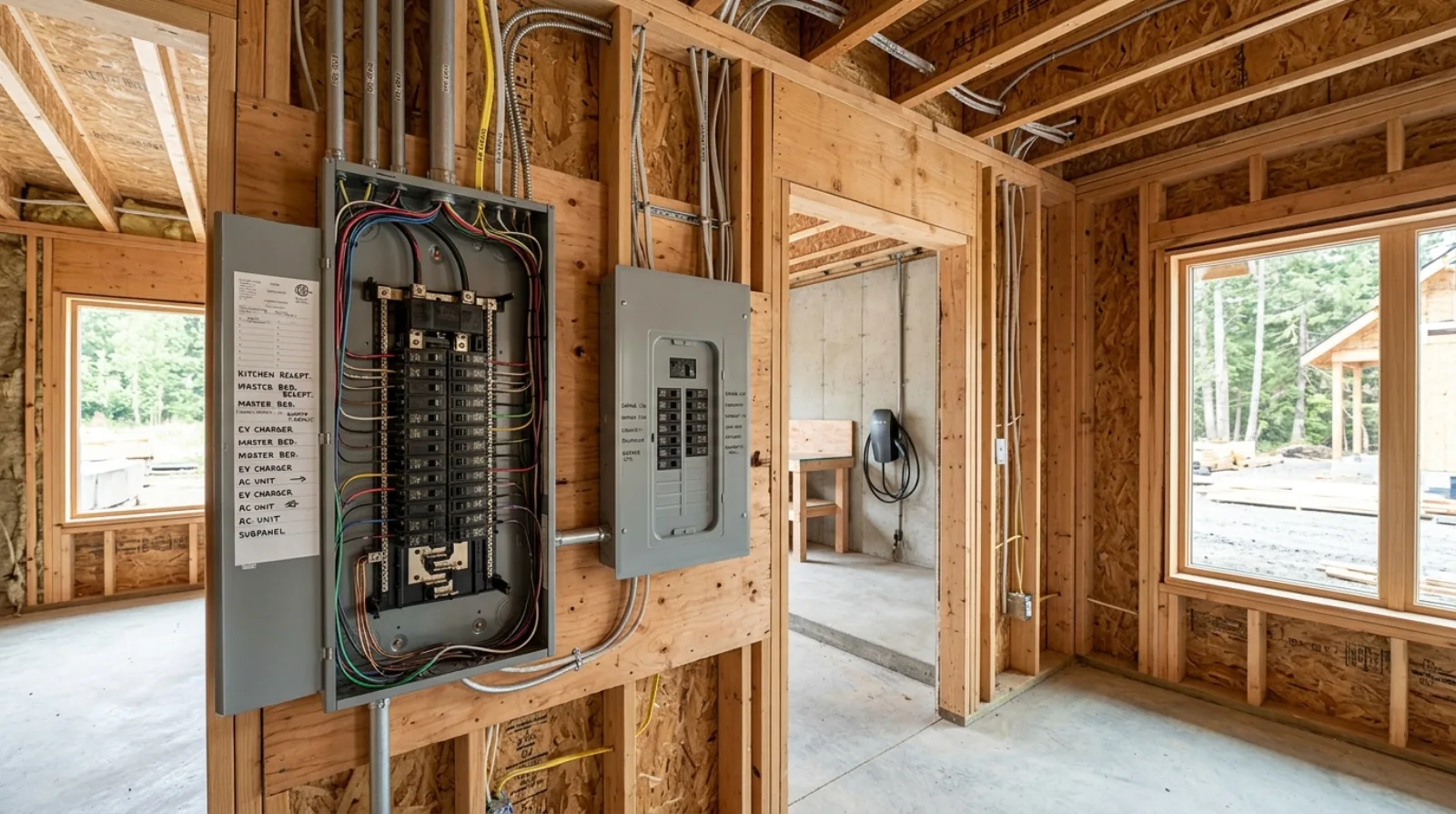
Outdoor outlets are installed with weatherproof covers and ground-fault protection under the electrical code. The electrician confirms the requirements for each location. A dedicated circuit is used for a hot tub or a heater.
Exterior lighting
Article 9.34.2.1 of the 2024 BC Building Code requires an exterior light with a fixture, controlled by a wall switch inside the building, at every entrance to a residential building. That covers the front door, the back door, the garage side door and the suite entrance.
Beyond the code, exterior lighting covers paths, steps, the driveway, the house number, and the garden. Our post on landscape and exterior lighting covers the design.
Suites, shared yards and who pays for the water
On a house with a secondary suite, outdoor services raise a practical question: whose tap is it, and whose meter does it run on?
- Taps. If the suite has its own patio or garden, a tap on the suite side of the house lets the tenant water without using the main home's tap. We usually supply it from the main house's water line and give it its own shut-off inside, so the owner can turn it off.
- Outlets. An outdoor outlet at the suite entrance is useful for the tenant. It can be wired to the suite's own panel, so it runs on the suite's electricity. Our post on secondary suite plumbing covers how water and power are split between the units.
- Entry lights. Each entrance needs its own exterior light, switched from inside, as Article 9.34.2.1 requires. The suite entrance light is switched from inside the suite.
Our guide to secondary suites in Burnaby covers the rest of the suite layout.
Winterizing: a two-minute job each fall
Even with frost-proof hose bibbs, a few habits protect the outdoor services each fall:
- Disconnect hoses from every tap. A hose left connected holds water in the tap body, which stops a frost-proof bibb from draining and can let it freeze.
- Drain the irrigation system following the installer's instructions, and close its shut-off.
- Close any inside shut-off that serves an outdoor tap, and open the outside tap to let it drain.
- Check outdoor outlet covers for damage, and make sure they close.
- Store hoses in the garage.
We leave owners a short list of these steps at handover. Our post on the first fall and winter in a new home includes them with the rest of the seasonal checks.
Irrigation
If the garden will be irrigated, the build is the time to prepare:
- A dedicated water line for the irrigation system, with its own shut-off and backflow protection.
- Power for the controller, indoors or outdoors.
- Sleeves under paths, patios and driveways, so the irrigation lines can cross them later without cutting concrete.
- A drain-down plan for winter.
Our post on rainwater harvesting and irrigation covers the systems, including collecting roof water for the garden.
Sleeves and conduit: the cheapest future-proofing
Before patios, walks and driveways are poured, we lay empty plastic sleeves and conduits under them, wherever a future line might need to cross:
- from the house to the garden beds, for lighting and irrigation,
- from the house to the back of the lot, for a future shed, studio, or laneway home,
- from the garage to the driveway edge, for a future gate or EV charger,
- to the front of the lot, for a future gate, mailbox light or camera.
Each sleeve is capped and its position recorded on the as-built drawings, so it can be found later. Our post on exterior concrete covers the patios and walks they run under.
Hot tubs, outdoor kitchens and pools
Bigger outdoor features need bigger services. A hot tub needs a dedicated electrical circuit and a disconnect, and a way to drain it. An outdoor kitchen needs power, sometimes gas or water, and a drain. A pool needs its own equipment, power and fencing. Our posts on covered outdoor kitchens and pools and spas cover them. Even when these are planned for a later phase, the conduit and water line can go in during the build.
How we plan outdoor services on a Burnaby build
- Walk the yard on paper with the owners and the landscape plan.
- Place taps where a hose reaches every planted area, the driveway and the deck.
- Use frost-proof hose bibbs with backflow protection.
- Place outdoor outlets at entries, patios, decks, beds and taps.
- Add entry lights, as the code requires, and plan the rest of the exterior lighting.
- Lay sleeves under every hard surface before it is poured.
Our custom homes service page shows how we build in Burnaby, Richmond and across the Lower Mainland.
Frequently asked questions
- Do outdoor taps need to be frost-proof in BC?
- Article 2.6.1.4 of the National Plumbing Code of Canada 2020, which the BC Plumbing Code 2024 is based on, requires pipes that pass through an exterior wall to supply water outside to have either a frost-proof hydrant or a stop-and-waste cock inside the building close to the wall. A frost-proof hose bibb keeps its valve inside the heated wall, so the part outside drains when it is shut off.
- Do outdoor taps need backflow protection?
- Yes. Article 2.6.2.7 requires the potable water system to be protected against backflow through a hose bibb installed outside a building, inside a garage, or anywhere with an identifiable risk of contamination. A hose connected to a sprayer of fertilizer, or lying in a puddle, could otherwise draw contaminated water back into the house supply.
- How many outdoor taps should a new house have?
- It depends on the lot. On most of our builds we plan at least one at the front, one at the back, and one in the garage, plus one near a deck, balcony or roof deck with planters. We place them where a standard hose reaches every planted area and where the car is washed.
- Does the building code require outdoor lights?
- Article 9.34.2.1 of the 2024 BC Building Code requires an exterior lighting outlet with a fixture, controlled by a wall switch inside the building, at every entrance to a residential building.
- What outdoor outlets should a new house have?
- We plan weatherproof outlets with ground-fault protection at the front entry, the back patio, any deck or balcony, the garden beds, and near the hose taps for a pressure washer. The electrician confirms the electrical code requirements for each location, including covers that stay weatherproof while something is plugged in.
- Should irrigation be planned during the build?
- If you expect to irrigate, yes. A dedicated water line with its own shut-off and backflow protection, power for the controller, and sleeves under paths and driveways are easy to install before landscaping and hard to add after. Our post on rainwater harvesting and irrigation covers the system.