A Step Code house in Burnaby has to pass two air-leakage tests, so a range hood can only move as much air as the house can let back in. Here is how we size the hood, run the duct, plan makeup air and keep the fan quiet on a new BC custom home.
A new custom home in Burnaby has to pass an air-leakage test twice. The City requires a mid-construction blower door test before the insulation inspection and a final test before occupancy, and the mid-construction result has to land within 1.5 air changes per hour of the airtightness assumed in the energy model. That tight envelope is why a Step Code house is comfortable and efficient to heat. It is also why the range hood needs more planning than it did in an older house.
A range hood pushes air out of the house. The same volume of air has to come back in from somewhere. In an older house it leaks in through gaps around windows, sill plates and attic hatches, and nobody thinks about it. In a tight house most of those gaps are gone, so the hood pulls the whole house below outdoor pressure. The fan moves less air than its rated flow. It gets louder. It captures less of the smoke and grease it was bought to remove. Any appliance that relies on a chimney can pull exhaust back into the house.
The air brought in to replace what the hood removes is called makeup air. Here is how we plan it with the hood and duct on a custom home in Burnaby, Coquitlam or Vancouver.
What the BC Building Code requires in the kitchen
Section 9.32 of the 2024 BC Building Code covers ventilation for houses, and Section 9.10.22 covers clearances at the cooktop. Four articles shape the kitchen.
Article 9.32.3.6 requires an exhaust fan in every kitchen, and Table 9.32.3.6 sets its minimum intermittent air-flow rate at 47 litres per second. The rating is measured at 50 pascals of static pressure, which stands in for the resistance of a duct run, so a rating measured with no duct attached tells you little about what the fan will do once it is installed.
Article 9.32.3.8 governs the duct. Exhaust ducts discharge to the outdoors. A duct downstream of an exhaust fan has no connections to other fans or ducts. The duct is sized to the fan manufacturer's requirements. Every joint is sealed with one of the sealants or tapes the code lists, such as mastic or aluminum foil tape. Where the duct passes through or beside a space outside the conditioned part of the house, it is insulated to at least RSI 0.75. And where the exhaust grille sits within 1.2 metres horizontally of the cooktop, the duct has to be noncombustible, corrosion-resistant and cleanable, with a grease filter at the intake.
Article 9.10.22.2 sets the vertical clearance above the burners or elements. Framing, finishes and cabinets directly above the cooktop sit at least 750 mm above it. That can drop to 600 mm if those materials are noncombustible or protected by a metal hood that projects 125 mm beyond them. The hood manufacturer's installation instructions add their own mounting height, and we follow whichever is higher.
Article 9.32.4.1 covers makeup air, and it has a specific trigger, which we cover below.
Sizing the hood: capture first, air flow second
The first thing we look at is the hood's shape and position, because a hood can only remove what it catches. The air-flow number comes second.
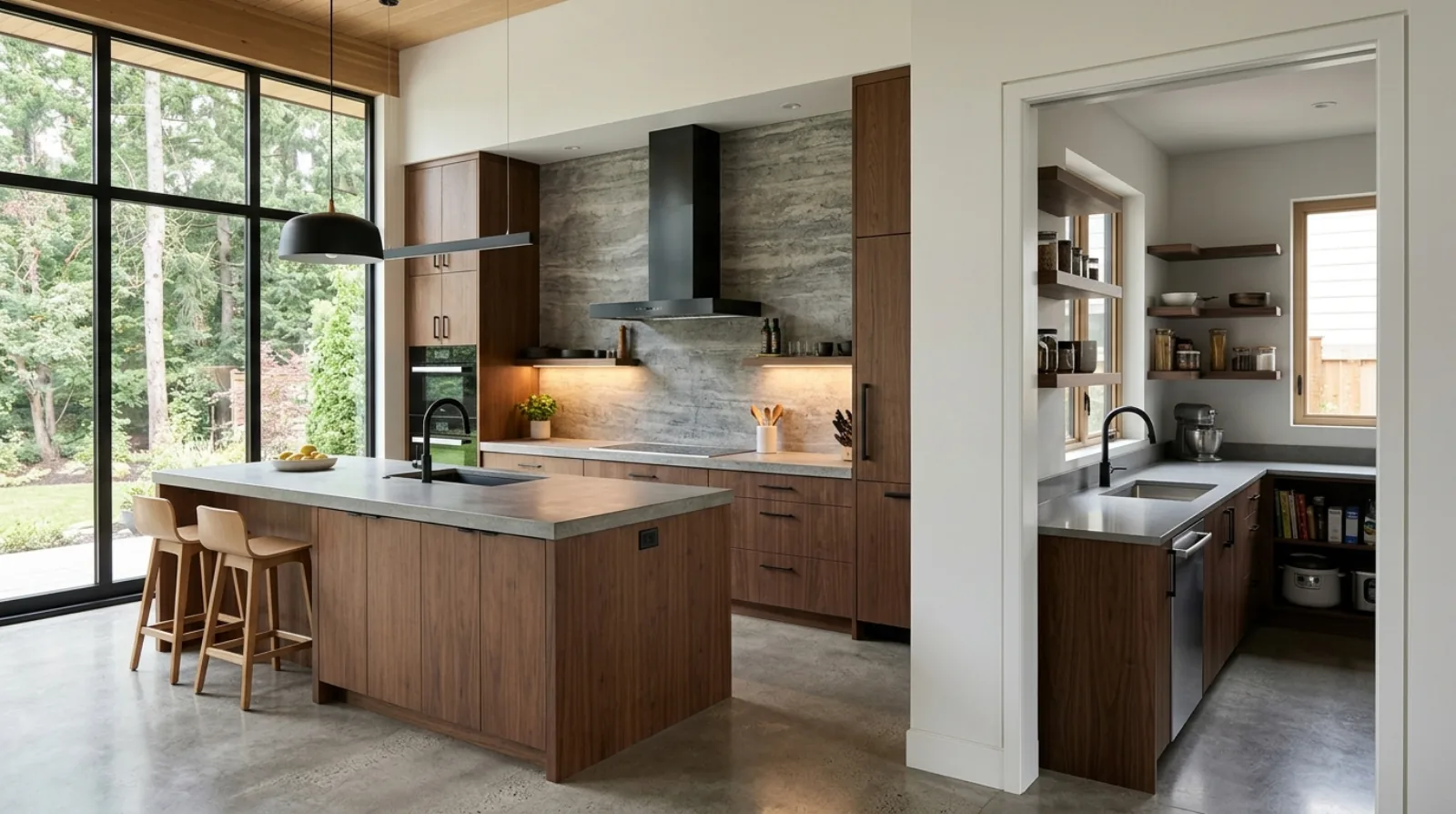
Smoke and grease rise from the pan in a plume that spreads as it rises. A hood that covers the whole cooking surface, mounted at the lowest height the code and the manufacturer allow, catches more of that plume at a lower fan speed. Health Canada's cooking and indoor air quality factsheet recommends that the hood fully extend over the stove burners. An island hood has open air on every side, and drafts from a patio door or a ceiling fan push the plume sideways. On an island we plan a wider hood and keep supply air vents from blowing across the cooktop.
Then the air flow. The code minimum is 47 litres per second. Above that, the right number depends on the cooktop, the cooking style and the hood shape, and we set it with the mechanical designer and the hood manufacturer's data. The factsheet also reports that running the hood on its high setting during cooking cut exposure to cooking pollutants by more than 80 percent compared with slower speeds. So we pick a hood the family will be comfortable running on high. A large fan that stays on low because it is too loud does less than a smaller fan that runs on high every time.
The best range hood is the one the family actually turns on. Size it so the high setting is quiet enough to use every night.
Icon Projects Team
Makeup air: what the code triggers and what the house needs
Article 9.32.4.1 of the 2024 code requires additional makeup air for any appliance that exhausts air to the outside at an installed rate above 0.5 air changes per hour, when the home also contains a naturally aspirating fuel-fired vented appliance. The code's own note (A-9.32.4.1) explains that these are appliances with draft hoods, which can backdraft when the house is under negative pressure. Direct-vent and power-vented gas appliances are classed outside that group.
When the rule applies, the code is specific. The makeup air comes from a supply fan rated to deliver outdoor air at the rate of the exhaust appliance. That supply fan is interlocked with the hood so they run together. The incoming air is tempered to at least 12 degrees Celsius before it enters occupied rooms, or at least 1 degree Celsius before it enters a normally unoccupied area.
Many of the Burnaby custom homes we build under EL-4 are all-electric: a heat pump for heating and cooling, a heat pump or electric water heater, and induction in the kitchen. With no draft-hood appliance in the house, the Article 9.32.4.1 trigger is often absent. A large hood in an all-electric house still lowers the indoor pressure. Health Canada's ventilation guidance says larger fans, which it places at 90 to 180 litres per second (200 to 400 cubic feet per minute), need added venting or ductwork to supply makeup air, and that house depressurization at levels such as 5 pascals can cause backdrafting in appliances that vent through chimneys.
So on any large hood we plan a makeup air path whether the code triggers it or not. That usually means a dedicated outdoor air duct with a motorized damper that opens when the hood runs, often with a small heater in the duct so cold January air is warmed before it reaches the kitchen floor. Where the house has a wood-burning fireplace or any gas appliance with a chimney, we treat the makeup air as a safety system and design it to the code rule. Our post on fireplace design in a Burnaby custom home covers why we prefer sealed, direct-vent units in a tight house.
Ducting, and the case against recirculating hoods
The duct run decides how well the hood performs and how loud it is. Table 9.32.3.8 in the code counts the exterior wall or roof hood as 10 metres of equivalent duct length and each 90 degree elbow as another 3 metres. A run with a wall cap and three elbows already counts as 19 metres before any straight duct is added. Every metre adds resistance, and a fan pushing against resistance moves less air and makes more noise.
We plan the kitchen so the hood sits near an outside wall, with the duct running straight out through the wall or up through a short chase. An island hood is still possible, but its duct has to cross the floor above, so the joists are laid out around it on the drawings. Our kitchen design post covers the layout side of this.
A recirculating hood pulls air through a grease filter and a charcoal filter and blows it back into the kitchen. It catches some grease. Moisture, heat and combustion gases stay in the house, and the code's kitchen exhaust must discharge outdoors. Natural Resources Canada's publication on heat recovery ventilators notes that kitchen exhaust grilles on an HRV should have filters to catch grease. In 2023 the BC Building Code Appeal Board ruled in decision 1906, under the 2018 code, that the required kitchen exhaust could come from an HRV that delivers at least 47 litres per second with spot control for the kitchen, provided the HRV system can handle grease and vapour. That allows one other design: a recirculating hood for grease, paired with an HRV exhaust grille in the kitchen. We still prefer a ducted hood for any family that cooks with high heat.
Induction or gas
The cooktop choice changes both the air and the permit.
Health Canada says cooking on a gas or an electric stove creates fine particles from frying, roasting, toasting and burning food, and that a gas stove also produces nitrogen dioxide and carbon monoxide. Its nitrogen dioxide page advises that gas stoves have a range hood fan that vents to the outside, and suggests cooking on the back burners so the gases rise into the exhaust fan. Induction takes the combustion gases out of the kitchen. The grease, steam and smoke from the food stay, so an induction kitchen still needs a real hood.
On the permit side, Burnaby requires Step 3 of the Energy Step Code plus EL-4 of the Zero Carbon Step Code for Part 9 permits submitted on or after January 1, 2025. The City states that cooktops using fossil fuels are not allowed at EL-4 on the prescriptive compliance pathway, and that the performance pathway model does not specifically disallow a gas cooktop. A client who wants gas has to tell us before the energy advisor sets up the model, and we then check every gas appliance in the house against the backdraft rule.
The HRV, the hood and noise
Every new house needs a principal ventilation system under Article 9.32.3.3, and in a tight Burnaby home that is usually a heat recovery ventilator. Our post on heat pumps and HRVs in a BC custom home covers how it works. The hood and the HRV have to be designed together for three reasons.
The HRV is balanced: it brings in the same volume of air it exhausts. The hood removes air with nothing coming back, so the hood's makeup air has to be handled separately. We place any HRV exhaust grille in the kitchen more than 1.2 metres horizontally from the cooktop, the distance Article 9.32.3.8 uses for its grease duct rule, and fit it with a grease filter as the NRCan guide advises. And the HRV's supply grilles should not blow across the cooktop and push the plume away from the hood.
On noise, Article 9.32.3.5 limits the principal ventilation fan to 1.0 sone. The kitchen fan in Article 9.32.3.6 has no sound limit, so its noise depends on the design. A short, straight, full-size duct is the biggest factor. After that, a remote or inline motor mounted in a mechanical space or on the exterior wall takes the motor out of the kitchen, leaving only the sound of moving air.
When we plan the hood, the duct route, the makeup air and the HRV at the same meeting, the kitchen works on the first night. The hood runs on high without anyone raising their voice, and the house stays at a stable pressure while it does.
Frequently asked questions
- What does the BC Building Code require for a kitchen exhaust fan in a new house?
- Article 9.32.3.6 of the 2024 BC Building Code requires an exhaust fan in every kitchen with a minimum intermittent air-flow rate of 47 litres per second, rated at 50 pascals of static pressure. Article 9.32.3.8 requires exhaust ducts to discharge to the outdoors and to be sized to the fan manufacturer's requirements. Where the exhaust grille is within 1.2 metres horizontally of the cooktop, the duct must be noncombustible, corrosion-resistant and cleanable, with a grease filter at the intake.
- When is a makeup air fan required for a range hood in BC?
- Article 9.32.4.1 of the 2024 BC Building Code requires makeup air when an appliance exhausts air to the outside at an installed rate above 0.5 air changes per hour in a home that also contains a naturally aspirating fuel-fired vented appliance, such as a gas water heater with a draft hood. The makeup air must come from a supply fan rated for the same flow as the exhaust appliance and interlocked with it. The air must be tempered to at least 12 degrees Celsius before it enters occupied areas.
- Do I need makeup air for a range hood in an all-electric Burnaby home?
- The code rule in Article 9.32.4.1 is triggered by a fuel-fired appliance that can backdraft, so an all-electric house with direct-vent or no combustion appliances may fall outside it. A large hood in an airtight house lowers the indoor pressure and moves less air than its rating in either case. Health Canada's ventilation guidance says larger fans, which it puts at 90 to 180 litres per second (200 to 400 cubic feet per minute), need an added path for makeup air, so we plan one on large hoods either way.
- Can I use a recirculating range hood in a new BC custom home?
- The BC Building Code requires a kitchen exhaust fan whose ducts discharge to the outdoors, and a recirculating hood returns filtered air to the room. So a recirculating hood cannot be the required kitchen exhaust on its own. In 2023 the BC Building Code Appeal Board accepted a design where an HRV provided the kitchen exhaust at 47 litres per second with spot control, which is one route for a home that uses a recirculating hood for grease capture.
- Can a gas cooktop go in a new Burnaby custom home?
- Burnaby requires Step 3 of the Energy Step Code plus EL-4 of the Zero Carbon Step Code for Part 9 permits submitted on or after January 1, 2025. The City says fossil-fuel cooktops are not allowed at EL-4 on the prescriptive pathway, while the performance pathway model does not specifically disallow a gas cooktop. If you want gas, the energy model has to be set up for it from the start.
- Does an induction cooktop still need a range hood?
- Yes. Health Canada says cooking creates fine particles on both gas and electric stoves, from frying, roasting, sauteing, toasting and burning food. Induction removes the combustion gases that a gas flame adds, such as nitrogen dioxide and carbon monoxide, but the grease, steam and smoke from the food are still there, and the code requires the 47 litres per second kitchen fan in either case.
- How can a range hood be quieter in a Burnaby custom home?
- Duct size and length matter most, because a fan pushing air through a small or long duct works harder and makes more noise. The 2024 BC Building Code counts 10 metres of equivalent length for the exterior hood and 3 metres for each 90 degree elbow when sizing ducts, so a short, straight run to the outside wall helps. A remote or inline fan motor mounted away from the kitchen also moves the motor sound out of the room.
- How does a range hood's air flow affect a heat recovery ventilator?
- An HRV is balanced, meaning it brings in the same volume of air it exhausts, while a range hood removes air with nothing built in to replace it. The two systems are designed together so the hood's makeup air is handled on its own path rather than being pulled through the HRV. Any HRV exhaust grille placed in the kitchen also needs a grease filter and has to sit more than 1.2 metres from the cooktop, the same distance the code sets for the hood's own duct rule.
- Is there a noise limit for a kitchen range hood fan under the BC Building Code?
- No. Article 9.32.3.5 limits the home's principal ventilation fan, typically the HRV, to 1.0 sone, but Article 9.32.3.6, which covers the kitchen exhaust fan, sets no sound limit. The hood's real-world noise depends entirely on its duct design and motor placement, which is why a short, straight duct run and a remote or inline motor matter more for a quiet kitchen than the fan's rated specifications alone.