Design
Fireplace design in a Burnaby custom home: gas, electric, or wood
Burnaby's Step 3 + EL-4 rules are quietly changing how we design fireplaces. Here's the real trade-off between gas, electric, and wood, and why the fireplace is an architectural decision before it's a heat source.
Gas, electric, or wood, which fireplace makes sense in a Burnaby custom home?
For most new custom homes in Burnaby right now, the honest answer is electric or a linear gas unit chosen for looks, not for heat, and almost never wood as a primary source. The reason isn't fashion. It's that Burnaby adopted Step 3 + EL-4 of the Zero Carbon Step Code effective January 1, 2025, and EL-4 is the emissions level that targets fossil-fuel space-heating equipment (Zero Carbon Step Code). When the city is steering your primary heating system away from gas, a gas fireplace stops being the efficient room-heater it was twenty years ago and becomes one more combustion appliance to justify.
So the question splits in two. What do you want the fireplace to do, heat a room, or look like a fire? And what's the heating system it has to live alongside? Answer those honestly and the material choice usually answers itself.
What the Zero Carbon Step Code actually changes here
Step 3 is the energy-efficiency target. It pulls airtightness down to 2.5 air changes per hour at 50 pascals, verified with a blower-door test, under the performance path in 9.36.6 of the BC Building Code and modelled against the BC Energy Step Code. EL-4 is the emissions dial layered on top, and it's the one pushing owners toward heat pumps for the main system. We unpack the energy side more fully in our piece on the Zero Carbon Step Code, but the fireplace consequence is specific.
A house built this tight barely loses heat. Drop a 30,000-BTU gas insert into that living room and on a mild Burnaby evening you'll open a window to cool off, you've fought your own envelope. Meanwhile the heat-pump system sized with a CSA F280-12 load calculation is already carrying the house comfortably. The fireplace isn't pulling weight; it's competing.
That's the shift. Twenty years ago a gas fireplace was a legitimate zone heater. In a Step 3 home it's a luxury that runs hot in a space that doesn't need it.
In a house this airtight, a big gas fireplace doesn't heat the room, it overheats it. Buy the fire for the look, and let the heat pump do the actual work.
Icon Projects Team
The case for electric, and why it's stopped being the cheap option
Electric used to mean a glowing log set that fooled no one. The current linear electric units are a different animal: long flame ribbons, adjustable colour and intensity, no flue, no gas line, no combustion air. Because there's nothing burning, you can frame the unit into a wall almost anywhere and run a full-height surround right up to it without the clearance gymnastics that gas demands.
For a Brentwood or Metrotown infill where the living wall faces a neighbour and a chimney chase would eat floor area, electric is often the cleanest answer. It also sidesteps the EL-4 conversation entirely, it runs on the same low-carbon electricity as the heat pump.
The catch is electrical capacity. A large linear electric fireplace pulls real amperage, and it lands on the same panel that's already feeding a heat pump, an EV charger, and an induction range. We plan that load at the framing stage, not after drywall, the same discipline we describe in wiring for the electrical future. Run the circuit early, size the panel honestly under the Canadian Electrical Code, and you avoid a service upgrade later.
When gas still earns its place
Gas isn't banned, and there are homes where a linear gas fireplace is the right call, a Deer Lake great room with a soaring ceiling where a real flame anchors the space, or a client who simply wants the warmth and movement only combustion gives. EL-4 governs your primary heating equipment, not whether you can have a decorative fireplace.
If you go gas, design it as a feature, not a furnace:
- Choose a direct-vent sealed unit. It draws combustion air from outside and exhausts outside through a sealed flue, so it doesn't pull from the conditioned, depressurized interior of an airtight house.
- Coordinate the vent run early. Direct-vent terminations have to clear windows, soffits, and the property line, and on a tight Burnaby lot those clearances drive where the fireplace can physically sit.
- Right-size the BTU output. A smaller, lower-output unit on a tall, dramatic surround reads as architecture without cooking the room.
And it triggers a code requirement people forget. Any fuel-burning appliance, or an attached garage, means carbon monoxide alarms under 9.32.4.2 of the BC Building Code. That's not optional and not something to bolt on at occupancy. We map CO and smoke-alarm locations into the electrical plan alongside the smoke-alarm requirements in 9.10.19 so every storey and sleeping area is covered.
Wood: beautiful, demanding, and rarely the primary choice
We love a real wood fire. We just rarely recommend one as a primary heat source in a new Burnaby home, and the Zero Carbon Step Code is only part of it.
A wood-burning fireplace or stove wants a masonry or listed metal chimney, generous non-combustible clearances, a hearth extension, and a structural chimney that has to be carried down through the floor framing to the foundation. On a Capitol Hill or Burnaby Heights hillside lot, threading a masonry chimney down a stepped structure is real engineering and real money. Add the same CO-alarm requirement, plus combustion air, plus the reality that an airtight Step 3 envelope and a wood fire that wants makeup air don't naturally get along.
Where wood does make sense is a deliberate, romantic centrepiece in a home that isn't depending on it for warmth, and where the owner accepts the maintenance: chimney sweeping, ash management, and the kindling habit. If that's the dream, we design it properly. If it's nostalgia, a linear electric or gas unit usually delivers the feeling without the structural commitment.
Designing the fireplace as architecture, not an afterthought
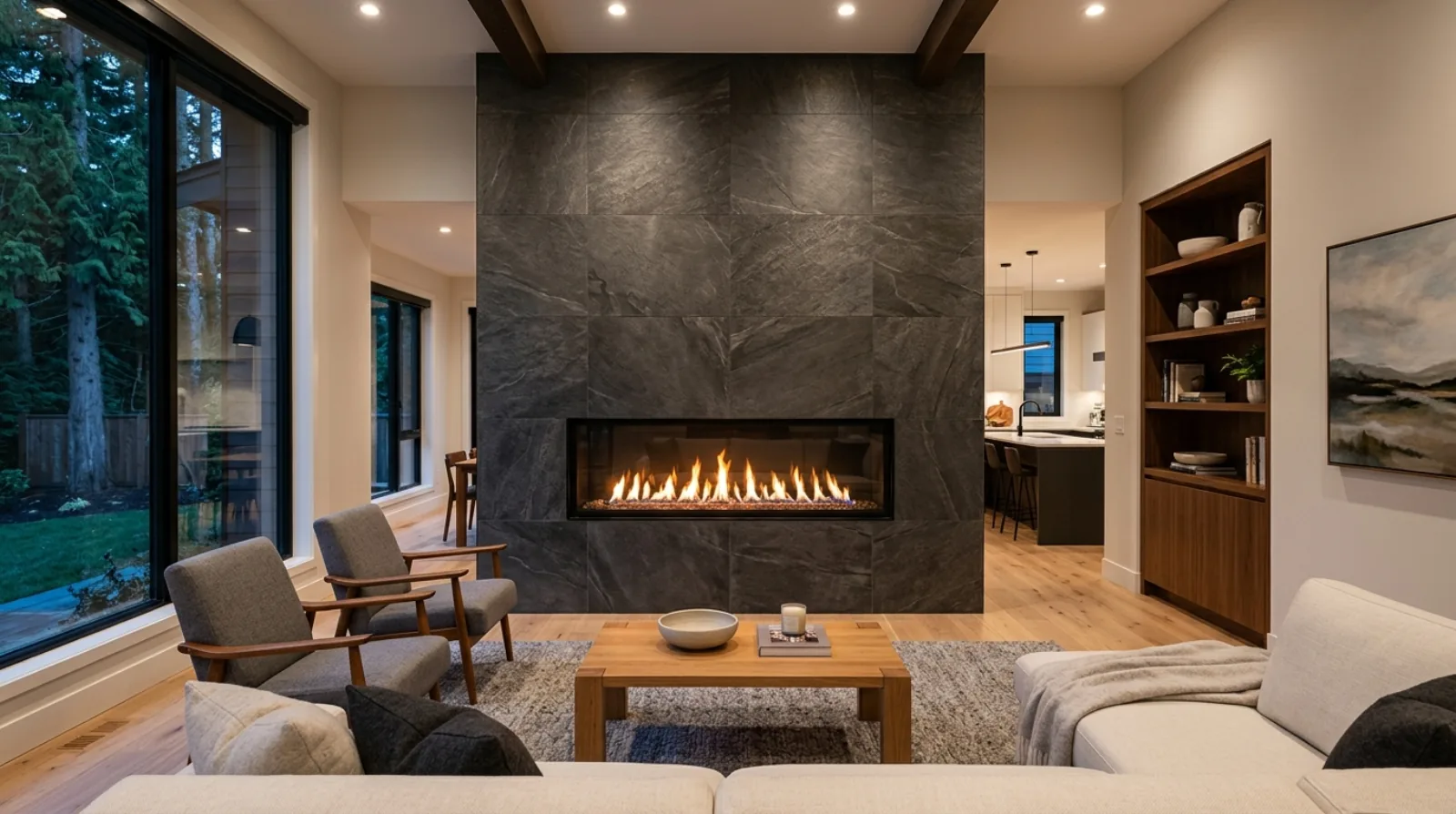
Whatever burns inside it, the surround is the part you live with. The firebox is replaceable technology; the stone, the proportion, and where it sits in the room are permanent. So we design the wall first.
A few moves we keep coming back to on Burnaby builds:
- Full-height surround. Carrying stone, large-format porcelain, or plaster from floor to ceiling makes a modest room feel taller and turns the fireplace into the architectural anchor of the space. It pairs naturally with the materials that age beautifully, honed stone and real plaster only get better.
- Linear and see-through. A long horizontal firebox suits modern Burnaby interiors, and a see-through unit set into a partition between living and dining lets one fireplace serve two rooms, a genuinely smart use of a feature wall in an open plan.
- Scale the surround to the ceiling, not the firebox. A small insert lost in a big blank wall is the most common fireplace mistake we're called in to fix. The cladding should answer the room's volume.
- Integrate the millwork. Floating hearths, flanking cabinetry, a TV niche planned so the screen isn't an afterthought stuck above the flames, these are millwork decisions made on paper, not on site.
This is exactly the kind of decision worth getting right the first time, which is why it shows up in our list of custom-home features worth investing in. A cheap fireplace surround announces itself for the life of the house.
How the fireplace coordinates with your heating system
The fireplace and the mechanical system are one decision, not two. In a Step 3 + EL-4 Burnaby home the heat pump is the workhorse, sized properly, distributing even heat without the hot-and-cold of a single radiating appliance. The fireplace lives on top of that as ambience and a touch of supplemental warmth on the coldest nights.
Get this sequencing right and you avoid the two classic failures. One: an oversized gas fireplace that fights an oversized furnace, so the room swings between roasting and stuffy. Two: an electric unit specified after the panel schedule is locked, forcing a scramble for capacity. We resolve both during planning, when the load calc, the panel, the flue routing, and the surround are still drawings we can change for free.
The home's whole heating story, heat pump, HRV under CSA F326:23, and how a fireplace fits the comfort plan, is worth reading alongside our piece on heat pumps and HRV for the 2026 code. The fireplace is the last 5% of comfort, not the foundation of it.
Frequently asked questions
Can I still install a gas fireplace in a new Burnaby custom home under the Zero Carbon Step Code? Yes. Burnaby's Step 3 + EL-4 requirement (effective January 1, 2025) governs your primary space-heating and water-heating equipment, which is steering owners toward heat pumps, it doesn't outright ban a decorative gas fireplace. We design gas units as direct-vent sealed appliances chosen for ambience, with the heat pump carrying the actual heating load.
Does a gas fireplace require a carbon monoxide alarm? Yes. Under BC Building Code 9.32.4.2, any home with a fuel-burning appliance, including a gas fireplace, or an attached garage requires carbon monoxide alarms. We plan those locations into the electrical drawings alongside the smoke alarms, not as a last-minute add at occupancy.
Is electric or gas better for an airtight Step 3 home? For most new Burnaby homes we lean electric, because a linear electric unit adds no combustion load, needs no flue, and runs on the same low-carbon electricity as the heat pump. Gas still suits tall great rooms where a real flame anchors the space, as long as it's a sealed direct-vent unit sized modestly so it doesn't overheat a tight envelope.
Why not just put in a big wood-burning fireplace? A wood fireplace needs a structural chimney carried to the foundation, non-combustible clearances, a hearth extension, and combustion air that fights an airtight envelope, on a sloped Burnaby lot that's significant engineering. It's a wonderful centrepiece for an owner who wants it and accepts the maintenance, but it's rarely the right primary heat source in a modern custom home.
The firebox is technology and technology dates. Spend your attention on the wall it sits in, the proportion, the stone, and how the whole thing coordinates with a heating system that's already doing the real work, and you'll have a fireplace that still looks right in twenty years, whatever's glowing inside it.
Related on the Journal