Industry & Code
Wiring a Burnaby Custom Home for the Electrical Future: EV-Ready, Heat Pumps, Panel Sizing
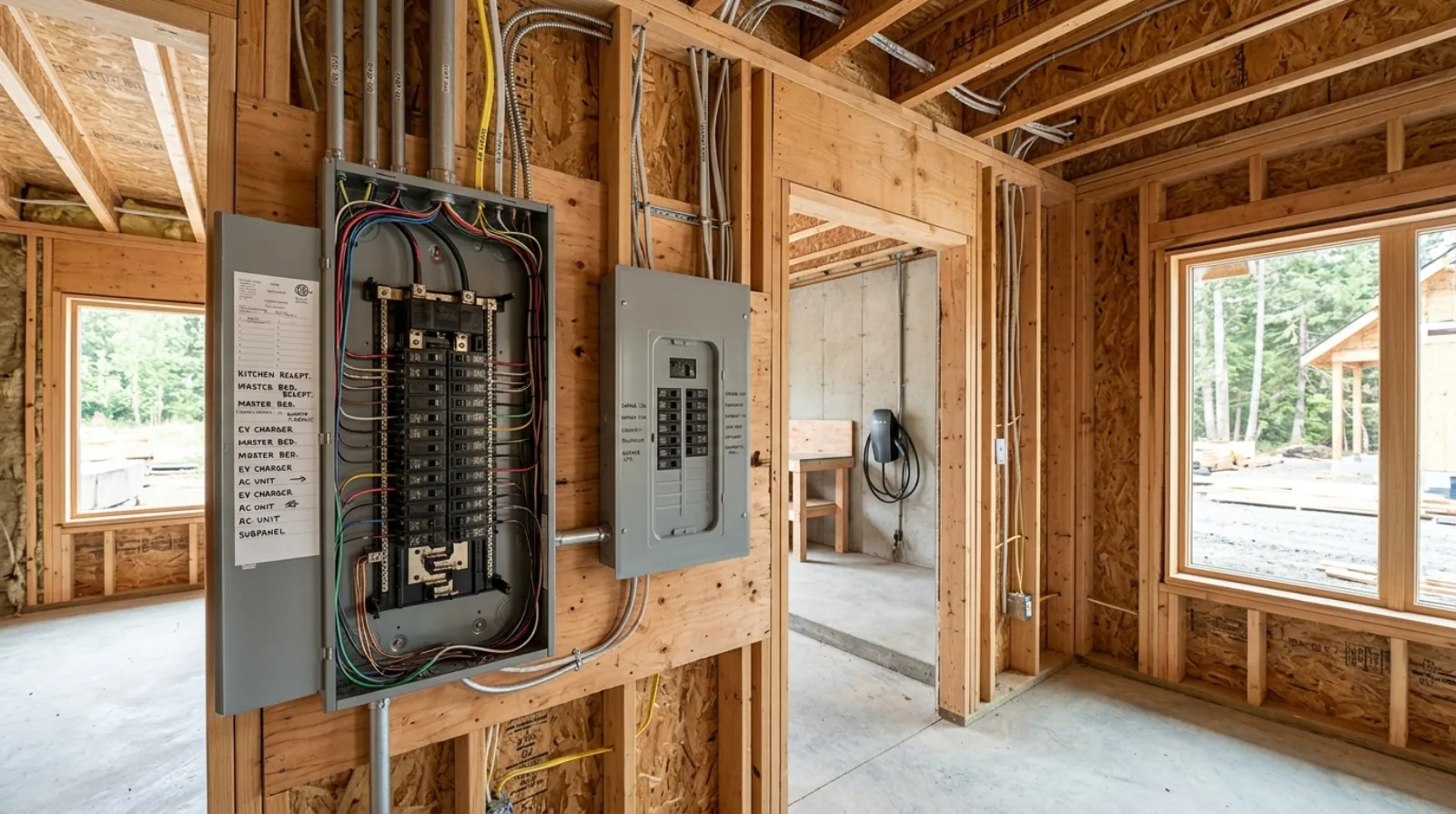
An all-electric Burnaby home runs a heat pump, a heat-pump water heater, induction cooking, and an EV charger off one service. Get the panel and the service sized at the design table, not after the drywall is closed.
The electrical drawings are usually the last thing a homeowner looks at and the first thing that bites them later. People will spend weeks on tile and an afternoon on the panel. Then two winters in, the heat pump, the EV charger, and the oven all want to run at once, and the house is tripping breakers or the homeowner is calling BC Hydro to ask what a service upgrade costs.
I've taken over jobs where the previous plan had a service sized for a house that doesn't exist anymore, a house that burned gas for heat, gas for hot water, gas for the stove, and never charged a car in the garage. That house is gone. The home a Burnaby family builds today runs almost everything off the electrical service, and the panel has to be planned for that on day one.
This is a design-stage decision. Not an afterthought you hand to the electrician once the framing is up. Get it on the table at the same meeting where you're talking about the kitchen layout, because the kitchen layout, the mechanical room, and the garage all feed into one number: how much electrical capacity the house needs.
The all-electric house is the default now, and it changes the math
Two things pushed Burnaby homes toward all-electric, and both are now baked into how we build.
First, the energy code. Burnaby requires new Part 9 homes to meet Step 3 of the BC Energy Step Code plus EL-4 of the Zero Carbon Step Code. EL-4 is the strongest emissions tier, in plain terms, it pushes new homes off fossil-fuel space heating and water heating. That means a heat pump for heating and cooling, and a heat-pump water heater for hot water. Both run on electricity. We dig into how those systems fit together in our companion post on heat pumps and HRV in a Burnaby build, and the broader envelope picture in our piece on Step Code in Burnaby.
Second, the cooking changed. Most clients building a custom home now want an induction range, not gas. Induction is a heavy, dedicated electrical load.
Add it up. A modern Burnaby home is carrying its heating, its cooling, its hot water, its cooking, and, as I'll get to, its car, all on the electrical service. Fifteen years ago, three of those five things burned gas. Today they're all electric, and they all land on the same panel. If you size the service the way you would have in 2010, you've under-built the house before the first wire goes in.
Burnaby has required EV-ready homes since 2018
This surprises people, so I'll be precise about it. The City of Burnaby requires that 100% of parking spaces in new residential buildings, including single-family, two-family, and multi-family dwellings, include Level 2 EV charging infrastructure, and that requirement has been in effect since September 1, 2018.
"EV-ready" doesn't mean the city makes you buy a charger. It means the home must have an energized outlet capable of supporting a Level 2 charger at the parking space. The wiring and the circuit have to be there. Whether you mount the actual charger on the wall day one or three years later is your call, the capacity has to be built in either way.
New Westminster has the same approach. Its zoning bylaw requires that new residential parking spaces provide a Level 2 (208 to 240 volt) energized outlet capable of providing charging, labelled for that purpose. So whether the lot is in Burnaby Heights, Brentwood, or across the river in New Westminster, an EV-ready parking stall isn't optional, it's a permit condition.
Here's why it matters for the panel. A Level 2 charger is a 240-volt load on its own dedicated circuit. It's one of the biggest single loads in the house, in the same weight class as the range or the heat pump. You can't treat it as an extra you'll figure out later. It belongs in the load calculation from the start.
Sizing the service: add up the future, not just today
The service is the main feed coming into the house from BC Hydro, and the number everyone fixates on is whether it's 200 amps. For decades, 200 amps was plenty for a large home. Heat from gas, hot water from gas, stove from gas: the electrical service mostly ran lights, plugs, and a dryer.
An all-electric house is a different animal. Heat pump, heat-pump water heater, induction range, and a Level 2 EV charger are four substantial loads that didn't exist on that old service. Whether 200 amps still covers it depends on the specific equipment, the size of the house, and how the loads are managed, and that's exactly the calculation a licensed electrical contractor runs to the rules in the BC Electrical Code. I'm not going to throw a percentage at you about how many all-electric homes need more than 200 amps, because the honest answer is: it depends on the house, and the load calc is what tells you.
What I will tell you is that this calculation has to happen at design, while the answer can still change the drawings cheaply. If the calc comes back saying the house needs a larger service, that's a conversation to have with BC Hydro before the foundation goes in, not a surprise after move-in, when upgrading the service means trenching, transformer questions, and a wait.
The cheapest amp is the one you planned for. The most expensive is the one you discover you need after the drywall is up.
The 2024 code gave you a way out of a service upgrade
Here's the part that's changed the game, and it's recent. As of March 4, 2025, BC adopted the 2024 Canadian Electrical Code (CSA C22.1-24) as the BC Electrical Code. One of the meaningful updates in that edition is new demand rules for electric vehicle supply equipment and electric vehicle energy management systems, which fall under the load-calculation rules for services and feeders.
What that means in practice: an energy management system can watch the total load on the house and throttle or pause the EV charger when the heat pump, the oven, and everything else are pulling hard. The car charges when there's headroom. Because the charger's load is managed instead of assumed to run flat-out alongside everything else, the load calculation can sometimes fit a fully-electric house onto a service that would otherwise have needed an upgrade.
This is why a smart panel, a panel with built-in load management, is a real alternative to upsizing the service on some Burnaby builds. It's not a gimmick. It's a code-recognized way to manage demand. The City of Burnaby's own EV requirements allow EV energy management systems and load-sharing to satisfy the EV-ready rule on shared parking, and the same logic helps a single-family service stay within its limits.
Whether a smart panel or a bigger service is the right move is a per-house decision. But you can only make it if the question gets asked at design. A smart panel changes where the wiring goes and what equipment sits in the electrical room, that's not a swap you make after the walls are closed.
Panel and sub-panel planning
Once the service size is settled, the next decision is how the panel and any sub-panels are laid out. A few things I plan for on every build:
- Dedicated circuits for the big loads. The heat pump, the heat-pump water heater, the induction range, and the EV charger each get their own dedicated circuit. None of them shares. A Level 2 charger in particular has to sit on its own 240-volt circuit, that's not negotiable, and it's part of why installing one requires an electrical installation permit from Technical Safety BC.
- A sub-panel near the loads. On a larger or multi-level Burnaby home, a Capitol Hill build on a slope, say, with the garage well below the main living level, running a sub-panel out to the garage area can be cheaper and cleaner than pulling every heavy circuit back to the main panel. Where the panel and sub-panel sit gets decided with the framing, because they need real estate on a wall and a clear path for the conduit.
- Spare capacity in the panel itself. Even when the service is sized right, I want open breaker spaces in the panel for what comes later, a second EV charger, a future battery, a workshop circuit. A panel that's full on day one is a whole-home renovation waiting to happen.
Run the conduit now, even if the car isn't here yet
This is the single cheapest piece of future-proofing on the whole electrical plan, and it's the one most often skipped.
If the EV charger isn't going in on day one, and on a lot of builds it isn't, I still want empty conduit run from the panel out to the garage wall or the driveway parking spot while the walls are open. Pulling a conduit through an open, framed wall is trivial. Doing it after the drywall, the insulation, and the finished garage are in means cutting, patching, and repainting, and it costs many times more for the same result.
Burnaby's bylaw already pushes you most of the way here, because the energized outlet has to be there regardless. But I go a step further on coordination: I make sure the conduit path, the panel location, and the parking spot all line up so the eventual charger install is a wall-mount and a connection, not a demolition project. The same thinking applies to a second stall, or to a driveway charger on a wide Government Road lot, leave the path before you close the walls.
Coordinate the electrical with the mechanical
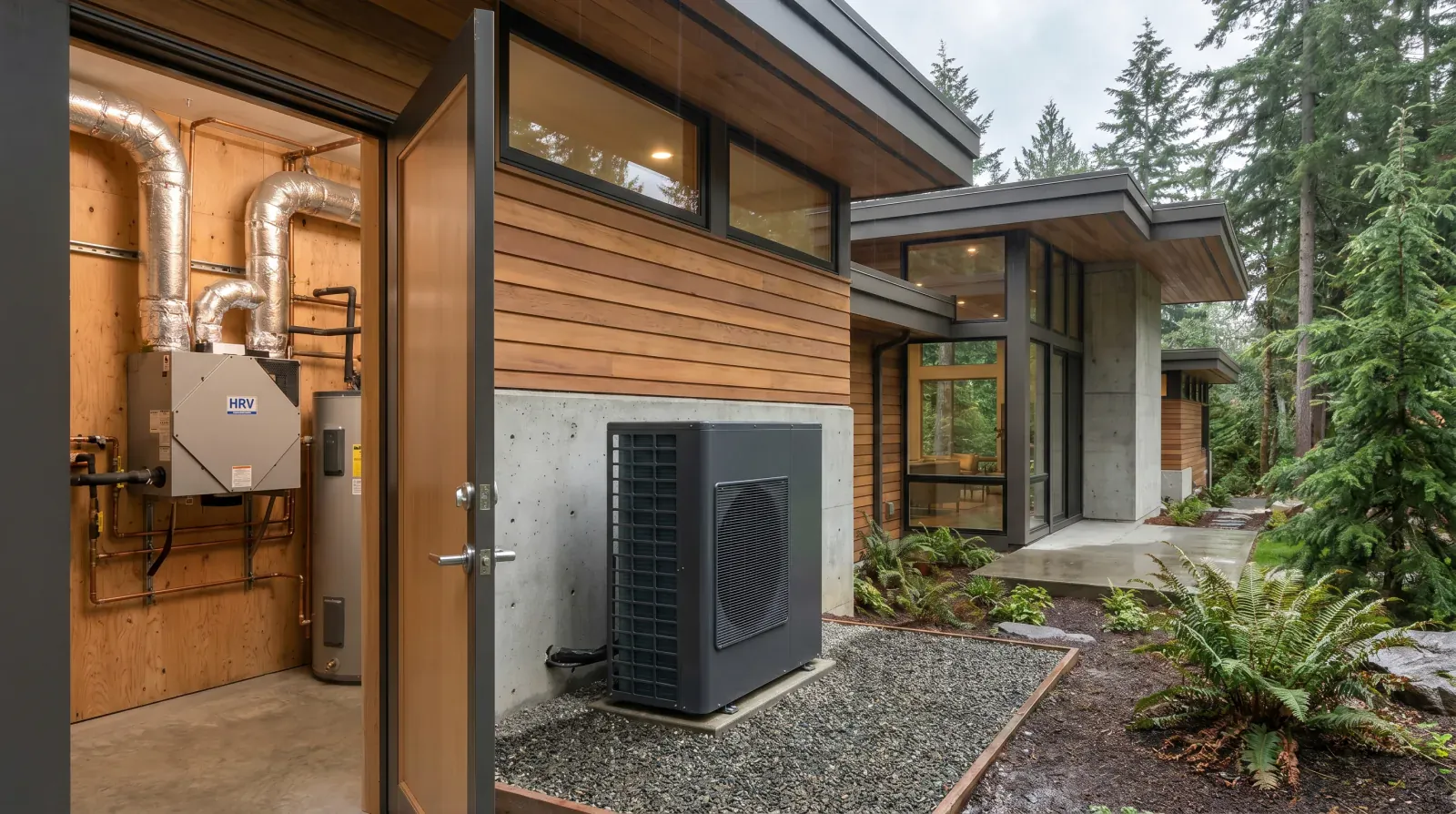
The electrical plan can't be drawn in isolation, because the heaviest electrical loads live in the mechanical room. The heat pump and the heat-pump water heater are mechanical equipment with electrical appetites, and the electrician and the mechanical contractor have to agree on the circuits, the disconnects, and the locations before either one roughs in.
I've walked into jobs where the heat pump was specced after the panel was laid out, and the dedicated circuit it needed wasn't there. That's a coordination failure, not a code failure, and it's avoidable. On our builds the mechanical equipment is selected and the electrical loads are pinned down in the same design coordination conversation, the one that also settles the HRV and ventilation, since a sealed, code-compliant Burnaby home needs that running continuously too.
Solar and battery: leave the door open even if you're not walking through it
Most clients aren't installing solar panels or a home battery on day one. A good number think about it later. The cost of keeping that option open at design is small; the cost of retrofitting it into a finished house is not.
Leaving the door open means a couple of concrete things. Run empty conduit from the electrical room to the attic or roof staging area, so a future solar install has a wire path that doesn't require opening finished walls. And plan the panel for a future backfeed, a battery or solar system pushes power into the panel, and the panel has to have room and the right configuration to accept it. None of this means buying the equipment now. It means not building a house that fights you when you decide to add it.
The through-line on all of this is the same: the electrical future of a Burnaby home is decided in the design meeting, with the panel schedule and the load calculation in front of you, not after the drywall is hung. Every one of these moves, the service size, the dedicated circuits, the conduit to the garage, the smart panel, the solar path, is cheap as a line on a drawing and expensive as a renovation.
If you're early in design on a Burnaby custom home and want the electrical thought through properly from the start, that's exactly the planning we build into our custom home process. Reach out and we'll walk through what your panel actually needs to carry.
Related on the Journal
- Heat pumps and HRV in a 2026 Burnaby build
- BC Step Code in Burnaby: Step 3 + EL-4 today, Step 5 by 2032
- Our custom home process
Frequently asked questions
- Does a new home in Burnaby have to be EV-ready?
- Yes. The City of Burnaby requires 100% of parking spaces in new residential buildings, including single-family, two-family, and multi-family homes, to include Level 2 EV charging infrastructure, in effect since September 1, 2018. The home must have an energized outlet capable of supporting a Level 2 charger at the parking space, even if you don't mount the charger on day one. New Westminster has a comparable requirement under its zoning bylaw.
- Is 200 amps enough for an all-electric custom home in Burnaby?
- It depends on the house. Whether 200 amps covers a heat pump, a heat-pump water heater, an induction range, and a Level 2 EV charger is settled by the load calculation a licensed electrical contractor runs to the BC Electrical Code, based on the specific equipment, the size of the home, and whether the loads are managed. There's no single yes-or-no answer, which is exactly why the calc belongs at the design stage, before the service size is locked.
- Can a smart panel let me avoid upsizing my electrical service?
- Sometimes. The 2024 Canadian Electrical Code, adopted as the BC Electrical Code on March 4, 2025, includes demand rules for electric vehicle energy management systems. A system that manages the EV charger's load, pausing or throttling it when other loads are heavy, can let the load calculation fit an all-electric house onto a service that would otherwise need upgrading. Whether that works for your house is a per-build decision made at design.
- Do I need a permit to install a Level 2 EV charger in BC?
- Yes. Installing a Level 2 (240-volt) EV charger is regulated electrical work that requires an electrical installation permit from Technical Safety BC, because it adds a new dedicated 240-volt circuit. In a fully detached home, a qualifying homeowner may be able to get a homeowner permit; in stratas, duplexes, and similar situations, a licensed electrical contractor must do the work. Always confirm current requirements with Technical Safety BC.
- Should I run wiring for an EV charger even if I'm not buying an electric car yet?
- In Burnaby and New Westminster you don't have a choice, the energized outlet is required at the parking space regardless. Beyond the minimum, it's worth running empty conduit from the panel to the garage or driveway while the walls are open. Pulling conduit through open framing is cheap; doing it after the drywall, insulation, and finished garage are in costs many times more for the same result.
- What's the current BC Electrical Code, and when did it change?
- As of March 4, 2025, BC adopted the 2024 Canadian Electrical Code (CSA C22.1-24, the 26th edition) as the BC Electrical Code. Among other updates, it added demand rules for EV supply equipment and EV energy management systems. Electrical work on permits issued after that date must comply with the 2024 edition.
- Why does a sub-panel near the garage make sense on a sloped Burnaby lot?
- On a larger or multi-level Burnaby home where the garage sits well below the main living level, a sub-panel placed near the garage can be cheaper and cleaner than pulling every heavy circuit back to the main panel. The panel and sub-panel locations get decided alongside the framing, because they need wall space and a clear conduit path, which is why the electrical layout has to be part of the design conversation, not an afterthought handed to the electrician later.
- Why should the electrical plan and the mechanical plan be coordinated together?
- Because the heaviest electrical loads in a Burnaby custom home, the heat pump and the heat-pump water heater, are mechanical equipment with electrical appetites. If the mechanical equipment is specced after the panel layout is finished, the dedicated circuit it needs may not be there. Settling the mechanical equipment and the electrical loads in the same design coordination conversation avoids that gap before either trade roughs in.