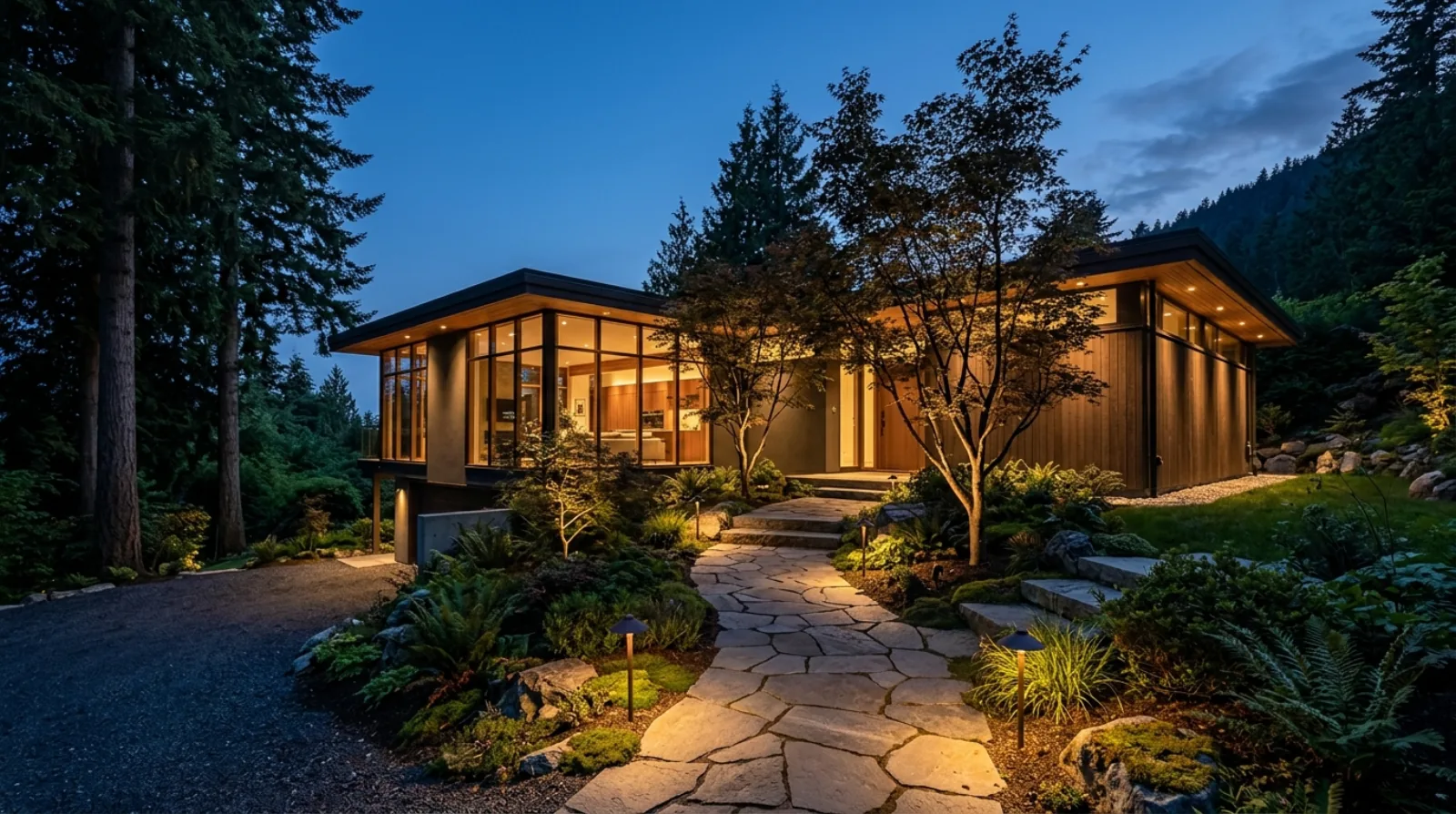
Good exterior lighting is planned with the electrician during rough-in, not bought at a hardware store after the landscaping is finished. Here's how we layer path lights, uplighting, and eave downlighting on a Burnaby custom home.
Exterior lighting is one of the last things a homeowner thinks about and one of the first things we need to plan for, because the wiring decisions happen months before anyone picks a fixture.
Why this has to be planned during rough-in
Low-voltage lighting to garden beds, specimen trees, and pathways needs a wiring run that goes in during electrical rough-in, before drywall closes the interior walls and before the driveway or a patio gets poured over any conduit. Once the hardscaping is finished, adding proper wiring usually means trenching through an established lawn or lifting sections of driveway or patio, both a bigger job and a bigger expense than running the conduit at the right stage. We bring the lighting layout into the same conversation as the electrical plan, deciding on transformer location, which beds get a wiring run, and which trees are worth lighting, while the rest of the rough-in is still being finalized.
The layers that make up a real lighting design
Good exterior lighting on a custom home comes from layering a few different techniques rather than relying on one type of fixture everywhere:
- Uplighting places a fixture at ground level aimed upward, used to highlight a tree trunk, a stone column, or a textured exterior wall, casting light and shadow up the surface for depth.
- Downlighting does the opposite, mounted higher (often at the eaves) and aimed down, washing the exterior wall or illuminating a walkway below without a visible fixture at ground level.
- Well lighting uses recessed, hardwired fixtures set flush into the ground, brightening garden areas or highlighting shrubs and trees while staying invisible during the day.
- Moon lighting mounts a fixture high in a mature tree's canopy, aimed down, to imitate the soft, dappled effect of real moonlight through branches, a technique that only works with trees large enough to carry a fixture well above head height.
We choose which layers to use based on what the yard actually has, mature trees are worth lighting differently than a newly planted garden bed, and a textured stone or wood exterior takes uplighting better than a flat stucco wall does.
Path lighting is a safety decision first
Illuminated walkways and steps matter beyond how they look at night. On a sloped Burnaby lot, where a retaining wall or terraced grade change often creates real level shifts across the yard, an unlit step is a genuine trip hazard after dark. We treat path and step lighting as a safety layer first, spacing fixtures to keep the whole walking surface visible rather than leaving gaps of shadow between decorative pools of light. The same wiring plan often runs along a privacy fence line, since fencing and lighting both get decided as part of the same perimeter design.
On a lot with multiple terraced levels, this often means more individual path and step fixtures spread across each level, compared to a flat lot where one continuous run of lighting can cover a longer stretch of walkway.
Controlling the system
Most low-voltage landscape lighting runs through a transformer that steps household voltage down to a safe level for outdoor fixtures, controlled by a timer or, increasingly, tied into the home's broader smart-home system where one exists. Deciding on the transformer's location and how the system will be controlled during rough-in means it ends up somewhere sensible, inside a garage or utility space, rather than becoming an exposed afterthought mounted wherever was convenient once the landscaping was already finished.
Bringing it together
The best exterior lighting reads as one composed layer of light made up of several techniques working together. That only happens when the lighting plan gets decided alongside the electrical rough-in and the landscape design, while there is still conduit going into the ground.
If you're planning a custom home and know you want real landscape lighting, raise it during design, not after the landscaping crew has already broken ground. It's one of the easiest details to get right early and one of the most disruptive to fix later, and it's part of the same outdoor living and landscape design process we run for every custom home.
Frequently asked questions
- When should exterior lighting be planned during a custom home build?
- Exterior lighting needs to be planned during electrical rough-in, before drywall closes the walls and before hardscaping like a driveway or patio is poured over any conduit runs. Low-voltage wiring to garden beds, specimen trees, and pathways is far cheaper to install as part of the original rough-in than to trench in after the landscaping is finished.
- What is the difference between uplighting and downlighting on a custom home exterior?
- Uplighting places a fixture at ground level aimed upward, commonly used to highlight a tree trunk, a column, or a textured exterior wall, casting light and shadow upward across the surface. Downlighting does the reverse, shining light downward from a higher point such as the eaves, which washes the exterior wall or illuminates a walkway below without a visible ground-level fixture.
- What is well lighting used for in a landscape design?
- Well lights are recessed, hardwired fixtures set into the ground, typically used to brighten yard and garden areas or as accent lighting highlighting shrubs, trees, and other landscape features. Because they sit flush with the grade, they stay out of view during the day and don't interrupt a lawn or planting bed's appearance when not lit.
- What is moon lighting in landscape design?
- Moon lighting places fixtures high in a mature tree's canopy, aimed downward, to imitate the soft, dappled effect of natural moonlight filtering through branches onto the ground below. It's most effective on properties with established trees large enough to mount a fixture well above head height, and it reads as more natural than a direct ground-level floodlight.
- Why does path lighting matter beyond looks?
- Path and step lighting has a genuine safety function, illuminating walkways and steps so they're visible after dark, which matters most on a sloped Burnaby lot where an unlit step or grade change is a real trip hazard. We treat path lighting as a safety layer first and a design layer second, though a well-planned path light does both at once.
- Can landscape lighting be added after a home is already built?
- Yes, but it's more limited and more disruptive than planning it during construction. Adding wiring after landscaping and hardscaping are finished usually means trenching through an established lawn or lifting sections of a driveway or patio to run new conduit, which is why we recommend deciding on the lighting layout during the same design phase as the electrical rough-in.
- What controls low-voltage landscape lighting on a custom home?
- Most systems run through a transformer that steps household voltage down to a safe low voltage for outdoor fixtures, typically controlled by a timer or a smart control tied into the home's broader automation system where one exists. Deciding on the transformer location and control method during rough-in avoids an exposed unit becoming an afterthought mounted wherever is convenient later.
- How does landscape lighting design differ between a flat lot and a sloped Burnaby lot?
- On a sloped lot, lighting has to account for grade changes, retaining walls, and terraced levels, which usually means more path and step lighting spread across multiple levels rather than one continuous walkway. A flat lot allows more flexibility for uplighting specimen trees or washing a longer stretch of exterior wall, since there are fewer level changes competing for the lighting plan's attention.