Your dog and your floors do not have to be at war. Here is how we design a custom home that welcomes pets: durable flooring, a mudroom dog-wash, scratch-resistant surfaces, feeding nooks, and a safe yard.
A couple came to us with two big dogs and a simple worry. They loved the idea of a beautiful custom home, but every nice house they had lived in seemed to lose the fight with the animals. Scratched floors. A muddy entry after every walk. Feeding bowls that never had a good home and always ended up underfoot.
The good news is that a pet-friendly home does not have to look like one. You do not need rubber floors and baby gates on every doorway. You need the right materials in the spots that take the abuse, a proper place to deal with a wet, muddy dog, and a few built-ins that fold the daily routine into the design instead of fighting it.
This is how we approach designing a home around the animals who actually live in it. It connects to a few things we have written already: flooring for a Burnaby custom home, the mudroom and entry, and landscaping and site drainage. Pets touch all of them.
Durable flooring in the paths that take the traffic
Flooring is where most pet wear shows up, and it is the decision worth getting right first. The goal is hard, scratch-resistant, and easy to clean in the places dogs and cats actually live: the entry, the hallways, the kitchen, the family room.
Tile is close to indestructible and shrugs off claws, water, and mud, which makes it a natural choice for the entry and mudroom. Many engineered and luxury vinyl products handle an active dog well too, and they warm up a room more than tile does underfoot. A textured or matte finish is your friend, because it hides the small scratches that a high-gloss surface would show. Softer solid woods and delicate finishes look beautiful and wear faster under a big dog's nails, so they belong in the quieter rooms rather than the main runways.
The point is not one perfect floor for the whole house. It is matching the floor to how the space is used. Put the toughest surface where the paws are, and you can still have something softer and warmer in the bedrooms. We go deeper on the material trade-offs in our flooring post.
The mudroom dog-wash: end the mess at the door
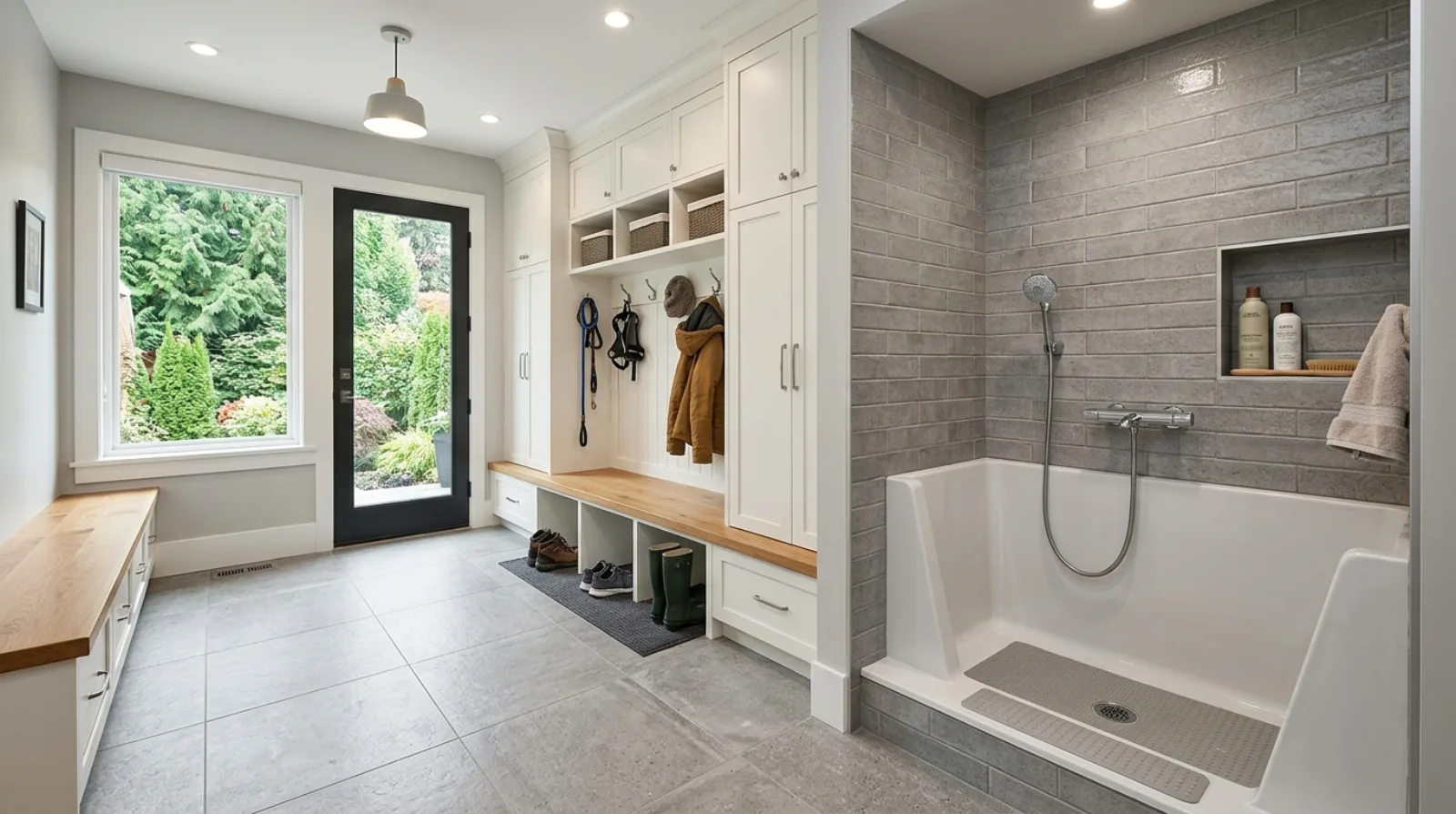
For a dog owner in a rainy climate, the single most useful pet feature is a dog-wash station in the mudroom. On the Lower Mainland, a walk means a wet, muddy dog, and the mudroom is where that walk should end, not the hallway and definitely not the family bathtub.
A dog-wash is a raised, tiled shower stall near the entry, with a handheld sprayer, a drain, and enough room for your dog to stand. Raising it saves your back from lifting a wet animal. Tiling and waterproofing it properly means it takes the abuse without leaking. Because it needs plumbing, drainage, and waterproofing, it has to be planned during design and roughed in with everything else, not bolted on later. This is exactly the feature that is easy during the mudroom and entry design and nearly impossible to add once the walls are closed.
Around the wash, the rest of the mudroom earns its keep too: a durable floor that drains, hooks and a bench, storage for leashes and towels and food, and a spot for muddy boots and paws to dry. A good mudroom is the airlock between the outside world and your clean house, and for a pet household that job is real.
Surfaces that shrug off claws and clean easily
Beyond the floor, a few surfaces take the most contact from pets, and choosing them with animals in mind saves years of frustration.
Scratch-resistant hard surfaces where paws land. Quartz and many engineered stone countertops resist scratching and clean easily, which matters if a cat treats the counter as a walkway. Durable, wipeable wall finishes near the pet zones handle the inevitable brush of a muddy tail.
Easy-clean materials where the mess actually happens. Around feeding areas and the mudroom, choose surfaces that wipe down fast: tile backsplashes, sealed stone, wipeable paint. The less a spill or a muddy paw print becomes a project, the happier you are with the house.
Fabrics and finishes that forgive. This is more a furnishing choice than a build one, but the design supports it: performance fabrics, materials that do not show hair, and colours that live with a bit of fur. The house should be built so that living with an animal is normal, not a constant cleanup.
Built-in feeding nooks and pet spaces
A little planning makes the daily pet routine disappear into the design. Feeding bowls in the middle of a kitchen floor are a tripping hazard and an eyesore. Built into a low cabinet niche or a toe-kick drawer, they are out of the traffic path and easy to clean around.
A few built-ins that owners tend to love: a recessed feeding nook at the end of an island or in a pantry base, with a nearby spot for the food bin; a built-in crate or a quiet den space under a stair or in a cabinet run, so the animal has a place of its own that is not a plastic box in the corner; and a small storage zone for the leashes, medications, toys, and grooming gear that otherwise scatter. None of these cost much to plan when the millwork is being drawn. All of them are hard to add once the cabinets are built. We think about this alongside the interior doors, trim, and millwork, because the pet built-ins are just millwork with a purpose.
The yard, the fence, and the drainage
Outside, a pet-friendly home is about safety and durability. Start with the fence. A secure fence line with no gaps a dog can push through or dig under, and a gate that latches reliably every time, is the foundation of a safe yard. Match the fence height and strength to your animal.
Then think about the surface. The patch of yard a dog uses most gets heavy paw traffic, and grass wears out fast under it. A durable surface, a hardy ground cover, gravel, or a designated run, keeps that zone from turning into a mud pit every winter. Which brings up drainage, the quiet hero of any Lower Mainland yard. If the site does not drain, the yard becomes mud, the mud comes inside on the dog, and the whole pet-friendly plan falls apart at the back door. We plan the yard's grading and drainage so water sheds away from the house and the yard stays usable, which we cover in landscaping and site drainage. It is also worth keeping plants that are toxic to pets out of the areas the animals can reach.
The best pet-friendly home does not look like one. It just quietly survives the animals, because the tough materials went where the paws are and the muddy dog has somewhere to go.
Icon Projects Team
Frequently asked questions
- What is the best flooring for a home with dogs?
- The best pet flooring is hard, scratch-resistant, and easy to clean. Tile and many engineered and luxury vinyl products handle claws, moisture, and daily traffic well, and a textured or matte finish hides small scratches better than a high-gloss one. Softer solid woods and delicate finishes show wear faster under an active dog. At Icon Projects we help owners match the flooring to how their pets actually live, room by room, so the busy paths get the toughest surface and the quiet rooms can be softer.
- Is a mudroom dog-wash station worth including in a custom home?
- For most dog owners in a rainy climate, yes. A dog-wash station is a raised, tiled shower stall near the entry with a handheld sprayer and a drain, sized for your dog. It ends the muddy walk at the door instead of on the hallway or in the family bathtub, and it saves your back from lifting a wet dog. At Icon Projects we build these into the mudroom during rough-in, since the plumbing and waterproofing have to be planned early, not added later.
- How do I design a safe yard for a dog?
- Start with a secure fence with no gaps a dog can push through or dig under, and a gate that latches reliably. Plan a durable surface for the area the dog uses most, since heavy paw traffic wears out grass. Keep the site drainage working so the yard does not turn to mud, and avoid plants that are toxic to pets. At Icon Projects we coordinate the fencing, drainage, and landscaping together so the yard is safe for the animals and still sheds water away from the house.
- What countertop material works best in a home with cats?
- Quartz and many engineered stone countertops resist scratching and clean easily, which matters if a cat treats the counter as a walkway. At Icon Projects we choose scratch-resistant hard surfaces for the areas pets can reach, paired with durable, wipeable wall finishes near feeding and pet zones, so a brush from a muddy tail or a curious paw does not become a lasting mark on the kitchen.
- Where should pet feeding bowls go in a custom home?
- Not in the middle of the kitchen floor, where they become a tripping hazard and an eyesore. At Icon Projects we build a recessed feeding nook into a low cabinet niche or a toe-kick drawer at the end of an island or in a pantry base, with a nearby spot for the food bin. Planning it into the millwork drawings costs little; adding it after the cabinets are built is difficult, so we settle the location early.
- Can a custom home have a built-in space for a dog crate?
- Yes. At Icon Projects we build a quiet den space under a stair or within a cabinet run so the animal has a place of its own instead of a plastic crate sitting in a corner. Like the feeding nook, this works best when it is planned alongside the interior doors, trim, and millwork rather than added as an afterthought once the cabinetry is finished.
- Do glossy floor finishes hide scratches from dog claws better than matte ones?
- No, the opposite. A textured or matte finish hides small claw scratches better than a high-gloss surface, which shows every mark clearly. At Icon Projects we steer pet owners toward matte or textured tile, engineered wood, or luxury vinyl in the high-traffic paths, while reserving glossier, more delicate finishes for quieter rooms the animals use less.
- Why does a mudroom matter so much in a pet-friendly Burnaby home?
- Because on the Lower Mainland a daily dog walk almost always means a wet, muddy animal coming back through the door, and the mudroom is where that mess should end rather than spreading into the hallway or the family bathtub. At Icon Projects we build a dog-wash station, durable draining flooring, and storage for leashes and towels into the mudroom during rough-in, since the plumbing and waterproofing it needs have to be planned early, not added later.