Planning
Landscaping and Site Drainage on a Burnaby Lot: Grading, Retaining Walls, and Where Water Goes
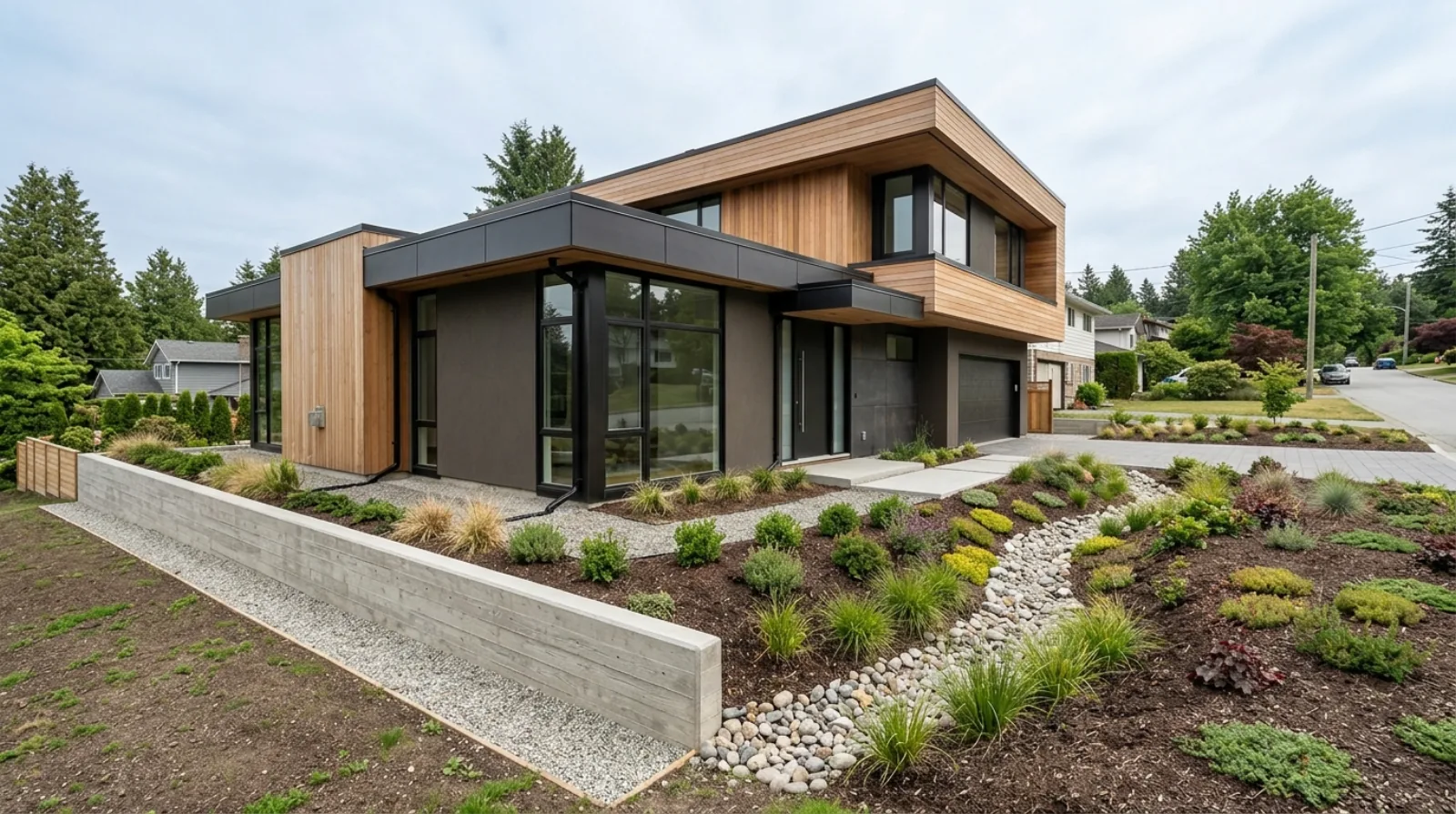
The most expensive callbacks a builder sees aren't inside the house, they're in how water moves around it. On Burnaby's wet, sloped lots, final grade and drainage decide whether the basement stays dry. A builder's guide to getting the finished site right.
The most expensive callback a builder ever gets isn't inside the house. It's water, and water is almost never a framing problem or a flashing problem. It's a site problem. The ground around the foundation was graded a touch the wrong way, or a downspout dumped against the wall, or a retaining wall held back soil with nowhere for the water to go. Two winters later the owner calls about a damp basement, and the house itself is built fine.
I've watched this play out enough times that I now treat the finished site as part of the building, not as decoration. On a Burnaby lot, especially the sloped ones, the final grade and the drainage decide whether the basement stays dry. This is the layer that comes after the structural work everyone talks about. We've already written about foundations on Burnaby hillside lots and what a geotechnical report on a slope lot actually tells you. This post picks up where those leave off: the finished site, where the dirt meets the house and the rain has to go somewhere.
Why Burnaby's lots make this harder
Two things about Burnaby make drainage the thing I lose sleep over.
The first is rain. The west coast gets a lot of it, and it doesn't arrive in dramatic bursts so much as long, soaking weeks. Soil stays saturated for months. Water that would evaporate in a drier climate just sits in the ground, looking for the lowest point and the path of least resistance.
The second is slope. A flat lot in a dry climate is forgiving. A sloped Burnaby lot is the opposite, it collects water from everything uphill of it and channels that water straight at your foundation unless something stops it. Look at the streets that fall away toward the water or the lake: Capitol Hill, Burnaby Heights, Buckingham Heights, Forest Glen, the neighbourhoods around Deer Lake. On lots like these you aren't just managing your own roof water. You're managing the runoff from the properties above you, which arrives below grade as soil moisture and surface flow whether you planned for it or not.
So the finished-site work on a Burnaby slope isn't a landscaping afterthought. It's the part of the build that keeps the house dry, and it's the part most likely to generate a callback if it's rushed.
Positive grade: the cheapest insurance you'll ever buy
The single most important thing you can do for a foundation costs almost nothing: slope the ground away from it.
This is called positive grade, the finished soil and hardscape around the house pitch downward as they move away from the foundation wall, so surface water runs off rather than pooling against the building. It's the first line of defence, and it's free. It's also the thing that gets quietly undone at the end of a project when a landscaper backfills a planting bed, or builds up a patio, or a homeowner brings in topsoil for a lawn and accidentally creates a little dam that tips water back toward the house.
The BC Building Code treats drainage as a Part 9 requirement for houses and small buildings, Section 9.14 covers foundation drainage and dampproofing below grade, and the broader requirement to direct surface water away from the building is part of the same framework. You can see how the province organizes the code on the official BC Codes page. The principle the code is protecting is simple: don't let water collect against the foundation. Everything else in this post is in service of that one idea.
Here's the field-note version of how we hold the line on grade. We set the finished floor and the surrounding grade early, on paper, before anyone pours. We protect that relationship through the whole build. And we check it again at the end, after the landscaper has been through, because that's exactly when a perfectly graded site gets re-contoured into a bathtub. The ground should fall away from the house in every direction it can, and where it can't, uphill on a slope, that's where the rest of the drainage system has to do the work.
How far should the ground slope away?
Far enough that water clearly moves away from the wall and keeps moving for a stretch before the grade flattens out. The code intent is a noticeable downward pitch for the first stretch out from the foundation, then a continued fall so the water doesn't just pool a few feet away and soak back in. I won't quote a number here, because the right slope depends on the soil, the surface, and what's downhill, and the figure that matters is the one your designer and the City sign off on for your specific lot. The principle to hold onto: a flat finished grade against a foundation is a defect, not a neutral choice.
Surface drainage vs. foundation drainage, two different systems
People use "drainage" as one word, but on a real site it's two systems doing two jobs. Confusing them is how basements get wet.
Surface drainage is everything above ground: the grade itself, swales, area drains, and catch basins that move rainfall and runoff across the lot and away from the house before it ever soaks in. A swale is just a shallow, shaped channel in the landscape, often planted so it doesn't read as a ditch, that collects surface water and guides it where you want it to go. On a sloped lot a well-placed swale uphill of the house intercepts the runoff coming down at you and routes it around the building. That's surface drainage doing its job: keeping water moving on top of the ground.
Foundation drainage is below ground, at the footing. This is the perimeter drain, what the trades still call weeping tile or drain tile, a perforated pipe run in a bed of clean drain rock around the outside of the footings. Its job is to collect the groundwater that does make it down alongside the foundation and carry it away before it builds up against the wall. This is the system Section 9.14 of the code is most concerned with, and on a Burnaby slope it's not optional. The geotech report on a hillside lot usually has specific things to say about how this perimeter drainage gets designed.
The two systems work together. Surface drainage keeps as much water as possible from ever reaching the foundation. Foundation drainage handles what gets through. If you only build one of them, you've left half the job undone.
Where does the foundation drainage water actually go?
This is the question that matters and the one that's easiest to wave away. The perimeter drain has to discharge somewhere. There are really only a few honest answers:
- It drains to a storm connection, tied into the municipal storm system where the City permits that connection. This is common for many Burnaby lots and is part of the site servicing you sort out with the City's engineering side during the permit process.
- It drains to a sump, a pit, often with a pump, that collects the water and lifts it to where it can be discharged. On a low spot or a lot where gravity won't carry the water out, a sump is how you get it moving.
- It daylights, the pipe exits at a lower point on a sloped lot and lets the water out onto the surface, downhill of the house, where it can't come back.
What it absolutely cannot do is end nowhere, or quietly loop back toward the building. The City of Burnaby treats site servicing and drainage as part of the building permit for a new home, its new home construction requirements call for engineering pre-application review, a topographical survey, and drainage details before a building application is complete. Burnaby also publishes a Foundation and Surface Drainage Installation Guide as part of its building information resources. In plain terms: the City wants to see where your water goes before they let you start, and that's a good instinct.
Roof water is its own problem
Your roof is the biggest single catchment on the site, and all of that water arrives concentrated at a handful of downspouts. Mishandle it and you've created a fire hose aimed at the foundation.
The cheap, lazy version is a splash block, a little ramp at the base of the downspout that throws the water a couple of feet from the wall. On a flat, dry lot that might be fine. On a Burnaby slope in November it isn't, because a few feet isn't far enough and the saturated ground just carries that water right back to the footing.
The version I want to see ties the downspouts into the ground and carries the roof water away through a dedicated pipe, to the storm connection, to the same engineered discharge point as the rest of the site drainage, or to a controlled outlet well clear of the house. Roof water should be treated as the large, predictable volume it is and given its own path off the lot. When we set the drainage plan, the downspout connections are part of it from the start, not something the gutter installer figures out on the last day.
Rainwater and stormwater: keeping it on site where you can
There's a newer layer to all of this, and it's about not just shedding water but managing where it ends up. Cities across the region, Burnaby included, care about how much stormwater a property dumps into the system and how much sediment-laden runoff leaves a construction site and ends up in creeks and lakes.
Burnaby's green building and land development policies are explicit that the City works to prevent silt-laden runoff from construction sites entering the downstream drainage system. On the finished-site side, that points toward designs that let some rainfall soak into the ground on your own lot, through permeable surfaces and planted areas, rather than racing every drop to the storm sewer. Where the soil and the geotech allow on-site infiltration, it's a genuinely better outcome: less load on the City system, and water returned to the ground the way it would be on an undeveloped lot.
The caveat is the soil. On a slope, you do not infiltrate water without understanding what that water does to slope stability, and that's a question for the geotechnical engineer, not a landscape decision made in isolation. Infiltration where it's appropriate is good practice. Infiltration on the wrong slope is how you destabilize the ground your house sits on. The two posts on hillside foundations and the geotech report exist precisely because these decisions are connected.
Permeable vs. impermeable surfaces
Every hard surface you add, driveway, patio, walkway, is a surface that sheds water instead of absorbing it. The more of the lot you pave with impermeable material, the more runoff you generate and the more work your drainage system has to do. Permeable surfaces (permeable pavers, gravel, certain unit-paving systems with open joints) let rainfall pass through into the ground beneath, which reduces runoff and eases the load on the storm system.
I'm not religious about it, you need a solid driveway and a usable patio. But on a tight lot, being thoughtful about how much you pave, and choosing permeable surfaces where they make sense, is part of a drainage plan that holds up. It's also increasingly what the City wants to see.
Retaining walls: when an engineer has to be involved
Slope means retaining walls. To build a level yard, a usable driveway, or a flat building pad on sloped ground, you hold back earth, and the structure that holds it back is a retaining wall. These are not landscape features. They are structures carrying real loads, and Burnaby regulates them accordingly.
In the City of Burnaby, a building permit is required for any retaining wall greater than 1.2 m (3.94 ft) in height, and for terraced walls, a permit is required if the group includes two or more walls and any one of them is over that height, or if walls are terraced steeper than a 1-in-1 ratio. That threshold and those rules come straight from the City's own Fences and Retaining Walls guidance, available through Burnaby's building information resources. And because retaining walls are structural, they hold back the weight of soil and water, the City requires that the design be done by a registered professional engineer, with signed and sealed structural drawings and the engineer's Letter of Assurance (Schedule B) submitted with the permit application. The professional engineers who do this work are registered with Engineers and Geoscientists BC.
A few things I'd add from the field that the permit threshold doesn't capture:
- Drainage behind the wall is half the design. A retaining wall with no way to relieve the water building up behind it is a wall that's slowly being pushed over by water pressure. Proper walls have drain rock and a drain behind them, and in Burnaby, a plumbing permit is required for the drain tile associated with a retaining wall. The wall you see is only the visible half; the drainage behind it is what keeps it standing.
- Surcharge changes everything. A wall holding back a quiet planting bed is one thing. A wall that also has a driveway, a parked car, or another structure bearing down on the soil above it carries a "surcharge," an extra load, and that load is exactly the thing that makes engineered design non-negotiable.
- Frost and saturation matter. Wet, saturated soil weighs more and pushes harder than dry soil. The design has to account for the worst case, which on a soaked Burnaby slope is a meaningful condition, not a footnote.
The honest summary: on a sloped Burnaby lot, treat retaining walls as engineered structures from day one. Trying to keep a wall just under the permit height to dodge the engineering is the false economy that comes back as a leaning wall and a much bigger bill.
Protecting the build while it's open
There's a window during construction when the lot is most vulnerable: when the soil is exposed and disturbed and the structural drainage isn't yet finished. On a slope, a hard rain on bare, open ground moves a lot of dirt, and that dirt ends up in the storm system, in the neighbour's yard, and in the creek downhill.
Burnaby takes this seriously. The City runs an erosion and sediment control program specifically to keep silt-laden runoff from construction sites out of the drainage system and out of creeks and lakes, that's the stated purpose on its green building and land development page, and the City's engineering department determines whether a given site needs a formal erosion and sediment control permit. For single and two-family construction, the expectation is that the site follows best management practices, perimeter controls, stabilizing exposed soil, keeping sediment on site and out of the storm drains, even where a separate permit isn't triggered.
This is one of those things that separates a builder who's thinking about the whole site from one who's only thinking about the house. Sediment control on a slope is a daily discipline during the wet months, not a one-time setup.
Planting: keep it away from the foundation
Landscaping is where the finished site finally looks like a home, and it's also where good drainage gets undone if no one's paying attention.
The rules of thumb I hold to are unglamorous. Keep planting beds and built-up soil from burying the foundation or reversing the grade against it, a bed that piles soil against the wall is a bed that holds water against the wall. Keep large, thirsty, aggressive-rooted trees a sensible distance from the foundation and from the perimeter drain, because roots find drain pipes and roots move soil. And lean toward planting that suits the west coast and the lot's drainage rather than fighting it, restrained, drought-tolerant planting in the dry months and species that tolerate wet feet in the swales and low spots. Plants that match the water regime survive and do their job. Plants fighting it need constant intervention and often lose.
The point of the planting plan isn't only how it looks. It's that the landscape works with the drainage instead of against it.
The trees you can't touch shape the whole plan
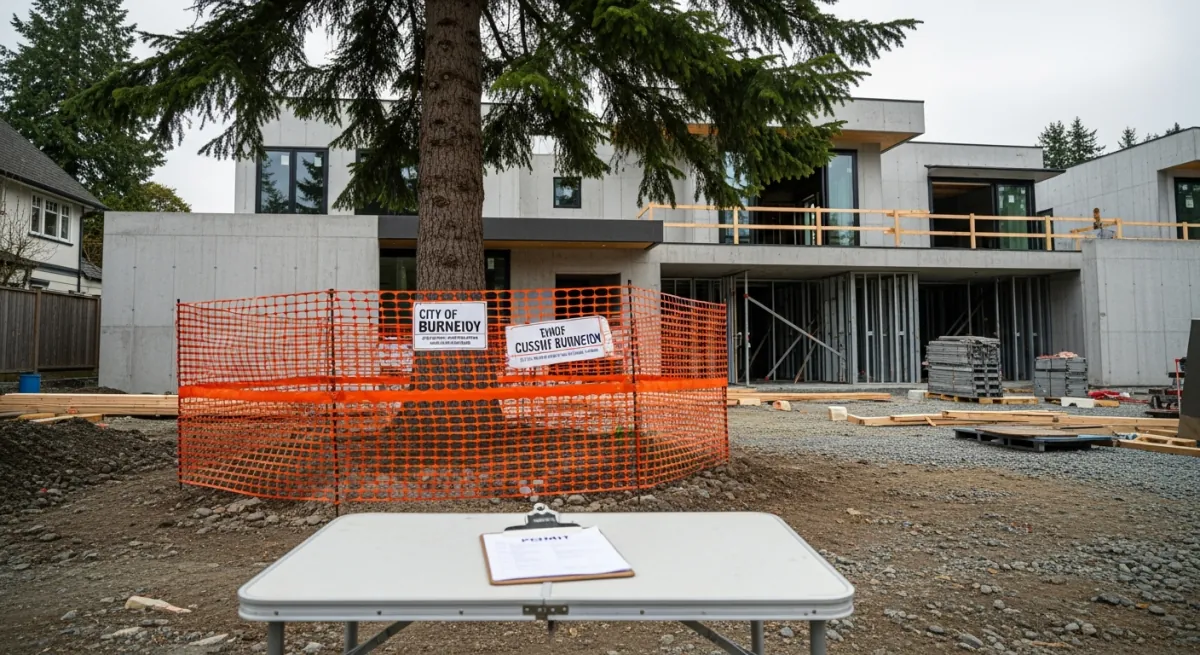
Here's the constraint that surprises owners most: the protected trees on your lot quietly dictate where you can move dirt.
The City of Burnaby's tree rules require that driveways, paving, construction activity, and utility connections stay outside designated tree protection areas, and that trees marked for retention be shown on your site plan, see the City's tree removal and replacement page. The reason this collides with drainage is the root zone. A protected tree's roots extend well beyond its trunk, and the soil within that protection area can't be re-graded, compacted, trenched, or buried without harming or killing the tree, which is exactly the earthwork that final grading, swales, and drain runs involve.
So a protected tree in the wrong corner of the lot can rule out the swale you wanted there, or force the drainage to route around it, or change where a retaining wall can go. This is why we map the protected trees and their root zones before we finalize the grading and drainage plan, not after. We dug into this in detail in Burnaby's tree bylaw and your custom home, if your lot has mature trees, read it alongside this one, because the tree plan and the drainage plan are the same conversation.
Where this fits in the build
Drainage and grading get treated as the last thing, the stuff you sort out when the house is nearly done. That's backwards. The finished-site plan, grade, surface drainage, perimeter drainage and where it discharges, retaining walls, roof water, sediment control, and the tree constraints that shape all of it, belongs in the design, alongside the foundation it protects. Getting it onto paper early is part of what our planning work is for. Done right, it's invisible: the basement stays dry and nobody thinks about it. Done wrong, it's the callback that arrives two winters later, on a house that was otherwise built perfectly.
If you're planning a custom home on a sloped lot anywhere in Burnaby, Vancouver, North Vancouver, Coquitlam, or New Westminster, treat the finished site as flood protection for your most expensive room. Because that's what it is.
Frequently asked questions
- How far should the ground slope away from a foundation?
- Far enough that surface water clearly moves away from the wall and keeps moving before the grade flattens out, a noticeable downward pitch for the first stretch out from the foundation, then a continued fall. The exact slope depends on the soil, the surface, and what's downhill of the house, and it's confirmed by the designer and the City for the specific lot. The principle that matters: a flat finished grade against a foundation is a defect, not a neutral choice. The BC Building Code treats directing surface water away from the building as a Part 9 requirement, with Section 9.14 covering foundation drainage.
- Does a retaining wall need a permit in Burnaby?
- Yes, above a height threshold. In the City of Burnaby a building permit is required for any retaining wall greater than 1.2 metres (3.94 feet) in height, and for terraced walls where the group includes two or more walls and any one is over that height, or where walls are terraced steeper than a 1-in-1 ratio. Because retaining walls are structural, the City requires the design to be done by a registered professional engineer, with signed and sealed drawings and the engineer's Letter of Assurance. A plumbing permit is also required for the drain tile behind the wall.
- What's the difference between surface drainage and foundation drainage?
- Surface drainage is everything above ground, the finished grade, swales, and area drains that move rainfall and runoff across the lot and away from the house before it soaks in. Foundation drainage is below ground: the perimeter drain, also called weeping tile, sits in clean drain rock around the footings and collects the groundwater that does reach the foundation, carrying it away before it builds up against the wall. They're two systems doing two jobs, and a dry basement needs both.
- Where does foundation drainage water go?
- It has to discharge somewhere deliberate. The common options are a storm connection tied into the municipal system where the City permits it, a sump, a collection pit often with a pump, that lifts the water to a discharge point, or daylighting on a sloped lot, where the pipe exits lower than the house and lets water out downhill where it can't return. What it can't do is end nowhere or loop back toward the building. In Burnaby, site servicing and drainage are reviewed as part of the new-home building permit.
- Do I need to manage stormwater on my own lot?
- Increasingly, yes. Burnaby's green building and land development policies aim to keep silt-laden runoff out of the drainage system and creeks, and good current practice favours letting some rainfall soak into the ground on the lot itself, through permeable surfaces and planted areas, rather than sending every drop to the storm sewer. On a slope, on-site infiltration must be cleared with the geotechnical engineer, because water in the wrong place can affect slope stability.
- Why does erosion and sediment control matter during construction?
- Because an open, disturbed lot on a slope sheds a lot of soil in a hard rain, and that sediment ends up in the storm system, the neighbour's yard, and downstream creeks. The City of Burnaby runs an erosion and sediment control program specifically to prevent this, and its engineering department determines whether a site needs a formal permit. Single and two-family sites are expected to follow best management practices, perimeter controls, stabilizing exposed soil, keeping sediment out of storm drains, through the wet months.
- How do protected trees affect grading and drainage?
- A protected tree's roots extend well beyond its trunk, and the City of Burnaby requires that driveways, paving, construction activity, and utilities stay outside designated tree protection areas. Re-grading, trenching, compacting, or burying soil inside that zone can kill the tree, and that earthwork is exactly what final grading, swales, and drain runs involve. A protected tree can rule out a swale location or force the drainage to route around it, which is why mapping protected trees and their root zones happens before finalizing the grading plan, not after.
- Should downspouts just use splash blocks?
- On a wet Burnaby slope, no. A splash block throws roof water only a couple of feet from the wall, and saturated ground carries it right back to the footing. The roof is the biggest single catchment on the site and its water arrives concentrated at a few downspouts, so it should be tied into the ground and piped to the same engineered discharge point as the rest of the site drainage, well clear of the house.