Burnaby families own bikes, e-bikes, skis, paddleboards, camping gear and wet rain jackets, and most houses give them a corner of the garage at best. Planned at design, gear storage can have its own wall, its own power for e-bike charging, a place for wet things to dry, and a door to the lane. Here is how we plan it.
We ask every family the same question early in design: what do you own that lives outside the house but needs to stay dry?
In Burnaby the answer is often a long list. Road bikes, mountain bikes, a cargo e-bike for school runs, scooters, skis and snowboards, a paddleboard, camping gear, and a pile of rain jackets that stay damp. The Central Valley Greenway runs through the city, Burnaby Mountain has trails, and the North Shore mountains sit across the inlet. Gear is part of daily life here.
Most houses give all of it a corner of the garage, stacked around the car. Planned at design, the same gear can have its own wall, its own power, a place to dry, and a short path to the street. This post covers how we plan it.
Start with an inventory
Before we draw any storage, we list what the family owns and how often each item is used:
- Daily: commuter bikes, e-bikes, scooters, strollers, rain gear.
- Weekly: mountain bikes, sports equipment, a dog's gear.
- Seasonal: skis, snowboards, paddleboards, camping gear, holiday decorations.
- Rarely: bike boxes, roof boxes, spare tires.
Daily items get the easiest spots: close to the door, at hand height, with no lifting. Seasonal items can go higher, on the ceiling or in a storage room. That simple sort shapes the whole layout.
The gear wall
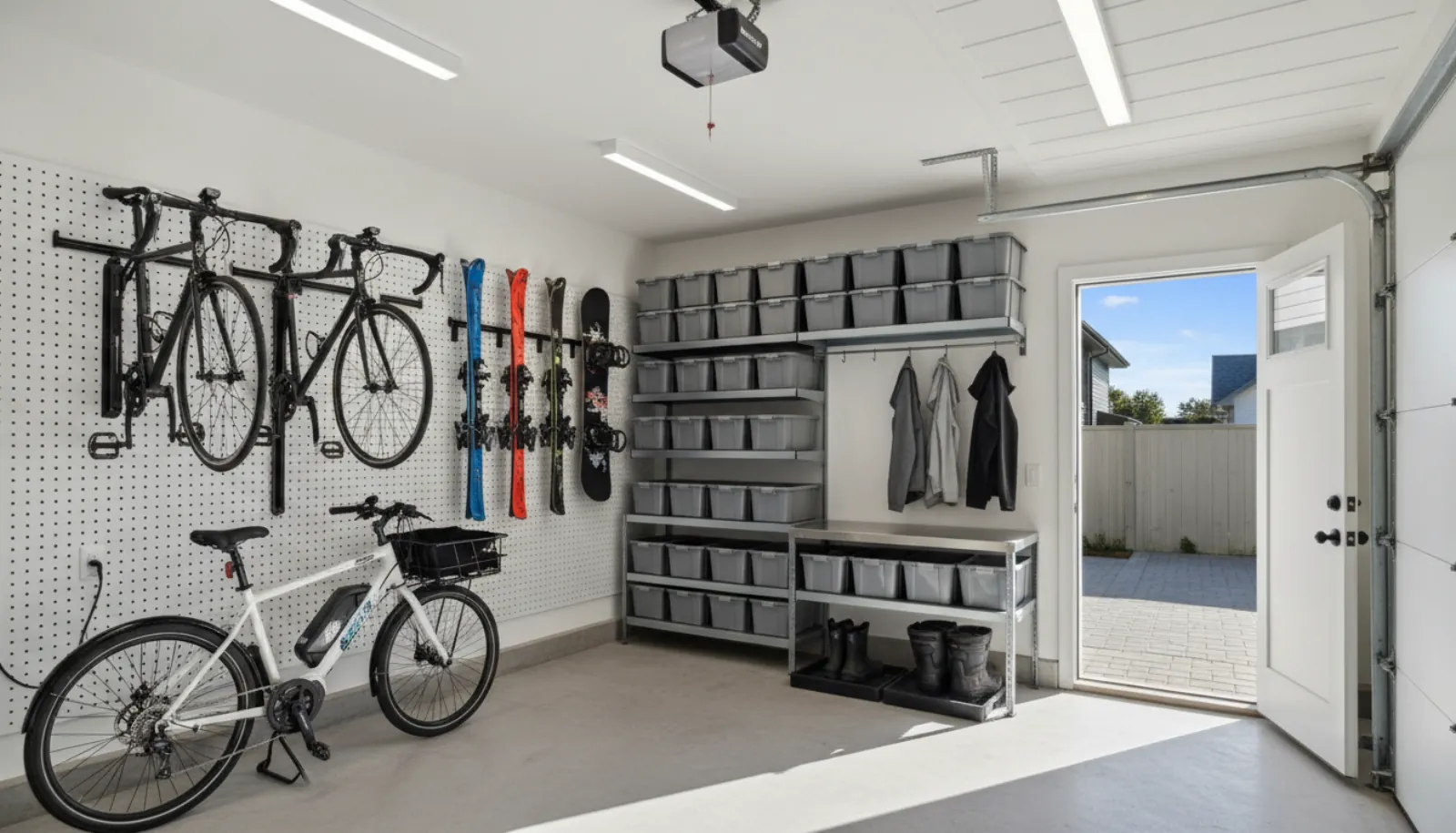
On a garage, the best gear storage is usually a full wall the car does not need. On that wall we plan:
- Bike hooks. Vertical hooks hang bikes by the front wheel, which takes less depth. Horizontal hooks take less height. We space them for handlebars, which overlap if hooks are set too close, and we stagger heights so bikes nest.
- Ski and board racks. Wall racks keep edges apart and off the floor.
- Shelving or a slatwall system. Adjustable systems let the wall change as kids grow and hobbies change.
- Solid blocking. Hooks and racks carrying bikes need solid backing. We install solid blocking or a plywood backing panel in the framing before drywall, at the heights we expect hooks.
The width of the garage decides how much wall is free. On a double garage, one side wall often becomes the gear wall. On a narrow lot with a single garage, the back wall may be the only option. Our post on garage workshops covers garages that also serve as workspaces.
Most houses store bikes wherever the car is not. We give them a wall of their own, with power and a way out to the lane that does not go around the car.
Icon Projects Team
Ceiling storage
Seasonal gear can go overhead, on ceiling racks or a hoist that lowers items to the floor. That only works when:
- the ceiling is high enough above the car,
- the garage door track and opener leave space, and
- the ceiling framing can carry the load.
A wall-mount garage door opener sits beside the door and leaves the ceiling clear. Our post on garage doors and openers covers that choice. We check the ceiling framing with the structural designer if the racks will be heavy, and add blocking at the rack locations.
E-bike charging
E-bikes and e-scooters have changed garage planning. Their batteries need charging, often every day, and charging should follow the battery maker's instructions. In the design we plan:
- Outlets at the bike wall, at a height that keeps chargers off the floor and away from water.
- A dedicated circuit, so chargers do not share with a freezer or power tools.
- Distance from fuel and solvents, such as gas cans, paint and thinners.
- A smoke or heat alarm that covers the charging area, in addition to the alarms the code requires in the house. Our post on smoke and CO alarms covers those rules.
- A charging shelf for removable batteries, on a non-combustible surface.
Some owners prefer to charge removable batteries on a shelf instead of on the bike. Either way, the outlets have to be planned before drywall. Our post on EV charger rough-in covers the car side of garage power.
Wet gear and the drying zone
The Lower Mainland is wet for much of the year. Rain shells, cycling gloves, ski boots and muddy shoes need somewhere to dry before they come into the house.
We plan a drying zone near the garage-to-house door, or in a mudroom:
- Hooks with space between them, so jackets do not touch.
- A boot tray or a floor drain, so water has somewhere to go.
- A bench for taking off boots.
- Air movement, from an exhaust fan or the ventilation system, to carry moisture away.
- A durable floor, such as tile or sealed concrete.
Our post on mudroom design covers the room between the garage and the house, and our post on pet-friendly design covers a dog wash that can share the space.
Keeping it secure
Bikes and e-bikes are a common target for theft, and a garage full of gear is worth protecting. Most of the protection is cheap to build in at framing and awkward to add later. In the design we plan:
- Solid doors and good locks on any garage side door and bike room, with a deadbolt and a strike plate fixed into solid framing. Our post on door hardware covers locks and strikes.
- No glass at reach of the lock on a side door, or laminated glass where there is glass.
- Lighting at the lane door, on a motion sensor.
- An alarm contact on the overhead door and the side door, and a camera that covers the lane approach. Our post on home security covers the wiring.
- A floor or wall anchor at the bike wall for owners who want to lock expensive bikes inside the garage.
Gear that cannot be seen from the lane is less likely to attract attention, so we avoid windows that show the gear wall from outside. Where the garage needs daylight, a high window or a frosted glass panel lets light in without showing what is stored inside.
Kids' gear grows with them
Families with young children store strollers, balance bikes, scooters and car seats, and the list changes every year or two. A few habits keep the system working:
- Low hooks and bins for children's bikes and helmets, so they can put their own things away.
- Adjustable wall systems that move up as bikes get bigger.
- A stroller spot near the house door, with room to fold it.
- A shelf for helmets and gloves, at child height, near the door they use.
When the children are grown, the same wall holds adult bikes or becomes a workshop. Our post on kids' bedrooms and flex rooms covers planning the inside of the house for the same years.
Getting gear in and out
The path matters as much as the storage. A bike should go from the gear wall to the street without passing through the house or squeezing past the car.
- A side or rear door from the garage to the lane or side yard is the most useful feature for cyclists.
- A clear route along the gear wall, with no shelving blocking it.
- A wide gate on the side yard, if bikes come in from the front.
- A covered spot by the door to lean a bike while unloading.
Where a garage faces the lane, a pedestrian door beside the overhead door lets bikes out without opening the big door.
Narrow lots and suites
On narrow lots with a single garage or a carport, or where part of the garage becomes living space, gear needs another home:
- A bike room off the lane, lockable, with power and a light.
- Storage under a deck or stair, built dry.
- A shed, placed within the zoning bylaw's rules for accessory buildings and setbacks, which we check for each lot. Our post on laneway and coach houses covers what else may share the back of the lot.
On a house with a secondary suite, the suite's household needs gear storage too. A lockable section of the garage or a separate bike room keeps both households' gear secure.
How we plan gear storage on a Burnaby build
- Take an inventory of what the family owns and how often each item is used.
- Give gear its own wall, with blocking for hooks and racks.
- Plan ceiling storage around the door track and opener.
- Add e-bike power on its own circuit, away from fuel, with alarm coverage.
- Create a drying zone near the house door.
- Plan the route to the lane or street.
Our custom homes service page shows how we design garages and mudrooms on builds in Burnaby, North Vancouver and across the Lower Mainland.
Frequently asked questions
- Where should bikes be stored in a new house?
- Usually on a dedicated wall of the garage, on vertical or horizontal hooks, with room to roll each bike in and out without moving the car. On narrow lots without a wide garage, a covered, lockable bike room or a shed with lane access can work. Bikes should not have to pass through the house.
- How should e-bike batteries be charged at home?
- Follow the battery maker's instructions. We plan outlets at the bike wall on their own circuit, at a height that keeps chargers off the floor, away from fuel, solvents and anything that burns easily, and where a smoke alarm or heat alarm can detect a problem. Some owners charge removable batteries in a dedicated spot instead of on the bike.
- Can we store bikes on the garage ceiling?
- Often, using ceiling racks or a hoist, if the ceiling height allows and the garage door track and opener leave space. A wall-mount garage door opener frees the ceiling. Ceiling storage suits gear used a few times a year; daily bikes are easier on a wall.
- How do you deal with wet gear in a rainy climate?
- We plan a drying zone near the garage door or in the mudroom: hooks with space between them, a boot tray or a floor drain, a bench, and air movement from an exhaust fan or the ventilation system. That keeps wet jackets and boots out of the main house and lets them dry before the next ride.
- What about secure bike storage on a narrow lot?
- On narrow Burnaby lots with a single garage or a carport, a lockable bike room off the lane, a storage room under a deck, or a shed placed within the zoning rules can hold bikes and gear. We check the zoning bylaw's rules on accessory buildings and setbacks before placing a shed.
- Does gear storage need a heated space?
- Most bikes and gear are fine in an unheated, dry garage. Some items, such as e-bike batteries, paint and wax, do better above freezing; check the makers' instructions. A garage that stays dry, with good air movement, protects most gear.