Craft
Water softeners and conditioning in a BC custom home: where they help and where they do not
Metro Vancouver's municipal water is among the softest in Canada, so a city-serviced Burnaby house usually does not need a softener. A well-sourced Fraser Valley or Abbotsford house often does. Here is how we read a water test, where a softener earns its place, what a conditioner can and cannot do, and the rough-in we leave at framing so the choice can be made with real data.
Metro Vancouver's municipal water comes from the Capilano, Seymour and Coquitlam watersheds. It is among the softest water in Canada. A Burnaby house on city water almost never needs a softener. A Fraser Valley or Abbotsford house on a well often does. The choice is not based on habit or marketing; it is based on a water test.
This post covers how we read a water report, where a softener earns its place in a BC custom home, what a conditioner can and cannot do, and the rough-in we leave at framing so the owner can change their mind years later with real data. Our post on whole-home water filtration covers the filtration side, and this one covers the mineral side.
What hardness is and how to read it
Water hardness is a measure of the dissolved calcium and magnesium in the supply. The industry and the regulators usually report it in milligrams per litre of calcium carbonate, sometimes in grains per gallon (one grain per US gallon is about 17.1 milligrams per litre). Health Canada's drinking water guideline does not set a hardness maximum because hardness does not harm people; it is a nuisance parameter.
A rough reading:
- Under 60 milligrams per litre: soft. Metro Vancouver surface water sits here.
- 60 to 120: moderately hard. Common on some Fraser Valley wells and some mixed supplies.
- 120 to 180: hard. A softener earns its place.
- Over 180: very hard. A softener is a clear call.
Hardness is one of several numbers on a water test. Iron, manganese, sulphur, chloride, hydrogen sulphide, pH, total dissolved solids, bacteria and nitrates are separate parameters and a softener does not address any of them. A water quality specialist reads the whole report and recommends the treatment train.
Our post on well water and septic on a rural Abbotsford home covers the well side.
Why Metro Vancouver is different
Metro Vancouver's three source reservoirs sit on young, granitic rock with little dissolved mineral. The water arrives at the house after chloramine disinfection and pH adjustment. For hardness, the finished water is typically well under 20 milligrams per litre of calcium carbonate, which is well inside the soft range.
A softener on that water:
- Strips out the small amount of beneficial calcium and magnesium.
- Replaces it with sodium, which is unhelpful at the kitchen tap.
- Needs regular salt refills.
- Needs a drain for the regeneration cycle.
- Needs a 120-volt circuit.
- Takes mechanical-room floor space.
On a city-serviced Burnaby or Vancouver custom home, a softener is almost always the wrong answer. A sediment filter and a carbon filter for chloramine taste are often useful. A softener is not.
Where a softener does earn its place
Four common cases where we fit one:
- A well-sourced Fraser Valley or Abbotsford house on groundwater harder than 120 milligrams per litre. Scale on appliances, white deposits on glass and faucets, and the soap-scum ring in the shower all come from hardness. A softener fixes all three.
- A rural property on a shared well where the water report comes back hard, with or without iron.
- A heavily serviced house, with a large tankless water heater, radiant floor heating and multiple showers, where the scale penalty of hard water on the equipment is high.
- A house with high-end plumbing fixtures that the maker's warranty ties to a specified maximum hardness.
The water quality specialist sizes the softener to the flow rate (the total gallons per minute the house might draw at peak) and the hardness grains per gallon. An undersized softener is worse than none, because it regenerates all the time and never fully softens the water.
What a conditioner is and is not
A conditioner is a scale-reducing device that does not remove calcium or magnesium. The common technologies are template-assisted crystallization, electromagnetic devices and polyphosphate dosing. They change the way minerals precipitate, so the scale is less sticky and washes off instead of building up.
Benefits:
- No salt, no drain, no electrical except for some models.
- The calcium and magnesium stay in the water for drinking and gardening.
- Smaller footprint and lower install cost.
Limits:
- The scale reduction is partial, not complete. On very hard water, scale still appears at the appliances, just less of it.
- They do not remove minerals, so the soap-scum ring in the shower and the white mineral deposits on glass continue.
- Independent verification is harder than for ion-exchange softeners.
A conditioner is a reasonable middle choice on moderately hard water (60 to 120 milligrams per litre) where an owner wants less scale but keeps the minerals. On hard water, a softener does more.
A softener on Burnaby city water strips out the only minerals the water carried, and adds sodium instead. A softener on a hard Fraser Valley well earns its place every day.
Icon Projects Team
The install details in a new build
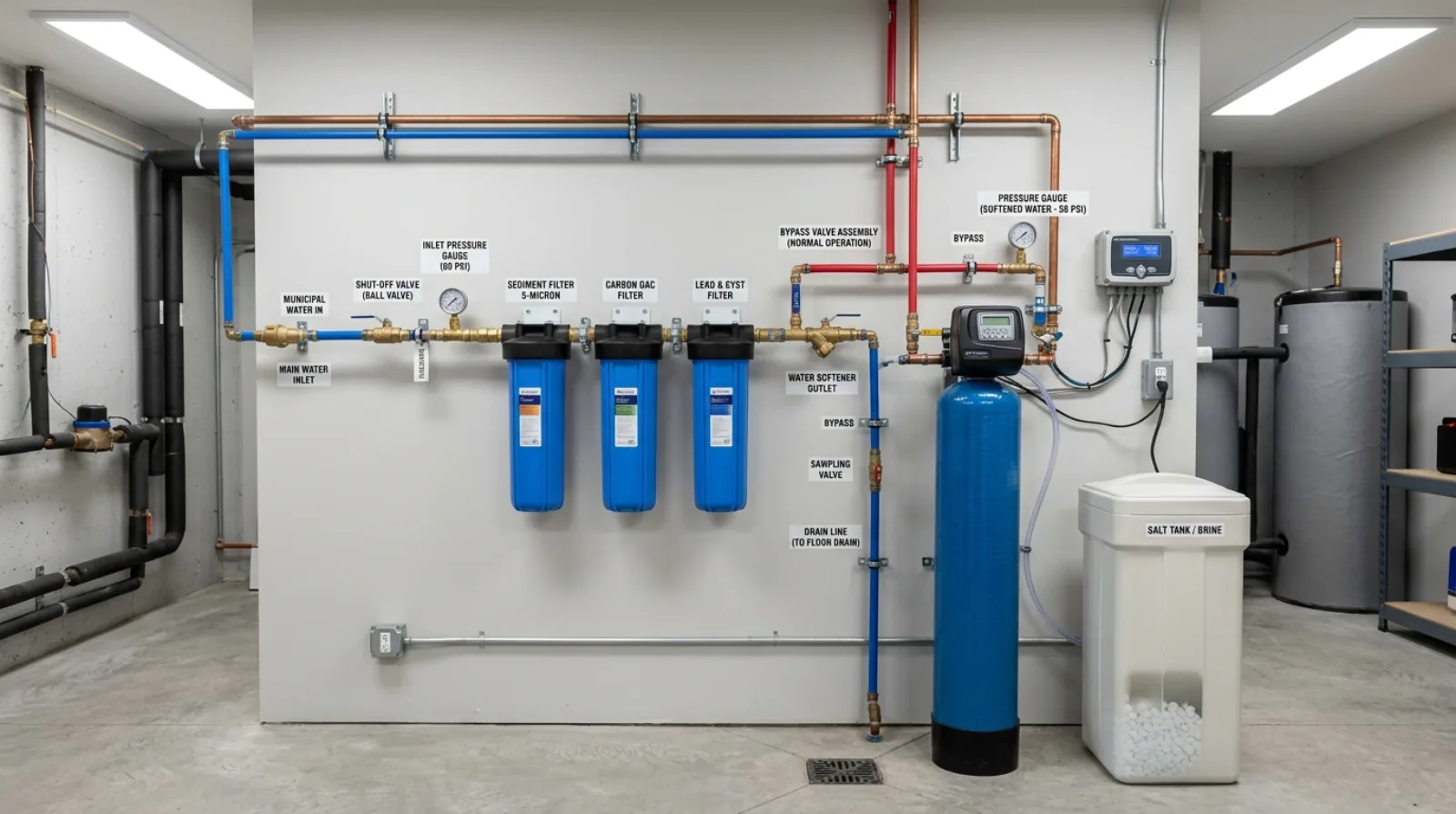
A softener install in a mechanical room needs:
- A location on the main cold water line, after the shut-off and any whole-home sediment filter, and before the water heater. Soft water through the water heater cuts scale on the heat exchanger.
- A bypass valve set, so the softener can be isolated for service without turning off the house water.
- A drain for the regeneration cycle. A floor drain or a standpipe to the plumbing stack, with an air gap to meet the plumbing code.
- A dedicated 120-volt circuit for the control head.
- A brine tank beside the softener, with floor space for salt bags.
- A drip pan under the whole system with a drain to the floor drain, catching any leak.
- A bypass to the kitchen cold tap if the owner wants unsoftened drinking water. A reverse osmosis system under the sink is the other way to handle drinking water, after the softener. Our post on plumbing fixtures selection covers the tap side.
Our post on mechanical room planning covers the room, and our post on hot water heater options covers the water heater that sits downstream.
The rough-in we leave when it is not needed now
On every custom home we leave a softener rough-in in the mechanical room, whether or not the softener goes in on day one:
- A loop in the main cold water line with isolation valves both sides and a bypass valve, so a softener can be added without shutting down the house.
- A floor drain within 1.5 metres of the loop.
- A dedicated 120-volt outlet in the softener zone.
- A floor space of at least 900 by 900 millimetres, kept clear.
- A note on the mechanical drawings showing the rough-in.
The cost of the rough-in is a few hundred dollars at plumbing and electrical. The cost of adding it later is far higher, because the mechanical room is full and the floor drain is often in the wrong place.
What a softener does not do
Three failure modes we see:
- An owner buys a softener for drinking water quality. A softener does not improve drinking water. It removes calcium and magnesium (not harmful) and adds sodium (not helpful).
- An owner buys a softener for chlorine or chloramine taste. A softener does not remove disinfectants. A carbon filter does.
- An owner buys a softener for iron or sulphur. Some softeners remove small amounts of iron, but anything over the softener's iron rating fouls the resin and the softener stops working. Iron, manganese and sulphur need their own treatment stages ahead of the softener.
The treatment train for a well with multiple issues is:
- A sediment filter at the pressure tank.
- An iron or manganese filter if the test shows them.
- An ultraviolet lamp for bacteria if the well is at risk.
- A softener if hardness is above the threshold.
- A carbon filter for taste and odour.
- A drinking-water polish at the kitchen tap, usually reverse osmosis.
Each stage has its own backwash drain and footprint. Our post on whole-home water filtration covers the treatment train, and our post on smart water leak protection covers what sits around the softener in the mechanical room.
Maintenance an owner signs up for
A softener is a serviceable piece of equipment, not a fit-and-forget device:
- Refill the brine tank with softener-grade salt every few weeks, depending on use. A typical family goes through one or two 20-kilogram bags a month.
- Clean the brine tank once a year.
- Replace the resin every eight to ten years, depending on the raw water quality.
- Service the control head at the maker's interval.
- Test the softened water hardness once or twice a year, so a failing softener is caught early.
A conditioner has less maintenance, often just an annual check and a cartridge change on filtered models.
How we handle water quality on a Burnaby or Fraser Valley build
- Test the water before design, from the exact supply the house will use. For city water, pull the utility's water quality report. For a well, send a sample to a certified lab.
- Read the test with the water quality specialist, not with the salesperson for one piece of equipment.
- Choose the treatment train for the real numbers: filtration, iron removal, UV, softener, carbon, drinking-water polish, in that order where each one is needed.
- Lay out the mechanical room with floor space, drains, electrical and a flat path for service.
- Leave a rough-in for the softener even if the house does not need one on day one.
- Hand the owner a one-page maintenance sheet with the schedule for salt, filter changes and annual tests.
Our custom homes service page shows how we build in Burnaby, Abbotsford and across the Lower Mainland.
Frequently asked questions
- Does Metro Vancouver water need a softener?
- Usually not. Metro Vancouver's municipal supply from the Capilano, Seymour and Coquitlam watersheds is among the softest in Canada, typically well under 20 milligrams per litre of hardness as calcium carbonate, which the industry classes as soft. A softener on soft water offers little benefit and adds sodium to the drinking supply.
- Do Fraser Valley wells need a softener?
- Many do. Groundwater in parts of Abbotsford, Chilliwack, Langley and Mission runs harder than Metro Vancouver surface water. A water test from a certified lab is the only way to know what any specific well produces, and the softener decision follows the test, not the postcode.
- What is the difference between a softener and a conditioner?
- A softener replaces calcium and magnesium ions with sodium or potassium ions through ion exchange, removing hardness. A conditioner changes the way the calcium and magnesium precipitate, reducing scale without removing the minerals. Softeners need salt and a drain. Conditioners need neither. Softeners are more effective. Conditioners keep the beneficial minerals in the water.
- Where do we install a softener in a new house?
- On the main cold water line, after the shut-off and after any whole-home sediment filter, before any hot water tank. The softener needs a drain for its regeneration cycle, a 120-volt circuit, floor space for its brine tank and salt storage, and a drip pan with a drain. The mechanical room is usually the right place.
- Does a softener affect drinking water?
- Yes. A softener replaces calcium and magnesium with sodium, so the finished water is higher in sodium than the raw water. Owners who want soft water for bathing and dishes but low-sodium water for drinking install a bypass line to the kitchen cold tap, so the drinking and cooking water skips the softener.
- Should we rough in for a softener even if we do not need one?
- Yes. A softener rough-in at framing costs little, and a future owner, a changed water source or a new well all change the answer. The rough-in is a loop in the mechanical room with isolation valves, a drain within reach and a dedicated circuit. If the softener is never needed, the loop stays bypassed.