Systems
Smart water-leak protection in a Burnaby custom home: the system nobody photographs
A burst supply line can put hundreds of litres an hour into a finished Burnaby home. An automatic shutoff at the main plus a handful of point sensors is the cheapest insurance you'll never see, and it has to be planned at rough-in.
What is a smart water-leak system, and why build one into a Burnaby home?
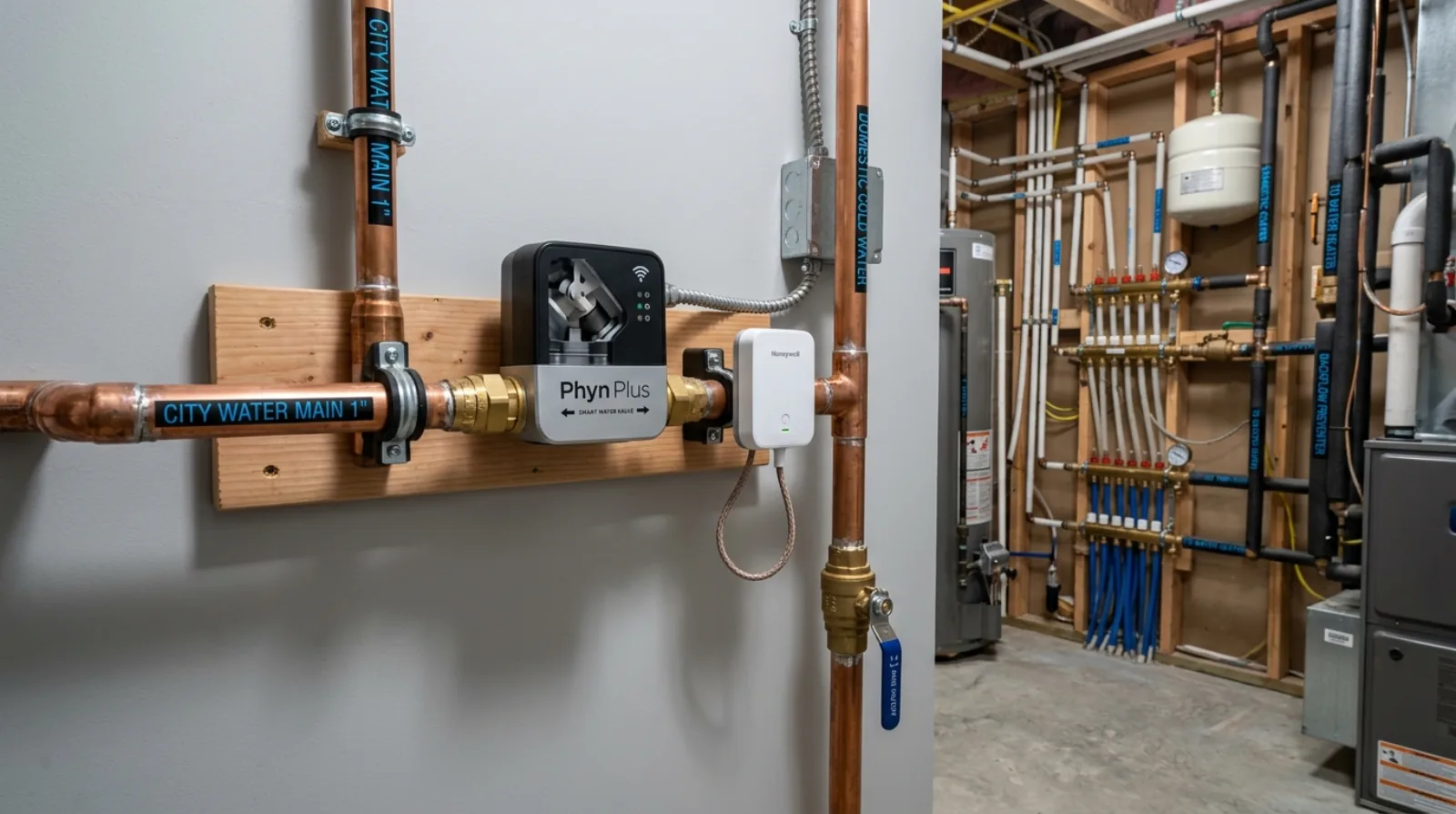
A smart water-leak system has two parts that do two different jobs. At the water main, where the supply enters the house, sits an automatic shutoff valve with a flow meter built into it. It measures every drop moving through the house and watches the pattern, a toilet fill is a short burst, a shower is a steady draw, a dishwasher cycles. When it sees flow that doesn't fit any normal pattern, water running continuously for an hour, a draw starting at 3 a.m. when nobody's up, it can close the valve and shut the whole house down before a leak turns into a flood. The second part is a set of small point sensors that sit on the floor under the things most likely to fail: the kitchen sink, the bathroom vanities, the dishwasher, the clothes washer, and the water heater. They catch the slow drips and the standing water the main valve can't detect by flow alone.
We build this into every Burnaby home for one reason: water is the thing most likely to damage a finished house, and it does the most damage when nobody's home to catch it. A burst supply line doesn't politely wait for you to get back from work. It runs at full pressure, and a finished basement on Capitol Hill or a hardwood main floor in Buckingham Heights can take on a frightening amount of water in the hours before anyone notices.
This is the least glamorous system we install and, dollar for dollar, one of the most valuable. Nobody photographs the shutoff valve. But it's quietly protecting everything they did photograph.
Water is the claim that wrecks a finished house
If you talk to anyone in home insurance, water damage comes up before fire, before theft, before almost anything. It's one of the most common and most expensive categories of claim a homeowner ever files. And the reason is simple physics: a supply line is under constant pressure, so when one fails, it doesn't drip, it pours, and it keeps pouring until someone turns off the water.
The usual suspects are mundane. A braided washing-machine hose that's twenty years old and finally gives. A dishwasher supply line. A toilet fill valve that sticks open. A water-heater tank that rusts through at the seam. None of these are dramatic. All of them can put hundreds of litres an hour into a house.
The fire alarm gets all the respect, but it's water that quietly destroys more finished homes. A leak doesn't announce itself, it just runs until the floor below tells you.
Icon Projects Team
What makes water uniquely nasty in a new home is where it goes. It doesn't stay where it starts. It runs along the subfloor, finds the path of least resistance, drops into the wall cavity, and shows up two rooms away. By the time you see a stain on a ceiling, the water's been travelling through the structure for a while. That's the difference between wiping up a puddle and tearing out drywall, insulation, flooring, and millwork.
The 2-5-10 warranty angle people don't think about
Here's a part of the picture that rarely comes up at the design table. A plumbing failure in the first couple of years isn't only an insurance question, it can be a warranty matter too.
Every new home in BC carries the mandatory 2-5-10 home warranty. The middle tier covers the home's distribution systems, the electrical, plumbing, heating, ventilation, and cooling distribution, for 24 months, along with parts of the exterior. So if a plumbing supply connection inside the house fails within that two-year window because of how it was installed, that sits inside the warranty.
But, and this is the point, the warranty covers the defect, not your patience or the contents of the room. It deals with the failed connection. It does not magically un-flood the basement or make the four months you spent in a rental disappear. A shutoff valve does something the warranty can't: it stops the event from becoming a catastrophe in the first place. The two work together. The warranty backstops the workmanship; the leak system limits the damage when something fails anyway, whether that's in year one or year fifteen.
For homeowners who want to understand what that 24-month tier actually covers and how a provider judges a claim, we go deep on it in our post on the 2-5-10 warranty for a Burnaby custom home.
Where it gets plumbed and powered, at rough-in, not after
This is the section that matters most, because almost everything that makes a leak system work or not work is decided during the plumbing rough-in, before a wall is closed.
The main shutoff valve installs on the supply line right after it enters the house, downstream of the main shutoff and the water meter. To work cleanly it needs three things planned for it:
- Physical room on the pipe. The valve body adds length to the run. We make sure there's a straight, accessible section of pipe with enough clearance to drop the valve in and still service it later. On a crawlspace or basement entry, that's a coordination item with the plumber, not an afterthought.
- A power source at the valve. A motorized shutoff valve needs power. That means a receptacle or a hardwired feed at the valve location, run by the electrician during the electrical rough-in. If nobody planned the outlet, the valve has nowhere to plug in, and now you're running a cord across a mechanical room or fishing a new circuit through finished walls.
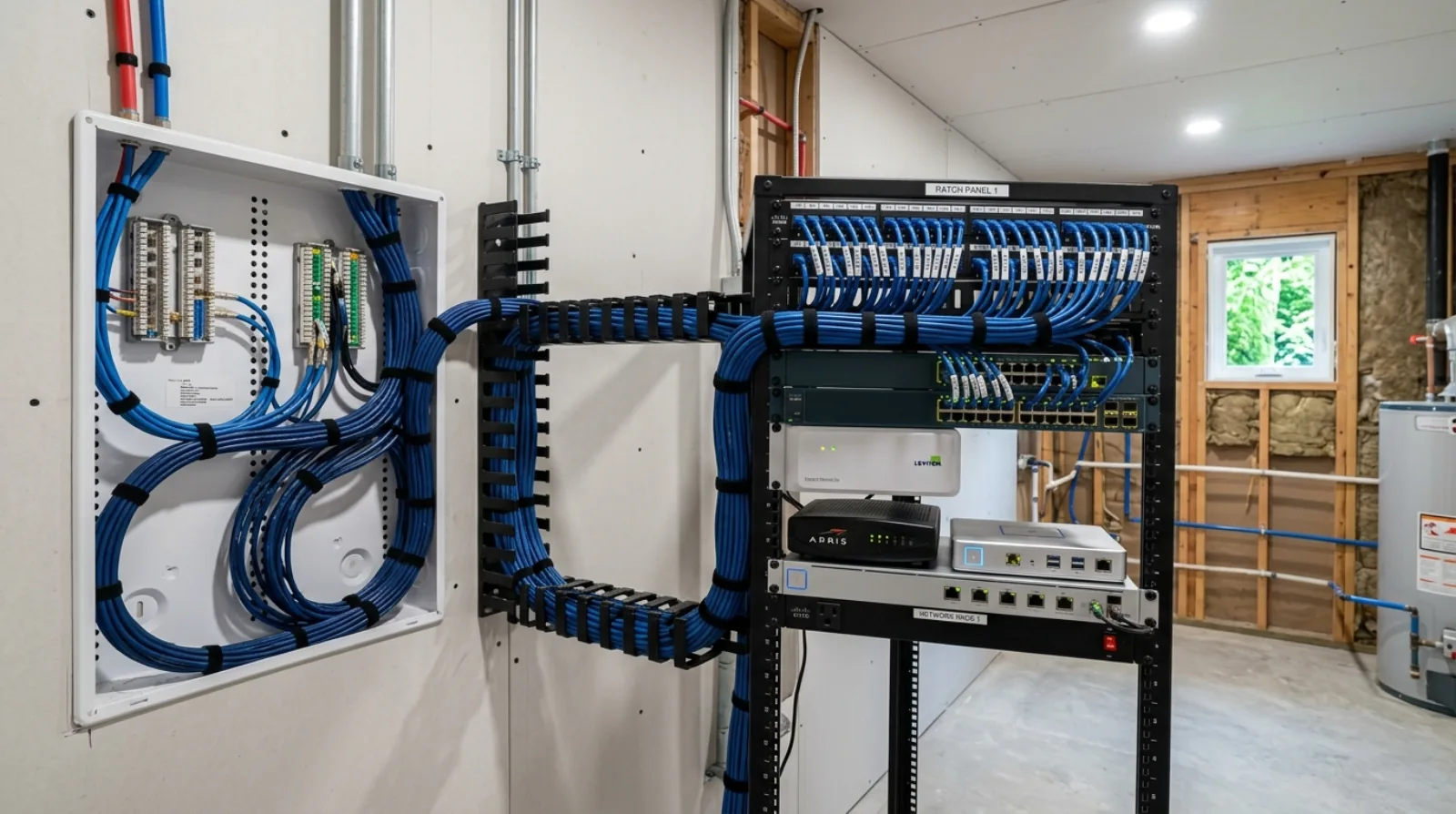
- A data path to the rest of the house. Most of these valves talk over Wi-Fi, but the strongest installs get a hardwired network drop run to the valve location so the connection never drops. We run that cable with the rest of the low-voltage rough-in.
The point sensors are simpler but still benefit from planning. Battery-powered wireless pucks can go anywhere later, but where we want the strongest reliability, at the water heater, behind the washer, we'll leave a low-voltage drop so a wired sensor can report without a battery to change. Either way, we map the sensor locations during framing so the homeowner knows every wet point in the house is covered: every vanity, the kitchen, the laundry, the mechanical room, and any second-floor bathroom sitting over finished space below.
Do all of this at rough-in and the system is invisible and bulletproof. Try to add it after move-in and you're working around finished surfaces, fishing wires, and accepting a worse install. That's the same lesson that runs through everything we wire ahead of time, we cover the broader version in our guide to home-automation wiring in a Burnaby build.
Tying it into the smart-home head-end
A leak system can run perfectly well on its own little app. But in a custom home where we're already wiring a central smart-home controller, the head-end, there's real value in bringing the leak system into the same place everything else lives.
When it's integrated, a few useful things happen. A leak alert can trigger more than a phone notification: it can flash the lights, announce over the audio system, and push to every device in the household at once, so a leak at 2 a.m. actually wakes someone. The shutoff can tie into an "away" mode, leave for the weekend and the system can watch for any flow at all and shut down at the first sign of trouble, since nobody should be using water in an empty house. And the whole thing reports into one dashboard instead of yet another standalone app the homeowner forgets they have.
The catch is that integration is a design decision. Which controller, which protocol, whether the valve speaks the same language as the rest of the system, that gets decided when we're laying out the head-end, not after. A valve chosen in isolation might not talk to the platform the rest of the house runs on. So we pick the leak hardware as part of the smart-home plan, the same way we pick the lighting control or the network gear.
The Wet Coast makes this non-negotiable
Everything above is true anywhere. It's more true here.
Metro Vancouver is a high-rainfall coastal climate, the place where annual rainfall comfortably exceeds 1,000 mm, which is exactly why BC's building code requires a rainscreen on cladding across the whole Lower Mainland. We build homes to keep that weather out. So it's a particular irony that the water most likely to damage a Burnaby home isn't the rain hammering the building envelope, it's the clean, pressurized supply water running inside the walls.
But the wet climate compounds the problem in a real way. A house that's already managing a lot of exterior moisture, sitting on a Burnaby Heights slope or a Deer Lake lot where drainage is a constant conversation, has no spare tolerance for an interior leak on top of it. Trapped water in an assembly that's already working hard against outside moisture is how you get mould and rot. The drier you keep the inside of the walls, the longer the home lasts. A leak system is part of that same discipline, it's moisture management, just from the inside.
It also pairs naturally with the home's first-year routine. The sensors and the valve give a new owner a baseline of what normal water use looks like, and the first year is exactly when you want to be paying attention. We fold leak-system checks into the maintenance rhythm we lay out in our first-year maintenance guide for a Burnaby custom home.
Frequently asked questions
Will the shutoff valve turn off my water by mistake? A well-set-up flow-monitoring valve learns your household's normal patterns over the first few weeks, so it gets better at telling a long shower from a real leak. You can also set your own thresholds and override a shutoff instantly from the app if it ever closes when you didn't expect it. In practice the bigger risk is a valve set too lax, not too aggressive, and that's a tuning conversation, not a hardware flaw.
Do I need the point sensors if I already have the main shutoff valve? Yes, because they catch different things. The main valve sees flow, it's brilliant at a burst line or a fixture left running, but a slow drip under a vanity might not move enough water to register against normal use. A puck sensor sitting on the floor catches that standing water immediately. The two together cover both fast floods and slow leaks.
Can I add this to my house after it's built? You can, and battery sensors especially are easy to add anytime. But the main shutoff valve is far cleaner installed at rough-in, when there's room on the pipe and the electrician can drop power right at the valve. Retrofitting means working around finished surfaces and often fishing in a new circuit, doable, just not as clean or as cheap as planning it from the start.
Does a leak system lower my insurance? Some insurers offer a discount for a monitored automatic shutoff, and several recognize these systems specifically because water claims are so common and expensive. The discount varies by insurer, so we won't quote a number, ask your broker. The stronger argument isn't the discount anyway; it's avoiding the claim, the deductible, and the months of disruption entirely.
The systems homeowners fight over at the design table are the ones they'll see every day, the kitchen, the floors, the fixtures. The shutoff valve is the one they'll never look at again after the day it's installed. That's exactly why it's worth building in. The best version of this system is the one that does its whole job once, on a weekend you're away, and saves the house you spent a year building.
Related on the Journal
- Plumbing rough-in in a Burnaby custom home
- Home-automation wiring for a Burnaby build
- First-year maintenance for a Burnaby custom home
- What the 2-5-10 warranty covers in Burnaby
Frequently asked questions
- Will a whole-home water shutoff valve close unexpectedly and interrupt water use?
- A properly configured flow-monitoring valve learns your household's normal patterns in the first few weeks, becoming better at telling a long shower from a real leak. You can set your own thresholds and override a shutoff immediately from the app if it closes when you did not expect it. In practice, the bigger risk is a valve set too lax, not too aggressive, and that is a tuning conversation, not a hardware flaw.
- Do I need point sensors if I already have a main water shutoff valve?
- Yes, because they catch different problems. The main valve monitors flow, it is effective at a burst pipe or a fixture left running, but a slow drip under a vanity may not move enough water to register against normal household use. A puck sensor sitting on the floor catches that standing water immediately. The two together cover both fast floods and slow hidden leaks.
- Can I add water leak protection to a house after it is built?
- You can. Battery sensors are easy to add at any time. The main shutoff valve is cleaner installed at rough-in when there is room on the pipe and an electrician can drop power right at the valve. Retrofitting means working around finished surfaces and often running a new circuit, doable, but not as clean or inexpensive as planning it from the start.
- How does a flow-monitoring shutoff valve know the difference between a shower and a leak?
- The valve sits on the main supply line and measures every drop of water moving through the house, learning what normal patterns look like: a toilet fill is a short burst, a shower is a steady draw, a dishwasher cycles in a known pattern. Water running continuously for an hour, or flow starting at 3 a.m. when nobody is up, does not match any normal pattern, so the valve closes automatically before a leak turns into a flood. Icon Projects builds this into every Burnaby home as the first line of defence against a burst supply line.
- Where do point leak sensors get placed in a custom home?
- Icon Projects maps sensor locations during framing so every wet point in the house is covered: every vanity, the kitchen sink, the dishwasher, the clothes washer, the water heater, and any second-floor bathroom sitting over finished space below. These small wireless pucks sit on the floor and catch the slow drips and standing water that a main shutoff valve cannot detect by flow alone, since a slow leak may not move enough water to register against normal household use.
- How does a water leak system connect to the 2-5-10 home warranty?
- Every new BC home carries the mandatory 2-5-10 warranty, and its middle tier covers the home's plumbing, electrical, and mechanical distribution systems for 24 months. If a plumbing connection fails within that window because of how it was installed, the warranty covers the defect itself, but it does not undo the flood damage or the months spent living elsewhere while repairs happen. Icon Projects treats a leak system as the piece that stops the event from becoming a catastrophe in the first place, working alongside the warranty rather than replacing it.
- What needs to be planned at plumbing rough-in for a whole-home shutoff valve?
- Three things: physical room on the supply pipe with a straight, accessible section for the valve body, a power source at the valve location since a motorized shutoff needs electricity, and ideally a hardwired network data path so the connection to the app never drops on Wi-Fi alone. Icon Projects coordinates all three with the plumber and electrician during rough-in, since adding a valve after the walls are closed means fishing a new circuit or accepting a worse install.
- Why is water damage described as one of the most expensive claims a homeowner can face?
- A supply line is under constant pressure, so when a connection like a braided washing-machine hose fails, it does not drip, it pours, and keeps pouring until someone shuts off the water. Water also does not stay where it starts: it runs along the subfloor, drops into wall cavities, and can show up two rooms away before a stain ever appears on a ceiling. Icon Projects builds leak protection into every home because by the time water damage is visible, it has often already reached the hardwood, drywall, and insulation.