
A new Burnaby home built under the Zero Carbon Step Code's EL-4 cannot heat its water with gas on the prescriptive path, which turns the hot water decision into a choice between an electric tank, a heat-pump water heater, or a heat pump that does space heating and hot water together. Here is how each one behaves in a house with four bathrooms.
Until recently the hot water conversation on a Burnaby custom home took thirty seconds: a gas tankless unit on the garage wall, done. Under the Zero Carbon Step Code that answer is ruled out on the prescriptive path, and the replacement is a real design decision that touches the mechanical room, the plumbing stack, the electrical service and the noise map of the house.
Here is how the options behave in a real house with three or four bathrooms, and how we choose between them on a Burnaby build.
What the Zero Carbon Step Code decided for you
The Zero Carbon Step Code rates a new home's greenhouse gas emissions on four levels, from EL-1 (measure only) to EL-4 (zero carbon performance), and the Province says the higher the level, the more decarbonized the equipment has to be. Since March 10, 2025 the provincial floor for most new buildings is EL-1, and local governments can require any higher step.
Burnaby did. The City's green building page requires Energy Step Code Step 3 plus Zero Carbon Step Code EL-4 for new Part 9 homes with permits submitted on or after January 1, 2025. And it states the consequence in plain words: on the prescriptive pathway, the mechanical systems and equipment selected for space heating and hot water cannot use fossil fuels at the Strong and Zero Carbon steps. A performance pathway exists, based on energy modelling of the home's total emissions, and we walked through what that leaves open in our post on the Zero Carbon Step Code.
The short version for hot water: on a new Burnaby home, plan on electric. That leaves three real choices.
Option one: an electric storage tank
The simplest. A tank of water with electric elements, kept hot around the clock. Natural Resources Canada's guide to residential water heaters points out the cost of that convenience: a storage heater is consuming energy even when nobody is using hot water.
What a tank does well is peaks. Four showers between 6:30 and 7:15 on a school morning draw from a full tank at once, and the tank does not care how many taps are open until it runs out. Recovery, how fast the elements reheat the tank after the peak, is the number that matters for a big family, and it is where a plain electric tank is slow.
It goes almost anywhere with a drain pan and a nearby drain, it makes no noise, and it needs no air around it. On a house where the mechanical room is small and the family is small, it is still a sound choice. On a four-bathroom house in Deer Lake it is the fallback, not the first pick.
Option two: tankless, and why we rarely spec it now
Tankless units heat water as it flows, so there is no standing tank losing heat. The NRCan guide credits them with providing hot water on demand and using less energy than storage models. It also names the catch: if a family needs to take multiple showers at the same time, the demand can exceed what a tankless system can provide.
The gas tankless units that made this category popular are out on the prescriptive path in Burnaby. An electric tankless unit large enough to run two showers and a washer at once draws an amount of current that fights with everything else on an all-electric panel. On a single-bathroom laneway house it can make sense. On the family homes we build in Burnaby and Coquitlam it usually does not, and we say so early so nobody designs the mechanical room around a unit that will not be there.
Option three: a heat-pump water heater
This is the unit we install most on new Burnaby homes, and it is the one most owners have never seen.
A heat-pump water heater does not make heat with an element as its main job. NRCan explains that it moves heat from the air in the basement or utility room, or sometimes from outside, into the tank, and that this makes it up to four times more efficient than a standard electric water heater. The tank on top of the unit is still a storage tank, so the morning peak is handled the same way, and many units carry backup electric elements for faster recovery when the household empties it.
Three things follow from how it works, and they all land on the drawings.
It needs air. The unit is pulling heat out of the room around it, so a sealed closet leaves it short of air to draw from. We give it an open mechanical room, or a louvred door, or ducting that lets it draw from a larger space. The NRCan guide notes that heat-pump water heaters perform better in mild climates, and a Burnaby basement holds a mild, stable temperature all year, which is why it is the right room.
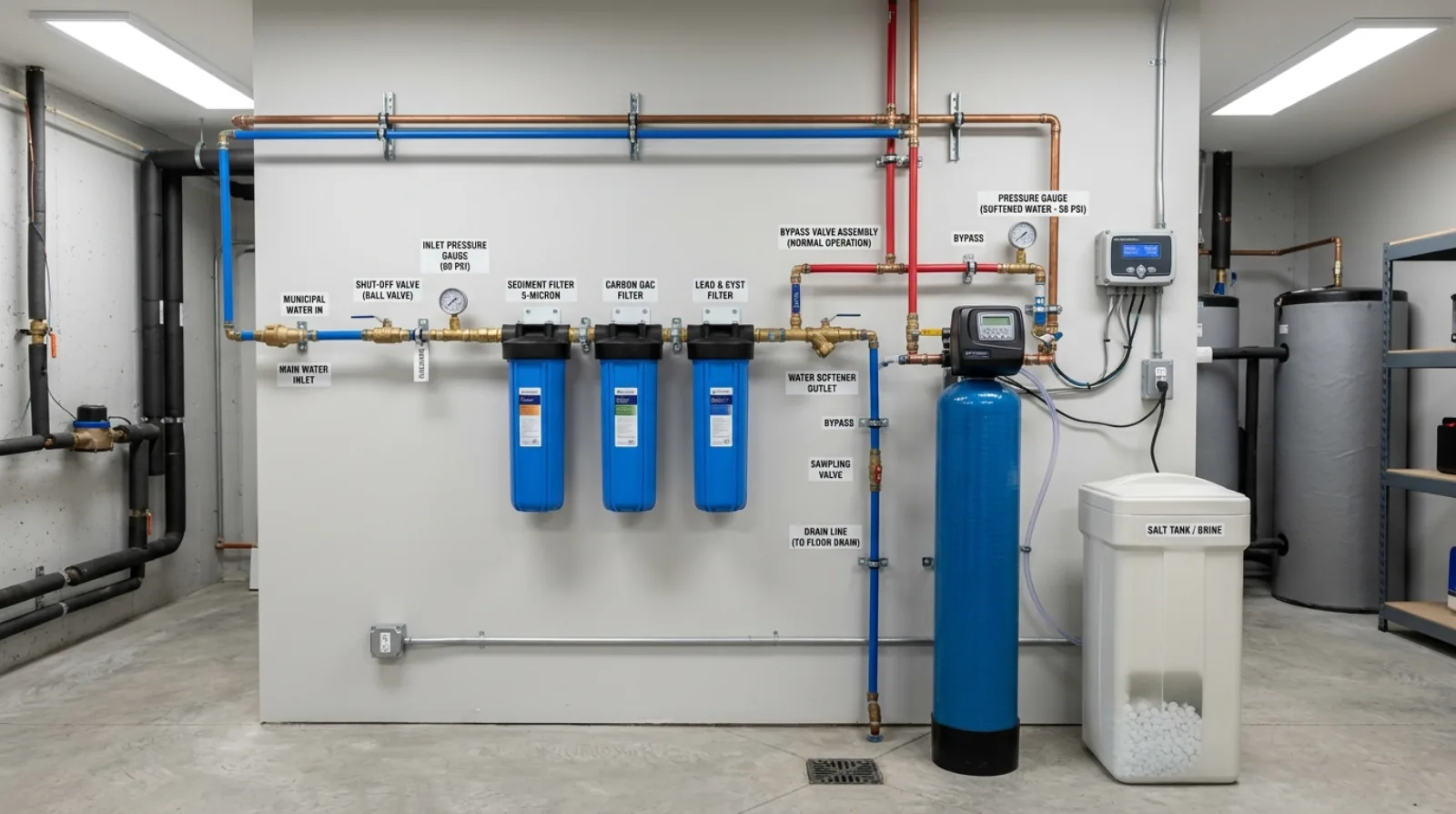
It makes condensate. Pulling heat out of air also pulls moisture out of it, and that water has to go to a drain. So does the drain pan under the tank. A floor drain in the mechanical room solves both and is why we plan the mechanical room next to the plumbing stack at the plumbing rough-in stage.
It makes noise and cools the room. A fan and a compressor run while it heats. The room gets cooler and drier while it does. In a basement mechanical room that is a benefit in a wet Lower Mainland winter. Beside a bedroom, it is a complaint. We keep it behind a solid door on the lower floor and away from any sleeping wall.
Every heat-pump water heater we install gets three things before it gets a brand: a room that can feed it air, a drain it can reach, and a door between it and the nearest bedroom.
Icon Projects Team
Option four: one heat pump for heating and hot water
On a house designed around radiant in-floor heat, there is a fourth path. A single air-to-water heat pump outside heats a buffer tank of water that feeds the floor loops or radiators, and the same unit heats the domestic hot water tank. One outdoor unit, two tanks in the mechanical room, one set of controls.
We like it where it fits. It fits when the owners want radiant floors, when there is a mechanical room with space for two tanks, and when the mechanical designer has done the heat loss calculation under CSA F280 and confirmed that the outdoor unit can carry the house on the coldest Burnaby morning and still recover the hot water tank. It does not fit as an afterthought on a forced-air house. We covered how the space heating side and the ventilation tie together in heat pumps and HRV in a BC custom home, and the hot water decision has to be made in the same meeting, because the two systems either share a unit or they do not.
The electrical side
Every one of the electric options needs its own circuit, and on an all-electric house the water heater is one large load among several: the space heating heat pump, an induction range, a dryer, an EV charger. The BC Electrical Code sets the rules for sizing those circuits and the service that feeds them, and since March 4, 2025 the code in force is the 26th edition of the Canadian Electrical Code, per Technical Safety BC's adoption bulletin. We do not quote circuit sizes here because the electrician sizes them from the actual equipment schedule, and we would rather the number come from the code and the spec sheet than from a blog post.
What we can say is when the sizing has to happen: at the design table, before the service is ordered, with the water heater on the same load list as everything else. A heat-pump water heater draws less current than a resistance tank in normal operation, but when its backup elements switch on they draw like a resistance tank, and the panel has to be sized for the day they do.
Rebates: read the fine print before you count on them
Owners arrive with headlines about heat-pump water heater rebates. Both programs are real, and both are for existing homes.
BC Hydro's heat-pump water heater rebate offers up to $1,000, and its eligibility page requires that the home's existing water heater is being replaced as the primary unit and that a licensed contractor installs the new one. BC Hydro's home renovation eligibility rules exclude new homes built within the last 12 months. The CleanBC Home Renovation Rebate Program lists its own heat-pump water heater rebate of up to $1,000 and requires the home to be a year-round primary residence at least 12 months old.
So a new custom home in Burnaby or Coquitlam gets the efficient equipment because the code and the design call for it, and the rebate stays with the retrofit market. We laid out the same rule for the space heating side in BC Hydro and CleanBC heat pump rebates in 2026. Check the program pages yourself before relying on any figure, because both programs change their terms without much notice.
How we choose
Count the bathrooms and count the people. Ask about the soaker tub, because filling a large tub is one of the biggest single draws in the house. Ask whether the family showers in a cluster or spreads out. Then look at the plan for a mechanical room that can hold a heat-pump water heater with air around it, a floor drain, and a wall between it and any bedroom.
If that room exists, a heat-pump water heater sized for the morning peak is the answer on most of our Burnaby homes. If the house is going radiant, the combined unit gets a serious look. If the mechanical room is small and the household is small, a plain electric tank still does the job. Tankless stays on the list for a laneway house and comes off it for the family home.
The one thing that never changes is when the decision gets made. The water heater picks its room, its drain and its breaker at the drawings stage, and once the plumbing rough-in has passed inspection, the room has been chosen for you.
Frequently asked questions
- Can a new custom home in Burnaby have a gas water heater in 2026?
- On the prescriptive path, no. The City of Burnaby requires Emission Level 4 of the Zero Carbon Step Code for new Part 9 homes with permits submitted on or after January 1, 2025, and the City states that under the prescriptive pathway the equipment selected for space heating and hot water cannot use fossil fuels at the Strong and Zero Carbon steps. A performance path exists that uses energy modelling to show the home's total emissions, and we work through that option with the energy advisor when a client has a specific reason to ask.
- How does a heat-pump water heater work?
- It moves heat instead of making it. Natural Resources Canada describes a heat-pump water heater as drawing heat from the air in the basement or utility room, or sometimes from outside, and transferring it into the tank, which makes it up to four times more efficient than a standard electric water heater. Because it takes heat out of the surrounding air, the room it sits in gets cooler and drier while it runs, and the moisture it pulls from the air drains away as condensate.
- Where should a heat-pump water heater go in a Burnaby custom home?
- In a mechanical room with enough open air around it, a floor drain or a condensate drain, and a door between it and any bedroom. The unit draws heat and moisture out of the room it sits in and makes some fan noise, so a sealed closet beside the primary suite is the wrong spot. At Icon Projects we plan the mechanical room on the lower floor with the heat pump water heater, the HRV and the electrical panel together, near the plumbing stack, before the plumbing rough-in.
- Is a tankless water heater a good choice for a house with four bathrooms?
- It depends on how many showers run at once. Natural Resources Canada notes that a tankless unit provides hot water on demand but that if a family needs multiple showers at the same time the demand can exceed what the unit can supply. In a Burnaby home under EL-4 the tankless option would also need to be electric, which pushes the electrical service hard, so on a multi-bathroom house we usually favour a storage tank sized for the morning peak.
- What is a combined space heating and hot water heat pump?
- A single air-to-water heat pump that heats a buffer tank of water for the home's heating, through in-floor loops or radiators, and also heats the domestic hot water tank. One outdoor unit does both jobs. It suits a house designed around radiant heating from the start, and it needs a mechanical room with space for two tanks plus the controls. We size it with the mechanical designer under the CSA F280 heat loss calculation so it carries the coldest Burnaby morning and still recovers the hot water tank.
- Does a heat-pump water heater need its own electrical circuit?
- Yes. Every water heater we install, storage tank or heat pump, gets a dedicated circuit sized by the electrician to the BC Electrical Code, which since March 4, 2025 has been the 26th edition of the Canadian Electrical Code. On an all-electric Burnaby home the water heater is one of several large loads, alongside the space heating heat pump, an induction range, the dryer and an EV charger, so the panel and service are sized as a whole at the design stage.
- Do BC Hydro or CleanBC rebates apply to the water heater in a new custom home?
- No. BC Hydro's heat-pump water heater rebate requires that an existing electric water heater is being replaced as the home's primary unit, and CleanBC's Home Renovation Rebate Program requires the home to be at least 12 months old. A new build in Burnaby or Coquitlam gets the efficient equipment because the code and the design call for it, and the rebates stay with the retrofit market.
- How do you size a water heater for a large family in a Burnaby custom home?
- Start from the morning peak, the half hour when the most showers and the washer run together, and from how fast the unit can recover between peaks. Natural Resources Canada's guidance is that every family is different and that a licensed plumber should estimate the demand. At Icon Projects we count bathrooms, count people, ask about the soaker tub, and then choose the tank volume and the heat pump's recovery mode with the mechanical designer, rather than defaulting to whatever size fits the closet.