Municipal water and well water need different treatment. Whether you need sediment, chlorine, or hardness filtering, the equipment has to be roughed into the plumbing before the wall closes. Here is how we decide and where it lives.
Two homeowners can ask us the same question, "do we need a whole-home water system," and the right answer for one is "yes, and here is exactly which pieces," while for the other it is "test it first, you may barely need anything." The difference is not the house. It is the water coming into it.
Water filtration gets sold as a single product, the big system in the mechanical room that makes your water "pure." In reality it is a set of tools, each aimed at a specific problem: grit, chlorine taste, hardness, iron, bacteria. Which tools you need depends entirely on what is actually in your water, and that depends most of all on where the water comes from.
So before anyone talks equipment, we talk about your source and your water test. Here is how we work through it.
The split that decides everything: well vs municipal
The single biggest factor is whether your home is on city water or a private well.
Municipal water in Metro Vancouver comes largely from protected mountain reservoirs. It is surface water, which tends to be soft and low in minerals, and it is already treated and disinfected to a drinking-water standard before it reaches your home. That means many homes on city water need little. Often the useful additions are modest: a sediment filter to catch any grit, and a taste-and-odour filter at the kitchen tap for the small amount of chlorine used to keep the water safe on its way to you. A large water softener on already-soft city water can be solving a problem the house does not have.
Well water is a different situation entirely. On a private well, whatever is in the ground is in your water, and nobody has treated it before it reaches your tap. Fraser Valley groundwater commonly carries sediment, iron and manganese that stain fixtures, hardness that scales up pipes and appliances, and in some areas nitrates or bacteria. A well home usually does need real treatment, and the exact mix depends on what the test finds. We walk through the well side of this in detail in our guide to well water and septic for a rural Abbotsford home.
So the same equipment that is close to essential on one lot can be pointless on another. That is why we never start with the hardware.
Test first, always
The honest first step in any water treatment plan is a lab test of your actual water. Not a guess, not a neighbour's setup, not a salesperson's default package. A test.
A water test tells you the specific things you need to treat: the hardness level, whether iron or manganese are present, sediment, and, on a well, whether there is any bacterial concern. On municipal water it confirms whether you even need much beyond a taste filter. On a well it is also a health check on the water you and your family will drink every day. BC's drinking water guidance recommends regular testing for private supplies for exactly this reason.
We build that test into the design stage for every home where treatment is on the table, because the result decides two things at once: whether you need equipment, and if so, what kind and how much space it takes in the mechanical room.
The most expensive water system is the one that solves a problem you never had. Test the water first, then buy only the treatment your water actually needs.
Icon Projects Team
The common treatment pieces, and what each one does
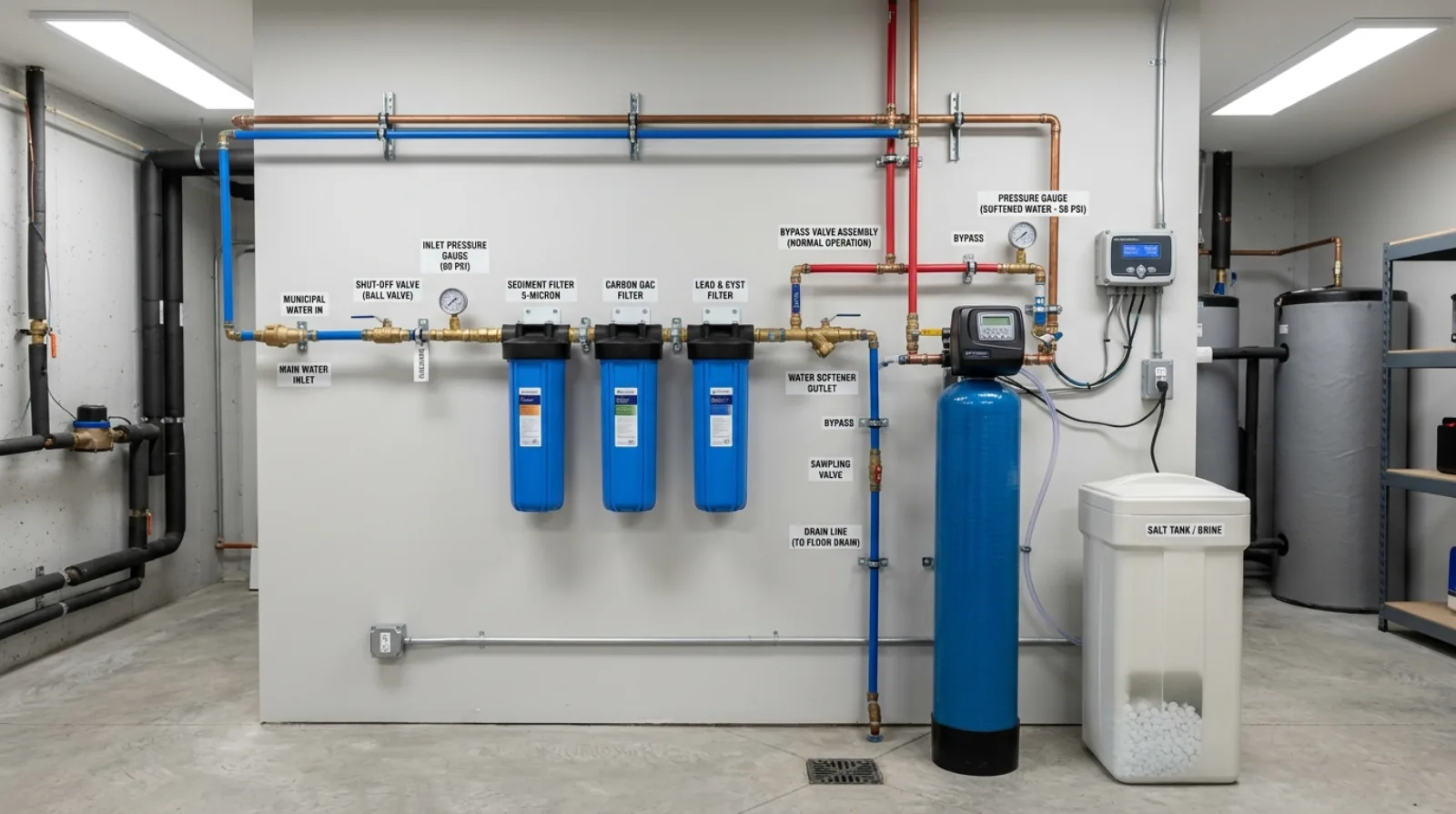
Once the test is back, the treatment "train" is built from a few standard pieces, in the order the water flows through them:
- Sediment filter. The first stage on most systems. It catches sand, grit, and rust particles before they reach the finer equipment downstream. On a well this protects everything after it. On city water it is often the main thing worth having.
- Carbon filter for taste and odour. Activated carbon removes the chlorine taste and smell that municipal supplies carry, and improves the taste of drinking water generally. Many city-water homes only want this and a sediment filter.
- Water softener. This is for hardness, water high in calcium and magnesium that scales up pipes, leaves spots on glassware, and shortens the life of water heaters and dishwashers. Softeners are genuinely useful where the water is hard, common on wells, and often unnecessary on soft Metro Vancouver city water. A softener needs a drain and space for a brine tank, so it has to be planned in.
- Iron and manganese removal. Specific to wells that test high for these. They cause rust-coloured staining on fixtures and laundry. The right media depends on the levels in the test.
- Disinfection. Where a well tests positive for bacteria, a treatment step such as ultraviolet light can be added to keep the water safe. This is a well concern, not usually a city-water one.
- A drinking-water tap at the kitchen. Some owners want the highest polish only where they drink, so a dedicated filtered tap at the kitchen sink treats just that water rather than the whole house.
You do not want all of these on every home. The test tells you which ones belong on yours.
Where it lives, and why rough-in matters
Wherever the treatment lands, it goes on the incoming water line, in the mechanical room or utility area, right after the water enters the house and before it splits out to the fixtures. That location is not flexible, which is exactly why it has to be planned during the plumbing rough-in.
Three things have to be roughed in for the treatment to fit cleanly:
- Physical space in the right order. A treatment train can be several tanks and filters in a row on the wall or the floor. The plumber has to leave a straight, accessible run on the incoming line with room for the equipment the test calls for, plus clearance to service and replace filters later.
- A drain. A water softener flushes its brine tank on a cycle and needs a drain to send that water to. Some filters backwash and need a drain too. If nobody planned a drain at the equipment location, the softener has nowhere to discharge.
- Power, where needed. Some equipment, like a softener's controller or a UV disinfection unit, needs an outlet at the equipment location, which the electrician runs during the electrical rough-in.
Do all of this at rough-in and the system fits like it was always meant to be there. Try to add a full system after move-in and you are finding room on a finished line, and often running a new drain and a new circuit through closed walls. A simple under-sink drinking filter can go in anytime. A whole-home system is far cleaner when the space, the drain, and the power were left for it.
Plan the space even if you are not sure yet
If you are on city water and the test says you barely need treatment today, we still often leave a little room and the connections for a future system. Water sources and preferences change, and leaving a serviceable section of incoming pipe, a nearby drain, and an outlet costs almost nothing at rough-in. It means that if you ever want to add treatment, it is a clean install rather than a plumbing project.
This is the same principle that runs through everything we plan ahead, and it pairs directly with the smart water-leak protection we build into the same mechanical room. Both are about the water inside the walls, one keeps it clean, the other keeps it from flooding the house.
The bottom line is simple. Filtration is not a badge you add because a system looks impressive. It is a targeted answer to what your water test shows, and the treatment your home needs is only clean and reliable if it was roughed into the plumbing before the wall closed.
Frequently asked questions
- Do I need whole-home water filtration on municipal water in BC?
- Often not much. A lot of Metro Vancouver municipal water is soft, low-mineral surface water that is already treated to a drinking-water standard, so a big softener may be solving a problem you do not have. Many homes on city water only want a sediment filter and a taste-and-odour filter at the kitchen tap. The only way to know is to test your specific supply. Icon Projects has the water tested at design so we treat what is actually there, not what a brochure assumes.
- What does well water usually need for treatment?
- It depends on the well, but Fraser Valley wells often carry sediment, iron, manganese, or hardness, and sometimes bacteria. Each of those needs a different piece of equipment: a sediment filter for grit, specific media for iron and manganese, a softener for hardness, and disinfection for bacteria. That is why a detailed water test comes first. Icon Projects builds that test into the planning for a rural home so the right treatment is designed and roughed into the mechanical room from the start.
- Where does water treatment equipment go in a new home?
- It lives on the incoming water line, usually in the mechanical room or utility area, right after the water enters the house and before it splits out to the fixtures. Softeners and some filters need a drain and, in some cases, power, so those have to be planned in. Icon Projects sets aside the space, the drain, and the power at plumbing rough-in, so the treatment train fits cleanly instead of being crammed in later.
- Can I add water filtration after the home is built?
- Some of it, yes. A simple under-sink filter is easy to add anytime. A whole-home softener or multi-stage system is much cleaner when the space, the drain, and the power are roughed in at build, because retrofitting means finding room on a finished line and often running a new drain or circuit. Icon Projects at minimum leaves the space and the connections so a future system is a straightforward install, not a plumbing project.
- Why should a water test come before buying any filtration equipment?
- Water filtration is a set of tools aimed at specific problems, grit, chlorine taste, hardness, iron, bacteria, and the right set depends entirely on what is actually in the water. A large softener installed on already-soft municipal water can solve a problem the house does not have. Icon Projects tests the water at the design stage so treatment is matched to the lab results, not to a sales pitch or a neighbour's setup.
- What is the typical order of components in a whole-home water treatment train?
- Water usually passes through a sediment filter first to catch sand, grit and rust particles, then a carbon filter for chlorine taste and odour on municipal supplies. A well may add a softener for hardness, iron and manganese removal media, and disinfection such as ultraviolet light where bacteria is present. Icon Projects builds only the pieces the water test actually calls for, in this flow order, rather than installing every stage on every home.
- Does a water softener need anything beyond plumbing connections?
- Yes. A softener flushes its brine tank on a cycle and needs a drain to discharge into, and its controller typically needs a nearby power outlet. Both the drain and the electrical outlet have to be planned during rough-in, the drain during plumbing rough-in and the outlet during electrical rough-in, or the equipment has nowhere to go when it arrives.
- Is it worth roughing in space for water treatment even if none is needed right now?
- Often yes. If a water test shows a home on municipal water barely needs treatment today, Icon Projects still commonly leaves a serviceable section of incoming pipe, a nearby drain, and an outlet, since water sources and preferences can change over time. That small allowance at rough-in costs little and turns a future system into a clean install rather than a full plumbing project.