Burnaby's Zero Carbon Step Code rules decide part of this choice before you see a showroom. Under the simple compliance path, EL-4 rules out a gas cooktop. Under the modelled path, gas can still fit. Here is how the rule works, how induction and gas compare in daily cooking, and what each one needs from the house.
"Can we still have a gas range?"
We hear that question often in Burnaby kitchen meetings. Owners who ask for gas usually want control. They want to see the flame, turn the heat down fast, and toss a wok over high heat.
In Burnaby the first answer comes from the City, before any showroom visit. This post covers what the City's Zero Carbon Step Code rule says about cooktops, how induction and gas compare in daily cooking, and what each one needs from the house.
What Burnaby's EL-4 rule says about cooktops
The City of Burnaby sets energy and carbon requirements for new homes on its green building page. For Part 9 homes, building permits submitted on or after January 1, 2025 must meet Step 3 of the Energy Step Code and EL-4 of the Zero Carbon Step Code.
The page explains two ways to meet EL-4:
- The prescriptive path is a checklist of equipment. Heating and hot water cannot use fossil fuels. The City states that fossil-fuel cooktops are allowed at EL-3 and are not allowed at EL-4 under this path.
- The performance path models the whole house against a greenhouse gas limit. The City states that its modelling tool does not specifically disallow natural gas fireplaces or cooktops, so they can still be installed in a home that meets EL-4 this way.
So a gas cooktop is possible on a new Burnaby home, through the performance path, if the modelled house stays under its emissions limit. The heating and hot water will be electric in either case, usually heat pumps. Our post on the Zero Carbon Step Code covers the rest of what EL-4 decides.
We make this choice with the energy advisor at the start of design, because it decides which path the house follows and whether a gas line, a meter and a gas connection fee are part of the project.
How induction works
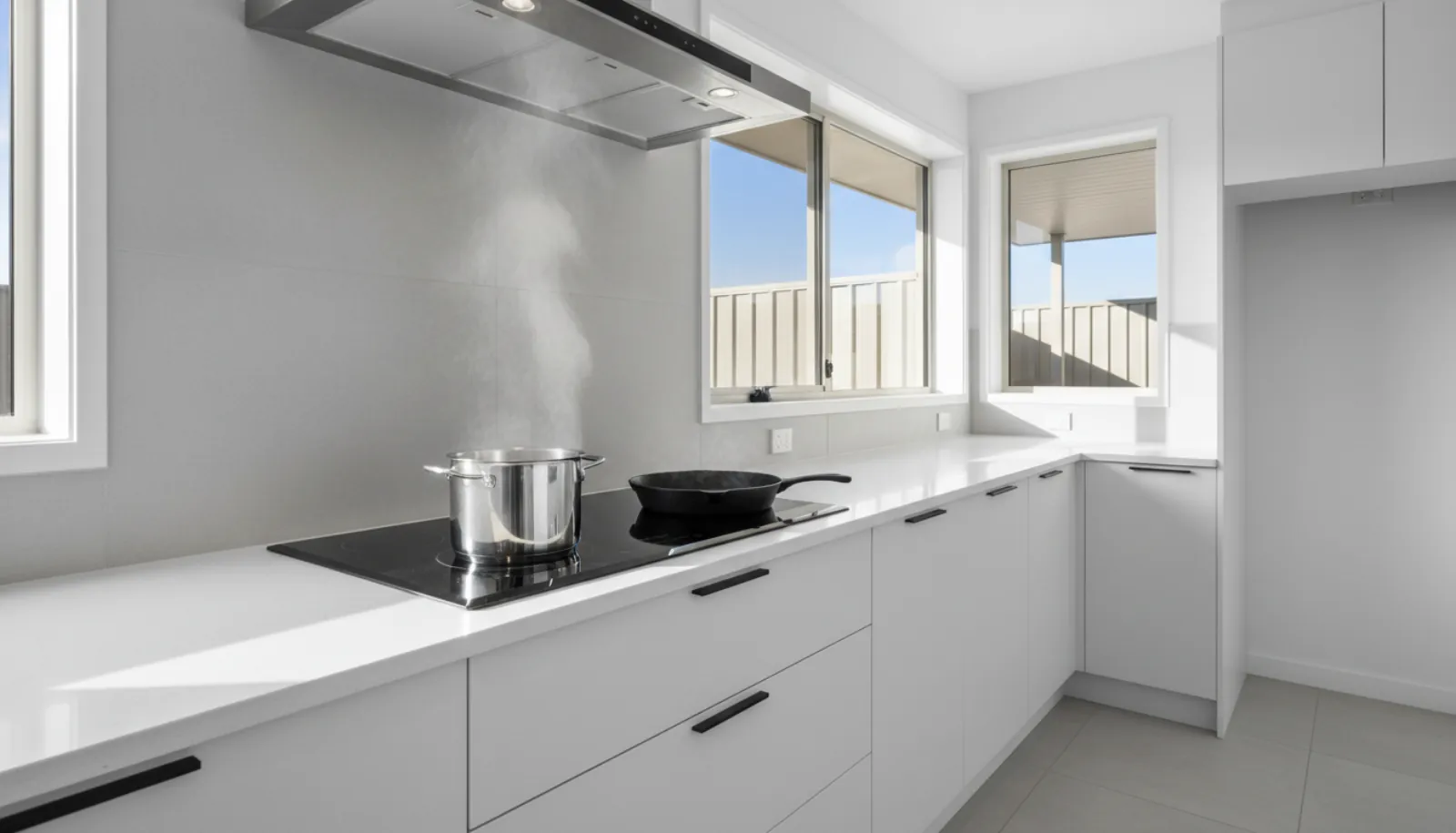
An induction cooktop has a coil under each cooking zone. When a pan sits on the zone, the coil makes a changing magnetic field that heats the pan itself. The glass surface warms up only from contact with the hot pan.
That gives induction four practical traits:
- Fast response. Turn the setting down and the pan stops heating right away, much like turning down a gas flame.
- Fast boiling. The heat is made in the pan, so little is lost to the air around it.
- A cooler surface. The glass is only warm after cooking, and spills do not burn onto it as fast. It wipes clean.
- Safety. Most induction zones switch off when the pan is lifted, and the surface cools quickly.
The one requirement is cookware. Induction only works with pans that a magnet sticks to: cast iron, enamelled steel and most stainless steel. Aluminium, copper and glass do not work unless they have a magnetic base. A fridge magnet is the easiest test.
How gas compares
Gas gives an open flame that wraps up the sides of a pan. For wok cooking, charring peppers, or toasting over the flame, many cooks prefer it. Some induction makers now sell cooktops with a curved wok zone, which gives some of that style on induction.
Gas also needs more from the house:
- A gas line and meter. FortisBC supplies gas in Burnaby. A new gas service adds a meter on the outside wall and a gas line through the house.
- Combustion by-products. Health Canada's fact sheet on cooking and indoor air quality says both gas and electric cooking create particles, and that gas stoves can also produce nitrogen dioxide and carbon monoxide.
- A carbon monoxide alarm. The same fact sheet recommends at least one CO alarm in the home. Our post on smoke and CO alarms covers where the code requires them.
Gas or induction, the range hood does the most work for the air in the kitchen. We size the hood and its makeup air before we pick the cooktop.
Icon Projects Team
The range hood matters with either fuel
Health Canada's fact sheet recommends using the range hood when cooking, preferably on high, and says a hood should extend over the burners. In an airtight new house the hood is the main way cooking smoke, grease and moisture leave the kitchen, with any fuel.
The 2024 BC Building Code requires a kitchen exhaust of at least 47 L/s (Table 9.32.3.6 of the 2024 BC Building Code). Most hoods owners choose move far more than that. A large hood in a tight house pulls air out faster than it can leak back in, so it needs makeup air: a ducted supply of outdoor air that opens when the hood runs. Our post on range hoods and makeup air covers how we size both.
With gas, the hood also removes combustion by-products, which raises the stakes on hood size, capture area and makeup air.
What each one needs from the house
Induction:
- Its own circuit, sized to the maker's specification. Induction ranges draw a large load.
- Room in the electrical service. The electrician adds the cooktop to the service calculation with the heat pump, the hot water heater and any EV charger. Our post on electrical planning covers panel sizing.
- Ventilation space under some cooktops. Many induction units need a clear gap or vents in the cabinet below for cooling. The cabinet maker works from the installation guide.
Gas:
- A gas service, meter and line to the kitchen, sized for every gas appliance on it.
- A shut-off valve near the appliance.
- A performance-path energy model that includes the gas load.
- A range hood sized for combustion by-products, with makeup air.
The kitchen layout around the cooktop
The cooktop location sets the hood location, the duct route, the electrical or gas line, and the cabinet below. We decide it early in kitchen design.
A few layout points apply to both:
- On an island, a cooktop needs a ceiling hood or a downdraft unit. Ceiling hoods capture better than downdrafts, and need a duct route through the ceiling. Our post on kitchen island design covers islands in detail.
- On a wall, a wall hood over the cooktop captures best, with the duct running straight out.
- In a scullery or wok kitchen, a second cooking area handles heavy frying and strong smells, often with its own hood. Our post on pantries and sculleries covers that room.
Some families choose induction in the main kitchen and a second cooktop in the scullery for wok cooking. Under the prescriptive path, both would be electric. Under the performance path, the scullery cooktop could be gas if the model allows it.
Living with induction day to day
Owners new to induction usually notice a few things in the first weeks.
Sound. Induction zones can hum or buzz at high settings, and the cooling fan under the glass runs during and after cooking. The sound depends on the cooktop and the pan. Heavier, flat-bottomed pans are quieter.
Settings. Induction uses numbered power levels and often a boost setting for fast boiling. Most cooks adjust within a week. Some cooktops let two zones join into one large zone for a griddle or a fish pan.
Cleaning. The flat glass top has no grates to lift. Most spills wipe off with a damp cloth once the glass cools. A glass scraper removes anything burnt on.
Timers and controls. Many induction cooktops have a timer per zone and a lock for children. Some connect to the range hood, so the hood starts and changes speed with the cooktop.
Keeping options open
Some owners are unsure and want to keep the choice open for later. Under the prescriptive path, the house is designed all-electric and the cooktop is induction or electric. Under the performance path, the house has a gas line to the kitchen and the gas load is in the energy model.
What does stay open on either path is the size of the electrical service. We size the panel and the service so an induction range can be added later, even in a house that starts with gas. A larger electrical rough-in at the cooktop costs little at framing and saves opening walls in the future.
How we help owners decide
- Cook on both. We suggest owners try induction at an appliance showroom that has a working demo kitchen before deciding.
- Settle the path with the energy advisor. Prescriptive or performance, at the start of design.
- Size the hood and makeup air for the chosen fuel and the cooking style.
- Plan power or gas in the service calculation or the gas line layout.
- Choose the cabinet details from the appliance installation guide.
The cooktop is one of the most used parts of the house, and the City's rules shape it before the design starts. Our custom homes service page shows how we plan kitchens on builds in Burnaby, New Westminster and across the Lower Mainland.
Frequently asked questions
- Can a new house in Burnaby have a gas cooktop?
- It depends on the compliance path. The City of Burnaby requires EL-4 of the Zero Carbon Step Code for building permits submitted on or after January 1, 2025. Under the prescriptive path, fossil-fuel cooktops are not allowed at EL-4. Under the performance path, the City says its modelling tool does not specifically disallow natural gas cooktops or fireplaces, so a gas cooktop can be included if the modelled house stays within its emissions limit.
- Does induction cook as well as gas?
- Induction responds to a change in setting as fast as gas, and it brings water to a boil quickly because the heat is made in the pan itself. The cooking surface stays cooler than a gas grate, which makes cleaning easier. Cooks who want a large open flame for charring or wok cooking often still prefer gas, and some induction makers offer curved wok zones for that style.
- Do I need new pots for induction?
- Induction only works with cookware that a magnet sticks to, such as cast iron, enamelled steel and most stainless steel. Aluminium, copper and glass pans do not work unless they have a magnetic base. A fridge magnet held to the bottom of a pan is a quick test.
- Is gas cooking bad for indoor air?
- Health Canada says both gas and electric cooking create particles, and that gas stoves can also produce nitrogen dioxide and carbon monoxide. It recommends using a range hood, preferably on high, that extends over the burners. In an airtight new house, a properly sized hood with makeup air matters with either fuel.
- What does an induction cooktop need from the electrical system?
- An induction cooktop or range needs its own circuit sized to the maker's specification, and it adds a large load to the home's electrical service. Your electrician includes it in the service size calculation with the heat pump, the hot water heater and any EV charger.
- Can we install a gas line now and decide later?
- Under the prescriptive EL-4 path, a gas cooktop is not allowed, so a gas line for one would not be used. Under the performance path, the gas supply is part of the design and the energy model. We make this decision with the energy advisor before the permit drawings go in.