A creek at the back of a lot can look like a feature. Under BC rules it is a constraint. Here is how riparian setbacks work and how they shape where you can build.
A lot with a creek along the back can look like a gift. Running water, mature trees, real privacy, and a natural view most lots never have. A client showed us exactly that lot, and they had already sketched a house that backed right up to the water with big windows facing it.
Then we measured the buildable area with the riparian rules in mind, and the sketch did not work. Land next to a creek in BC is protected. There is a strip along the water where you cannot build, and the house the owner imagined sat partly inside it.
This is one of the constraints that surprises people most, because a creek reads as a feature, not a limit. Under BC rules it is both.
What the riparian rules protect
Streams and creeks are fish habitat, and the plants and soil along their banks keep that habitat healthy. They shade the water, hold the bank in place, and filter runoff before it reaches the stream. Build too close, clear the vegetation, or change the grading, and you damage that system.
To prevent that, the province has the Riparian Areas Protection Regulation. It sets up a process for keeping development back from watercourses that provide fish habitat. The rule applies across much of the province, and municipalities carry it out through their own permit and development processes.
The core idea is simple. If you want to build near a protected watercourse, a qualified professional assesses it first and sets how far back your development has to stay.
What triggers a riparian assessment
A riparian assessment comes into play when a lot has, or sits next to, a watercourse that provides fish habitat. That includes:
Creeks and streams. The obvious ones, whether they run all year or only part of the year.
Rivers and ravines. Larger watercourses and the ravines that carry them.
Some ditches. A ditch that connects to fish habitat can count, even if it does not look like a natural creek.
If a lot has one of these features, and development is proposed near it, the regulation applies. The assessment is carried out by a qualified environmental professional, often called a QEP. This is a biologist or environmental professional with the credentials to assess the watercourse and apply the regulation.
The QEP looks at the watercourse, the bank, the vegetation, and the fish habitat, and then sets the setback: how far your development has to stay back from the top of the bank. That setback is the number that shapes your project.
Because each municipality applies the regulation its own way, the first move is to confirm with the local authority whether your lot triggers it. This is part of the pre-purchase homework in our lot evaluation checklist, and it belongs in the same early stage as checking zoning and slope.
How the setback changes the buildable area
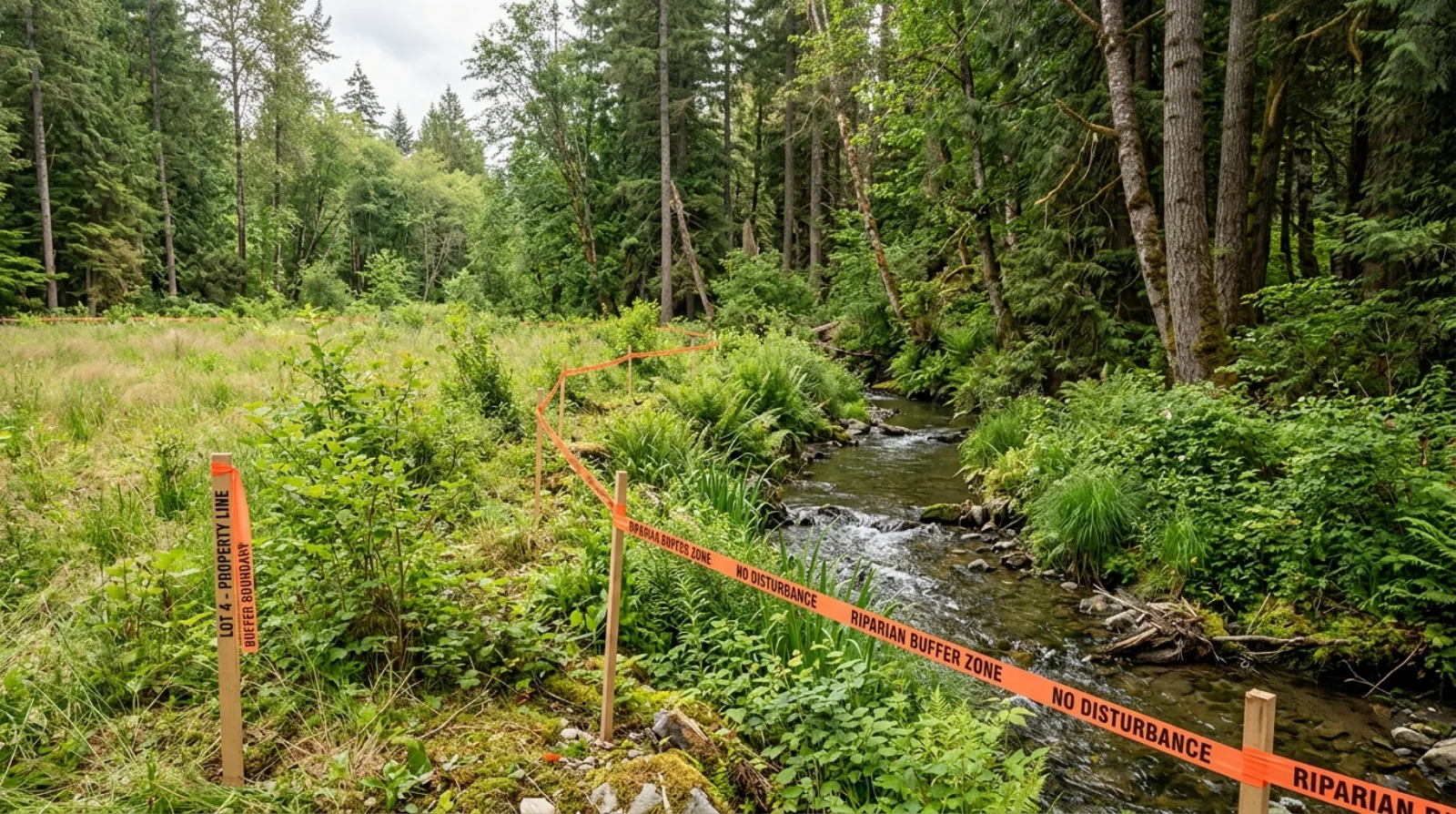
Here is where it becomes real. The riparian setback creates a strip along the watercourse where you cannot place the house, the driveway, or the grading, and often cannot clear the existing vegetation. Everything you build has to sit outside that strip.
On a large, deep lot with a creek tucked into a far corner, the setback might barely affect where the house goes. On a narrow or shallow lot with a creek near the middle of the usable ground, the setback can take a serious bite out of the buildable area. The lot lines say one thing. The area you can actually build on says another.
This is why the sequence matters so much. If you design first and assess later, you risk drawing a house that sits partly inside the protected strip, and then you are reworking the whole plan around the setback you should have started with. If you assess first, you know the real buildable area on day one, and the house is designed to fit it.
The same principle runs through several of the early constraints on a lot. Just as floor space ratio and lot coverage cap how much house the zoning allows, and just as a development permit can control where a house sits on a sensitive lot, the riparian setback caps where the house can physically go. These are all envelope questions, and they all belong before design, not after.
A creek does not shrink your lot on paper. It shrinks the part of the lot you are allowed to build on. Find that line before you draw the house, not after.
Icon Projects Team
How the assessment fits the wider process
On a lot with a watercourse, the riparian assessment usually rides alongside the other early professional work. If the lot is also on a slope, it may need a geotechnical report too, and the two often overlap because creeks and ravines and slopes tend to come together. Our post on geotechnical reports on slope lots covers that side.
The QEP's report becomes a document the whole team works from. The designer places the house outside the setback. The grading and drainage plan respects the protected strip. The municipality reviews the development against the assessment. When the assessment comes first and everyone works from it, the project stays clean. When it arrives late, the design has to bend around it, which is slower and more expensive.
There can also be conditions attached, like protecting or replanting vegetation along the bank, or controlling how runoff reaches the watercourse. These are workable, but they are easier to plan for early than to bolt on at the end.
Can you still build on a creek lot
In most cases, yes. A watercourse reduces the buildable area, it does not usually rule out building. Plenty of good custom homes sit on lots with a creek, and the creek often becomes the best thing about the finished house, a protected green edge that no future development can take away.
The difference between a smooth project and a painful one is timing. Assess the watercourse before you design. Know where the setback falls before you commit to a footprint. Treat the creek as part of the site plan from the first sketch, not as a surprise the permit review hands you.
If you are looking at a lot with any water on it, or even a ditch you are not sure about, get the riparian question answered before subjects come off. A qualified professional can often give you a rough read early, which is enough to tell you whether the lot suits the house you have in mind.
What a QEP assessment actually involves
A QEP assessment is a site-specific piece of work, not a form the professional fills out from a desk. The QEP visits the property, walks the bank of the watercourse, identifies the vegetation and fish habitat present, and measures the physical features that the regulation's setback formula is built around, things like the width of the watercourse, the stability of the bank, and the type of riparian vegetation already growing there. That fieldwork is what produces the specific setback number for your lot, not a flat rule that applies the same distance everywhere.
The timeline for the assessment depends on the QEP's schedule and the complexity of the site, but it is worth building into the pre-purchase or early design timeline as its own step, not an afterthought squeezed in after subjects come off. On a lot where the watercourse question is genuinely uncertain, ordering the assessment early is one of the cheapest ways to avoid redesigning a floor plan around a setback discovered too late.
Does every municipality handle riparian setbacks the same way
No. The Riparian Areas Protection Regulation is provincial, but each municipality carries it out through its own permit and development process, some require the QEP report to be submitted directly to the municipality for review, others require registration through the Province's own notification system. The practical result is the same everywhere, a qualified professional sets the setback and your development has to respect it, but the paperwork path and the timing inside your specific municipality's permit process is worth confirming locally rather than assuming it works the same way it did on a different project or in a different city.
Frequently asked questions
- What is a riparian setback in BC?
- A riparian setback is a protected strip of land next to a stream, creek, or other watercourse where development is restricted to protect fish habitat. It comes from the provincial Riparian Areas Protection Regulation. The width of the setback is set by a qualified environmental professional after they assess the watercourse. Your house, driveway, and grading have to sit outside it. Icon Projects checks whether a lot has a riparian feature during pre-design so the setback is known before any design work begins.
- What triggers a riparian assessment for a custom home?
- A riparian assessment is triggered when a lot has, or is next to, a watercourse that provides fish habitat: a creek, stream, river, ravine, or certain ditches. If development is proposed near that feature, a qualified environmental professional assesses it under the Riparian Areas Protection Regulation and sets the required setback. Each municipality applies the regulation through its own process. Icon Projects confirms with the local authority whether a lot triggers this before design starts.
- How does a riparian setback affect where I can build?
- The setback creates a strip along the watercourse where you cannot place the house, the driveway, or grading, and often cannot clear vegetation. That reduces the buildable area of the lot, sometimes sharply on a narrow or shallow lot. The house then has to be designed to fit the area that remains. Icon Projects maps the setback against the lot early so the design starts from the real buildable area instead of the full lot lines.
- Can I still build a custom home on a lot with a creek in BC?
- In most cases yes, as long as the design respects the riparian setback set by the qualified environmental professional. The creek reduces the buildable area, it does not usually rule out building. The key is to assess the watercourse before you design, so the house fits the area outside the protected strip. Icon Projects sequences the riparian assessment before design so the buildable area is confirmed first.
- What does a QEP actually do when assessing a watercourse?
- A qualified environmental professional visits the property, walks the bank, identifies the vegetation and fish habitat present, and measures the physical features the setback formula depends on, including the width of the watercourse, bank stability, and the riparian vegetation already there. That site-specific fieldwork produces the exact setback distance for that lot, not a flat number applied everywhere.
- How long does a riparian assessment take?
- It depends on the QEP's schedule and the complexity of the site, which is why it is worth ordering early as its own step in the pre-purchase or design timeline rather than squeezing it in after subjects come off. Ordering it early is one of the cheapest ways to avoid redesigning a floor plan around a setback discovered too late.
- Does every BC municipality handle riparian setbacks the same way?
- The Riparian Areas Protection Regulation itself is provincial, but each municipality carries it out through its own permit process, some require the QEP report submitted directly for municipal review, others route it through the Province's own notification system. The setback still comes from a qualified professional either way, but the paperwork path is worth confirming with your specific municipality rather than assuming it matches a different project.
- Who pays for the riparian assessment, the buyer or the seller?
- There is no standard rule, it depends on how the purchase is negotiated. Some buyers order the assessment during a due diligence or subject-removal period before completing the purchase; others negotiate it as a seller-provided report. Either way, the assessment needs to happen before design work starts, since it directly sets the buildable area the house has to fit within.