Engineered and solid hardwood look almost the same in the showroom. In a BC home with wet winters and radiant heat, they behave differently. Here is how we pick between them.
A homeowner in Burnaby showed us two white oak floor samples she was choosing between. They looked the same. Same colour, same width, same matte finish. One was solid wood and one was engineered, and she wanted to know why they cost different amounts and which one to buy.
That is the wrong first question, and we told her so gently. The real question is what the room is doing underneath and around the floor. On the BC coast, hardwood is a moisture decision before it is a looks decision. Get the moisture right and both samples will look great for years. Get it wrong and the prettiest board in the showroom will telegraph the mistake back to you in the second winter.
Here is how we think through engineered versus solid hardwood for a BC home, and where each one actually belongs.
What is the real difference between engineered and solid
The difference is in how the board is built, not in the wood you see on top.
A solid board is one piece of hardwood all the way through. What you walk on is the same material as what sits against the subfloor. A solid oak board is oak top to bottom.
An engineered board is a real hardwood wear layer bonded to a core of cross-layered plywood. The top is genuine wood, the same species and finish you would get in solid. The core underneath is layers of wood glued so their grain runs in alternating directions. That cross-layering is the whole point. Wood wants to expand and shrink across its width when humidity changes. When you glue layers at right angles to each other, they fight that movement, so the finished board moves far less than a solid board of the same wood.
So an engineered floor is still a real wood floor. It is not vinyl, it is not a photo of wood. The surface is the same oak or maple you would choose in solid. It just sits on a core built to stay flat.
Why BC's humidity swings change the answer
Our climate is the reason this matters so much here.
The Lower Mainland has wet, mild winters. Rain sits against the house for months, and outdoor humidity stays high through the cool season. Inside, your heating system pulls that damp air in and dries it right out. So the wood in your floor goes through a big swing: humid conditions for part of the year, bone-dry heated conditions for another part.
Wood feels every bit of that swing. When it takes on moisture it expands. When it dries out it shrinks. A solid board moves the most because it is one solid piece. Cycle it through a wet-to-dry BC year and it can cup (edges rise), crown (middle rises), or gap (boards pull apart and leave lines you can see).
Engineered wood moves far less through the same year because the core resists it. That is the single biggest reason we lean engineered on the coast. It is not that solid wood is bad. It is that our climate punishes movement, and engineered moves less.
Here is the head-to-head in one place, using the points that decide the choice on a BC build.
| Factor | Engineered hardwood | Solid hardwood |
|---|---|---|
| How the board is built | Real hardwood wear layer over a cross-layered plywood core | One piece of hardwood all the way through |
| Movement in BC humidity swings | Moves far less, because the cross-layered core resists it | Moves the most, so it can cup, crown, or gap |
| Over radiant heat | The choice we use, the core stays stable through daily heat cycles | Where we see the worst gapping |
| Refinishing life | Depends on wear-layer thickness, fewer sandings than solid | Can be sanded and refinished many times |
| Wide planks (seven inches or more) | Core holds the wider board flat, much safer here | Wider boards move more, so gaps are more likely |
| Best fit | Radiant slabs, ground-floor slabs, wide planks, most main floors | Upper storeys over wood framing with a steady indoor climate |
| Acclimatization before install | Required, the floor must settle in the conditioned house | Required, the floor must settle in the conditioned house |
We covered the wider flooring picture, tile, concrete, and where vinyl plank fits, in our Burnaby flooring guide. This post zooms in on the wood choice itself.
On the BC coast, solid wood over a heated slab is a bet against physics. Engineered is how you stop gambling and still get a real wood floor.
Icon Projects Team
Radiant heat: the rule that decides most jobs
If your home has hydronic radiant heat, warm water in tubing under or inside the floor, the choice gets simple.
Use engineered, not solid.
Radiant heat warms the floor and then lets it cool, over and over, every day through the heating season. That constant heat-up and cool-down is exactly the cycling that makes solid wood move. An engineered board handles it because the core stays stable through the temperature swing. A solid board over radiant is where we see the worst gapping.
There is a second rule with radiant, and it applies to any wood floor: the system needs a slow, controlled ramp-up before and during install. The slab has to be warmed gradually so it and the wood reach a settled point together, not shocked from cold to hot in one afternoon. We schedule that ramp-up with the radiant designer as part of the build, so it happens on a plan instead of being rushed at the end.
What does not belong over radiant: thick solid planks, and any floor with a thick foam backing that traps the heat you paid to make. The floor over radiant should pass heat up into the room, not hold it down against the slab.
Refinishing: how many lives does the floor get
This is where solid wood keeps its main advantage.
Solid hardwood. Because it is one thick piece of wood, a solid floor can be sanded down and refinished many times over its life. Scratches, dents, a tired finish, a colour you have grown out of, all of it can be sanded away and redone. A solid floor can outlive the people who installed it if it is looked after.
Engineered hardwood. How many times you can refinish depends entirely on the thickness of the top hardwood layer, called the wear layer. A thick wear layer can be sanded and refinished, just fewer times than solid. A thin wear layer can only take a light screen and recoat, not a full sanding down, because there is not enough real wood on top to remove.
So if long-term refinishing matters to you, ask about the wear-layer thickness before anything else. A quality engineered floor with a thick wear layer gives you real refinishing life. A cheap one with a paper-thin top does not, and no one will tell you that unless you ask. We check this on every engineered product we spec so a client knows what they are actually buying.
Look, species, and width
Here the two are close, because the surface is the same real wood either way.
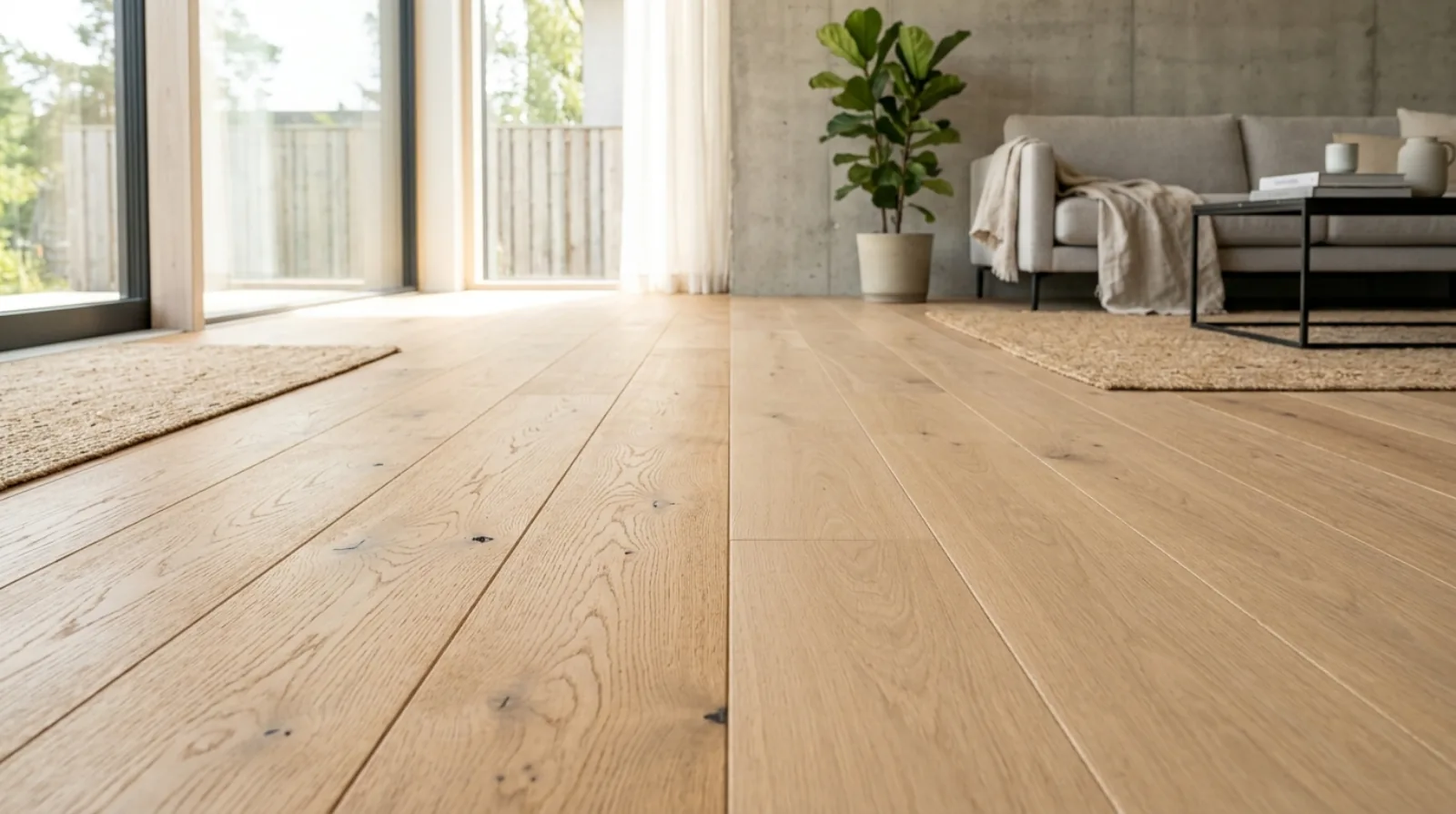
White oak is the default request on almost every build we do, and for good reason. It takes stain and natural finishes well, the grain hides everyday wear, and it does not carry the yellow-orange cast that dates older red oak or honey maple. A light matte or wire-brushed white oak is about as timeless as a wood floor gets. You can get it in both solid and engineered.
Width is where engineered pulls ahead for the look most people want now. Wide planks, the seven to nine inch range is the common ask, read calm and modern because there are fewer seams across the room. But wider boards move more in absolute terms, so the wider you go, the more you want an engineered core holding them flat. Wide solid planks in our climate are asking for gaps. Wide engineered planks are much safer.
On finish, the same rule holds for both: matte, natural, and quiet ages slowly. High-gloss, dark, and trendy grey-wash tones age fast. Fall in love with the wood, not the finish.
Where each one actually fits
Here is how we sort it on a real BC build.
Reach for engineered when:
- The floor sits over a radiant slab. This is close to a hard rule.
- You want wide planks (seven inches or more).
- The room is on a ground-floor slab or anywhere moisture is harder to control.
- You want the safest long-term bet against our humidity swings, which is most main-floor situations.
Solid still earns its place when:
- The floor is on an upper storey over a wood-framed structure, away from any slab.
- The indoor climate is steady and the owner will keep humidity in a sensible range through the year.
- Long-term refinishing life is a priority and you want the maximum number of sand-and-refinish cycles.
- Board widths are kept moderate rather than wide.
Both are real wood. Both can look beautiful. The choice is about matching the board to what the room underneath is doing.
Acclimatization: the step that quietly decides everything
Most floor failures, engineered or solid, are actually born here.
Wood flooring needs to sit inside the finished house, in its real conditions, long enough to settle to the moisture level it will live at. On the coast this is not optional. Our outdoor air is wet, our heated interiors are dry, and a board delivered off a damp truck and nailed down the same afternoon is set up to move.
Doing it right means the house is closed in, the heating and ventilation are running and holding a normal indoor climate, and the flooring is stacked with spacers and resting in the rooms where it will go, for the time the manufacturer asks for. Rush this and you get gapping in the first dry winter or cupping in the first wet stretch. Both are avoidable, and both are on the installer, not the wood.
This ties into build sequence. Flooring goes in after the home is weather-tight and conditioned, never before. When a warranty claim over gapping or cupping does come up, providers judge it against the BC Housing Residential Construction Performance Guide, the same reference behind the 2-5-10 warranty. A floor that moved because nobody let it settle is a workmanship issue, not a product defect, and proper acclimatization is how you stay on the right side of that line.
Frequently asked questions
- Is engineered hardwood better than solid hardwood in BC?
- For most BC rooms, yes, because our climate is hard on wood. Engineered hardwood has a cross-layered core that keeps the board flatter when humidity swings from a wet winter to a dry, heated interior. Solid wood moves more, so it is more likely to cup or gap here. Solid still has a place on an upper floor with a steady indoor climate and an owner who keeps humidity in check. Icon Projects picks engineered as the safe default and reaches for solid only where the conditions clearly support it.
- Can you refinish engineered hardwood?
- Usually once or twice, depending on how thick the top hardwood layer is. A thicker wear layer can be sanded and refinished like solid wood, just fewer times over its life. A thin wear layer can only take a light screen and recoat, not a full sanding. Solid hardwood can be sanded many more times because it is one piece of wood all the way through. Icon Projects checks the wear-layer thickness before we spec any engineered floor so you know what you are getting.
- Can I put hardwood over radiant heat in a BC home?
- Yes, but use engineered, not solid. Engineered's cross-layered core handles the heat-up and cool-down cycles far better, so the floor stays flat. The radiant system also needs a slow, controlled ramp-up before and during install so the slab and the wood settle together instead of getting shocked. Icon Projects coordinates that ramp-up with the radiant designer so it is scheduled, not improvised on the last day of the job.
- What is the structural difference between engineered and solid hardwood?
- A solid board is one piece of hardwood all the way through, so a solid oak board is oak top to bottom. An engineered board is a real hardwood wear layer bonded to a core of cross-layered plywood, where the layers are glued with their grain running in alternating directions. That cross-layering fights the wood's natural tendency to expand and shrink across its width, so an engineered board stays flatter through a humidity swing than a solid board of the same species.
- Why does BC's climate make solid hardwood riskier than in other regions?
- The Lower Mainland has wet, mild winters where outdoor humidity stays high for months, while the indoor heating system dries that same air out once it enters the house. Wood responds to this swing by expanding when humid and shrinking when dry, and a solid board, being one solid piece, moves the most through that cycle. Over a wet-to-dry BC year, solid wood can cup at the edges, crown in the middle, or gap between boards in a way engineered wood resists.
- Does wide-plank flooring work better as engineered or solid in BC?
- Engineered is the safer choice for wide planks. Wider boards move more in absolute terms when humidity changes, so a seven to nine inch solid plank is more likely to gap or cup in our climate than a narrower one. An engineered core holds the wider board flat through the same humidity swing, which is why Icon Projects pairs the wide-plank look people want now with an engineered core rather than solid wood.
- What happens if hardwood flooring is installed without acclimatization?
- The floor is set up to move. Flooring needs to sit inside the finished, conditioned house long enough to settle to the moisture level it will live at before installation, and skipping this step is where most floor failures actually begin. A board delivered off a damp truck and nailed down the same afternoon will likely gap in the first dry winter or cup in the first wet stretch, and warranty providers treat that outcome as a workmanship issue rather than a product defect.
- Does white oak work equally well in solid or engineered hardwood?
- Yes, because the surface is the same real wood either way, and white oak is the default request on almost every BC build Icon Projects does. It takes stain and natural finishes well, the grain hides everyday wear, and it does not carry the yellow-orange cast that dates older red oak or honey maple. The construction choice, solid versus engineered, depends on the room's moisture conditions, not on which one shows the species better.