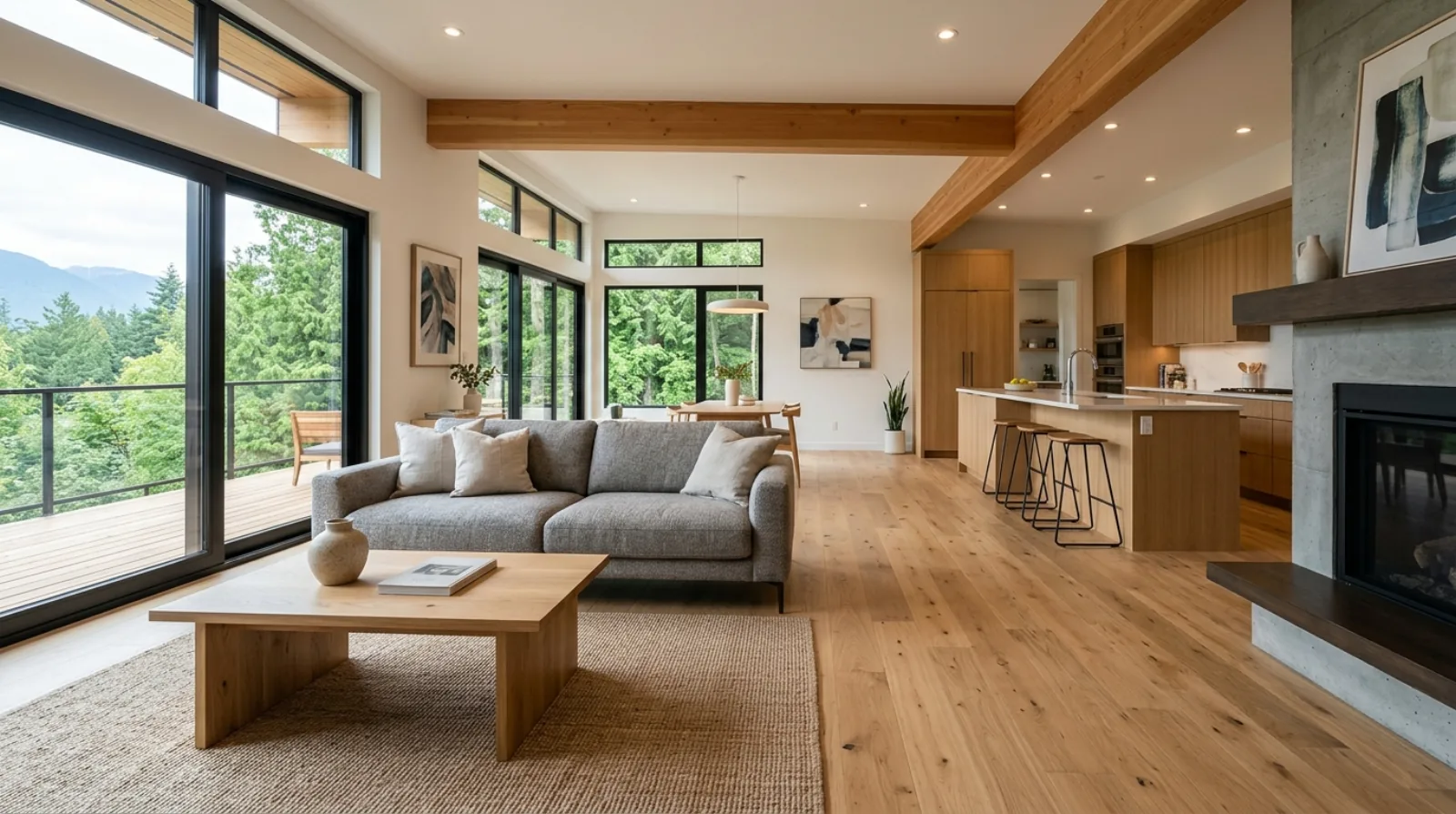
Quartzite, marble, granite, engineered quartz, porcelain slab, or solid surface, each wears and ages differently in a Burnaby kitchen. Here's how we match the counter to the room, plan seams and edges, and what the silica safety story means for your fabricator.
Which countertop material is right for a Burnaby custom home kitchen?
There is no single right answer, and any builder who gives you one without asking how you cook is selling, not advising. The honest version is this: natural stone, engineered quartz, porcelain slab, and solid surface each win on different axes, heat, scratch, stain, etch, repairability, and the way they age, and the right pick is the one whose weaknesses you can live with in the room you actually use. A marble island is a joy for a baker and a heartbreak for a family that leaves citrus on the counter. A quartz island is bulletproof against stains and a worry near a 230°C pan straight off the cooktop. So before we look at a single slab, we ask how this kitchen gets used.
We've handed over kitchens across Burnaby Heights, Brentwood, and Deer Lake where the counters look the same on move-in day and behave completely differently five years in. The difference was almost never the price of the slab. It was whether the material matched the household.
Natural stone: quartzite, marble, and granite each age on their own terms
Natural stone is quarried, not manufactured, so every slab is one of a kind and no two seams match perfectly. That's the appeal and the discipline of it.
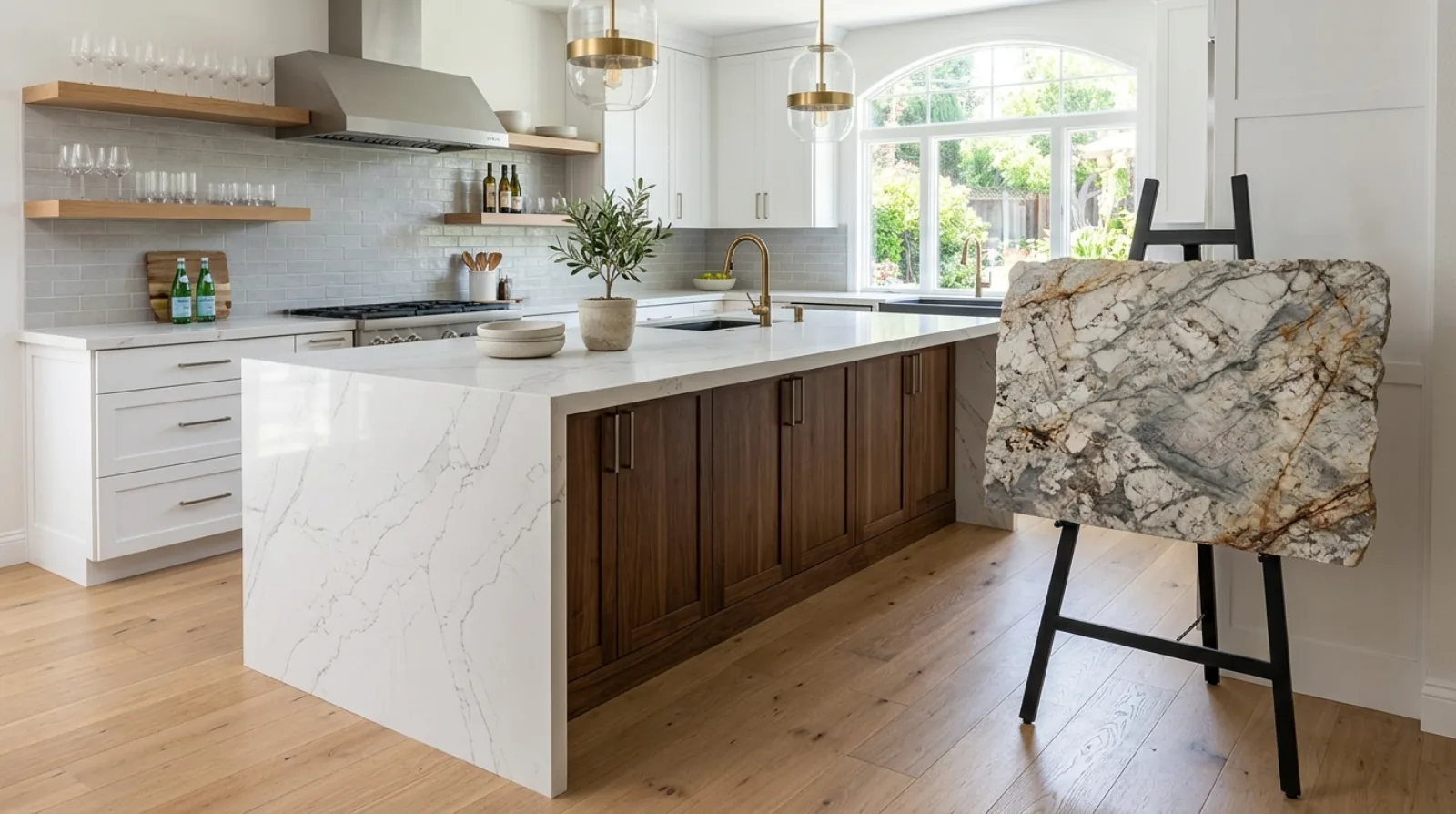
Quartzite is the one we reach for most often when a client wants the look of marble without the anxiety. It's a metamorphic stone, dense, hard, and far more resistant to etching and scratching than marble. Many quartzites take a sealer well and shrug off daily kitchen use. The catch is that the trade name "quartzite" gets stretched in some showrooms to cover softer dolomitic stones that behave more like marble, so we test a sample with a drop of lemon juice and a knife before anyone commits. If it etches or scratches in the showroom, it'll do the same in your kitchen.
Marble is the most beautiful and the most demanding. It's calcium-based, which means acid, lemon, wine, tomato, a splash of vinegar, eats the polish and leaves a dull etch mark. It also stains more readily than denser stones. None of that makes it a bad choice; it makes it a choice for someone who either wants a honed (matte) finish that hides etching, or who genuinely likes the lived-in patina that marble develops. We've put marble on a baking station and quartzite on the main run in the same Capitol Hill kitchen, and everybody was happy.
Granite fell out of fashion when the busy speckled slabs of the 2000s went everywhere, but the stone itself is excellent, hard, heat-tolerant, and stain-resistant when sealed. Today's granites run quieter and more linear, and they remain one of the most forgiving natural surfaces for a working kitchen.
Natural stone doesn't fail. It ages, and the only mistake is choosing a stone that ages in a way you didn't sign up for.
Icon Projects Team
All three want periodic sealing, and all three reward honest expectations. The conversation we have at the table is less "which is best" and more "which patina can you live with."
Engineered quartz: consistency, and the worker-safety story you should know
Engineered quartz is a manufactured slab, crushed stone bound in resin and pigment. Because it's made, not quarried, it's non-porous, never needs sealing, resists stains and etching better than almost any natural stone, and comes in a consistent pattern you can match seam to seam. For a busy family island, it's often the lowest-worry surface we install. Its two real limits: it's less heat-tolerant than stone (a pan straight off the burner can scorch or stress it, so you want trivets), and direct sun over years can fade some colours, which matters on a counter near big south-facing glass.
There's a second part of this conversation that's reshaping the BC fabrication trade, and we think clients deserve to hear it. Traditional engineered quartz is high in crystalline silica, and cutting and polishing it releases respirable silica dust that has caused a serious rise in silicosis, an irreversible lung disease, among stone-countertop workers. WorkSafeBC has tightened enforcement of silica controls, and reputable BC fabricators now run wet-cutting, enclosed equipment, ventilation, and respiratory protection. It's also pushed manufacturers to release lower-silica and silica-free engineered slabs.
What this means for you as a homeowner is simple: ask your fabricator how they control silica. A shop that answers confidently, wet processing, exposure monitoring, the right protection for their crew, is a shop that's well-run in every other way too. We only work with fabricators who take it seriously, because the people cutting your counter matter as much as the slab.
Porcelain slab and solid surface: the two specialists
Two materials don't get enough airtime, and both earn their place in the right spot.
Porcelain slab is a large-format sintered surface, hard, heat-proof, UV-stable, and non-porous. It barely scratches, won't etch, and laughs off a hot pan, which makes it our default for outdoor kitchens on a covered Burnaby deck and for fireplace surrounds. Indoors it's excellent too, though it's typically thinner than stone, so the edge needs a mitred build-up to read as a substantial counter, and the fabrication demands a shop that's genuinely good with large brittle panels. Done by the wrong hands, the edges chip.
Solid surface (acrylic-based, the Corian family) is the quiet problem-solver. It runs joint-free, sinks integrate with no visible seam, repairable by sanding out scratches, and warm to the touch. It's not as hard or heat-tolerant as stone or porcelain, so it's not where we'd put the main cooking run. But for a scullery, a laundry counter, a mudroom bench, or a wet bar, where a continuous easy-clean surface beats showroom drama, it's underrated.
Matching the counter to a scullery or working-kitchen split
A lot of Burnaby custom kitchens we build now have two counters: the show kitchen and the scullery (or working pantry) behind it. That split is the cleanest reason to stop thinking about one countertop and start thinking about the right surface for each job. This is the same logic we walk through in our kitchen design guide when we lay out work zones.
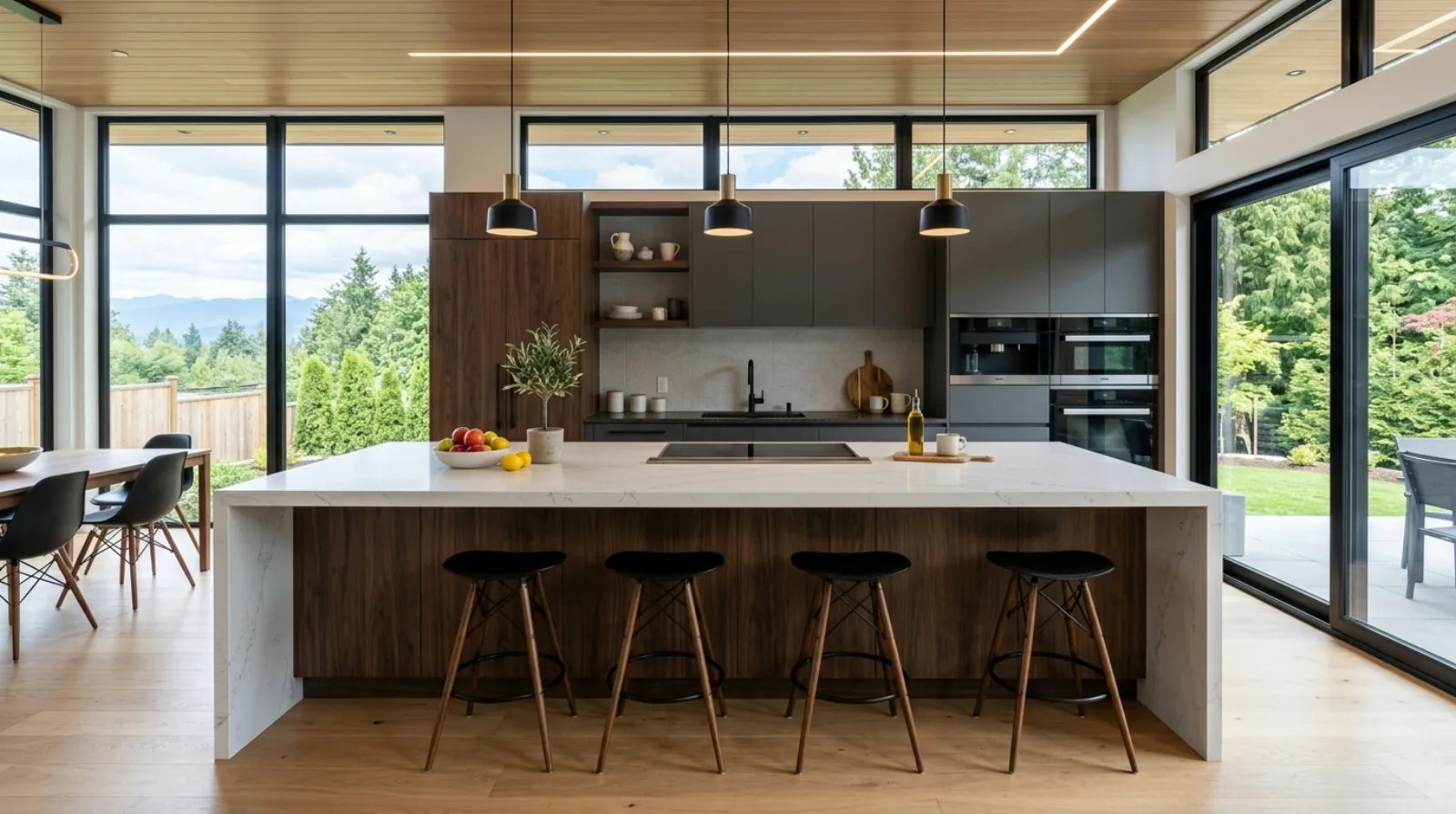
Out front, on the island everyone gathers around, you can spend your visual budget, a dramatic quartzite, a honed marble, a waterfall end. Behind it, in the scullery where the real cooking, prepping, and dish-stacking happens out of sight, you put the bulletproof material: a workhorse quartz or a solid surface with an integrated sink that wipes down in one pass. The guests never see it, and it never lets you down.
That division does something else too: it lets you put a material you love but worry about, marble, say, in the spot where it stays clean and admired, while the hard-use abuse lands on a surface that doesn't care. It's the same philosophy behind features worth investing in: spend where it shows and matters, protect the rest.
Edges, waterfalls, thickness, and where the seams go
The slab gets all the attention, but the fabrication details are what make a counter read as custom instead of ordinary.
- Edge profile. A simple square or lightly eased edge looks current and lets the stone speak. Ornate ogee and bullnose profiles date a kitchen quickly. We default to clean.
- Thickness. Standard slabs are often around 20mm or 30mm. A thicker look, a 60mm or 100mm island edge, is built by mitring two pieces together so the seam disappears into the corner. It's a fabrication skill, and it's where good shops separate from average ones.
- Waterfall ends. Running the slab down the side of an island to the floor is striking, but the vein or pattern has to be "bookmatched" so it flows around the corner. Done well it's a centrepiece; done carelessly the grain jumps at the corner and the whole thing looks wrong. It also commits more material and demands precise templating.
- Seams. Slabs have a maximum size, so a long run or a big island will have a seam. The art is putting it where it's least seen and least stressed, never centred over a dishwasher cutout or an undermount sink, where the span is weakest. We plan seam locations on paper before the slab is cut, and we'd rather move a seam than apologise for it later.
Get these right and an affordable slab can look like a million dollars. Get them wrong and the most expensive stone in the showroom looks like a builder special.
Frequently asked questions
Does quartz or quartzite scratch and stain less? They're different materials despite the similar name. Engineered quartz is non-porous, never needs sealing, and resists stains and etching better than almost any natural surface, but it's more sensitive to heat. Natural quartzite is harder and more heat-tolerant, but it should be sealed periodically and the softer stones sold under that name can etch. For a worry-free family island, engineered quartz usually wins on stains; for heat and natural character, quartzite.
Will marble really etch in a Burnaby kitchen? Yes, marble is calcium-based and any acid (lemon, wine, tomato, vinegar) will dull the polish wherever it sits. That isn't a defect; it's how the stone behaves everywhere. If you love the look, choose a honed matte finish that hides etching, reserve marble for a baking station or a low-traffic spot, and accept the patina as part of its character.
Why does my fabricator keep talking about silica dust? Because cutting engineered quartz releases respirable crystalline silica, which has driven a serious rise in the lung disease silicosis among countertop workers. WorkSafeBC has tightened enforcement, so good BC shops now wet-cut, ventilate, and protect their crews, and low-silica slabs are increasingly available. A fabricator who talks about it openly is one you want.
Can I put a different countertop in the scullery than the main kitchen? Absolutely, and we recommend it. Put the dramatic, more delicate material on the island everyone sees, and a tougher, easy-clean surface, a hard-wearing quartz or a solid surface with an integrated sink, in the scullery where the heavy work happens. It protects the showpiece and gives the working zone a surface that never complains.
The slab you pick will outlast the appliances, the paint, and probably the dishwasher twice over. Choose it for the way your family actually cooks, plan the seams and edges before anyone fires up a saw, and ask the people cutting it how they keep themselves safe. Do that, and you'll run your hand across that counter in twenty years and still be glad you chose it.
Related on the Journal
- Designing the kitchen in a Burnaby custom home
- Materials that age beautifully
- Custom home features worth investing in
- Quartz vs natural stone countertops in BC
Frequently asked questions
- Does quartz or quartzite scratch and stain less?
- They are different materials despite the similar name. Engineered quartz is non-porous, never needs sealing, and resists stains and etching better than almost any natural surface, but it is more sensitive to heat. Natural quartzite is harder and more heat-tolerant, but the softer stones sold under that name can etch and should be sealed periodically. For a worry-free family island, engineered quartz usually wins on stains; for heat tolerance and natural character, quartzite.
- Will marble really etch in a kitchen?
- Yes, marble is calcium-based and any acid (lemon, wine, tomato, vinegar) will dull the polish wherever it sits. That is not a defect; it is how the stone behaves everywhere. If you love the look, choose a honed matte finish that hides etching, reserve marble for a baking station or a low-traffic spot, and accept the patina as part of its character.
- Can I put a different countertop in the scullery than the main kitchen?
- Absolutely, and Icon Projects recommends it. Put the dramatic material on the island everyone sees, and a tougher, easy-clean surface, a hard-wearing quartz or a solid surface with an integrated sink, in the scullery where the heavy work happens. It protects the showpiece and gives the working zone a surface that never complains.
- Is granite still a good countertop choice for a custom home?
- Yes, granite fell out of fashion when busy speckled slabs from the 2000s were everywhere, but the stone itself remains excellent. It is hard, heat-tolerant, and stain-resistant when sealed, and today's granites run quieter and more linear than older patterns. Granite is one of the most forgiving natural surfaces for a working kitchen, and Icon Projects still specs it where a client wants natural stone durability without marble's fussiness.
- What is the best countertop for an outdoor kitchen in Burnaby?
- Porcelain slab is Icon Projects' default for outdoor kitchens on a covered Burnaby deck. It is a large-format sintered surface that is hard, heat-proof, UV-stable, and non-porous, so it barely scratches, will not etch, and shrugs off a hot pan sitting directly on it. Those same properties also make it a strong choice for fireplace surrounds where heat resistance matters.
- What is solid surface countertop material and where does it work best?
- Solid surface is an acrylic-based material, the Corian family, that runs joint-free because sinks integrate with no visible seam. It is warm to the touch and any scratch can be sanded out, but it is not as hard or heat-tolerant as stone or porcelain, so Icon Projects does not use it on the main cooking run. It earns its place in a scullery, a laundry counter, a mudroom bench, or a wet bar, where continuous easy-clean performance matters more than showroom drama.
- Do countertops need to be resealed over time?
- Natural stone counters, quartzite, marble, and granite, all want periodic sealing to stay stain-resistant, since they are porous to some degree even when polished. Engineered quartz never needs sealing because it is manufactured and non-porous. Porcelain slab is also non-porous and needs no sealing. Icon Projects tells clients up front which material they are choosing so the maintenance expectation is set before installation, not discovered later.
- How thick should a kitchen island countertop be?
- Standard slabs typically run 20mm or 30mm thick. For a bolder island edge, a 60mm or 100mm look is achieved by mitring two pieces of the same slab together so the seam disappears into the corner, rather than using a single thick slab. Icon Projects treats this mitred build-up as a fabrication skill that separates a custom-looking counter from an ordinary one, and it has to be planned before the slab is cut.