
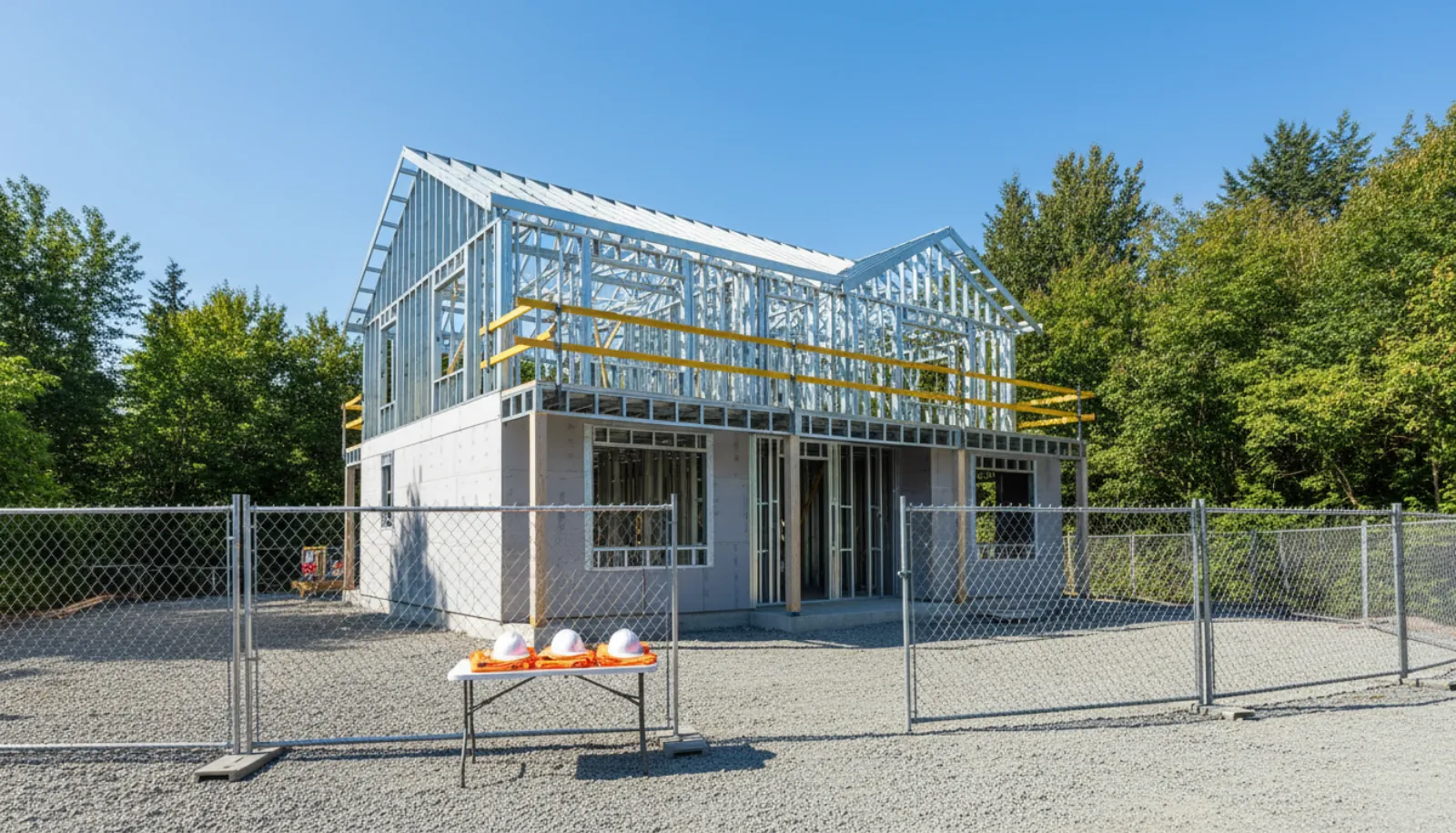
Owners want to see their house take shape, and they should. A construction site is also a workplace with real hazards, and BC law makes someone responsible for coordinating safety on it. Here is who that is, why it matters for owners, and how we set up site visits on our Burnaby builds so they are safe and useful.
Owners want to see their house take shape, and we want them to. Some of the best decisions on a custom home get made standing in a framed room, looking at where the light falls and where a doorway lands.
A construction site is also a workplace, and it has real hazards: open excavations, floor edges with no railings yet, stairs with no handrails, extension cords, nails, rebar ends, and machines whose operators cannot see behind them. BC law makes someone responsible for coordinating safety on that site, and it can be the owner.
This post covers who is responsible, why site visits are booked, what to wear, how the hazards change through the build, and how to bring children. It is general information. Your builder's site rules and WorkSafeBC's requirements are what apply on your site.
Who is responsible: the prime contractor
BC's Workers Compensation Act sets the rules:
- Section 13 defines a multiple-employer workplace as one where workers of two or more employers are working at the same time. A custom home build is that kind of workplace: framers, plumbers, electricians and other trades often overlap.
- The same section defines the prime contractor as the contractor or other person who enters into a written agreement with the owner to take the role. If there is no written agreement, the owner of the workplace is the prime contractor.
- Section 24 says the prime contractor must ensure that the health and safety activities of employers, workers and other persons at the workplace are coordinated, and must do everything reasonably practicable to establish and maintain a system that ensures compliance with the health and safety rules.
On a builder-run custom home, the builder normally takes on the prime contractor role in the contract. Check that your contract says so in writing. Owners who manage their own builds, or hire trades directly, should know that the role falls to them by default unless someone agrees in writing to take it.
Section 25 adds duties that stay with the owner either way: to maintain the land and premises so they are safe for people at or near the workplace, to give the prime contractor or employer any information the owner knows about hazards, and to comply with the health and safety rules. If you know about an old oil tank, a soft patch of ground, or asbestos in the old house, tell your builder. Our post on the hazardous materials survey covers what the survey finds.
Why visits are booked
"Other persons at the workplace" in section 24 includes visitors. When an owner arrives on site, the prime contractor is responsible for their safety. That is why we book visits:
- The site lead is there, to walk with you and answer questions.
- The site is ready for you. We plan visits for times when work that is hazardous to visitors, such as a concrete pour, a crane lift or roofing, is not under way.
- Everyone signs in, so the site lead knows who is on site in an emergency.
- The right trade can be there if you want to talk about the kitchen layout with the cabinet maker or the lighting with the electrician.
Our weekly site meeting is the regular slot for owner visits, and we add others for walkthroughs at key stages.
We want owners on site, and we want them there with us. A booked visit is a better visit: the site is ready and the right people are there to answer questions.
Icon Projects Team
What to wear
On a build site, visitors should wear:
- A hard hat. Ask the site lead whether one is waiting for you.
- Sturdy closed-toe footwear with stiff soles. Nails and screws on the ground go through running shoes.
- Long pants.
- A high-visibility vest when machines are working.
- Eye protection where the site lead asks for it.
Leave loose scarves and dangling jewellery at home, and keep your phone in your pocket while walking. It is easy to trip on site while looking at a screen.
How the hazards change through the build
Each stage of a build has its own risks:
- Demolition and excavation. Open holes with steep sides, heavy machines and trucks. Owners view this stage from outside the fence. Our post on site preparation covers it.
- Foundations. Formwork, rebar with exposed ends, and concrete trucks and pumps. Visits are from the edge, with the site lead.
- Framing. The stage owners most want to see. Upper floors may have open edges, stair openings and window openings with no guards yet. We walk owners on the floors that have guards or temporary railings in place.
- Roofing. No visits to the roof.
- Rough-in. Cords, ladders, holes in floors for pipes and ducts, and work overhead. This is the stage for the pre-drywall walkthrough, which we schedule with owners.
- Drywall and finishing. Dust, scaffolds, and fresh finishes that are easy to damage. Shoe covers may be needed indoors.
- Before handover. The house looks finished, but trades are still working, and some systems are live. The pre-occupancy walkthrough is the planned visit at this stage.
Making each visit useful
A site visit is safest and most useful when it has a purpose. Before each one, we agree with the owner what they want to see and decide. A few examples by stage:
- After the foundation: check the house's position on the lot and the height of the main floor against the street and the neighbours.
- After framing: walk each room for size, ceiling height, window positions and views. Stand where the kitchen island will be. Check the stair.
- At rough-in: confirm outlet, switch, data and light locations, the shower valve and head heights, and the blocking for TVs, grab bars and heavy items.
- Before cabinets: confirm appliance sizes, the cabinet layout against the walls, and the lighting under and over cabinets.
- Before handover: walk the finished house with a deficiency list.
Bring a tape measure, a notebook and the latest drawings. A phone camera helps too, used while standing still. Write down every decision, and send it to the project manager the same day so the trades get it in writing. Our post on the selections schedule explains how those decisions feed the build.
First aid and emergencies
A site with several trades also needs a first aid plan. WorkSafeBC sets out prime contractor first aid responsibilities for multiple-employer workplaces, and the prime contractor coordinates first aid for everyone on site. When you sign in, the site lead can point out the first aid kit, the muster point and the emergency contact numbers posted on site.
If you are ever on site when someone is hurt, follow the site lead's directions, stay clear of the area, and let the trained first aid attendant work.
Children and pets
Children love to see their future bedroom. They can come at quieter stages, booked ahead, holding an adult's hand, and staying close to the site lead. We avoid bringing children during excavation, upper-floor framing, roofing, or when machines are working.
Pets stay home. A dog on a site can step on nails, fall into an excavation, or startle a worker on a ladder.
Visiting after hours
Owners sometimes drive by in the evening and want to walk through. We ask owners not to enter the site after hours on their own. The site may have open edges, stored materials and live temporary power, and nobody is there to help in an emergency. A locked gate also protects the owner's house against theft and damage. Our post on insurance during a build covers how the site is insured.
If you see something from the street that worries you, such as a gate left open or something blown over by wind, call your site lead.
Owner work on site
Some owners want to do part of the work themselves: painting, landscaping, installing a sound system. That has to fit the prime contractor's safety system, the contract and the insurance. We agree it in writing first, including when it happens, which areas are handed over, and who is responsible for safety during that work.
Neighbours
The same law covers people near the workplace, and our responsibility extends to the sidewalk and the street. Our post on building next to neighbours covers how we manage the street side of a Burnaby site.
How we run owner visits
- Book the visit with the site lead.
- Sign in at the gate and put on a hard hat and vest.
- Walk with the site lead, on the routes they choose for that stage.
- Ask questions, and bring decisions to make on site.
- Sign out when you leave.
Our custom homes service page shows how we run builds in Burnaby, Coquitlam and across the Lower Mainland.
Frequently asked questions
- Can I visit my house while it is being built?
- Yes, and we encourage it, with a booked visit led by our site lead. A construction site is a workplace, and the prime contractor is responsible under BC law for coordinating the health and safety of everyone on it, including visitors. Booking lets us make the site safe for your visit and have the right people there to answer questions.
- Who is responsible for safety on a residential build site in BC?
- Under section 24 of BC's Workers Compensation Act, the prime contractor at a multiple-employer workplace must ensure that the health and safety activities of employers, workers and other persons at the site are coordinated, and must do everything reasonably practicable to keep a system in place for compliance. Section 13 says that if no one has agreed in writing to be the prime contractor, the owner of the workplace is the prime contractor.
- Does the owner have safety duties even when a builder is prime contractor?
- Yes. Section 25 of the Act requires every owner of a workplace to maintain the land and premises in a way that ensures the health and safety of people at or near the workplace, to give the employer or prime contractor information the owner knows about hazards, and to comply with the health and safety rules.
- What should I wear to visit a construction site?
- Sturdy closed-toe footwear with stiff soles, long pants and a hard hat at minimum, plus a high-visibility vest when machines are working. Ask your site lead whether to bring your own hard hat and vest. Follow the site lead's instructions, which may add eye protection or other gear for the stage of work.
- Can I bring my children to the build site?
- Children can visit at quieter stages, booked ahead, with an adult holding their hand and staying close to the site lead. We avoid bringing children during excavation, framing of upper floors and roofing, or when machines are working.
- Can I do some of the work myself on site?
- Any work on site has to fit the prime contractor's safety system, the contract and insurance. If an owner wants to do part of the work, such as painting or landscaping, we agree it in writing first, including when it happens and who is responsible for safety during it.


