
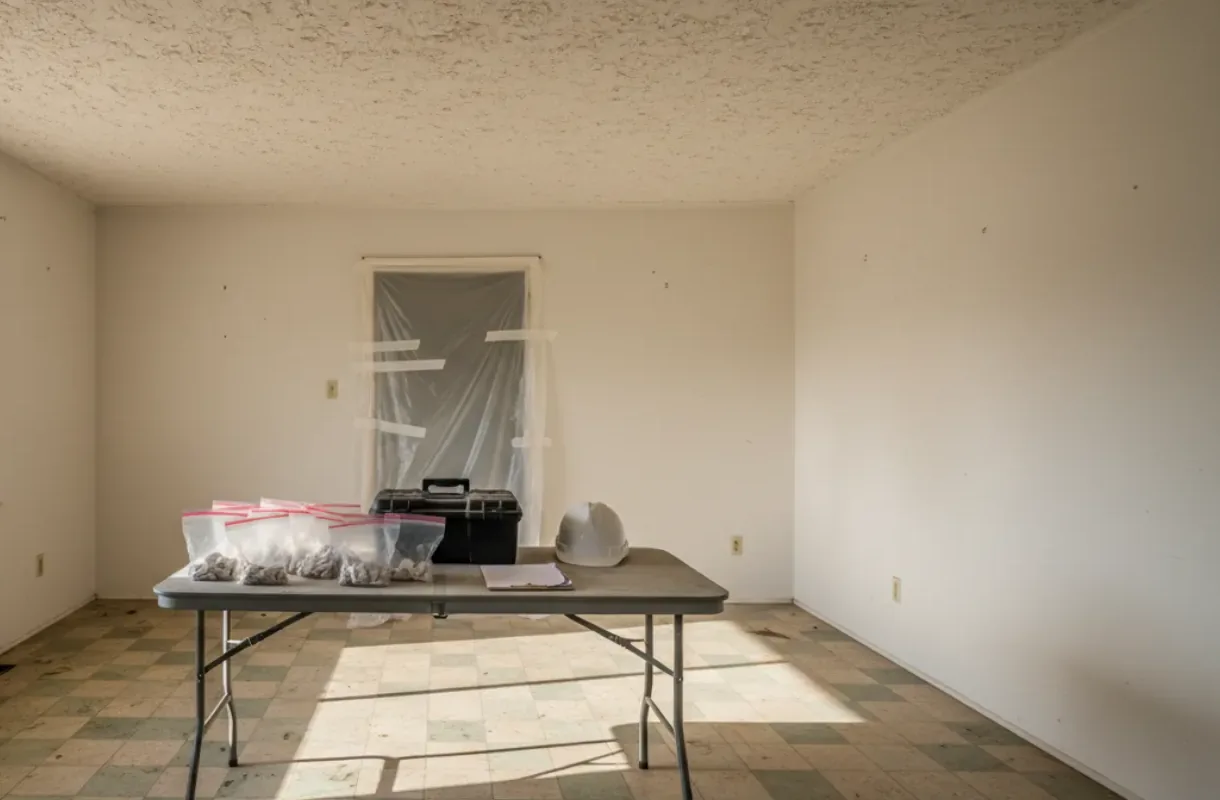
Before an older Burnaby house comes down, a qualified person has to find and report the asbestos, lead and other hazardous materials in it, and those materials have to be removed safely first. Here is what WorkSafeBC's rules require, what the survey looks for, how it fits into the demolition and Burnaby's waste diversion rule, and how it affects the schedule.
Owners planning a teardown usually think the schedule starts with the demolition permit. It starts a step earlier, with a person in a protective suit taking small samples from the old house.
That step is the hazardous materials survey. In BC, it is required before an older house is demolished, and what it finds has to be removed safely before the rest of the house comes down. This post covers what the rules say, what the survey looks for in older Burnaby homes, how removal works, and how all of it fits into the schedule. Our post on site preparation on a Burnaby teardown covers the steps that follow.
What the rule requires
Section 20.112 of BC's Occupational Health and Safety Regulation, Part 20, administered by WorkSafeBC, covers hazardous materials in demolition, salvage and renovation. In summary:
- Before work begins on the demolition of a building, the employers and the owner must ensure that a qualified person inspects the site to identify hazardous materials that may be handled, disturbed or removed.
- The inspection includes sampling where practical, and a written report on the identity and location of the materials.
- Identified hazardous materials must be safely contained or removed, and work that could disturb them cannot go ahead until that is done, apart from the work of removing them.
- If new suspect material turns up later, a qualified person must test it and report on it.
- The reports, and written confirmation that the materials were contained or removed, must be kept available at the worksite.
Note that the rule names the owner as well as the employers. On our projects we arrange the survey and the abatement for the owner, but the responsibility starts with the person who owns the house.
What counts as hazardous
The regulation defines hazardous material to include asbestos-containing material, lead or other heavy metals, and toxic, flammable or explosive materials. In a typical older Burnaby house, the survey looks closely at:
- Asbestos. WorkSafeBC's asbestos page says asbestos was widely used in BC as a building material until the early 1990s, and that a material should never be assumed to be free of asbestos. Common places in houses include drywall joint compound, textured or "popcorn" ceilings, vinyl floor tile and sheet flooring and their glue, stucco, cement board, pipe and duct wrap, and vermiculite attic insulation.
- Lead. Old paint, on walls, trim, windows and exterior siding.
- Mercury. Old thermostats and some light fixtures and switches.
- Other materials, such as PCBs in old fluorescent light ballasts, and stored chemicals left in garages and basements.
Later renovations matter too. A 1960s house with a 2000s kitchen can still have asbestos under the new flooring or behind the new drywall. The survey looks in every layer that the demolition will disturb.
The survey is the first thing that happens on a teardown, and the one owners least expect. We book it as soon as the purchase is firm, so it never holds up the permit.
Icon Projects Team
How the survey is done
A qualified hazardous materials consultant walks the house, room by room, including the attic, the crawlspace, and the exterior. They take small samples of each suspect material, label them, and send them to a lab. The house is left with small patched holes where samples were taken.
The report that comes back lists:
- each material sampled and where it is,
- the lab result for each, such as whether asbestos is present and what type,
- the materials assumed to be hazardous where sampling was not practical,
- recommendations for removal.
The report is used by more than one person. The abatement contractor prices and plans the removal from it. The demolition contractor uses it to plan the sequence. And section 20.2.1 of the same regulation says a notice of project filed with WorkSafeBC for this kind of work must include the written report from the inspection. A clear, complete report keeps all three moving.
Owners sometimes ask whether they can do the survey while still living in the house. Often yes, since sampling is limited and controlled. We coordinate the date with the owner's move-out plan, which our post on living elsewhere during a teardown covers.
Abatement: safe removal before demolition
Whatever the report finds is removed before the rest of the house is torn down. This is called abatement, and in BC it is done by licensed contractors. WorkSafeBC says asbestos abatement contractors must be licensed to operate in BC, workers doing abatement need WorkSafeBC certification, and a notice of project must be submitted to WorkSafeBC for asbestos work. WorkSafeBC also notes that new requirements to protect asbestos workers became mandatory on January 1, 2024.
Abatement work is sealed off from the rest of the house and the neighbours. Workers wear protective equipment, the work area is kept under negative pressure where the method calls for it, and the waste is bagged and taken to an approved disposal site.
When abatement is finished, the contractor and the consultant confirm in writing that the identified materials were removed. That written confirmation is one of the records the regulation requires at the site, and it is the green light for the demolition contractor.
Demolition and Burnaby's waste diversion rule
With the hazardous materials gone, the house can come down. The City of Burnaby has its own rule for what happens to the rest. Its demolition waste diversion page says the City requires a minimum of 70 percent of demolition waste to be diverted to an approved facility. The applicant submits a waste diversion plan with the demolition permit application, and within 90 days after demolition, a compliance report with receipts and weight bills.
In practice that means sorting: metal, concrete, clean wood, drywall and asphalt shingles go to different places. Some fixtures, doors and cabinets can be salvaged for reuse. The demolition contractor plans the sorting before the first machine arrives.
How it affects the schedule
The survey and abatement add time at the start of a project. The amount depends on the house:
- The survey needs a site visit and lab time.
- The abatement depends on how much material is found. A house with asbestos only in the drywall joint compound and a small area of flooring is a smaller job than one with asbestos in the stucco, the textured ceilings and the attic insulation.
- Surprises can happen during demolition, such as material hidden inside a wall cavity. The regulation requires that work stop for that material until it is tested and dealt with.
We plan this time into the schedule from the start. Our post on the Burnaby permit timeline covers how the demolition fits with the building permit, and our post on the phases of a custom home build covers the order of the whole project.
Neighbours and the street
Teardowns happen on streets where people live. Abatement and demolition are done under controls that protect workers, the neighbours and passers-by: sealed work areas, wet methods to keep dust down, and covered loads. We tell the neighbours before demolition starts, and keep the work within Burnaby's construction hours. Our post on building next to neighbours covers those hours and street permits.
Renovations need the same care
The same section of the regulation covers renovation as well as demolition. Owners who keep part of an older house, or renovate before a rebuild, face the same rule: before work that will disturb materials begins, a qualified person identifies the hazardous materials in the area of work.
That matters for projects we see in Burnaby, such as:
- A rear addition on an older house, where the wall being opened up may have asbestos in the stucco or drywall. Our post on rear additions covers that kind of project.
- A second storey, which disturbs the roof, the attic insulation and the top of the walls. Our post on adding a second storey covers the rest.
- An attic conversion, where vermiculite insulation can be found.
- A basement finish, where old floor tile and pipe wrap are often present.
In each case the survey covers the area of work, and abatement happens before the walls are opened.
What owners should do
- Book the survey early, once the purchase is firm or the decision to rebuild is made.
- Share any history of the house you know: past renovations, old flooring under newer flooring, attic insulation.
- Leave all demolition until after the survey, including removing a ceiling or a floor yourself. WorkSafeBC advises that if you suspect asbestos, you should not touch or move it.
- Keep the reports. The survey and the abatement confirmation belong with the project records.
- Plan the move-out around the survey and abatement dates.
Our custom homes service page shows how we run teardown and rebuild projects in Burnaby, Vancouver and across the Lower Mainland, starting from this first step.
Frequently asked questions
- Is an asbestos survey required before demolishing a house in BC?
- Yes. Section 20.112 of BC's Occupational Health and Safety Regulation requires that, before work begins on demolition of a building, the employers and the owner ensure a qualified person inspects the site to identify hazardous materials, including asbestos, takes samples where practical, and prepares a written report on their identity and location.
- Which houses might contain asbestos?
- WorkSafeBC says asbestos was widely used in BC as a building material until the early 1990s and that you should never assume a building material is free of asbestos. Any house built before then may contain it, and later renovations can hide older materials under newer finishes.
- What materials does a hazardous materials survey look at?
- The survey looks for asbestos-containing materials, lead and other heavy metals, and other toxic, flammable or explosive materials named in section 20.112. In a house that often means drywall joint compound, textured ceilings, vinyl flooring and its glue, stucco, pipe and duct insulation, vermiculite in the attic, old paint, and mercury in old thermostats.
- Who removes asbestos from a house before demolition?
- A licensed asbestos abatement contractor. WorkSafeBC says asbestos abatement contractors must be licensed to operate in BC and that workers doing abatement need WorkSafeBC certification. A notice of project must be submitted to WorkSafeBC for asbestos work.
- What happens if new suspect material is found during demolition?
- Section 20.112 requires that if material suspected to be hazardous is found after the first inspection, a qualified person must test it and report on it. Work that could disturb it stops until it has been dealt with.
- Does Burnaby have demolition recycling rules?
- Yes. The City of Burnaby requires a minimum of 70 percent of demolition waste to be diverted to an approved facility. The applicant submits a waste diversion plan with the demolition permit application and a compliance report with receipts and weight bills after the demolition.


